


Choose ready-built space if you need to be operating soon and your requirements are fairly standard. Choose built-to-suit if your operation needs a building shaped around it and you can commit to a long lease or purchase. In Singapore the choice usually turns on three things: how fast you must move in, how specialised your layout is, and how long you can commit. Our consultancy helps buyers, investors, landlords and tenants weigh exactly this trade-off across commercial and industrial space, and the sections below give you the framework we would use.
TL;DR
- Ready-built means the building already exists. You view it, negotiate and move in after fit-out, so it is the faster route and suits most SMEs and standard offices.
- Built-to-suit (BTS) means a developer designs and builds to your specification, then you lease or buy the finished property. It suits specialised operations and long-term occupiers.
- Rider Levett Bucknall’s 2025 Singapore figures put light industrial construction at S$1,270 to S$1,630 per sqm, before land, financing, professional fees and tenancy works, so a BTS budget starts well above the headline build cost.
- Grade A and Grade B are market labels, not legal categories. They describe location, building age and quality, amenities and floor design, and they are one more way to choose ready-built offices.
Table of Contents
- What each term means in Singapore
- Side-by-side comparison
- Cost: what the numbers look like
- Time to occupancy
- Customisation and control
- Grade A vs Grade B offices
- What to check before you commit
- Which route fits which reader
- Our perspective
- Finding the right space with our team
- FAQ
- Sources
What each term means in Singapore
Ready-built property is space that has already been completed. In the industrial world, JTC, the government agency that develops and manages most of Singapore’s industrial land, builds ready-built facilities such as flatted factories and then allocates them to businesses. JTC describes its approach as plug-and-play facilities with ready infrastructure that let businesses move in quickly and focus on operations. Offices, shophouse units and private industrial units that you can view and lease today follow the same logic.
Built-to-suit is different. It is a development where a developer designs and constructs a new facility to a prospective tenant’s specifications, and the tenant then signs a long-term lease or purchase agreement for the completed property. The tenant sets out the building’s design, size and features, while the developer handles site selection, financing and management of construction.
The Singapore industrial system recognises both routes. JTC’s 2Q 2014 market report separates ready-built facilities allocated to industrialists from prepared industrial land allocated to third-party facility providers under BTS arrangements. In plain terms: in one case you take a building that exists, in the other a provider builds one for a named occupier.
A useful middle ground exists too. Many tenants take a ready-built unit and then carry out their own fit-out, which changes the interior without the land, design and construction commitment of a BTS project. When people say “customised space” in Singapore, they often mean this.
Side-by-side comparison
| Factor | Ready-built | Built-to-suit |
|---|---|---|
| Time to occupy | Weeks to a few months, depending on the fit-out and approvals | Longer: land, design, approvals and construction come first |
| Customisation | Limited to the interior fit-out within the building’s existing structure | Design, size and features set around your operation |
| Upfront cash | Rent or purchase price plus fit-out | Provider funds the build, the tenant commits to a long lease or purchase |
| Commitment | Flexible: shorter leases are common | Long-term, because the building is made for one occupier |
| Best for | Standard offices, SMEs, retail, light industrial, growing teams | Specialised plants, logistics, data-heavy or branded campuses |
| Investor angle | Easier to re-let, wider tenant pool | Income stability from a pre-committed tenant and a long lease |
None of these rows is absolute. A ready-built unit with unusual specifications can be hard to match, and a BTS project with a flexible design can suit a second tenant later. Treat the table as a starting point for your own brief.
Cost: what the numbers look like
Cost is where the two routes feel most different, so it helps to anchor on published figures instead of guesses.
Rider Levett Bucknall’s Singapore digest for the first quarter of 2025 gives indicative construction costs per sqm of construction floor area: S$2,060 to S$3,500 for standard offices outside the CBD, S$2,100 to S$3,530 for standard offices within the CBD, and S$1,270 to S$1,630 for light industrial buildings. The same digest excludes land, financing, professional fees and tenancy works. That exclusion matters. A BTS budget has to add each of those lines, so the construction figure is the floor, not the total.
A real BTS case shows the proportions. Ascendas REIT’s 2019 announcement for a business-park project at one-north estimated the development cost at S$181.2 million, made up of S$84.0 million land premium, S$88.8 million construction costs and S$8.4 million stamp duty and other transaction costs. Land and transaction costs together were nearly half of the total. That is a large corporate example, but the lesson scales down: do not judge a BTS proposal on construction cost alone.

For a smaller operator the ESR-REIT announcement from 2011 is closer to scale. It estimated a BTS factory at Tuas View Circuit at S$13.2 million, with completion scheduled for the second half of 2012. These are historical projects, so use them to understand structure, not as today’s prices.
On the ready-built side, your outlay is rent or purchase price plus the fit-out. Design Bureau’s statistics page reports an average Singapore office fit-out cost of USD 140 per sqft, citing Cushman & Wakefield 2025. One advantage of BTS, as DBS Group explains, is that the provider’s delivery means the tenant does not spend working capital to design and construct the facility. The cost does not vanish, though. It is recovered through the lease or purchase terms, so compare the all-in occupancy cost over the full term, not the first-year cash.
Time to occupancy
Ready-built wins on speed because the structure, approvals for the building and basic services already exist. What remains is your own fit-out. The same Design Bureau page reports standard office fit-outs taking 6 to 12 weeks, SME projects 8 to 13 weeks and MNC-scale projects 28 to 46 weeks, with BCA permit approval adding 2 to 4 weeks (up to 8 for complex projects) and Grade A CBD projects needing an extra 2 to 4 weeks because of restricted working hours.
BTS takes longer because every stage comes before your fit-out: finding the site, agreeing a design, getting approvals, building. The ESR-REIT example above was announced in 2011 for completion in the second half of 2012, which shows a timeline measured in many months rather than weeks. If your current lease ends in a few months, BTS is usually out of reach and the useful question becomes which ready-built unit fits best.
For industrial users there is also a land dimension. JTC’s 2Q 2014 report recorded 11,600 sqm of ready-built facilities allocated, including 8,000 sqm of flatted factory space, and 5.9 ha of prepared industrial land allocated to third-party facility providers under BTS. In the same quarter, 27.5 ha went directly to end-users. Those are a decade old, but they show that the BTS route is one of several ways land reaches occupiers, not the default.
Customisation and control
This is the real reason to choose BTS. If your operation depends on floor loading, ceiling height, loading bays, ramp access, a specific column grid or a particular brand presence, a ready-built building may force you to adapt your process to the shell. BTS lets the shell adapt to the process.

The Tuas View Circuit project is a good illustration. It was a 121,423 sq ft BTS factory with ancillary office space, leased to Peter’s Polyethylene Industries for 10 years with a five-year renewal option. A manufacturer with a purpose-fit plant and a long horizon is the textbook BTS tenant.
On the other side, if your needs are a normal office, a showroom, a light-assembly unit or a storage space, a good ready-built unit covers 80 to 90 percent of what you want, and the fit-out does the rest. Before you commit to either, write down your must-haves in three groups: structural (cannot change later), operational (can be solved by layout) and cosmetic (fit-out only). If the first group is long, think BTS. If it is short, search ready-built.
For industrial space, also check what the zoning allows. Singapore industrial categories such as B1 and B2 govern permitted uses, and a ready-built unit that looks right can still be wrong for your activity. Our guide to industrial property for business use in Singapore and our explainer on what industrial real estate is for Singapore investors walk through the categories.
Grade A vs Grade B offices
If you searched this topic for offices, the question is usually not BTS but which ready-built grade to take. Grade A and Grade B are market labels, not a government rating. The Straits Times reported on 4 May 2026 that Singapore office grading is generally based on market-agreed criteria: location and transit access, building age and construction quality, amenities, and office design and floor-space characteristics.
The same report, citing Cushman & Wakefield, said Grade A CBD office rents averaged S$11.36 per sq ft monthly in Q1 2026, with vacancy at 4.1%. That is one quarter’s average. Rents move with each quarterly release from the property consultancies, so read the latest quarter before you budget.
Here is how we suggest you compare the two grades for your own team:
| Criterion | Grade A | Grade B |
|---|---|---|
| Location | Prime districts such as the CBD, strong MRT access | Often fringe or established districts, good access but less central |
| Building | Newer or well refurbished, high specification | Older or mid-specification, can be well kept |
| Amenities | Rich on-site food, services and common areas | More basic |
| Rent | Highest in the market | Lower per sq ft, so more floor area for the same budget |
| Fit for | Client-facing firms, large headcount hubs, brand statement | Cost-conscious teams, back-office, growing start-ups |
Building age alone is not decisive. A refurbished older building can serve a team better than a newer one in a poor location, and your own unit’s floor plate and layout still decide how well it works.
What to check before you commit
Whichever route you pick, run the same checks.
- Approved use. Confirm the unit or plot is permitted for your activity. This is non-negotiable for industrial and shophouse units.
- Total occupancy cost. Add rent or price, service charges, fit-out, reinstatement at lease end and, for purchases, stamp duty and other costs.
- Lease length and exit. BTS tenants commit long. Ready-built tenants can often negotiate shorter terms with renewal options. Match the term to your business plan.
- Approvals and timeline. Fit-out works usually need approvals. Plan the window before you give notice on your current space. Our guide on commercial renovation and leasing considerations covers the questions to settle early.
- Resale or re-letting. If you are an investor, ask who the next tenant or buyer would be. A standard ready-built unit has a wide pool. A BTS building is strongest when the occupier is committed for years.
Our article on commercial leasing tips for a better office deal and the Singapore office leasing market in 2026 add detail on negotiating terms.
Which route fits which reader
Business owners and corporate occupiers. A growing SME needing 1,500 to 5,000 sq ft of office or light industrial space should look first at ready-built units. You keep flexibility and move quickly. A manufacturer or logistics operator with a specialised process and a ten-year view is the BTS candidate.
Investors. BTS can offer income stability because the tenant is committed before the building exists. Ascendas REIT’s Grab project at one-north is the best-known example: 42,310 sqm, 100% pre-committed to Grab, and the announcement says the long lease provides income stability. Individual investors rarely have access to deals of that kind, so for most the practical play is a ready-built commercial or industrial unit with a good tenant pool. See our piece on high-yield commercial property investments for how we frame that choice.
Landlords. If you own a ready-built unit, its marketability depends on specification, location and grade. Presentation and accurate pricing matter. A valuation grounded in comparable transactions helps you set a rent that fills the space.
Tenants. Know your hard constraints, then shortlist ready-built units that meet them. Ask for the landlord’s fit-out rules, handover condition and reinstatement terms before you negotiate rent.
Our perspective
Most businesses that ask us about built-to-suit are really asking a different question: how do I get the right space without losing a year? In our experience of advising on commercial and industrial property, the answer starts with a clear brief, not a building. When we sit down with an owner or investor, we begin with objectives and exit strategy: how long will you stay, what will the space need to do, and who will take it after you?
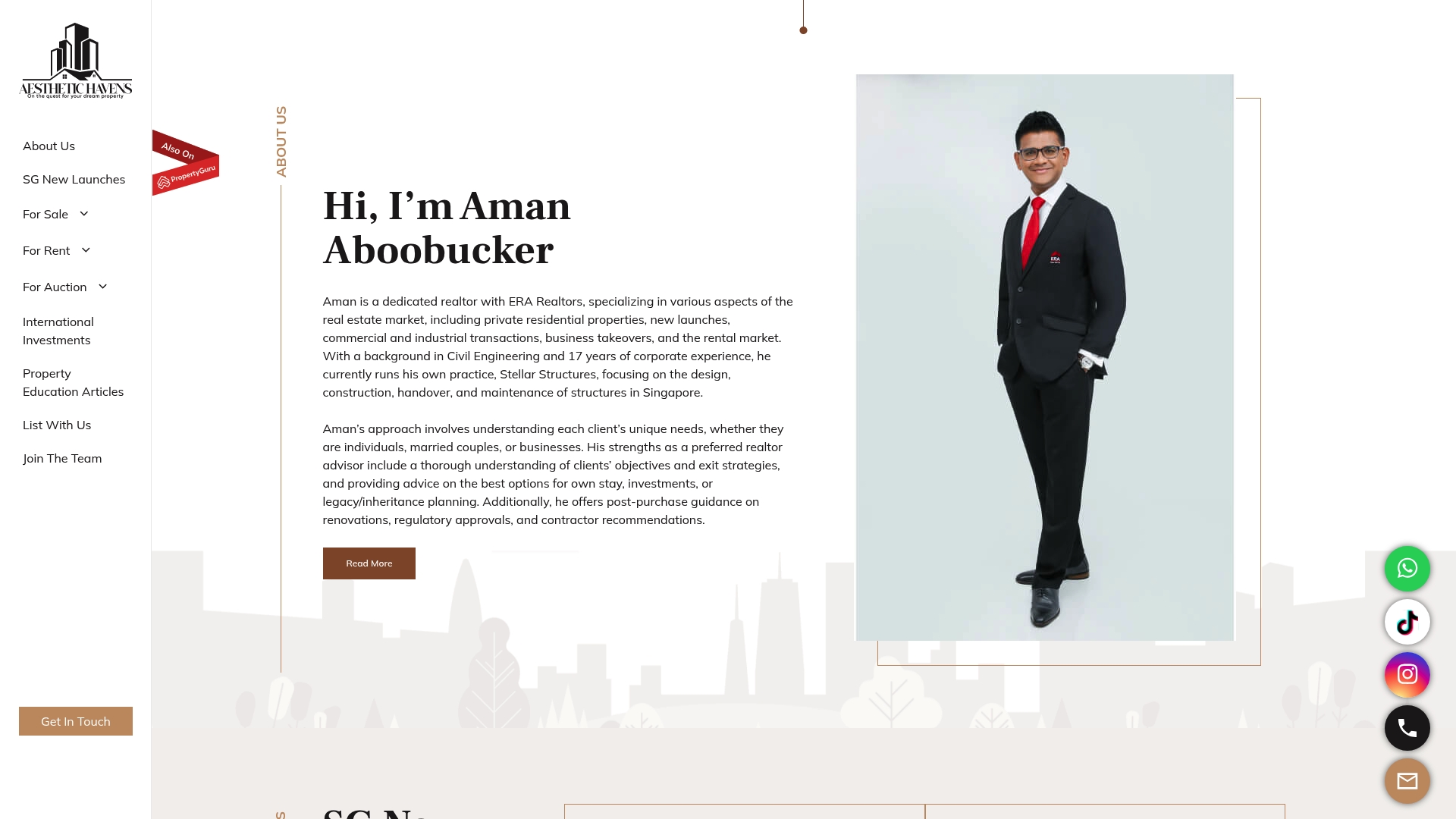
Because Aman’s background combines engineering and real estate, we read a floor plan, a loading specification or a fit-out scope with a practical eye as well as a market one. That helps when the choice is between a ready-built unit that needs some adaptation and a bespoke build that needs a long commitment.
Our view is simple. Where a ready-built property meets your must-haves, it is usually the efficient route, and we can source, value and negotiate it with you. Where the brief truly calls for a purpose-built facility, we help you frame the requirements, the term and the numbers before you commit. Either way, we stay with you after the deal, including renovation and regulatory guidance.
Aman
Finding the right space with our team
We handle commercial, industrial and residential listings and commercial rental space in Singapore, alongside property valuation, sales and leasing, and advisory on portfolio growth. If you are weighing a ready-built unit against a bespoke build, or trying to decide between a Grade A and a Grade B office, we can look at your requirements, shortlist options and work through the numbers with you.
Start on our main page to see the services, or browse the listings above if you already know what you want.
FAQ
What is built-to-suit in simple terms?
It is a development where a developer designs and builds a facility to a specific occupier’s requirements, and the occupier then leases or buys the finished property. The occupier sets the design, size and features, while the developer handles site selection, financing and construction. It is mainly used for specialised or long-term operations.
Is ready-built always cheaper than built-to-suit?
Not automatically, because the two are paid differently. Ready-built means rent or price plus fit-out, while BTS spreads design and construction cost into a long lease or purchase. Compare the total cost of occupancy over the whole term, including fit-out, service charges and reinstatement, rather than the first-year payment.
How long does a ready-built fit-out take in Singapore?
Published industry figures for office fit-outs range from about 6 to 12 weeks for standard projects to several months for large corporate ones, with permit approval adding a few weeks. Plan the fit-out window before you end your current lease, and confirm the timeline for your specific unit.
What is the difference between a Grade A and a Grade B office?
The grades are market labels based on location and transit access, building age and quality, amenities, and floor design. Grade A generally means a prime location and higher specification at a higher rent. Grade B can offer good space at a lower cost per sq ft, so it suits teams who value floor area over address.
Can individual investors use built-to-suit?
BTS projects are typically large and tied to one occupier, so they are more common among corporates and institutions. Individual investors more often buy ready-built commercial or industrial units with an existing or easy-to-find tenant pool. We can help you screen those options against your return and exit plans.
Sources
- JTC Quarterly Market Report 2Q14
- JTC lays groundwork for Singapore’s push in advanced manufacturing (EDB)
- Build to Suit Services (DBS Group)
- Rider Levett Bucknall Riders Digest 2025, Singapore
- Office Interior Design Statistics Singapore (Design Bureau)
- The Straits Times: more F&B and greenery for CBD workers
- ESR-REIT BTS acquisition announcement, 2011
- Ascendas REIT announcement on the Grab BTS project, 2019


