


A private condo in Singapore can house up to six unrelated people, or up to eight if the unit is at least 90 sqm and the owner has registered it with URA. Every occupant must stay at least three consecutive months. Domestic helpers and family members do not count toward the cap. This guide explains how the rules work in practice, who is responsible when they are broken, and what condo owners and landlords should do before a tenant moves in.
TL;DR
- The standard cap is six unrelated persons per private residential unit. Eligible units of at least 90 sqm can go up to eight, after registering with URA and paying a $20 fee.
- The eight-person allowance is temporary and runs until 31 December 2028. After that, the six-person cap applies immediately.
- Every occupant of a private home must stay at least three consecutive months. Daily or weekly letting is not allowed.
- You do not register tenants with URA, but your condo’s MCST may require its own tenant registration.
- Owners can be held responsible for breaches, so count occupants before you sign a lease and again whenever a tenant changes.
Table of Contents
- The occupancy cap: six unrelated persons, eight for larger units
- The temporary eight-person allowance
- Minimum stay: three consecutive months
- How MCSTs and by-laws fit in
- Your checklist before a tenant moves in
- What overcrowding looks like to enforcers
- Foreign owners and special cases
- Buying or leasing with the rules in mind
- FAQ
- Sources
The occupancy cap: six unrelated persons, eight for larger units
URA’s Renting Property guidelines set an occupancy cap of six unrelated persons for private residential properties smaller than 90 sqm. The cap applies to condominiums, apartments and landed homes alike. The government’s stated reason is to avoid too many tenants in one property, which causes disamenities to neighbours.
Two details trip people up.
Who counts as unrelated. Unrelated persons are people who are not part of the same family unit. URA treats domestic helpers as part of the same family unit, so a helper living with a family does not use up a slot.
Who the cap applies to. The cap covers the whole unit, not each room. A three-bedroom condo does not get six people per bedroom, and a larger unit does not automatically allow more. If tenants sublet, the same cap applies to the subtenants. Owners must make sure tenants follow the rules.
A quick example: a family of four, plus a helper, lives in a condo. Those five are one family unit for this purpose. If the owner lets them add two unrelated friends, the unit has two unrelated persons, well within the cap. Contrast that with a flat shared by seven working adults who have no family link. That is seven unrelated persons and is over the standard cap, whatever the tenancy agreement says.

The temporary eight-person allowance
From 22 January 2024, URA relaxed the cap so that larger private homes could take up to eight individuals. URA’s 16 January 2026 announcement extended this by two years, to 31 December 2028, as a temporary measure to meet sustained rental demand. The same release notes that close to 100,000 homes were completed across the public and private markets from 2023 to 2025.

Who qualifies
Before you register, URA’s guidelines say you must make sure that the property:
- Is approved for residential use.
- Has a minimum lot or strata area of 90 sqm.
- Is a private residential property. For an Executive Condominium, the HDB Minimum Occupation Period must already be fulfilled.
- Has not had a previous occupancy-cap relaxation registration cancelled in the last 12 months, or a shorter period URA specifies in writing.
The owner then registers with URA and pays a $20 fee. URA’s temporary cap FAQs confirm that increased occupancy is currently allowed only for units of at least 90 sqm. A 85 sqm three-bedroom unit, however well laid out, stays at six.
What can end it early
The higher cap is not unconditional. URA’s announcement says the approval to rent to up to eight unrelated persons will be revoked or cease where there are serious disamenities. Owners and tenants are both expected to minimize nuisance to neighbours, such as noise, rubbish and crowding in lifts.
What happens in 2029
When the relaxation ends, URA’s FAQs state that all private residential properties must follow the original cap of six unrelated persons with immediate effect. Owners and tenants can be held liable for breaches after that date. If you sign a multi-year lease that runs past 31 December 2028, do not promise an eight-person arrangement for the whole term. Write the lease so that the number of occupants follows whatever URA rules allow at the time.
| Situation | Maximum unrelated occupants | What you need to do |
|---|---|---|
| Private unit under 90 sqm | 6 | Stay within the cap |
| Private unit of at least 90 sqm, not registered | 6 | Register with URA to go higher |
| Private unit of at least 90 sqm, registered | 8 (until 31 December 2028) | Pay the $20 fee, meet the eligibility conditions |
| After 31 December 2028 | 6 | Cap returns with immediate effect |
Minimum stay: three consecutive months
The second major rule is about time, not headcount. URA’s guidelines state that all occupants of a private residential property must fulfil a minimum stay of three consecutive months. Renting out a unit as short-term accommodation on a daily or weekly basis is not allowed.
URA’s Short-Term Accommodation page is blunt that it is illegal for owners and tenants to rent out their properties as hotels, hostels, B&Bs or homestays to short-term visitors, including through online home-sharing platforms. It also says owners who fail to exercise due diligence to protect their properties against misuse will be held responsible.
So a condo cannot be let for a month, however it is described. Calling the arrangement a licence, using a booking platform, or having a tenant sublet does not change the three-month minimum. In 2018 URA explored a framework that could have allowed limited short stays, but according to a media report, it decided in May 2019 not to proceed, so the three-month rule stayed.
Once a tenant has stayed the full three months, they have met the minimum. The tenancy does not need to be a year long, though many landlords prefer 12 or 24 months for stability. If you want to understand how this shapes short-stay listings specifically, see our guide to Airbnb rules that trigger $5,000 fines.
A stable tenancy also changes what tenants worry about. Families who will be staying at least three months often start thinking about rental stairs childproofing before the first month is out, and landlords who agree to sensible, removable fittings tend to keep good tenants longer.
Penalties for short-term letting
URA states that under the Planning Act, an individual found guilty of engaging in short-term accommodation faces a fine of up to $5,000 at minimum, and repeat offenders or those operating several properties are taken to court, resulting in significantly heavier fines. In March 2025, URA charged a company and three senior managers with a total of 37 counts of unauthorised development for providing short-term accommodation at private homes, and noted that offenders can be fined up to $200,000 per charge. URA’s reason for the minimum stay is to prevent frequent turnover of transient occupants, which changes a property’s residential character and can affect neighbours.
Enforcement is active. According to the same media report, URA investigated 200 suspected illegal short-term accommodation cases in 2024 and 219 in 2025.
How MCSTs and by-laws fit in
National rules set the ceiling. Your condo’s Management Corporation (MCST) works inside it. The by-laws under the Building Maintenance and Strata Management Act apply to all residents and their guests, and they are meant to give owners and tenants a clear guide to living in the development. Mi Casa’s by-laws, for example, state that units are private residential dwellings and may not be used for commercial purposes. They also state that once a unit is leased out, the right to use the facilities passes to the lessee.
Tenant registration
URA’s guidelines say you do not need to register tenants’ names with URA for private properties. But owners should check with their MCST whether by-laws require registration. Many do. Mi Casa’s by-laws, as one example, require owners to notify management of leases and give the tenants’ particulars through a prescribed form.
Dover Parkview’s house rules show how detailed this can get:
- Tenants with a written, stamped lease can apply for a Resident Card at the management office.
- The application must be made within 7 days of moving in.
- A refundable deposit of S$50.00 applies, and it is not refunded if the tenancy is under 6 months or ends within 6 months.
- A copy of the tenancy document is required for tenancies of more than 6 months.
These are one condo’s rules, not a national standard. Your own development’s by-laws may be stricter, looser or different. Ask the management office for the current house rules before you advertise.
Security and enforcement
URA says MCSTs play an important role in tightening security to reduce short-term accommodation, for example by screening visitors seen with luggage and noting unit numbers and entry and exit dates. URA works with MCSTs to investigate suspected cases. A landlord whose tenant gets flagged by management can expect questions.
Your checklist before a tenant moves in
The rules are straightforward, but mistakes usually happen in the details. Work through these steps.
- Check eligibility. Confirm your unit’s strata area. If it is at least 90 sqm and you want the eight-person limit, register with URA and pay the $20 fee first.
- List the occupants. Note each person’s name, their relationship to one another, and the intended move-in and move-out dates.
- Count unrelated persons. Family members and helpers count as one unit. Everyone else counts individually. If you will live in the unit yourself, include yourself.
- Confirm the term. Each occupant must be staying at least three consecutive months.
- Check the by-laws. Ask the management office about tenant registration, move-in deposits, access cards and any lift or facility booking rules.
- Verify work pass holders. MOM advises private homeowners who rent out property to verify the names of work pass holders registered at their address using the Foreign Worker Tenant Enquiry Service.
- Put the numbers in the lease. State the maximum number of occupants and require written consent for any change.
- Recheck on every change. When a tenant leaves and another arrives, count again.
For the wider list of tenancy tasks, including inventory, deposits and stamping, our rental checklist for landlords covers the paperwork side. Rental income is taxable, so it is worth reading how rental income tax works in Singapore before the first payment arrives.
What overcrowding looks like to enforcers
The worst cases show why the cap exists. In a joint inspection at two partitioned shophouses in Geylang, MOM and URA found 39 occupants, far above the limit of six unrelated persons per private residential premises, as described in MOM’s press release. A condo is rarely that extreme, but the same logic applies to partitioning a living room into extra bedrooms or putting bunk beds in a master suite. The cap counts people, not rooms, and partitions do not raise it.
Also remember that URA says the tenancy agreement is a private contract between landlord and tenant. Questions about how many occupants the contract allows go to the landlord or agent, not to URA. A tenancy agreement, though, cannot authorise more occupants than the URA rules permit.
Foreign owners and special cases
Occupancy rules apply regardless of the owner’s nationality. If you are a foreign buyer thinking about a lease or a leaseback arrangement, check our guide to Singapore condo rules for foreigners for the ownership side. For Executive Condominiums, the HDB Minimum Occupation Period must be fulfilled before the unit is treated as private for the purposes of the eight-person registration.
Our perspective
Most occupancy problems we see begin before the lease is signed. An owner buys a larger unit, assumes it can be filled like a boarding house, and works out the yield on that basis. The numbers then fall apart when the cap, the three-month minimum or the MCST’s own rules come into the picture.
We start from the exit, not the entry. When we advise on a purchase for investment or own stay, we ask who the realistic tenant pool is, how many people will live there, and what happens to the return if the cap goes back to six after 2028. A unit that still works on the six-person cap is a safer holding than one that only works at eight.
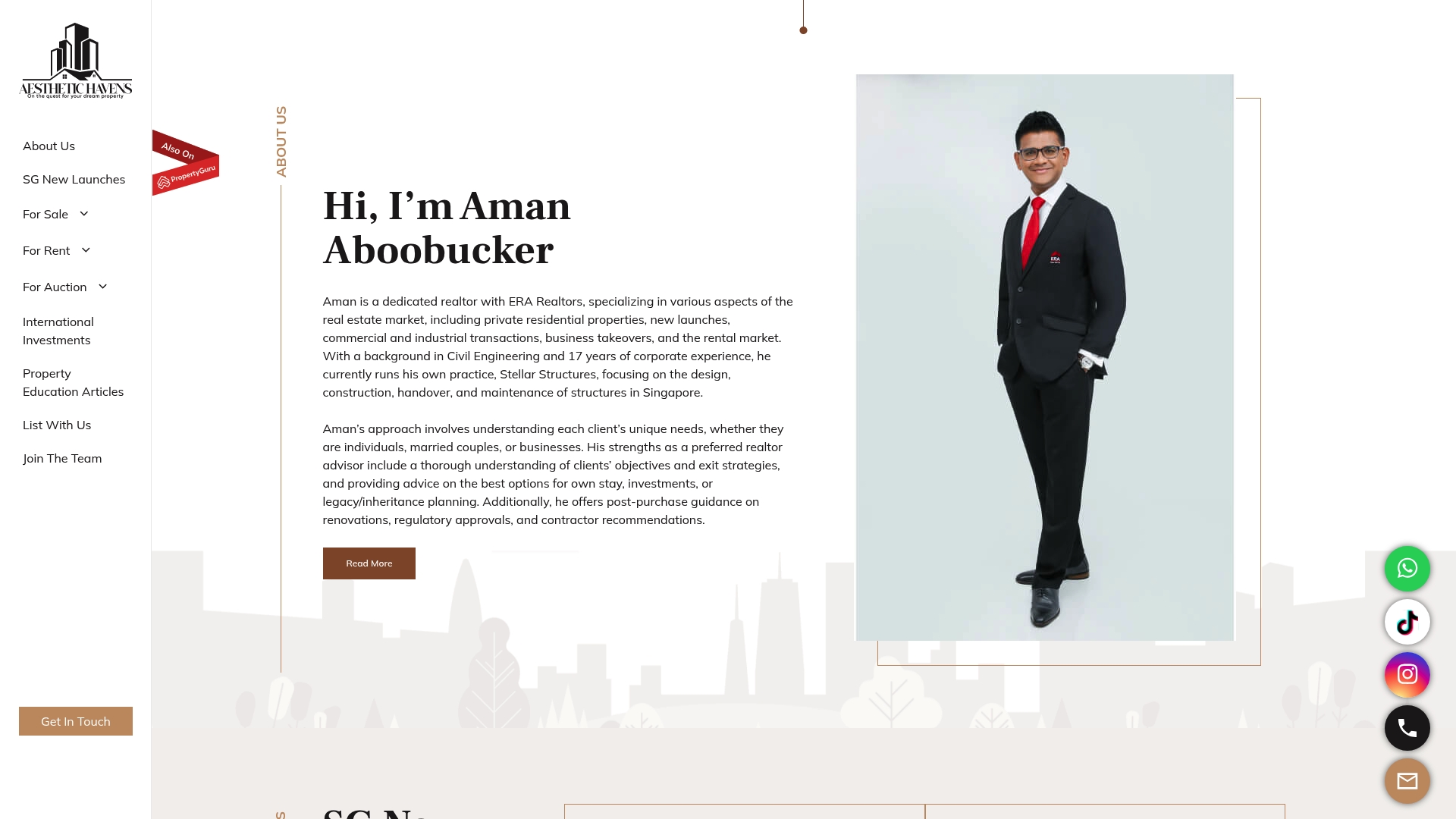
Our background in engineering and real estate means we also look at layout, strata area and the practical condition of the unit, not just the headline price. Rules, floor area and tenant demand should all be checked before you commit, and that is the conversation we like to have with clients early.
Aman
Buying or leasing with the rules in mind
If you are choosing a condo and the occupancy rules affect your plans, whether as a landlord, investor or family, we can help you match the unit to the strategy. Aesthetic Havens offers real estate consultancy, property valuation and sales and leasing support in Singapore. We can help you look at strata area, likely tenant demand and exit options before you make an offer.
Explore our residential listings, see current new launches, or speak to us through our main site.
If you want a fuller view of how leasing works, our complete guide to property leasing in Singapore goes through the process step by step.
FAQ
How many tenants are allowed in a Singapore condo?
The standard cap is six unrelated persons per unit. Units of at least 90 sqm that the owner has registered with URA may take up to eight until 31 December 2028. Family members and domestic helpers count as one family unit, not as separate unrelated persons.
Can I rent my condo for one month?
No. URA requires all occupants of private residential property to stay at least three consecutive months. Daily and weekly rentals count as short-term accommodation, which is illegal, and individuals can face fines of up to $5,000 at minimum under the Planning Act.
Do I need to register my tenants with URA?
Not for private properties. URA says tenant names do not need to be registered with it, but your MCST may require registration under its by-laws. You only need to register with URA if you want to use the higher eight-person cap for a unit of at least 90 sqm.
What happens after 31 December 2028?
Unless URA extends the relaxation again, the cap returns to six unrelated persons per private property with immediate effect. Owners and tenants can be held liable for infringements after that date. Avoid lease terms that guarantee an eight-person arrangement beyond it.
Sources
- URA: Renting Property
- URA: FAQs on Temporary Occupancy Cap
- URA: Short-Term Accommodation
- URA press release, 16 January 2026
- URA press release, 25 March 2025
- Telescope.gov.sg: parliamentary answer on occupancy cap
- MOM press release, 5 October 2021
- Goody Feed: short-term accommodation cases
- Mi Casa by-laws
- Dover Parkview house rules


