

Introduction
An “HDB upgrader” is an existing owner of public housing in Singapore who is planning to sell their HDB flat and move into a private property-typically an executive condominium or a new launch condo-after fulfilling the minimum occupation period. This guide walks you through exactly how to work out a safe, affordable budget for 2026 condo new launches, covering loan eligibility, cash and CPF planning, stamp duties, and the critical sequencing of your HDB sale.
The focus here is squarely on budgeting, loan eligibility, and cash/CPF planning for the HDB upgrader’s guide to 2026 new launches affordability. If you’re a first-time BTO applicant or a foreign buyer, this isn’t for you-this guide is built for existing HDB owners eyeing the 2026–2028 new launch window.
A practical rule of thumb before you read further: calculate your total debt servicing ratio and mortgage servicing ratio limits, aim for monthly mortgage payments at roughly 30–35% of your gross monthly income (not the bank’s maximum), and maintain 6–12 months of combined housing costs as a buffer fund. That single discipline separates comfortable upgraders from financially stretched ones.
This guide covers the full journey for HDB owners planning to move into a private condo or EC around 2026–2028. Here is what you will learn:
-
How to estimate a realistic purchase price range for 2026 new launches based on your combined income and existing debts.
-
How much cash, CPF, and stamp duties are typically needed to upgrade from an HDB flat to a private property.
-
How to sequence the sale of your current property versus booking the new launch to avoid cash crunches and ABSD traps.
-
How worked examples, tables, and visual frameworks can help you stress-test affordability before visiting a single showflat.
-
Key concepts-TDSR, MSR, LTV, buyer’s stamp duty, ABSD, and HFE-simplified with 2026 numbers.
Understanding HDB Upgrading and 2026 New Launch Affordability
“HDB upgrading” refers to the process of moving from an HDB flat to an executive condominium, a private condo, or eventually landed property. The 2026–2028 window is significant: a surge of new launch projects from 2025 Government Land Sales is entering the market, many HDB flats are reaching their minimum occupation period (unlocking equity and upgrader demand), and a defined set of cooling measures-55% TDSR, 30% MSR, higher ABSD rates-shapes what is feasible.
This section sets the foundation before we dive into specific numbers, calculations, and worked examples.
What Does “Affordability” Really Mean for an HDB Upgrader?
Affordability is not simply “what the bank approves.” It is the monthly instalment comfort level that accounts for future-proofing against interest rates rise, job changes, childcare costs, and elder-care responsibilities. The Monetary Authority of Singapore (MAS) uses the total debt servicing ratio (TDSR) as a hard cap-the TDSR limit is set at 55% of gross monthly income before tax, encompassing all monthly debt obligations including car loans, personal loans, credit card balances, and property loans. For HDB and EC buyers, the mortgage servicing ratio is capped at 30% of gross monthly income, covering only the housing loan instalment. MSR must be satisfied before the total debt servicing ratio is even assessed.
But a personally safe range is typically 25–35% of gross income directed to housing-well below what financial institutions will technically approve.
Affordability spans three dimensions:
-
Upfront cash/CPF: Downpayment, buyer’s stamp duty, ABSD (if applicable), legal and valuation fees.
-
Ongoing monthly costs: Monthly mortgage instalment, maintenance fees, property tax, and insurance.
-
Emergency and renovation reserves: A buffer fund of 6–12 months of combined housing costs, plus renovation capital.
A “safe budget” usually sits one tier below the maximum loan. For example, if you qualify for a $1.8M loan, many families should work with a property purchase ceiling of $1.4M–$1.5M instead.
The Asset Progression Ladder: HDB → Condo → Landed (and Where 2026 Fits)
Asset progression in Singapore’s context describes the deliberate, multi-step sequence of building wealth through property: starting with public housing, advancing to a private condo, and potentially moving to landed property over a 10–20 year horizon.
The typical pathway looks like this:
-
Build equity in an HDB flat – often after the 5-year minimum occupation period (or 10 years for Prime/Plus projects). Executive Condominiums are subject to a 5-year minimum occupation period before resale, after which they become fully privatised after 10 years.
-
Monetise HDB via resale – sell the resale HDB, unlock capital gains and CPF savings, and upgrade to a 2026–2028 new launch or young resale condo.
-
Eventual move to landed – when income and capital allow, some upgraders take a further step into landed property.
The 2026 new launch projects-particularly OCR and RCR sites awarded under 2025 GLS-represent a “bridge step” between public housing and landed. The key question is always affordability versus long-term capital appreciation potential. Professional advice from an independent advisor can help map this ladder over a decade or two, not just the next purchase.
Key 2026 Market Characteristics HDB Upgraders Must Know
Several 2025–2026 trends directly affect affordability for property buyers considering an upgrade:
-
Cooling measures remain in force: The TDSR limit is currently set at 55% (reduced from 60% to 55% in December 2021). The mortgage servicing ratio is capped at 30% for HDB and EC purchases. Singapore Citizens purchasing a second residential property face a 20% Additional Buyer’s Stamp Duty.
-
New launch prices continue to climb: Median launch psf as of mid-2026 is approximately $2,241 psf in OCR, $2,718 psf in RCR, and $3,313 psf in CCR. Prices for private new launches range from $1,800 to over $3,200 per square foot. New launch private homes prices continue to increase, creating affordability challenges for upgraders.
-
Pipeline is tighter than 2025: Singapore has only 17 new launch projects expected in 2026, marking a 30% drop compared to 2025. Over 71% of new private residential units launched are located in the Outside Central Region-the zone most relevant to HDB upgraders.
-
HDB flats reaching MOP in 2025–2027 are unlocking equity across estates like Punggol, Sengkang, Tampines, and Jurong, increasing upgrader demand, which in turn affects launch pricing and take-up speed.
-
Developers’ land bids have risen sharply, with OCR land bids jumping approximately 26.6% in 2025-costs that flow directly into launch psf.
Understanding these conditions is the base. The next section zooms into specific 2026 launch types and price bands.
Types of 2026 New Launches for HDB Upgraders and Typical Price Ranges
Now that the reader understands the concept of affordability, let’s examine the main categories of 2026 projects and what price levels HDB upgraders are realistically looking at.
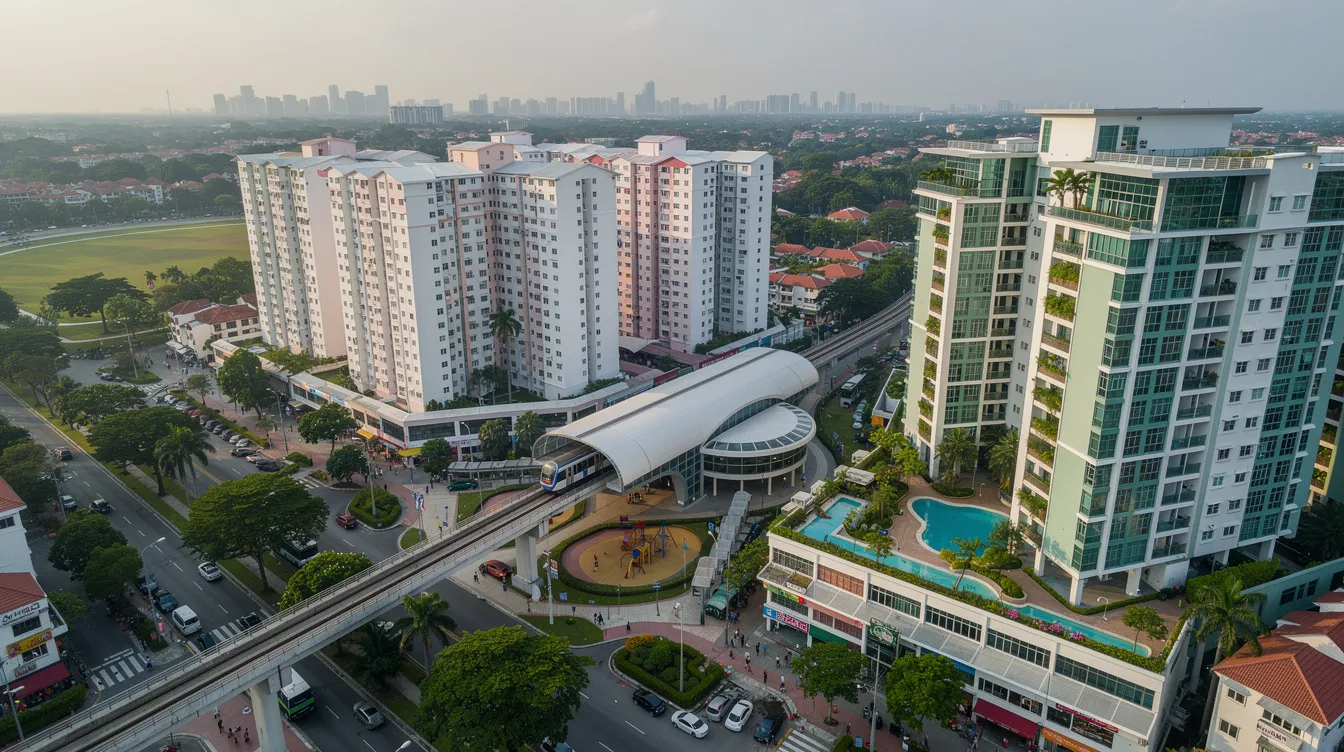
ECs vs Mass‑Market Condos vs City‑Fringe Condos (2026 Cohort)
Three categories dominate the upgrader conversation:
-
Executive Condominiums (ECs): A hybrid public-private product. MSR applies (30% cap on mortgage repayments relative to gross monthly income), and there is an income ceiling. EC buyers benefit from lower entry prices and potential future privatisation upside. Launches in areas like Tengah, Punggol, and Sengkang. However, for ECs launched after 8 May 2026, the minimum occupation period has increased to 10 years, the Deferred Payment Scheme has been removed, and the first-timer quota has been raised to 90%.
-
Mass-market OCR condos: Fully private property, typically near MRTs or town centres (e.g. Sengkang, Bukit Batok, Pasir Ris). No MSR restriction-only TDSR applies. Higher cash/CPF needs but more flexibility.
-
City-fringe RCR condos: Closer to CBD (e.g. Kallang/Whampoa, Queenstown fringe). Higher psf, demanding stronger incomes and larger downpayments.
|
Feature |
EC (2026) |
OCR Condo (2026) |
RCR Condo (2026) |
|---|---|---|---|
|
Est. Launch psf |
~$1,800–$1,900 |
~$2,200–$2,500 |
~$2,600–$2,800+ |
|
Typical 3-Bed Quantum |
~$1.8M–$2.0M |
~$2.4M–$2.8M |
~$2.8M–$3.2M+ |
|
Eligibility Rules |
Income ceiling, MSR 30%, first-timer quota |
No MSR, TDSR only |
No MSR, TDSR only |
|
Deposit Structure |
Progressive payments |
Progressive payments |
Progressive payments |
|
Key Advantage |
Lower entry, privatisation upside |
Flexible, no income cap |
Location premium, rental income potential |
Affordable new launches are typically found in the Rest of Central Region or Outside Central Region. If eligible, affordable new launches typically offer amenities without private-tier pricing.
Typical 2026 Quantum Ranges for Upgraders (By Household Income)
Affordability starts from your income, not from showflat prices. Below are illustrative income scenarios and typical safe quantum ranges, calculated using the 55% TDSR limit, a stress test rate of approximately 4%, and a 25% downpayment assumption.
|
Combined Gross Income |
Approx. Safe Monthly Instalment (~30% of income) |
Approx. Max Safe Loan (25-yr, 4% stress rate) |
Suggested Property Price Ceiling |
|---|---|---|---|
|
~$8,000/month |
~$2,400 |
~$500,000 |
~$667,000 |
|
~$12,000/month |
~$3,600 |
~$750,000 |
~$1,000,000 |
|
~$18,000/month |
~$5,400 |
~$1,125,000 |
~$1,500,000 |
A couple earning ~$8K combined income is unlikely to comfortably afford an OCR condo at $2,200 psf where a 3-bedder costs ~$2.4M-unless they bring substantial CPF ordinary account savings and opt for a much smaller unit. At $12K–$18K combined, reaching mid-RCR ranges ($2.5M–$3.0M) becomes possible, but ABSD, LTV, and upfront cash demands matter heavily.
These numbers are illustrations as of 2026 and must be checked with a banker or advisor using a TDSR calculator specific to your situation.
How Launch Timing (2026 vs 2027/2028 TOP) Affects Affordability
A 2026 new launch typically follows this timeline: booking in 2026, progressive payments during construction, and TOP around 2029–2030. New launches are sold under the Progressive Payment Scheme, disbursing costs incrementally as construction progresses-which smooths cashflow over 3–4 years rather than requiring full payment upfront.
This deferred structure helps compared to buying a completed resale condo (where you pay the full amount at completion), but it introduces a longer commitment with monthly repayments starting only upon loan disbursement during construction milestones.
HDB upgraders need to synchronise:
-
HDB sale timeline: Can you stay in your flat until the new launch nears TOP? If you sell early, where do you live?
-
Interim accommodation: Renting can cost $2,500–$4,000/month for a family, which severely strains budgets if the gap is 12–24 months.
-
ABSD structuring: If you buy a private property before selling your HDB flat, you must pay 20% ABSD upfront (remission possible if HDB is sold within 6 months).
The next section walks you through how to actually compute your loan eligibility and safe budget step by step.
Calculating a Safe Budget: Loan Eligibility, TDSR/MSR and LTV for 2026 Launches
This section walks through the full affordability framework-from income to maximum loan to safe buying price-using clear steps and worked examples.
Step 1 – Check Your HFE Letter and Basic Eligibility
The HDB Flat Eligibility (HFE) letter matters even for upgraders considering an executive condominium. It confirms your eligibility to buy or sell, remaining CPF housing grants entitlement (including the enhanced CPF housing grant if applicable), and HDB vs bank loan caps. Private condo buyers rely mainly on banks, but the HFE letter helps if an EC is on your shortlist.
Documents HDB upgraders should prepare before running numbers:
-
Latest 3–12 months payslips and CPF contribution history (obtainable via the HDB portal or CPF website).
-
IRAS Notice of Assessment (NOA) for self-employed or those with variable income. A 30% haircut applies to variable income in TDSR calculations.
-
Credit Bureau Singapore report to review existing debts-outstanding debts, credit card balances, car loans, personal loans, and renovation loans all count toward TDSR.
Step 2 – Apply TDSR and MSR to Your Situation
The TDSR limit is set at 55% of gross monthly income before tax. TDSR includes all monthly debt obligations, not just mortgages-car loans, personal loans, credit card obligations (calculated as 3.5% of outstanding balance), and any other property loans granted. The TDSR assessment uses a medium term interest rate of 4%, not your actual contract rate. The MSR limits mortgage repayments to 30% of gross monthly income and applies only to HDB flats and Executive Condominiums. If MSR exceeds 30%, loan approval is not possible.
Worked Example – Couple earning $12,000 combined income with a $600 car loan and $300 other debt:
-
55% TDSR ceiling: $12,000 × 55% = $6,600/month total allowable debt obligations.
-
Existing debts: $600 (car) + $300 (other) = $900/month.
-
Maximum allowed monthly mortgage (TDSR): $6,600 – $900 = $5,700/month.
-
If buying an EC (MSR 30%): $12,000 × 30% = $3,600/month maximum housing instalment – far lower than the TDSR-derived figure. MSR is binding for EC buyers.
-
If buying a private condo (no MSR): The $5,700 TDSR-derived figure applies. More borrowing capacity.
The stress test rate of approximately 4% is used by financial institutions to evaluate monthly repayments even though your actual mortgage rate might be 3.0–3.5% in 2026. This reduces loanable amounts compared to what the current rate would suggest.
Safe vs maximum: Aim for 70–80% of the theoretical maximum monthly instalment to create breathing room. In the example above, the safe monthly mortgage for a private condo buyer would be ~$4,000–$4,560, not $5,700.
Step 3 – Understand LTV and How Many Properties You Own
Loan-to-Value (LTV) determines how much you can borrow relative to the property’s value. Current MAS limits:
-
First housing loan: The maximum loan-to-value limit for bank loans is typically up to 75%, meaning 25% downpayment required. The down payment for a first housing loan is 25%, of which 5% of the down payment must be paid in cash-the rest can come from CPF ordinary account.
-
Second housing loan: LTV drops to approximately 45%, demanding significantly more upfront cash/CPF.
The sequence of selling your HDB versus buying the condo determines which LTV tier applies:
|
Factor |
Scenario A: Sell HDB First |
Scenario B: Keep HDB, Buy Condo |
|---|---|---|
|
LTV Allowed |
Up to 75% (first property) |
~45% (second property) |
|
Minimum Cash Downpayment |
5% of purchase price |
Higher (could be 25%+ in cash) |
|
ABSD Payable |
None (no existing property) |
20% upfront (remission if HDB sold within 6 months) |
|
Risk Profile |
Low financial risk, possible interim rental |
High cash exposure, ABSD timing risk |
If your HDB is not sold or at least contracted to sell when you exercise the Option to Purchase for the condo, the new loan is treated as a second property loan-lower LTV plus 20% ABSD.
Step 4 – Derive Your Safe Property Price Ceiling
Here is the mini-formula:
-
Income → Maximum monthly instalment: Apply TDSR (55%) or MSR (30% for ECs) to your gross monthly income, subtract total monthly debt obligations.
-
Monthly instalment → Maximum loan: Use the stress test rate (~4%) and your loan tenure (typically 25–30 years, but loan must usually end by age 65–75 depending on bank and co borrower age).
-
Loan → Property price ceiling: Divide maximum loan by 75% (assuming 75% LTV) to get the total property price ceiling.
Complete Numeric Example:
-
38-year-old couple, $220K annual household income (~$18,333/month gross), no existing debts, first property, 25-year tenure.
-
TDSR max instalment: $18,333 × 55% = $10,083/month.
-
Safe target (75% of max): ~$7,560/month.
-
Maximum safe loan at 4% over 25 years: ~$1,428,000.
-
Property price ceiling (75% LTV): $1,428,000 / 0.75 = ~$1,904,000.
Note: age caps tenure. If the borrower is 45, the bank may cap tenure at 20 years (to finish by age 65), which reduces the maximum loan. Older upgraders must factor this in. Borrower’s monthly income stability and the long term nature of the commitment also affect approval.
The next section breaks down actual cash/CPF needed and the full cost beyond just the purchase price.

Full Cost Breakdown for HDB Upgraders Buying a 2026 New Launch
The purchase price is only one part of the affordability equation. This section spells out every amount-upfront and ongoing-that upgraders must plan for.
Upfront Costs: Downpayment, BSD, ABSD and Legal Fees
Core one-time costs for a typical 2026 new launch property purchase:
-
Option fee: New launch booking typically requires ~5% of purchase price as an option fee (paid in cash at booking).
-
Remaining downpayment: To reach the full 25% downpayment. Of the 25% total, at least 5% must be cash; the balance can come from CPF ordinary account.
-
Buyer’s Stamp Duty (BSD): BSD is tiered and progressive. Current rates: 1% on the first $180,000; 2% on the next $180,000; 3% on the next $640,000; 4% on amounts above $1,000,000 for residential property.
BSD Worked Examples:
|
Purchase Price |
Approximate BSD |
|---|---|
|
$1.4M |
~$38,600 |
|
$1.5M |
~$44,600 |
|
$2.2M |
~$72,600 |
A $1.5M property incurs approximately $44,600 in BSD.
-
Additional Buyer’s Stamp Duty (ABSD): ABSD applies based on residency status. For Singapore Citizens purchasing a second residential property, the rate is 20%. If you buy a private property before selling your HDB flat, you must pay 20% ABSD upfront. Remission is possible if the existing property is disposed of within 6 months of the new purchase agreement or TOP/CSC.
-
Legal, valuation, and miscellaneous fees: Typically $3,000–$6,000+, depending on property price and complexity. A title search and loan documentation are standard expenses.
Cash vs CPF split example for a $1.5M first property purchase:
|
Component |
Amount |
Cash/CPF |
|---|---|---|
|
Option fee (5%) |
$75,000 |
Cash |
|
Remaining downpayment (20%) |
$300,000 |
CPF OA and/or cash |
|
BSD |
~$44,600 |
Cash |
|
Legal/valuation fees |
~$4,000 |
Cash |
|
Total upfront |
~$423,600 |
Ongoing Costs: Monthly Mortgage, Maintenance & Other Run‑Rates
Affordability must include all recurring costs:
Worked Example – $1.6M new launch, 3-bedroom, 75% loan over 25 years at 3.2% interest:
-
Loan amount: $1,200,000
-
Estimated monthly mortgage instalment: ~$5,800–$6,100 (varies by exact rate and bank spread)
-
Monthly condo maintenance fees and sinking fund: $300–$500 (varies by project size and facilities)
-
Property tax (owner-occupied): ~$100–$250/month equivalent
-
Home insurance: ~$20–$40/month
Total estimated monthly commitment: ~$6,400–$6,900
As a general principle, this total should ideally not exceed 40–45% of your household take-home pay-including all recurring debt obligations. If your home loan instalment alone is pushing 35%+ of borrower’s monthly income, you’re operating with minimal buffer.
Current SORA-based mortgage rates hover around 3.0–3.5%, but banks use a medium term interest rate stress test of approximately 4% for eligibility assessment, and you should personally plan for rates at that level or higher.
Hidden and Often Overlooked Costs (Renovation, Temporary Accommodation, Agent Fees)
HDB upgraders commonly underestimate these expenses:
-
Renovation and furnishing upon TOP: Budget $40,000–$120,000+ depending on unit size, design ambition, and fixtures. Many families deplete their CPF on the downpayment and then need cash or renovation loans at higher interest rates.
-
Interim rental and storage: If there is a gap between HDB sale completion and the new launch TOP, rental could cost $2,500–$4,000/month for 6–24 months. Moving and storage services add $2,000–$5,000.
-
Agency commissions and legal costs on the HDB sale side: Typically 1–2% of HDB resale price plus conveyancing fees.
-
Early redemption penalties: If redeeming an existing HDB bank loan early, penalties may apply depending on the lock-in period of your home loan.
-
CPF refund requirement: When selling an HDB flat, all CPF ordinary account funds used must be refunded back with accrued interest. This can significantly reduce the net cash proceeds from your HDB resale.
Transition buffer advice: Set aside at least 6 months’ worth of combined old and new housing costs to absorb overlaps, delays, and contingencies.
The next section shifts from raw numbers to sequencing-how to time your HDB sale, new launch booking, and financing to stay cash-safe.

Practical Implementation: Sequencing Your HDB Sale, New Launch Purchase and Cashflow
Many affordability issues arise not from poor income but from poor timing and sequencing of transactions. This section provides a process-driven approach with clear checklists.
Recommended Step‑by‑Step Sequence for a 2026 New Launch Upgrade
This sequence is for the typical HDB upgrader intending to avoid ABSD and minimise cash crunch:
-
Assess household budget and obtain In-Principle Approval (IPA) from at least one bank. This confirms your borrowing capacity and maximum loan before you commit emotionally to any project.
-
Model sale proceeds from your current HDB. Use recent transacted prices in your estate, deduct outstanding loan, and critically deduct CPF refund with accrued interest. The net proceeds are your real war chest.
-
Decide sale strategy: Sell first with longer completion/extension of stay, or buy first and bridge. For most upgraders with moderate cash reserves, sell-then-buy is safer.
-
Shortlist 2026 new launches within your conservative budget band. Assess quantum pricing-often between $1,800 and $2,300 per square foot in suburban areas-rather than fixating on psf alone.
-
Align showflat visits, booking window, and HDB sale marketing period. If you plan to sell first, start marketing your HDB 3–6 months before anticipated new launch dates.
-
Execute HDB sale Option to Purchase and coordinate legal timelines with condo booking date. A conveyancing lawyer’s involvement at this stage is critical.
-
Monitor the progressive payment schedule and keep your contingency fund untouched during construction.
Professional advice at steps 1–3 and step 6 adds significant value-especially for coordinating ABSD timelines, loan application sequencing, and resale application logistics.
Comparison: Sell‑Then‑Buy vs Buy‑Then‑Sell for HDB Upgraders
|
Factor |
Sell-Then-Buy |
Buy-Then-Sell |
|---|---|---|
|
ABSD Risk |
None – no existing property at purchase |
20% ABSD payable upfront; remission only if HDB sold within 6 months |
|
Certainty of Housing |
Risk of temporary rental gap |
Secured unit, but old flat must sell under pressure |
|
Negotiation Power |
Less urgency with developers; may miss hot launches |
Can secure preferred stack/facing in competitive launch |
|
Financing Complexity |
Straightforward – first property LTV (75%) |
New loan treated as second property (~45% LTV), may need bridging loan |
|
Cash/CPF Exposure |
Lower |
Significantly higher |
Profile fit:
-
Sell-then-buy is best for conservative budgets, families tight on cash/CPF, and those comfortable with short-term rental. Most HDB upgraders fall here.
-
Buy-then-sell suits those with strong cash reserves who prioritise securing a specific unit in a hot launch. Some dual-income, no-kids couples may be comfortable with the temporary ABSD exposure and higher TDSR ratio.
Families with school-going children generally prefer minimal disruption and lean toward sell-then-buy.
Using Visual Tools and Checklists to Stay on Track
Three visual frameworks to stress-test your plan:
-
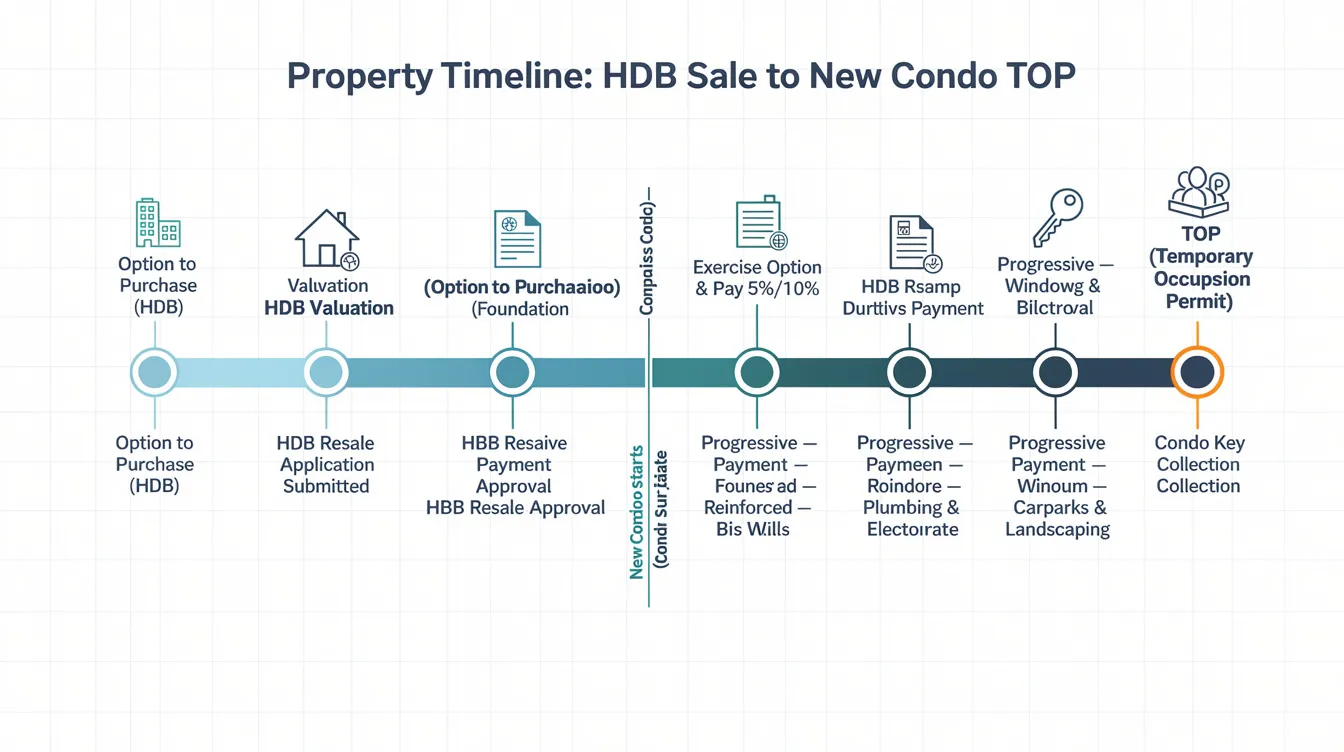
Timeline graphic: Map your HDB sale completion date, new launch progressive payments (5% at booking → 10% at foundation → incremental tranches → final at TOP), and expected TOP date on one horizontal axis. Gaps between HDB sale and TOP reveal interim rental needs.
-
Budget stack diagram: Break down total outlay into layers-purchase price, BSD, ABSD (if any), legal fees, renovation budget, and buffer fund. Seeing the full stack prevents tunnel vision on purchase price alone.
-
Interest rate sensitivity matrix: Show how your maximum loan and safe purchase price shift if rates move from 3% to 4% to 5%. Even a 1% interest rates rise can reduce borrowing capacity by 10–12%.
Printable Pre-Launch Checklist:
-
☐ Income documents gathered (payslips, NOA, CPF statements)
-
☐ Credit bureau report reviewed – all outstanding debts and credit card limits verified
-
☐ IPA obtained from at least one bank
-
☐ HDB net sale proceeds modelled (including CPF refund with accrued interest)
-
☐ Banker questioned on: lock-in period, repricing options, early redemption penalties for new loan
-
☐ Developer/agent questioned on: estimated TOP date, maintenance fee estimate, progressive payment schedule, co owners rules
-
☐ Transition buffer fund established (6 months of combined housing costs)
Even with careful planning, HDB upgraders often hit common pitfalls-addressed next.
Common Affordability Pitfalls for HDB Upgraders (and How to Avoid Them)
Small miscalculations in 2026’s regulatory environment can mean ABSD shocks or loan shortfalls worth tens of thousands of dollars.
Pitfall 1 – Relying on Bank’s “Maximum Loan” Without Stress‑Testing
Many upgraders anchor on the highest loan the bank will grant without accounting for childcare costs, parents’ financial support, or business income volatility. The TDSR calculation at 55% represents the absolute ceiling-operating at that level leaves zero margin for error.
Solution:
-
Stress-test your monthly instalment at +1–2% higher than your current contract rate. If you can handle payments at 5%, a 3.5% environment feels comfortable.
-
Ensure at least 6–12 months of mortgage payments are set aside in CPF OA or cash.
-
Align your budget with personal risk tolerance and career trajectory, not just the bank’s TDSR calculation output.
Pitfall 2 – Underestimating ABSD Timing Risks and HDB Sale Complexity
Missing ABSD remission deadlines or mis-sequencing the sale and purchase agreement can cost $200,000–$400,000+ in unrecoverable stamp duty on a $2M property. Many upgraders assume they can sell their HDB within 6 months, but the resale application process-marketing, finding a buyer, negotiation, legal completion-can drag longer, especially in softer market conditions.
Solution:
-
Map exact legal deadlines for ABSD remission (6 months to dispose of existing property for married Singapore Citizen couples under current 2026 rules).
-
Use a longer HDB completion period or apply for extension of stay if needed to align timelines.
-
Work closely with a conveyancing lawyer to coordinate OTP dates, exercise dates, and completion for both transactions.
Pitfall 3 – Forgetting About Renovation, Furnishing and Interim Rental
Families often allocate all CPF to the downpayment, then discover they need $60,000–$100,000+ for renovation-funding it through renovation loans at higher interest rates or personal loans that erode borrower’s TDSR headroom.
Solution:
-
Ring-fence renovation budget as part of the initial affordability plan-typically 5–10% of the property price.
-
Plan for at least 2–3 months of overlap or interim rental in case of TOP delays or HDB sale completing earlier than expected.
-
Phase non-essential fittings and furnishings over 12–24 months instead of doing everything at key collection.
Pitfall 4 – Not Coordinating Business or Investment Debts with Property Purchase
Many HDB upgraders are SME owners or investors with business loans, car loans, or credit facilities that heavily affect their debt servicing ratio TDSR. Credit card obligations, for TDSR purposes, are calculated as 3.5% of the outstanding balance-even unused credit limits on certain eligible financial assets or revolving facilities can count.
Solution:
-
Clear or restructure short-term debts (car loans, personal loans, high credit card balances) several months before your loan application. Every $500 in eliminated monthly debt obligations frees up roughly $100,000 in additional borrowing capacity.
-
For self-employed with variable income, plan taxable income declarations 1–2 years ahead if a major upgrade is on the horizon. Banks and financial institutions will apply a 30% haircut to variable income for TDSR calculations-stronger NOAs directly improve your position.
-
Sequence investments in other properties (industrial, commercial, or other residential) after securing your own-stay home, not before. Existing debts from property loans on other properties compress your TDSR headroom significantly.
Conclusion and Next Steps
Affordability for 2026 new launches is about integrated planning-TDSR/MSR limits, LTV tiers, ABSD/BSD obligations, HDB sale proceeds (net of CPF refunds), and realistic lifestyle budgets all interlock. No single number tells the full story. A “safe” property purchase typically means buying comfortably below the bank’s maximum loan and keeping substantial buffers for renovation, income shocks, and interest rate increases.
Your immediate next steps:
-
Gather your income, loan, and CPF information to compute a preliminary safe budget using the formulas in this guide.
-
Shortlist 1–2 likely 2026 launch windows and preferred regions based on commuting needs and family situation.
-
Map out a rough HDB sale and purchase timeline using the sell-then-buy or buy-then-sell framework.
-
Speak with an independent advisor or banker to sanity-check your numbers before visiting showflats.
If you want a personalised affordability walkthrough or a full asset progression plan-mapping the path from HDB to condo to landed, including diversification into industrial or commercial property-AESTHETIC HAVENS provides digital tools (calculators, visual guides) combined with human advisory tailored to Singapore buyers. Reach out to request a session customised to your household’s numbers.
Additional Resources for 2026 HDB Upgraders
These are optional but useful references for readers who want to go deeper:
-
TDSR / MSR / LTV calculator: Use a TDSR calculator pre-set with 2026 stress test assumptions to model different income and debt scenarios before approaching a bank.
-
HDB Upgrader 2026 Budget Sheet: A downloadable spreadsheet or PDF pre-filled with line items for BSD, ABSD, legal fees, renovation, interim rental, and buffer funds-customisable to your purchase price.
-
Stamp duty and loan rules visual guide: A one-page summary of buyer’s stamp duty tiers, ABSD rates by residency, and LTV limits as of mid-2026.
-
Official resources: MAS macroprudential policy page for TDSR framework, IRAS stamp duty page for ABSD rates, HDB and CPF official websites for eligibility and grant information.
-
Further reading on industrial and commercial property: For upgraders who eventually plan to diversify beyond residential, understanding how eligible financial assets and certain eligible financial assets factor into loan assessment for non-residential purchases is a natural next step.
Rules, rates, and launch pipelines evolve. Always verify key numbers against the latest 2026–2027 regulatory updates from MAS and IRAS before making any binding commitment to a property purchase.

