

Introduction
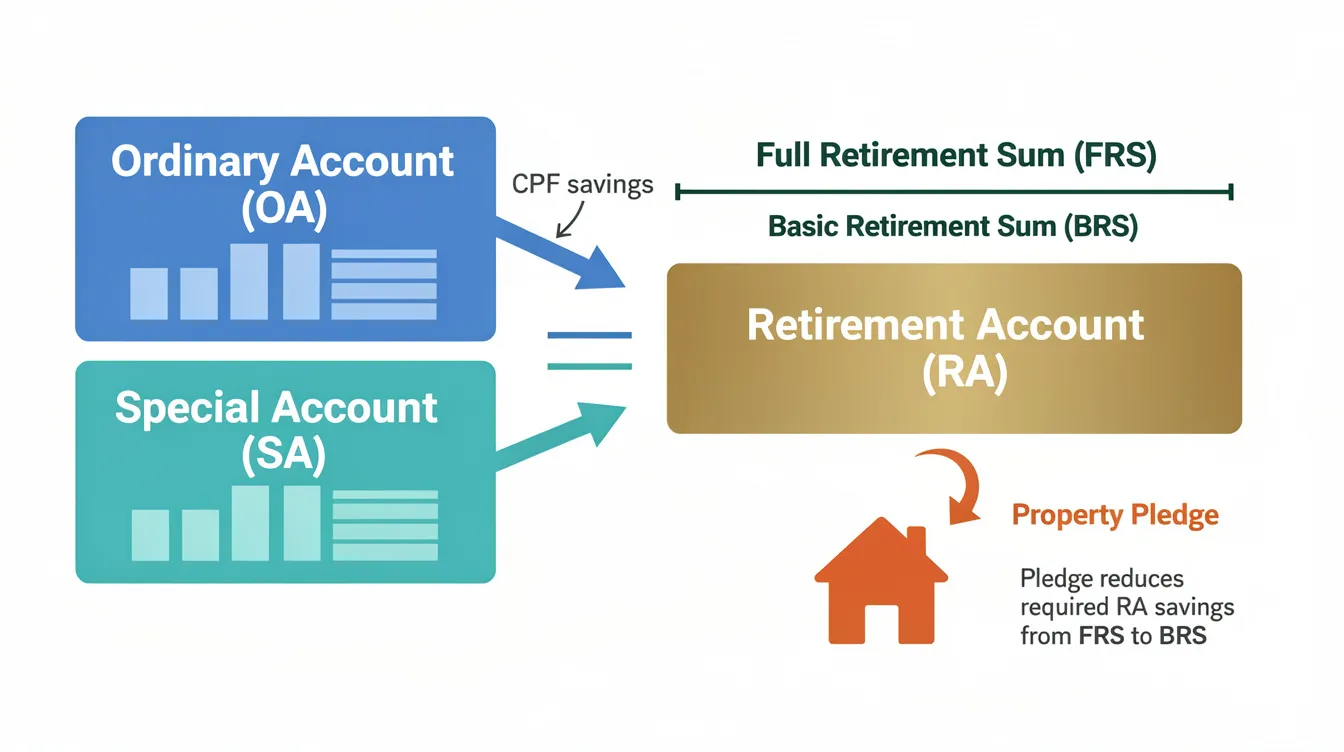
What is CPF pledging? It is a legal mechanism that allows Singapore CPF members who own a qualifying residential property to commit that property as security to the CPF Board, so they only need to set aside the Basic Retirement Sum (BRS) in their Retirement Account (RA) at age 55, instead of the Full Retirement Sum (FRS). The Basic Retirement Sum is half of the Full Retirement Sum in Singapore. By reducing the amount locked into the RA, pledging releases excess CPF Ordinary Account (OA) savings as withdrawable cash.
This article covers the rules, eligibility criteria, calculations, worked examples, pros, cons, and strategic uses of CPF property pledging for owner-occupiers, investors, and SME owners. It matters if you are deciding whether to use released CPF funds for a first home or for later property moves. It does not provide personalised financial advice; readers should consult the CPF Board or a licensed adviser for decisions specific to their circumstances.
CPF property pledging allows cash withdrawals from Retirement Accounts in Singapore by substituting part of the required retirement sum with a property-backed obligation. Instead of locking the full S$220,400 (2026 FRS) into your RA, you can lock only S$110,200 (2026 BRS) if your property qualifies, and withdraw the difference—this article focuses on the retirement-rule side rather than how much you can borrow for a property purchase.
By the end of this article, you will be able to:
-
Determine whether your property is eligible for CPF pledging
-
Calculate how much additional CPF cash you can withdraw at 55 with a pledge versus without one
-
Understand how your property’s CPF usage, ownership share, remaining lease, and outstanding loan affect pledge capacity
-
Weigh the trade-off between immediate cash and lower CPF LIFE monthly payouts
-
Identify risks such as refund obligations, lease decay, and constraints on future property decisions
Illustrative diagrams and comparison tables appear throughout the article to show the flow of CPF monies and property value at each stage.
Understanding CPF Property Pledging
Pledging is a retirement adequacy tool built into CPF policy. It is not a separate financial product you buy or subscribe to. It exists because CPF recognises that a residential property in Singapore can function as a form of retirement security alongside cash savings. The pledge ties a portion of your retirement sum obligation to your property’s value and your CPF usage history, rather than requiring all of it in cash within your RA.
Three retirement sum tiers define how much CPF expects you to hold in your RA at age 55. For members turning 55 in 2026:
-
Basic Retirement Sum (BRS): S$110,200. Produces estimated CPF LIFE Standard Plan monthly payouts of about S$950 from age 65.
-
Full Retirement Sum (FRS): S$220,400. Produces estimated monthly payouts of about S$1,780.
-
Enhanced Retirement Sum (ERS): S$440,800 (raised to 4× BRS from January 2025). Produces estimated monthly payouts of about S$3,440.
At age 55, CPF creates your retirement account by transferring savings from your Special Account (SA) first, then your OA, into the RA up to the applicable retirement sum. The pledging decision occurs at this point: pledge a qualifying property, and your RA target drops from FRS to BRS.
Pledging property creates a legal charge on the property until the pledged amount is refunded. This charge is a CPF-specific refund obligation, not a day-to-day restriction on living in or renting out your home.
What Exactly Is CPF Pledging?
Pledging is when you commit your property (or your share of it) to the CPF Board as security, so that you set aside only the BRS instead of the FRS in your RA at 55. It does not transfer ownership of your property to CPF. It does not create a bank-style mortgage. The pledge is a conditional promise: if you sell or transfer the property, CPF used plus accrued interest (up to the pledged amount) must be refunded to your CPF accounts.
Pledging property provides access to funds while retaining home ownership. You continue living in the property, and any existing bank loan remains the primary lien. CPF’s charge sits alongside or behind the bank’s mortgage.
For a member turning 55 in 2026: the FRS is S$220,400 and the BRS is S$110,200. Pledging allows that member to keep only S$110,200 in the RA instead of S$220,400, subject to the eligibility rules and calculations below.
When Does CPF Pledging Come Into the Picture?
The pledging decision arises at age 55 when CPF creates the RA. Before that point, members can plan by reviewing their CPF usage on property, projected OA and SA balances, and the remaining lease on their home.
A property qualifies for pledging if it meets these criteria:
-
It is a completed residential property in Singapore (HDB flat, private property such as a condominium, landed home, or eligible executive condominium). Only residential properties in Singapore, such as HDB and private properties, qualify for pledging.
-
Properties must have a remaining lease lasting until age 95 to qualify for pledging. If the lease falls short, the pledging amount may be pro-rated or disallowed entirely.
-
You are a registered owner or co-owner. Co-owners of a property must consent to pledging and withdraw cash accordingly.
Overseas properties and purely commercial or industrial properties do not qualify. Not all properties qualify for CPF pledging; specific eligibility criteria apply.
This is the point where you weigh two paths: lock more money into RA for higher lifelong CPF LIFE payouts, or pledge your property to free more CPF cash at 55, measured against the current Basic Retirement Scheme amount CPF requires at that age.
Key CPF Retirement Sums and Their Role in Pledging
Current and upcoming figures for members turning 55:
|
Year |
BRS |
FRS |
ERS |
|---|---|---|---|
|
2025 |
S$106,500 |
S$213,000 |
S$426,000 |
|
2026 |
S$110,200 |
S$220,400 |
S$440,800 |
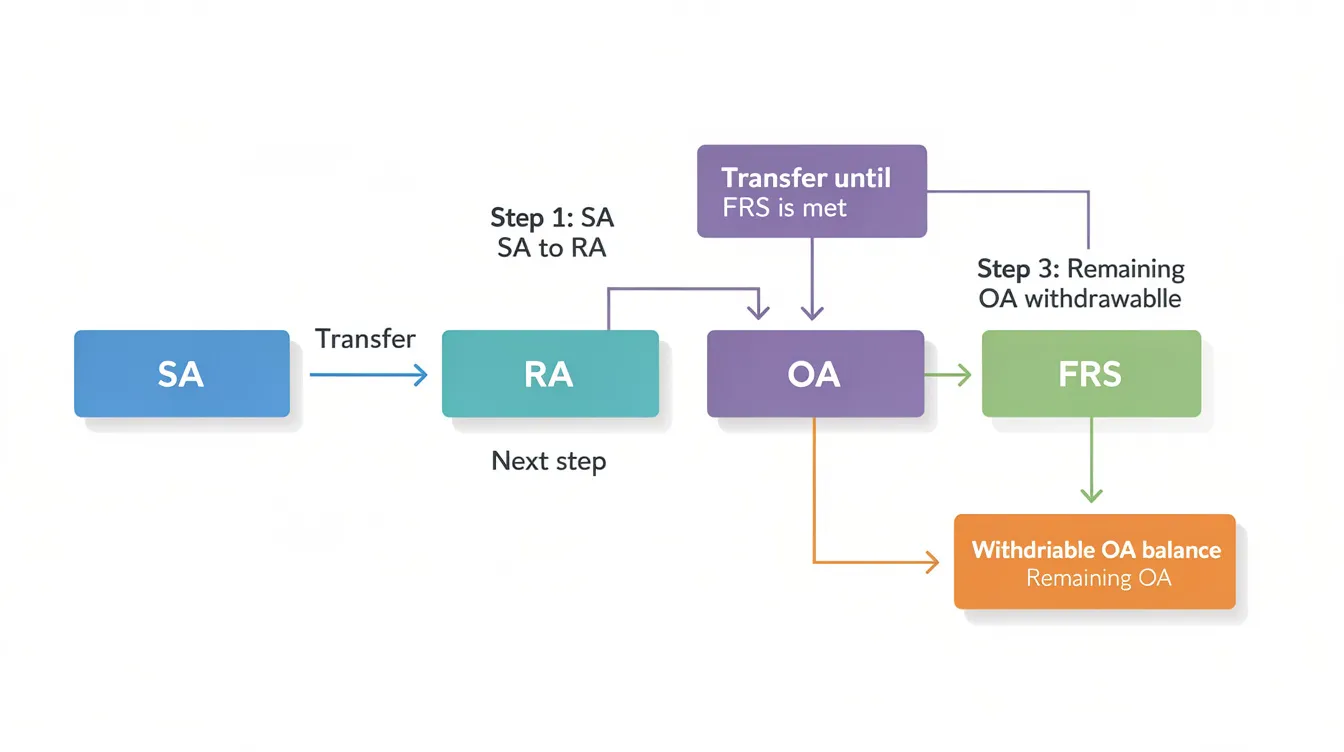
Without a property pledge, CPF sets aside the FRS from your combined SA and OA balances. With a pledge, the target drops to the BRS. The savings sweep follows a fixed sequence: SA balances move into the RA first, then OA balances fill the gap up to the target sum. This ordering matters because SA funds earn 4% interest (versus 2.5% for OA), and members who want to keep OA flexible for housing or investments prefer to minimise OA transfers into the RA.
The next section translates these definitions into specific numbers showing how pledging changes the cash you can withdraw at 55.
How CPF Pledging Helps You Unlock Excess OA Funds and CPF Savings at 55
The core question behind most searches on CPF pledging is: how does it change the amount I can take out as cash at 55? The answer depends on your SA and OA balances, the applicable FRS or BRS, and whether you pledge. At age 55, CPF members must set aside a Full Retirement Sum unless pledging property.
How Retirement Account Funding Works Without a Property Pledge
Without pledging, CPF transfers your SA and OA savings into the RA up to the FRS. Any amount above the FRS is withdrawable.
Example (no pledge, 2026 figures):
-
SA balance at 55: S$80,000
-
OA balance at 55: S$220,000
-
Total: S$300,000
-
FRS: S$220,400
CPF moves the full S$80,000 from SA into RA, then S$140,400 from OA into RA, reaching the S$220,400 FRS. The remaining OA balance is S$79,600, which is the withdrawable amount.
How Retirement Account Funding Changes With a Property Pledge
With a qualifying property pledge, CPF only requires the BRS in the RA. The difference between FRS and BRS stays withdrawable (subject to balances and pledge capacity).
Example (with pledge, same member, 2026 figures):
-
SA balance at 55: S$80,000
-
OA balance at 55: S$220,000
-
Total: S$300,000
-
BRS: S$110,200
CPF moves S$80,000 from SA into RA, then S$30,200 from OA, reaching S$110,200 BRS. The remaining OA balance is S$189,800. That is S$110,200 more in withdrawable cash compared to the no-pledge scenario.
|
No Pledge |
With Pledge |
|
|---|---|---|
|
RA set-aside |
S$220,400 (FRS) |
S$110,200 (BRS) |
|
Withdrawable cash |
S$79,600 |
S$189,800 |
|
Difference |
– |
+S$110,200 |
Liquid cash withdrawals from CPF can be used for immediate financial needs. However, lower CPF LIFE payouts result from withdrawing cash through property pledging, because less money compounds in the RA over the decade before payouts begin at 65.
Cash withdrawn through pledging does not earn CPF’s compounding interest. The S$110,200 difference, left in RA, would have earned 4% p.a. and contributed to higher monthly payouts. Withdrawing it trades future annuity income for present liquidity.
Step-by-Step: How to Apply to Pledge Your Property to CPF
-
Check eligibility. Log in to CPF’s Retirement Dashboard via Singpass. Confirm your property type, remaining lease, co-ownership structure, and CPF used for the property.
-
View estimated pledge capacity. The dashboard shows projected RA requirements under BRS versus FRS and how much excess savings above BRS you could access.
-
Prepare documentation. Gather your property title, latest property valuation (if requested), outstanding loan statements, NRIC, and consent forms from co-owners and lenders. For private property with an outstanding bank loan, the bank must consent to lodge the CPF charge.
-
Submit the application. For HDB flats and private property, forms differ. Co-owners may need to attend a CPF Service Centre in person for consent. A statutory charge or legal charge is then lodged on the title to secure the pledge and refund obligation.
Most steps can be completed online. Complex co-ownership situations or disputed ownership records may require a visit to a CPF Service Centre.
How Much Can You Actually Pledge? Key Rules and Calculations
You cannot pledge an arbitrary amount. The pledge is capped by the CPF you have used for the property, your ownership share, the property value minus outstanding loans, and the gap between FRS and BRS. Withdrawals can only occur if the property value sufficiently covers the pledged amount.
CPF Used for Property and Accrued Interest
The starting point is the total CPF savings you have used for the property purchase: down payment, monthly instalments, stamp duty, legal fees. On top of this, CPF adds accrued interest, calculated at the OA rate (currently 2.5% p.a.) compounding from the date each CPF withdrawal was made for housing.
Example: A member used S$150,000 in CPF for their HDB flat over 20 years. Accrued interest totals S$40,000. The combined figure is S$190,000. This S$190,000 represents the potential refund required if the property is sold, and it informs the maximum amount that can be pledged.
Withdrawal amounts are subject to property valuation and outstanding loans. If the property’s market value minus the mortgage is less than the CPF used plus accrued interest, the pledge capacity shrinks, and outstanding loan balances or other purchase-related cost factors can reduce the effective amount available for pledging.
Ownership Share and Remaining Lease Requirements
You can only pledge up to your share of the CPF used and property value, based on your legal ownership percentage. A 50-50 joint tenancy splits the pledge equally. A tenancy-in-common with a 99-1 split means one owner’s pledge capacity is 99% and the other’s is 1%.
Co-owners may have used different amounts of CPF. Pledging capacity is assessed individually. If you used S$100,000 in CPF and your co-owner used S$50,000, your respective pledge capacities differ even if ownership shares are equal.
The remaining lease must cover the youngest owner to at least age 95. An older HDB flat with only 40 years of lease remaining may not meet this threshold for a member who is 55, since they would need coverage to 95 (40 more years). If the lease falls short, CPF either reduces the pledge amount proportionally or disallows pledging entirely.
Short-lease example: A resale flat valued at S$200,000 with an outstanding mortgage of S$120,000 and one co-owner’s CPF housing usage of S$50,000. Ownership split is 1% to 99%. The residual property value is S$200,000 minus S$120,000 minus S$50,000, which equals S$30,000. The 1% owner’s share of that residual value is S$300. That member’s pledge capacity is S$300, regardless of whether the BRS is S$106,500 or S$110,200.
Example Scenarios: Typical Pledging Amounts and Outcomes
Scenario A: Single owner, fully paid HDB flat, strong CPF balances
|
Detail |
Amount |
|---|---|
|
Property: 4-room HDB flat, no outstanding loan |
– |
|
CPF used + accrued interest |
S$180,000 |
|
SA at 55 |
S$90,000 |
|
OA at 55 |
S$200,000 |
|
FRS (2026) |
S$220,400 |
|
BRS (2026) |
S$110,200 |
Without pledging: RA = S$220,400. Withdrawable = S$69,600. With pledging: RA = S$110,200. Withdrawable = S$179,800. The pledge amount is capped at S$110,200 (FRS minus BRS), which is below the S$180,000 CPF usage, so the full difference is available.
Scenario B: Couple, condo with outstanding mortgage, unequal CPF usage
|
Detail |
Owner 1 |
Owner 2 |
|---|---|---|
|
Ownership share |
60% |
40% |
|
CPF used + accrued interest |
S$200,000 |
S$80,000 |
|
Outstanding mortgage (total) |
S$300,000 |
S$300,000 |
|
Property value |
S$1,000,000 |
S$1,000,000 |
|
Residual value (value minus mortgage) |
S$700,000 |
S$700,000 |
|
Owner’s share of residual |
S$420,000 |
S$280,000 |
|
SA at 55 |
S$70,000 |
S$50,000 |
|
OA at 55 |
S$180,000 |
S$120,000 |
Owner 1 can pledge up to S$110,200 (the FRS-BRS gap), since their CPF usage (S$200,000) and share of residual value (S$420,000) both exceed the gap. Without pledging, Owner 1’s withdrawable amount is S$29,600; with pledging, it rises to S$139,800.
Owner 2’s CPF usage is S$80,000, which is below the S$110,200 gap. Owner 2’s pledge capacity is limited to S$80,000. Their RA requirement drops from S$220,400 to S$140,400 (FRS minus S$80,000 pledged). Without pledging, Owner 2 withdraws zero (total CPF of S$170,000 is below FRS). With pledging, Owner 2 sets aside S$140,400, leaving S$29,600 withdrawable.
Pledging tends to benefit those who already have substantial CPF in OA and SA and own a qualifying home with low or no outstanding mortgage.
Strategic Use of CPF Pledging for Property Owners and Investors
CPF pledging is one lever in a broader property and retirement strategy. While only residential property can be pledged for CPF retirement sums, the cash released at 55 becomes personal funds that can be deployed into other assets, including investments, industrial real estate, or commercial premises.
Owner-Occupiers: Improving Cash Flow at 55 Without Selling Your Home
Pledging helps meet retirement sum requirements without fully locking cash away. For “asset-rich, cash-poor” retirees, this means drawing more money at 55 while continuing to live in an existing HDB flat or private property.
The trade-off is concrete. A member setting aside BRS instead of FRS at age 55 in 2026 receives estimated CPF LIFE monthly payouts of S$950 instead of S$1,780 from age 65. That is S$830 less per month for life, in exchange for S$110,200 in upfront cash.
This reduces pressure to downsize immediately at 55. A property owner can stay in their first property, use the released cash for healthcare costs, business capital, or other expenses, and defer any sale or right-sizing decision to a time of their choosing.
Property Investors: Using Released CPF Cash for Investment Property to Reposition Your Portfolio
Investors might use cash unlocked via pledging to:
-
Fund the down payment on an income-producing industrial or commercial unit. CPF monies cannot be used directly for non-residential property purchase, but withdrawn cash has no such restriction.
-
Cover renovation or fit-out costs for business-use premises.
-
Reduce higher-interest personal loans or business debts, or use the funds to pay financing obligations or reposition capital, while maintaining a core residential home.
Property investing with released CPF cash still faces regulatory constraints. A second residential property purchase triggers additional buyer’s stamp duty (ABSD), which for Singapore citizens is 20% of the purchase price)))). A S$1 million condo purchase incurs S$200,000 in ABSD for citizens. For a second residential property, LTV drops, which reduces how much you can borrow and makes loan tenure and cash planning more important. A minimum cash down payment of 25% is required for second properties. The total debt servicing ratio limits borrowing to 55% of gross monthly income, applying to all debts including car loans and other personal loans. Some investors use leverage carefully, but overextending on debt can be risky.
For those who want property exposure without the concentration risk and fees of direct ownership, REITs offer an alternative. Investing in S-REITs allows joint ownership of commercial properties. REITs can yield 5 to 6% annually, provide tax-exempt dividends as retirement income, and typically hold 70% to 80% of assets in Singapore. Investing in REITs reduces risks compared to direct property ownership because of diversification across multiple properties and professional management.
Balancing CPF LIFE Monthly Payouts vs. External Property Income
Pledging reduces retirement account savings set aside for CPF LIFE, which lowers guaranteed monthly payouts. The question is whether external rental income or investment returns can compensate.
|
Factor |
Keep FRS in RA (no pledge) |
Pledge and withdraw difference |
|---|---|---|
|
CPF LIFE payout (est.) |
~S$1,780/month from 65 |
~S$950/month from 65 |
|
Upfront cash at 55 |
S$79,600 (example) |
S$189,800 (example) |
|
Income certainty |
Government-backed annuity |
Depends on rent, property prices, or investment returns |
|
Long term risk |
Low |
Higher; subject to vacancy, interest rates, capital appreciation fluctuations |
For many SME owners and investors, an optimal approach involves partial pledging combined with conservative use of released funds, rather than maximising the withdrawal; this comparison is usually assessed over at least five years, and the trade-off can look more attractive if rents or property values rise over time, though results still depend on execution and market conditions.
Common Misconceptions, Risks, and Practical Challenges
Misunderstanding CPF pledging can lead to over-optimistic cash expectations or complications when selling or upgrading property.
“Pledging Means CPF Owns My Home”
Pledging does not change your property title. You remain the registered owner. Banks retain first-lien mortgages where applicable. The CPF charge is a refund obligation triggered when you sell, transfer, or terminate the property. It does not give CPF day-to-day control over your home, and it does not prevent you from living in or renting out the property.
Overestimating How Much Cash You Can Withdraw
Many members assume they can withdraw large sums because they own property. Reality depends on four variables: CPF balances (SA + OA), property’s valuation limit minus outstanding loans, CPF used plus accrued interest, and ownership share. A member with a large mortgage or a small ownership share may find the pledge capacity is only a few hundred dollars, as the 1% ownership example above illustrates.
Check CPF’s online calculators before making financial commitments based on assumed withdrawal amounts. Note: do not commit to a purchase or financing plan until CPF confirms the actual withdrawable amount. Market volatility and policy updates can also affect long term outcomes.
Impact on Future Property Decisions
The pledged amount must be refunded upon selling or transferring the property. When you sell a pledged property, CPF takes its refund (CPF used plus accrued interest, up to the pledge amount and sale proceeds) before you receive the remaining cash. Pledging reduces available cash when selling the property due to refund obligations.
The refund obligation creates a long-term impact on future financial planning. If property prices decline over time, especially for older flats with lease decay, the sale proceeds may barely cover CPF refunds, leaving little cash for a replacement home. If sale proceeds minus outstanding loans do not fully cover CPF refund obligations, you do not have to top up the shortfall with cash, provided the property was sold at market value.
This can constrain upgrading, downsizing, or any plan to buy a second property. Readers considering selling pledged properties or restructuring portfolios should consult both CPF and a property adviser.
Administrative and Documentation Issues
Typical challenges include missing records on CPF usage for older properties, complex co-owner structures, and cases involving divorce or inheritance. For private property with an outstanding bank loan, obtaining the bank’s consent to lodge the CPF charge can add weeks to the process.
Keep copies of Sale & Purchase agreements, loan statements, and CPF transaction histories. Update CPF nominations and ownership records to smooth future pledging or sale.
Conclusion and Next Steps
CPF pledging lets qualifying homeowners set aside only the BRS (S$110,200 for 2026) instead of the FRS (S$220,400), freeing the difference as withdrawable cash at 55. The mechanism works by creating a legal charge on your residential property, promising CPF that if the property is sold, the CPF used plus accrued interest will be refunded.
The core trade-off is immediate liquidity versus higher guaranteed CPF LIFE income. A member who pledges receives an estimated S$950 per month from CPF LIFE at 65, compared to S$1,780 without pledging. Whether the additional cash at 55 generates enough value to justify lower lifelong payouts depends on individual circumstances, finance needs, and how the funds are deployed.
Concrete next steps:
-
Log in to your CPF account and check projected BRS and FRS requirements at your 55th birthday.
-
Review your property’s remaining lease and total CPF used plus accrued interest.
-
Use CPF calculators to model with-pledge versus without-pledge outcomes for cash at 55 and monthly payouts.
-
For business owners or investors, map how potential released funds could support industrial or commercial real estate strategy, keeping in mind loan to value caps, ABSD, and total debt servicing ratio constraints.
-
Arrange a conversation with Aesthetic Havens to align your property portfolio (residential, industrial, and commercial) with your CPF retirement plan.
Related topics worth exploring next: CPF LIFE plan options and payout structures, using CPF for property purchase of a second residential property, and the impact of lease decay on older HDB and industrial assets.
Frequently Asked Questions About CPF Pledging
These are concise answers to questions that commonly arise around CPF pledging.
1. Can I pledge my property before I turn 55?
CPF formally confirms pledging at RA creation, which happens at age 55. Before that, you can plan by checking your CPF usage on property, projected SA and OA balances, and remaining lease via the CPF Retirement Dashboard. Early planning is useful but the legal pledge itself is processed at 55.
2. Can I change or remove my property pledge later?
A pledge is tied to the specific property. It is adjusted or removed upon sale, transfer, or other disposition of the property. You cannot “unpledge” the property and replace it with another form of collateral to adjust your RA requirement while still holding the same property.
3. What happens to the pledge if I sell my home?
Sale proceeds must first refund CPF used plus accrued interest (up to the pledge amount and within the limits of the sale proceeds). After the refund, remaining cash goes to the owner. The pledge ceases when the property changes hands. If the sale proceeds are insufficient to cover the full CPF refund and the property was sold at market value, you are not required to top up the shortfall.
4. Can I pledge a second residential property but live in another?
CPF’s pledging rules focus on whether you own a qualifying residential property, not whether you occupy it. A member who owns an investment property (residential) can pledge it, subject to all the same eligibility criteria: remaining lease to age 95, co-owner consent, and sufficient property value minus outstanding mortgage. You can use CPF for a second property purchase, but you must set aside S$96,000 in CPF before using it, and additional buyer’s stamp duty and loan to value restrictions apply.
5. Does CPF pledging apply to commercial or industrial properties?
CPF cannot be used to buy industrial or commercial properties, so pledging is not available for such assets. However, cash released via pledging becomes personal funds once withdrawn at 55 and can then be invested in commercial or industrial real estate, subject to standard MAS and IRAS rules.
6. How does CPF pledging affect my estate and beneficiaries?
If a member passes away while owning a pledged property, the CPF refund obligation applies to the property’s disposition (whether sold by the estate or transferred to beneficiaries). CPF monies refunded go back into the deceased member’s CPF account and are distributed according to CPF nominations, not the will. Beneficiaries should be aware that the refund obligation reduces the net value of the property within the estate.
Additional Resources
-
CPF Board: Withdrawal of CPF Savings for Property Owners – Official eligibility rules and application steps for property pledging.
-
CPF Retirement Sum Explainer – Current BRS, FRS, and ERS figures with CPF LIFE payout estimates.
-
CPF Calculators – Model your retirement sum scenarios, with-pledge and without-pledge outcomes.
-
IRAS: Additional Buyer’s Stamp Duty – Current ABSD rates for second and subsequent property purchases.
-
Aesthetic Havens guides on planning industrial and commercial property investments for retirement income. Contact the team for a portfolio alignment discussion.


