

Introduction
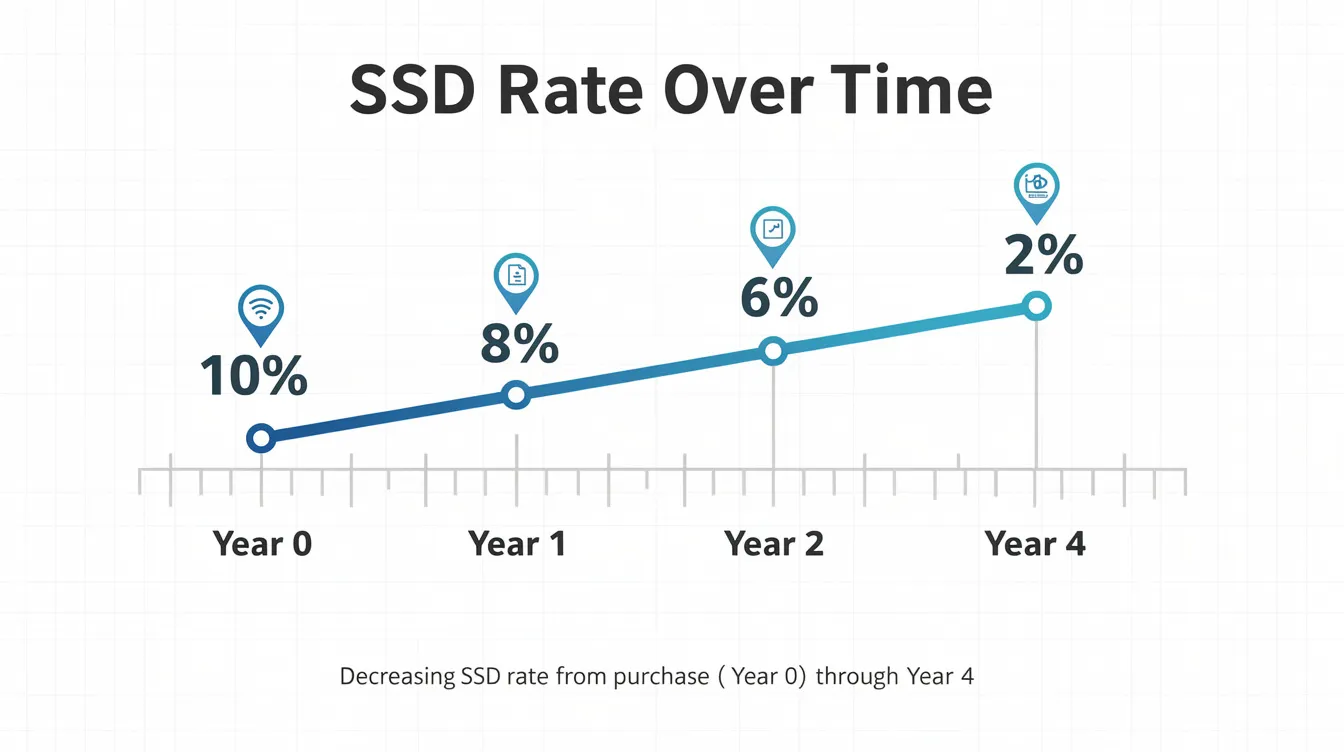
Seller’s Stamp Duty (SSD) is the tax Singapore imposes on anyone who sells a residential property within a prescribed holding period after buying it. Since 4 July 2025, the government announced a revised SSD schedule that extended the SSD holding period from three years back to four years and raised every holding period tier by four percentage points – bringing the rates to 16% / 12% / 8% / 4% for Years 1 through 4, up from the previous 12% / 8% / 4% across three years.
The rule that determines which schedule you fall under is straightforward: residential properties purchased before 4 July 2025 follow the old 3-year SSD regime, while those acquired on or after 4 July 2025 follow the new 4-year regime. There is no transition period; the purchase date alone decides everything.
This article focuses on Singapore’s residential SSD rules – the historical changes, how the holding period is measured, and what the shift means for property owners, investors, housing developers, and corporate occupiers who hold residential units alongside industrial property. Industrial property SSD is touched on for context, but the spotlight remains on comparing the old rules vs new rules for private residential property transactions. Whether you are an investor timing an exit, an owner-occupier worried about life-event sales, or a business owner balancing residential and industrial holdings, this guide gives you the numbers, timelines, and planning frameworks you need.
You will learn:
-
How IRAS measures the SSD holding period and what counts as “acquisition” and “disposal”
-
Which SSD rate table applies to your property based on its acquisition date
-
Exactly how much more you pay under the new 4-year rule, with worked dollar examples
-
How to plan your sale timing across the 2025–2029 dual-track window
-
What this means for industrial owners who also hold residential assets as part of an overall portfolio
The sections below include side-by-side rate tables, visual timelines, and case studies comparing old vs new regimes.
Understanding Seller’s Stamp Duty and Holding Periods
Seller’s stamp duty is a tax levied on the seller – not the buyer – when a private residential property or residential land is disposed of within a minimum holding period after acquisition. It is entirely separate from Buyer’s Stamp Duty (BSD) and Additional Buyer’s Stamp Duty (ABSD), both of which are borne by purchasers. SSD applies to residential properties acquired on or after 20 February 2010.
The policy rationale is simple: SSD discourages short-term speculation in Singapore’s land-scarce housing market. By imposing progressively lower rates the longer you hold, it penalises quick flips while leaving long-term owners untouched. The SSD framework is applicable solely to private residential properties and residential lands – not commercial or industrial assets (which have their own separate industrial property SSD regime).
The “holding period” is the elapsed time between your acquisition date and disposal date, counted in whole years for SSD purposes. Understanding exactly how these dates are defined – and which rate schedule your property falls under – is the single most important step in planning any exit.
How IRAS Defines the SSD Holding Period
The holding period runs from the date you acquire the property to the date you dispose of it. For most transactions:
-
Acquisition date is the date you exercise (accept) the Option to Purchase (OTP), or the date of the sale and purchase agreement if no OTP exists. For new HDB flats, it is the Agreement for Lease date. The key distinction is that the date an OTP is granted does not count – only the date it is exercised. For example, if you receive an OTP on 20 June 2025 but exercise it on 10 July 2025, your acquisition date for SSD purpose is 10 July 2025 – placing you firmly under the new 4-year regime.
-
Disposal date follows the same principle: it is the date the buyer exercises the OTP you granted, or the purchase agreement date if there is no OTP. Completion date, Temporary Occupation Permit (TOP) date, and key collection date do not determine when SSD applies.
For inherited property, the holding period may trace back to the deceased’s original acquisition date, provided the interest was held continuously. Transfers due to inheritance generally avoid SSD if held over three years from that original date. Similarly, for family transfers under specific statutory remissions, the earliest respective acquisition date among existing owners who continuously held interest may apply.
When partial interest in a property is acquired at different times – say, you buy a 50% share in 2023 and the remaining 50% in 2026 – each portion has its own acquisition date and its own SSD exposure. If you later sell the entire property, SSD is computed separately on each portion based on the relevant holding period tier.
What Counts as a “Disposal” for SSD Purposes
IRAS defines “disposal” broadly. It includes any sale, transfer, gift, assignment of an Option to Purchase, or disposal of a beneficial interest in residential property. Disposal date follows the same logic as acquisition: the date of the executed sale contract or exercised OTP, not the completion or settlement date.
Properties undergoing collective sale are also caught – the disposal date is typically when the collective sale order is finalised or the sale contract is executed. Intra-family transfers, including gifting a condo to a child, attract SSD if they occur within the holding period, unless they fall under specific statutory exemptions. Divorce settlements may exempt property transfers from SSD, but this depends on the court order and whether IRAS’ remission conditions are met.
Consider two quick examples: gifting a condo to your adult child 18 months after purchase still triggers SSD at the applicable Year 2 rate. Selling via a collective sale 2.5 years after purchase also triggers SSD – and the Strata Titles Board grants of a collective sale order do not override SSD liability.
Understanding what counts as a “sale” is key before we compare how the holding periods and rates have changed over time.
Evolution of SSD Rules: From 4 Years, to 3 Years, and Back to 4 Years
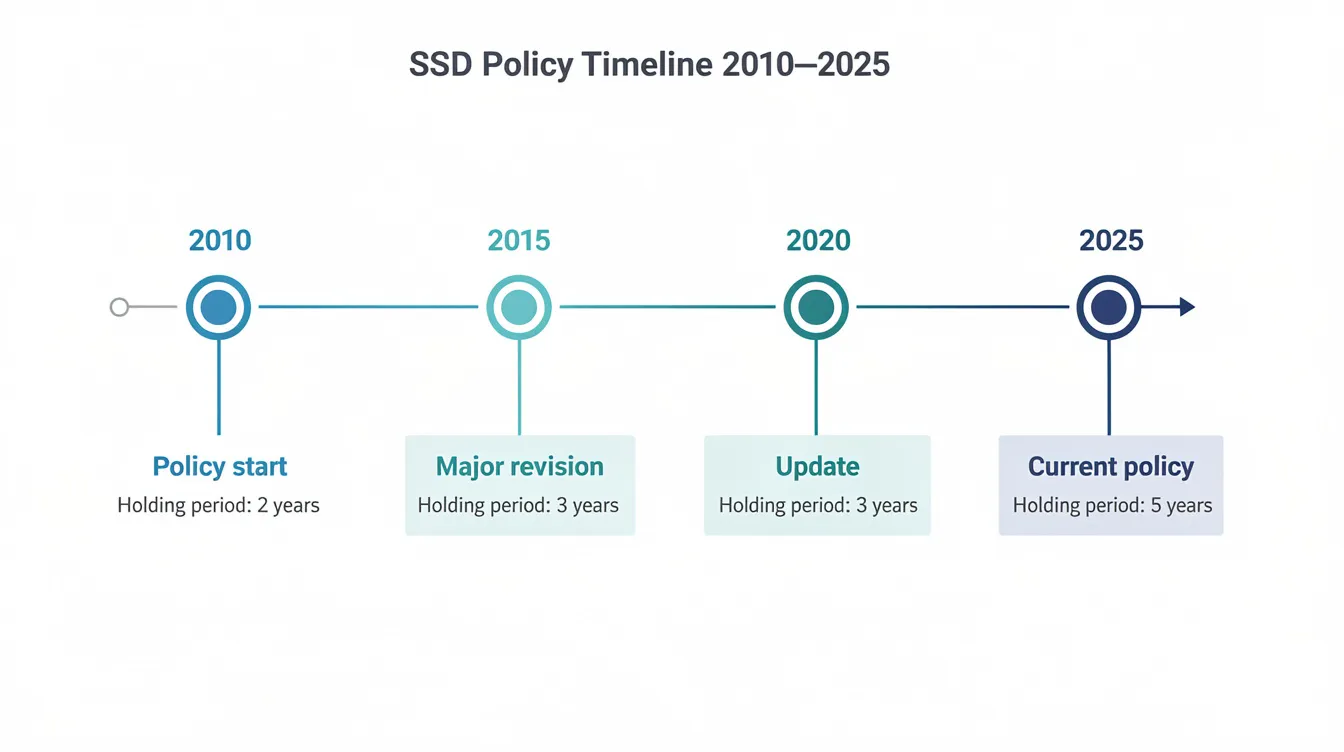
Singapore’s SSD policy has swung between tighter and looser settings over the past 16 years, always in response to market conditions. The overall arc: introduction in 2010, tightening in 2011, easing in 2017, and reversion to a stricter framework in July 2025. While earlier iterations matter for historical context, the practical comparison that concerns most readers today is between the “old” 3-year regime (11 March 2017 to 3 July 2025) and the “new” 4-year regime (from 4 July 2025).
Key Milestones in SSD Policy (2010–2026)
-
20 February 2010: SSD first introduced for residential property acquired on or after this date. Initial rates used standard ad valorem stamp duty bands and applied only to sales within one year.
-
14 January 2011: The government tightened SSD substantially – extending the holding period to four years and introducing flat tiered SSD rates of 16%, 12%, 8%, and 4% for Years 1 through 4. This was a direct response to escalating speculative activity in private residential property transactions.
-
11 March 2017: With the market stabilising, the government shortened the holding period from four years back to three years and cut rates by four percentage points per tier, creating the 12% / 8% / 4% schedule that became the “old” rules most sellers are familiar with.
-
4 July 2025: Responding to a surge in sub-sales and short holding periods – particularly in uncompleted units – the government extended the holding period back to four years and raised each tier by four percentage points, restoring the 16% / 12% / 8% / 4% structure. The government implemented these changes to curb short-term property speculation and “flipping.”
The “Old” 3-Year SSD Regime (11 March 2017 – 3 July 2025 Purchases)
This rule set applies to any residential property acquired between 11 March 2017 and 3 July 2025 inclusive. Under the old rules, SSD is payable only when the property is disposed of within three years of acquisition. From the start of the fourth year onward, no SSD applies.
The previous SSD rates for residential properties were:
|
Holding Period from Acquisition |
Old SSD Rate |
|---|---|
|
Up to 1 year |
12% |
|
More than 1 year, up to 2 years |
8% |
|
More than 2 years, up to 3 years |
4% |
|
More than 3 years |
0% (No SSD) |
SSD is calculated on the higher of selling price or market value, with the SSD payable amount rounded down to the nearest dollar. This regime remains relevant for many existing owners and will continue to govern sales through at least 3 July 2028 – three years after the last qualifying purchase date under the old schedule.
The “New” 4-Year SSD Regime (From 4 July 2025 Purchases)
The revised SSD schedule applies to all residential property acquired on or after 4 July 2025. The holding period for SSD is now four years for new purchases, meaning sellers must hold for more than four full years before they can sell SSD-free.
The current SSD tax rates are:
|
Holding Period from Acquisition |
New SSD Rate |
|---|---|
|
Up to 1 year |
16% |
|
More than 1 year, up to 2 years |
12% |
|
More than 2 years, up to 3 years |
8% |
|
More than 3 years, up to 4 years |
4% |
|
More than 4 years |
0% (No SSD) |
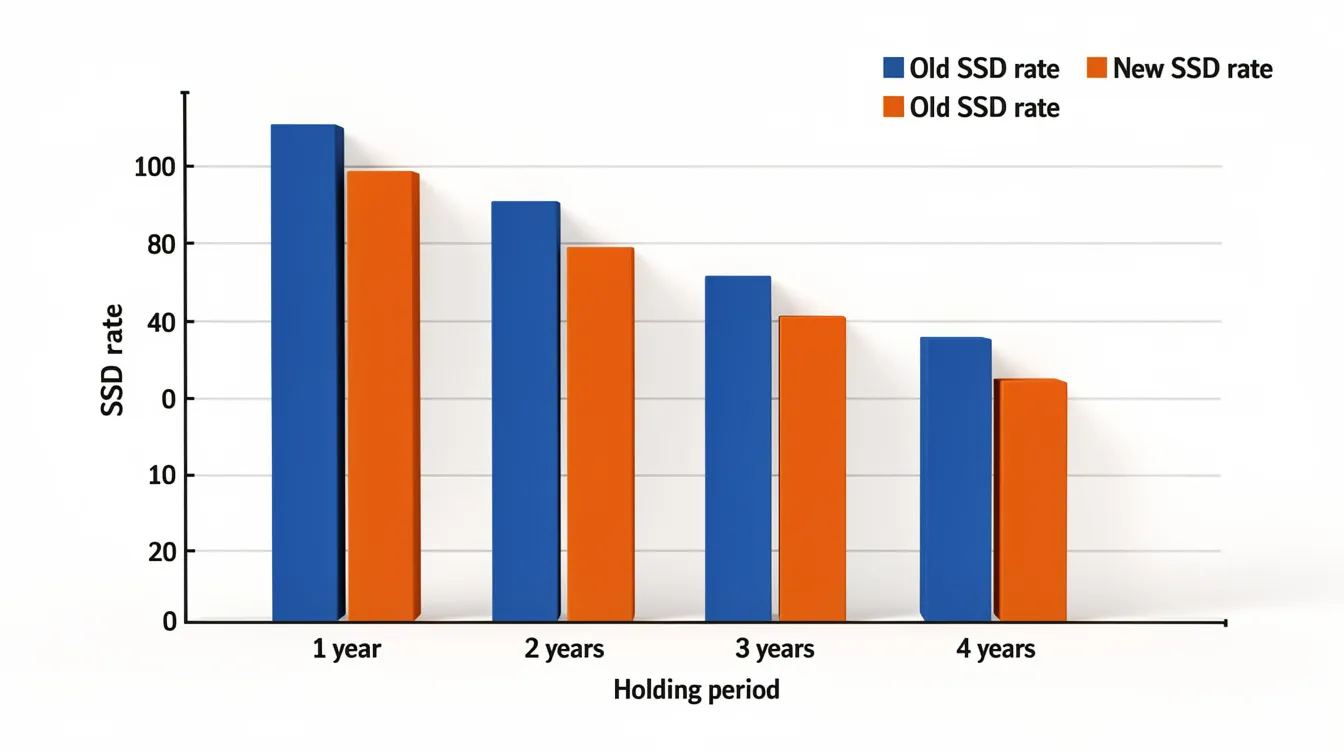
Each tier is exactly four percentage points higher than the old regime – a significant increase in the cost of early exits. SSD rates increased by four percentage points on 4 July 2025 across every holding period tier. Where previously a seller could escape SSD entirely at the start of Year 4, new purchasers face a 4% levy even in that window.
For private investors, licensed housing developers, and business owners who use residential property as part of their balance sheet, this changes the calculus on short-term strategies. Sub-sale transactions – selling before TOP – now carry materially higher SSD liability, and the extra year of exposure constrains capital recycling. New SSD rules apply to properties purchased after 4 July 2025 with no exceptions based on buyer profile; SSD applies regardless of whether the seller is among Singapore citizens, permanent residents, or foreigners.
Let’s now see exactly how old and new rules compare, numerically and visually.
Old Rules vs New Rules: Side-by-Side Comparison
This section is the quick-reference heart of the article. It places the 3-year and 4-year holding period SSD rate schedules next to each other, then runs through dollar examples so you can see the real financial impact of the revised SSD rates.
SSD Rate Table: 3-Year vs 4-Year Schedule
|
Holding Period (from Acquisition Date) |
Old 3-Year SSD Regime (Purchases: 11 Mar 2017 – 3 Jul 2025) |
New 4-Year SSD Regime (Purchases: from 4 Jul 2025) |
|---|---|---|
|
Up to 1 year |
12% |
16% |
|
>1 year – ≤2 years |
8% |
12% |
|
>2 years – ≤3 years |
4% |
8% |
|
>3 years – ≤4 years |
No SSD |
4% |
|
>4 years |
No SSD |
No SSD |
The two main differences are:
-
An extra year of exposure: the new regime adds a Year 4 tier at 4%, meaning SSD applies for a full additional year beyond the old schedule.
-
Higher percentage points at every tier: investors planning a flip in Year 2 or Year 3 are the most impacted, as the rate they face has effectively jumped by half (e.g., from 8% to 12% in Year 2).
Worked Dollar Examples: S$1.5M and S$2M Properties
To make the numbers concrete, here are three scenarios. In every case, SSD is calculated on the higher of the actual price or market value.
Example A – S$1.5M condo sold in Year 1:
|
Old Rules |
New Rules |
|
|---|---|---|
|
SSD Rate |
12% |
16% |
|
SSD Payable |
S$180,000 |
S$240,000 |
|
Difference |
S$60,000 more |
Example B – S$2M condo sold in Year 2:
|
Old Rules |
New Rules |
|
|---|---|---|
|
SSD Rate |
8% |
12% |
|
SSD Payable |
S$160,000 |
S$240,000 |
|
Difference |
S$80,000 more |
Example C – S$1.2M property, sold in Year 3 vs Year 4:
|
Sale Year |
Old Rules |
New Rules |
|---|---|---|
|
Year 3 |
4% → S$48,000 |
8% → S$96,000 |
|
Year 4 |
0% → S$0 |
4% → S$48,000 |
Under the old regime, a seller at Year 4 would pay nothing. Under the new regime, the same sale attracts S$48,000 in stamp duty. These examples show not just “more tax” but how the extended holding period shifts the optimal sale year: where previously Year 4 was the safe exit point, it is now Year 5.
SSD must be paid within 14 days of the sale agreement date – there is no extended payment window, so sellers must budget for this cash outflow at settlement. Law firms representing sellers will typically remind them of this deadline, but the obligation is the seller’s.
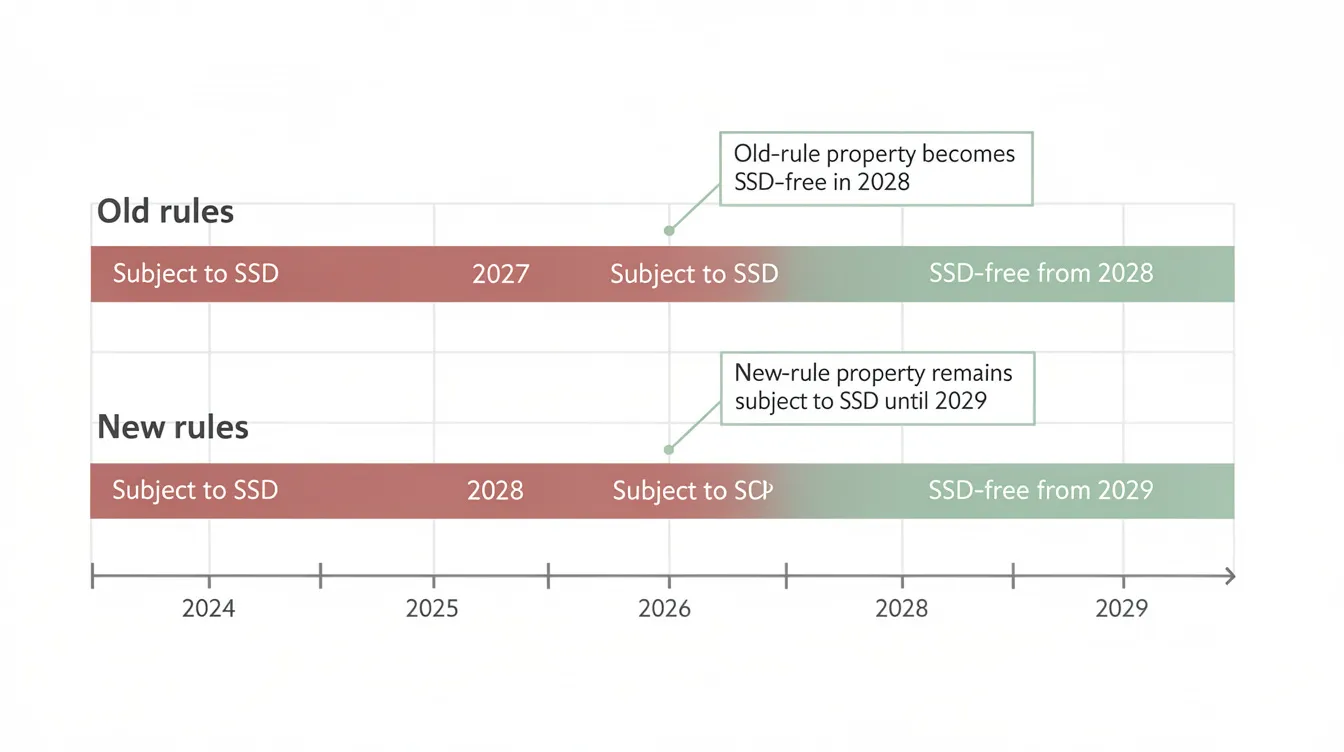
Transition Timeline: Dual-Track SSD Rules (2025–2029)
From 4 July 2025 to at least mid-2029, the Singapore market operates under two SSD systems simultaneously. Which system applies depends entirely on the purchase date – not the sale date.
Consider two properties separated by a single day:
-
Property bought on 3 July 2025 (old regime): follows the 3-year schedule. SSD drops to zero from 4 July 2028 onward.
-
Property bought on 4 July 2025 (new regime): follows the 4-year schedule. SSD payable remains at 4% in Year 4, dropping to zero only from 5 July 2029 onward.
Two purchasers separated by one day at acquisition face an extra year of SSD exposure – and materially higher rates at every comparable holding period.
This matters to:
-
Housing developers planning launches around mid-2025, as buyers’ willingness to commit may differ based on which SSD regime their purchase falls under.
-
Investors timing entry in June vs July 2025, where a few days’ difference translates into tens of thousands of dollars in potential SSD liability.
-
Corporate owners balancing residential investments alongside industrial premises, where the industrial property SSD regime (3-year holding period, rates of 15% / 10% / 5%) remains unchanged and offers a different risk profile.
Practical Application: How to Determine Which SSD Rules Apply to You
Now that the comparison is clear on paper, the next step is applying it to your own situation. This section walks through a systematic method to identify your regime, estimate your SSD, and inform your sale timing.
Step-by-Step: Identify Your SSD Regime and Rate
-
Confirm your acquisition date. Find the exercise date of your purchase OTP or the date of your sale and purchase agreement. This is the purchase agreement date that IRAS uses – not the date you were offered the OTP or the date you collected keys. Example: purchase exercised on 15 September 2023 → old rules. Purchase exercised on 10 August 2025 → new rules.
-
Check which rule set applies.
-
If acquisition date is between 11 March 2017 and 3 July 2025 inclusive: old 3-year SSD rules (12% / 8% / 4%).
-
If acquisition date is on or after 4 July 2025: new 4-year SSD rules (16% / 12% / 8% / 4%).
-
-
Calculate your holding period. Count from your acquisition date to your intended disposal date. IRAS measures in whole years: disposing one day before your first anniversary means you are still within “up to 1 year.” Disposing on the day after your first anniversary moves you into Year 2, and so on.
-
Match to the requisite SSD rate from the correct table above.
-
Apply the rate to the higher of sale price or current market value. SSD is calculated on the higher of selling price or market value – not the price you originally paid. If there is any doubt about valuation, get a professional assessment. SSD payable is rounded down to the nearest dollar.
Worked example (old regime): You bought on 1 March 2024 and plan to sell on 15 January 2026. Holding period = approximately 1 year 10 months → Year 2. Old rules apply. Rate = 8%. If market value is S$1.8M and selling price is S$1.75M, SSD = 8% × S$1.8M = S$144,000. SSD must be paid within 14 days of the sale agreement.
Worked example (new regime): You bought on 15 September 2025 and plan to sell on 1 August 2027. Holding period = approximately 1 year 10.5 months → Year 2. New rules apply. Rate = 12%. If price or market value is S$1.8M, SSD = 12% × S$1.8M = S$216,000. That’s S$72,000 more than the identical scenario under old rules.
Visual Timelines: When SSD “Drops Off” Under Old vs New Rules
Planning staggered disposals across a portfolio is easier when you can see the drop-off dates visually. Here are two illustrative owners:
Owner A – bought 1 January 2024 (old rules):
-
Year 1 (until 31 Dec 2024): 12%
-
Year 2 (1 Jan 2025 – 31 Dec 2025): 8%
-
Year 3 (1 Jan 2026 – 31 Dec 2026): 4%
-
SSD-free from 1 January 2027 onward ✅
Owner B – bought 1 September 2025 (new rules):
-
Year 1 (until 31 Aug 2026): 16%
-
Year 2 (1 Sep 2026 – 31 Aug 2027): 12%
-
Year 3 (1 Sep 2027 – 31 Aug 2028): 8%
-
Year 4 (1 Sep 2028 – 31 Aug 2029): 4%
-
SSD-free from 1 September 2029 onward ✅
For portfolio owners holding multiple residential properties acquired in different years, mapping these SSD-free dates helps sequence disposals to minimise total stamp duty payment.
Impact on Investors, Owner-Occupiers, and Corporate / Industrial Users
Individual investors: The longer minimum horizon for new purchases post-4 July 2025 fundamentally changes short-term residential investment strategies. Flipping uncompleted units or sub-sales – transactions that typically occur within one to two years – now attracts dramatically higher SSD. A Year 1 sub-sale under the new regime costs 16% of market value, up from 12%. For speculative strategies with slim margins, this can eliminate profitability entirely.
Owner-occupiers: Life events – job relocation, family changes, financial pressure – can force sales within three to four years. Under the new rules, even a Year 4 sale incurs 4% SSD. While this is not ruinous, on a S$2M property it amounts to S$80,000 that wouldn’t have existed under the old regime. SSD is payable regardless of profit or loss on sale, meaning even sellers disposing at a loss must still pay SSD.
Business owners and corporate entities: Companies that hold residential property for senior management housing or as treasury assets need to factor SSD into balance-sheet and cash-flow planning. The industrial property SSD regime remains at a 3-year holding period (15% / 10% / 5%), so the calculus differs for firms holding mixed portfolios. For an SME owner weighing whether to hold a residential unit versus redeploying capital into industrial space, the different SSD regimes – and the higher friction cost on the residential side – can tilt the analysis toward industrial investment.
Detailed Comparison and Analysis for 2025–2029 Sellers
This section uses realistic case studies to show precisely how different sale years trigger old vs new SSD, illustrating the dual-track environment that will persist through 2029.
Case Study 1: Pre-4 July 2025 Purchase Sold Within 3 Years
Scenario: Mr Tan buys a S$1.5M condo on 1 February 2025 and sells on 1 December 2026. His holding period is approximately 1 year and 10 months.
-
Applicable regime: Old 3-year SSD rules (acquisition before 4 July 2025).
-
Holding period tier: More than 1 year, up to 2 years → Year 2 → period SSD rate = 8%.
-
SSD calculation: The selling price is S$1.6M; market value at disposal is S$1.65M. SSD is calculated on the higher of selling price or market value, so: 8% × S$1,650,000 = S$132,000.
Planning lesson: Buying before 4 July 2025 keeps you under the more forgiving rule set, even if you sell well after 2025. Mr Tan’s SSD liability is S$132,000 – but under the new regime, the same holding period would attract 12% × S$1.65M = S$198,000. That is S$66,000 more for an identical property and identical holding period.
Case Study 2: Post-4 July 2025 Purchase Sold Within 3 Years
Scenario: Ms Lim buys a S$1.5M condo on 1 August 2025 and sells on 1 May 2027. Her holding period is approximately 1 year and 9 months.
-
Applicable regime: New 4-year SSD rules (acquisition on/after 4 July 2025).
-
Holding period tier: More than 1 year, up to 2 years → Year 2 → period SSD rate = 12%.
-
SSD calculation: Assuming the higher of price or market value is S$1.65M: 12% × S$1,650,000 = S$198,000.
Old vs New comparison box: Same purchase price, same sale price, comparable holding period – Ms Lim pays S$66,000 more than Mr Tan purely because her acquisition date falls under the new regime.
This difference alone exceeds a year’s worth of rental income on many condos, underscoring why acquisition date matters more than any other variable in SSD planning.
Case Study 3: Selling in the “New Year 4” Tier
Scenario: Mr Lee buys a property on 4 July 2025 at S$1.4M and sells on 1 February 2029. His holding period is approximately 3 years and 7 months.
-
Under old rules (if they had applied): Holding period exceeds 3 years → No SSD.
-
Under new rules (which actually apply): Still within the 4-year window → Year 4 rate = 4%. SSD = 4% × S$1,400,000 = S$56,000.
Mr Lee is “caught” by SSD for an extra year he may not have budgeted for when he purchased. Under the old regime, he would have walked away with zero SSD liability. Under the new regime, S$56,000 erodes his profit – or deepens his loss if the property has depreciated.
Planning reminder: New purchasers after 4 July 2025 should think in four-year horizons when setting investment strategies. The SSD-free date is now the beginning of Year 5, not Year 4.
Common SSD Challenges Under the New 4-Year Rules (and How to Handle Them)
Mistakes on dates, rule sets, and exemptions are common – especially during the dual-track period from 2025 to 2029. Here are the three most frequent pitfalls, with practical solutions.
Misreading Purchase Dates Around 4 July 2025
The most dangerous confusion is between the date an OTP is granted and the date it is exercised. A buyer who receives an OTP on 28 June 2025 but exercises it on 5 July 2025 falls under the new 4-year regime – not the old one. The purchase agreement date that triggers the SSD rules is the date of legal commitment, not the date of initial offer.
Solution: Always verify the legally binding acquisition date. Cross-check your law firm’s completion statement or IRAS e-Stamping records. If in doubt, law firms representing you in the transaction can confirm the operative date. There is no transition period for the new SSD rules; they apply based on the purchase date alone.
Forgetting the Extra Year of SSD Exposure
Many investors – particularly those experienced under the old regime – instinctively plan to sell “in Year 4” based on old habits, assuming SSD has already dropped to zero. For post-4 July 2025 purchases, Year 4 still carries a 4% rate. On a S$2M property, that is S$80,000 in unexpected stamp duty.
Solution: Map out a timeline at the time of purchase. Set calendar reminders for the exact date SSD drops to 0% – the first day after the fourth anniversary of your acquisition date. Budget for worst-case SSD exposure in every year until that date. A mis-timed sale can cost tens of thousands of dollars that proper planning would have avoided.
Assuming Exemptions Apply (e.g. Family Transfers) When They Do Not
A prevalent misconception is that gifting property to a spouse, child, or holding company avoids SSD. In reality, most voluntary transfers within the holding period still attract SSD. SSD is exempt for sellers under specific scenarios – such as transfers pursuant to inheritance (where the deceased’s original acquisition date applies), certain divorce settlements under court order, or disposals compelled by public authorities under the Land Acquisitions Act. Non-licensed developers, including companies or businesses engaged in housing development, may receive SSD remission when selling residential properties developed for sale. HDB sellers fulfilling the minimum occupation period are typically exempt from SSD. But outside these narrow carve-outs, an SSD exemption cannot be assumed.
Solution: Consult IRAS rules or a qualified professional before executing any restructuring, transfer, or gift within the holding period. Getting this wrong is expensive and non-reversible.
Conclusion and Next Steps
The shift from a 3-year to a 4-year SSD holding period – accompanied by a four-percentage-point increase at every tier – represents the most significant change to Singapore’s seller’s stamp duty framework since 2011. Here are the key takeaways:
-
Old regime (12% / 8% / 4%, 3-year holding) applies to residential properties purchased between 11 March 2017 and 3 July 2025. New regime (16% / 12% / 8% / 4%, 4-year holding) applies to properties purchased on or after 4 July 2025.
-
Your acquisition date – specifically, the date you exercised the OTP or signed the sale and purchase agreement – is the single factor that determines which SSD universe you inhabit.
-
The financial impact is substantial: at every holding period tier, sellers under the new rules pay more, and they face an additional year before reaching SSD-free status.
-
SSD is payable regardless of whether the sale generates a profit or a loss, and it must be paid within 14 days of the sale agreement date.
Your next steps:
-
Check your property’s acquisition date and compute your current holding period against the correct rate table.
-
Estimate SSD using both your expected selling price and a realistic market value – remember, SSD is calculated on whichever is higher.
-
Re-evaluate your sale timing; consider waiting until the SSD-free date if financially feasible.
-
For business owners and industrial property users, review how residential SSD interacts with your broader real estate strategy – industrial property SSD still operates on a 3-year regime with different rates.
-
Contact AESTHETIC HAVENS for a portfolio review that considers SSD timelines, industrial property opportunities, and operational fit across your holdings.
Related topics worth exploring next include ABSD changes for multiple property owners, the separate industrial property SSD framework for factories and warehouses, and structuring sale-and-leaseback arrangements to preserve cash while avoiding SSD surprises.
Frequently Asked Questions about SSD Holding Period Rules (Old vs New)
This FAQ consolidates the most common queries from investors, RES candidates, and corporate clients about the 3-year vs 4-year SSD rules.
Which SSD rules apply if I bought my property on 3 July 2025?
A purchase on 3 July 2025 falls under the old 3-year regime. Your SSD rates are 12% (Year 1), 8% (Year 2), and 4% (Year 3), with no SSD from the fourth year onward. You enjoy both lower rates and a shorter holding period than someone who buys one day later on 4 July 2025.
What if I received my OTP before 4 July 2025 but exercised it after?
SSD looks at the acquisition date – the date the OTP is exercised or the sale and purchase agreement is signed – not the date the OTP was granted. If exercise happens on or after 4 July 2025, the new 4-year regime applies in full, even if the OTP was granted weeks earlier in June 2025. There is no transition period or grandfathering.
Does SSD apply to HDB flats and executive condominiums (ECs)?
HDB flats are exempt from Seller’s Stamp Duty regulations due to their separate minimum occupation period (MOP), which is at least five years. By the time HDB owners satisfy MOP and are eligible to sell, the SSD holding period has long passed. However, certain special cases – such as an inherited HDB flat or a non HDB flat scenario following privatisation – may have nuanced SSD implications. An existing HDB flat held by someone who marries and restructures ownership could also raise questions, though HDB regulations generally govern these transfers separately.
For executive condominiums, the MOP must be satisfied before any sale is permitted. Once the EC is privatised (after the 10-year mark), it is treated as private residential property for stamp duty purposes, and SSD rules apply based on the acquisition date and holding period from that point.
How is SSD different from BSD and ABSD?
-
Seller’s Stamp Duty (SSD): Tax on sellers who dispose of residential property within the holding period. Applies regardless of nationality.
-
Buyer’s Stamp Duty (BSD): Standard stamp duty on buyers for all property purchases, calculated on the purchase price or market value.
-
Additional Buyer’s Stamp Duty (ABSD): Extra stamp duty on buyers based on their profile (citizen, PR, foreigner) and number of properties already owned.
SSD is solely about holding period and acquisition date. BSD and ABSD are about the purchase transaction and the buyer’s profile. All three can apply to different parties in the same transaction.
What if I sell my property at a loss – do I still pay SSD?
Yes. SSD is payable based on the higher of sale price or market value, regardless of whether the transaction results in a nominal loss. If you bought at S$2M and sell at S$1.8M within Year 2 under the new rules, SSD is 12% × S$1.8M (or market value, whichever is higher). There is no loss offset or exemption. This makes it critical to factor SSD into downside scenarios when planning residential investments.
Can AESTHETIC HAVENS help me plan around SSD for my industrial and residential portfolio?
Yes. AESTHETIC HAVENS provides data-backed analyses to help property owners and business operators navigate SSD across mixed portfolios. This includes mapping SSD timelines across all residential holdings, assessing optimal divestment windows, and evaluating when to redeploy capital from residential assets into industrial, commercial, or logistics spaces – where the industrial property SSD regime offers a shorter 3-year holding period and distinct rate structure. Reach out for a discussion or portfolio review tailored to your specific acquisition dates and investment horizon.

