


Singapore’s defects liability period (DLP) gives you a 12-month contractual window, starting from key collection, during which your developer must fix defects at no cost to you. Confirm your exact key collection date in your handover papers, then inspect your unit immediately, photograph every issue with a timestamp, and file a written report before that 12-month clock runs out.
TL;DR:
- The defects liability period in Singapore lasts 12 months from key collection or practical completion, depending on the contract, and must be documented carefully.
- Defects can be obvious or hidden, with latent defects often surfacing after the DLP expires, especially structural issues that require strong evidence for claims.
- Inspect and photograph every detail before moving in, keep all handover documents, and report issues through official channels with specific descriptions to ensure faster rectification.
- Rights extend beyond the DLP for latent or structural damages, but homeowners need timestamped proof and should consider independent inspections before escalating.
- Maintaining detailed records and understanding contractual retention clauses give homeowners leverage during disputes and long-term defect recovery.
Table of Contents
- What does the defects liability period mean in Singapore?
- How long does DLP last, and when does the clock start?
- What actually counts as a defect during the DLP?
- How do you inspect, document, and report a defect?
- What happens once the defects liability period ends?
- Where do you turn when rectification stalls?
- What should you do and avoid during the DLP?
- How does a property consultant help with DLP issues?
- Where can you find the official rules and forms?
- Why most homeowners underestimate their own leverage
- Sources
What does the defects liability period mean in Singapore?
The defects liability period is a contractual obligation, not a favor. Your developer or main contractor agrees, as part of the sale and purchase agreement, to repair defects in workmanship or materials at their own cost during a fixed period after handover. It’s a promise written into the contract you signed, enforceable the same way any other clause is.
People confuse the DLP with a maintenance period or a product warranty, but they’re different things entirely.
- A maintenance period usually refers to servicing (lifts, common facilities) and is managed separately, often by the management corporation.
- A product warranty covers a specific appliance or fitting, backed by the manufacturer, not the developer.
- The DLP covers the building itself, meaning workmanship and materials the developer or contractor is responsible for.
The biggest misconception: many owners assume all protection vanishes the moment the DLP ends. It doesn’t. As explained below, latent defects and major structural issues can still be pursued under longer-term legal remedies well after the 12 months close.
How long does DLP last, and when does the clock start?
For HDB flats, the defects liability period runs one year from the date you collect your keys. Most private new launches follow the same 12-month convention, though the exact starting trigger can differ slightly by contract.
- HDB flats: 12 months from key collection, confirmed by your key collection letter or appointment slip.
- Private condos: 12 months from either the key collection date or the date of “practical completion” as defined in your Sale and Purchase Agreement. Read the clause carefully. Some developers use vacant possession date instead.
- Documentation to keep: your key collection receipt, handover checklist, and any signed acknowledgment forms. These become your proof of when the clock started if a dispute ever comes up.
Don’t assume your DLP matches your neighbor’s. Two units in the same block, handed over weeks apart, will have two different end dates.
What actually counts as a defect during the DLP?
Defects fall into a few recognizable categories, and knowing which bucket your issue lands in saves you from a rejected claim. A construction defect under the DLP is generally a deficiency in design, materials, or workmanship that causes damage or fails to meet the standard your contract promised.
- Obvious defects: water leaks, cracked or uneven tiles, faulty wiring, doors that don’t close properly, uneven wall finishes.
- Latent defects: problems hidden at handover, like waterproofing failures behind walls or structural cracks that only show up years later.
- Typical exclusions: damage from your own renovation work, normal wear and tear, or misuse after you moved in.
Latent defects matter more than most owners realize. Because they’re invisible at handover, they may not surface until well after your DLP has closed, which is exactly why Singapore’s statutory framework allows for remedies beyond the DLP window for serious structural problems.
How do you inspect, document, and report a defect?
Treat your handover day like an audit, not a celebration. Every hour you delay inspection is an hour closer to your DLP deadline with less time to get repairs scheduled.
- Inspect every surface and system before you move in furniture. Check walls, ceilings, and floors for cracks or unevenness. Test every tap, drain, and toilet for leaks. Flip every light switch and test power points. Open and close every window and door. Check built-in cabinets and wardrobes for alignment and finish.
- Document each defect the moment you find it. Take timestamped photos and a short video walkthrough of each room. Write a one-line description for each issue: what it is, where it is, and how severe it looks.
- Keep your handover paperwork safe. Your key collection receipt, keys, and any signed handover checklist are your proof of the DLP start date.
- Submit your report through the right channel. HDB owners can file directly through the HDB online feedback and rectification service or visit their precinct’s Building Service Centre in person. Private condo owners typically submit reports to the developer or the appointed management office, following whatever process your Sale and Purchase Agreement outlines.
- Track every response in writing. Note the date the developer or HDB acknowledges your report, the date rectification work is scheduled, and whether the fix actually resolves the issue.
- Escalate if nothing happens. If weeks pass with no response, follow up in writing and reference your original report date and reference number.
Pro Tip: Vague reports get vague results. Instead of writing “bathroom has a problem,” write “hairline crack along the tile grout, bottom left corner of shower wall, first noticed [date].” Specific reports get faster developer action than ambiguous ones.
If you’re buying a new launch and want a fuller pre-handover checklist, this new launch property checklist for Singapore buyers walks through what to verify before you even collect your keys.
What happens once the defects liability period ends?
Your rights don’t disappear the day your DLP closes. Serious or hidden defects, particularly structural ones, may still be pursued through broader legal channels.
- Latent defects need strong evidence. If a crack or leak appears after your DLP has closed, the timestamped photos and written logs you kept during the DLP become critical proof that the issue traces back to original construction, not later misuse.
- Structural or major defects have longer limitation windows under Singapore’s statutory framework, though the process is more involved than a straightforward DLP claim.
- Get an independent inspection first. An engineer’s dated report linking the damage to original workmanship strengthens any claim you eventually make, whether that’s a direct approach to the developer or formal legal action.
- Notify the developer in writing even if you’re unsure whether the issue qualifies. A paper trail costs you nothing and protects you later.
Where do you turn when rectification stalls?
Most disputes resolve before they need a tribunal, but knowing the escalation path keeps you from feeling stuck. Start with your developer or, for HDB flats, your town’s HDB branch. Put every follow-up in writing so there’s a record of when you raised the issue and how it was handled.
- Mediation is often the fastest route when a developer disputes whether something qualifies as a defect.
- Small Claims Tribunal handles monetary disputes within its claim limits and works well for straightforward rectification cost disagreements, though it isn’t built for complex structural disputes.
- Litigation becomes worth considering only for serious, high-value structural defects where an independent engineer’s report supports your position.
Homeowners who keep detailed DLP documentation strengthen their position at every one of these stages, since dated logs and written communication carry more weight than memory ever will.
What should you do and avoid during the DLP?
A few disciplined habits during your DLP protect you far more than any clause in your contract.
- Don’t renovate before defects are fixed. Starting renovation work over an unresolved defect gives the developer grounds to argue the damage is now yours, not theirs.
- Get written sign-off if you must begin some renovation work before rectification is complete, so responsibility stays clearly documented.
- Keep a running defect log with dates, photos, and copies of every email or form you submit.
- Understand any retention clauses in your contract. Some construction contracts hold back a portion of payment until defects are cleared, which gives you leverage if a developer drags its feet.
Pro Tip: If your contract mentions a retention sum, ask your developer directly how much is held and what triggers its release. It’s one of the few pieces of financial leverage still on your side after handover. For a broader pre-purchase framework, the real estate due diligence checklist for Singapore buyers covers documentation habits worth adopting from day one.
How does a property consultant help with DLP issues?
Most homeowners can manage a straightforward DLP claim on their own, especially for HDB flats where the online rectification process is fairly linear. Where it gets harder is private property, where contract wording varies and developers sometimes push back on what counts as a defect.
A consultant familiar with Singapore’s property contracts can help you build a defect checklist at handover, draft reports that read as evidence rather than complaints, and liaise directly with a developer when communication stalls. That’s less about replacing your own effort and more about knowing which battles are worth escalating and which aren’t.
If you’re weighing whether professional support makes sense for your situation, Aesthetic Havens’s guide on why buyers use a property consultant breaks down what that support typically looks like in practice.
Where can you find the official rules and forms?
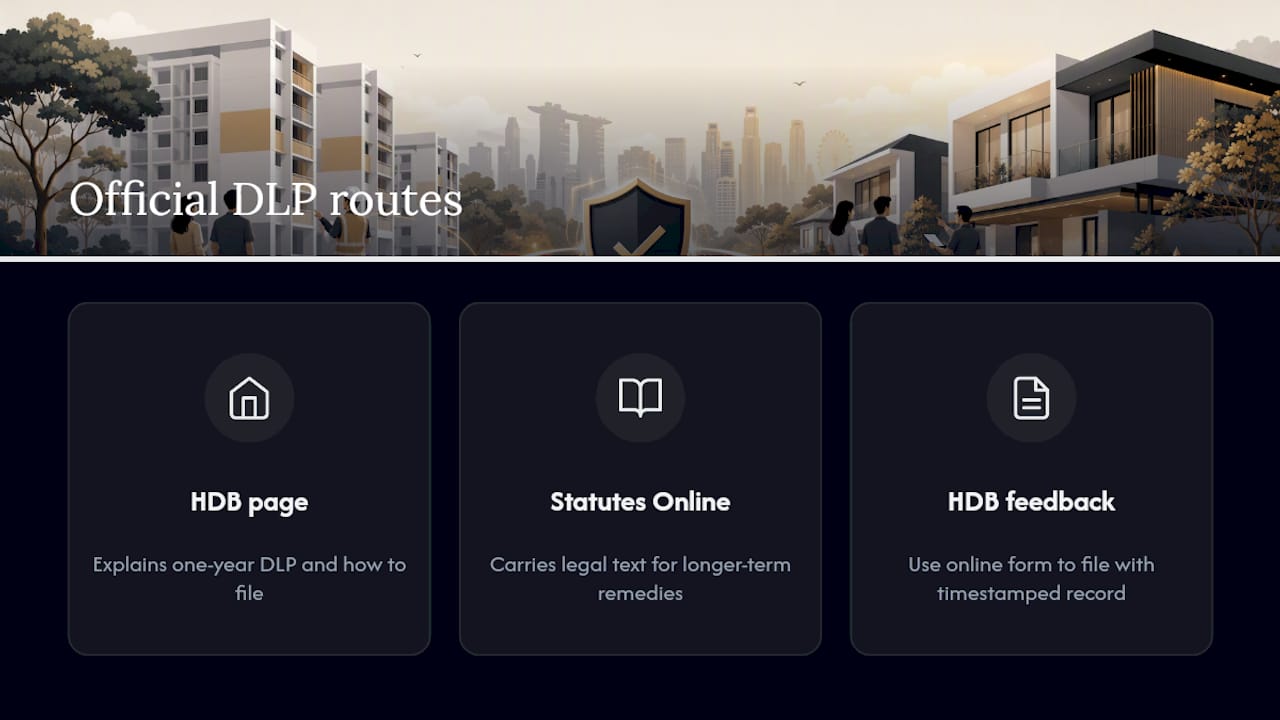
Two government sources matter most here: HDB’s rectification of defects page explains the one-year DLP and how to file a claim, while Singapore Statutes Online carries the legal text behind longer-term remedies. Use HDB’s online feedback form to file directly and get a timestamped record.
Why most homeowners underestimate their own leverage
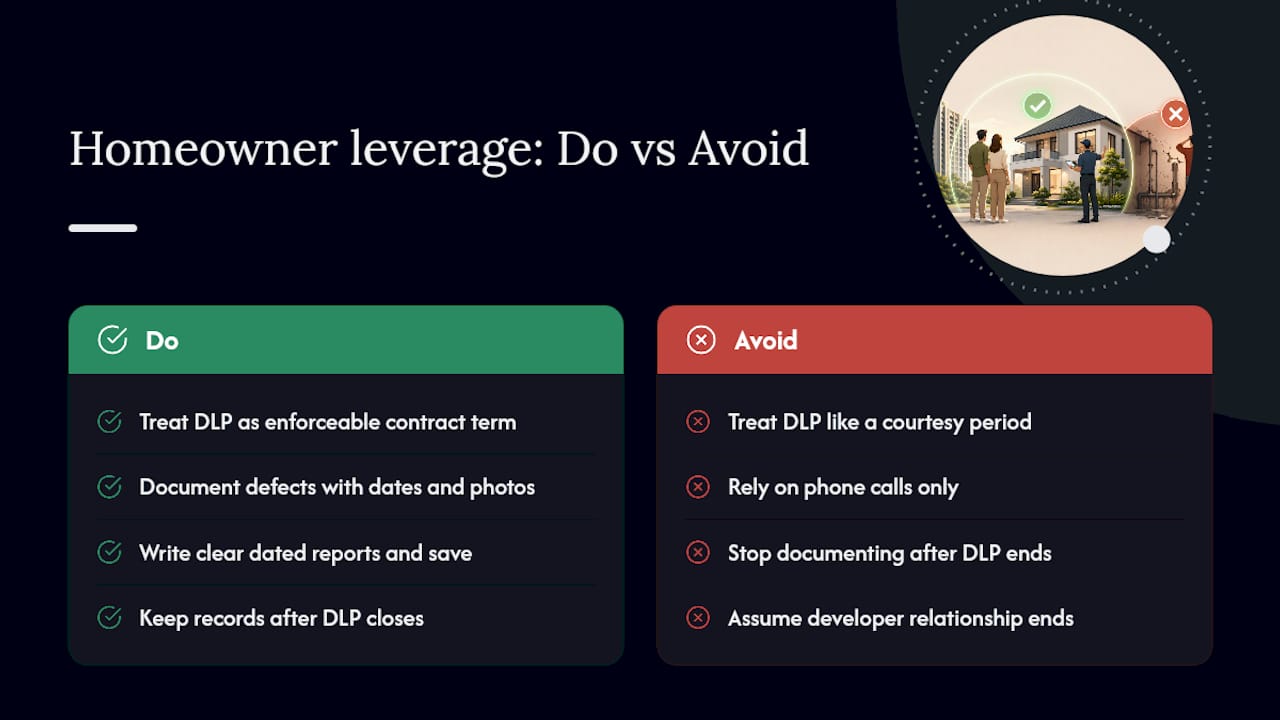
The biggest mistake I see homeowners make isn’t missing a defect. It’s treating the DLP like a courtesy period instead of an enforceable contract term. Developers have deadlines and reputations to manage too, and a well-documented report with dates, photos, and clear language moves faster through their pipeline than a phone call ever will.
The second mistake is silence after the DLP closes, as if the relationship with the developer simply ends. It doesn’t, particularly for latent defects that surface later. The habit of documenting everything during your DLP isn’t just about getting a crack fixed this year. It’s about building a paper trail that protects you five years from now, when a structural issue nobody caught at handover finally shows itself. Treat every inspection, every photo, and every email as evidence you’re building for a case you hope you’ll never need.
— Aman
Sources
- Rectification of defects in new flats – HDB
- Singapore Statutes Online — relevant housing/development legislation
- Defects liability periods — Pinsent Masons


