


Yes, foreign exchange risk can turn a profitable overseas property into a loss once you convert the proceeds home, and it deserves the same rigor you give the property itself. Before you commit funds, quantify every currency exposure across the deal’s life, decide which cash flows need a locked rate through a forward contract, and bring in a specialist FX broker for execution rather than relying on your bank’s counter rate.
TL;DR:
- Hedging transaction exposure with forward contracts or options is essential, but it does not mitigate economic risks like rising costs or demand shifts.
- Repatriation timing, transfer fees, and spreads can significantly erode returns, especially if the sale proceeds are converted during adverse currency movements.
- Hedging a short-term obligation at the right moment can cost little, but long-term economic exposure often requires careful, periodic management rather than guaranteed safety.
- Matching loan currency with rental income creates a natural hedge, reducing the need for costly financial instruments and lowering overall currency risk.
- Regularly reviewing and modeling your currency exposures before key transactions helps prevent large losses from unfavorable market moves or illiquid conditions.
Table of Contents
- What Is FX Risk in Property Investment, and Why Does It Matter?
- Transaction, Translation, and Economic Exposure: What’s the Difference?
- How Much Return Can FX Movements Actually Cost You?
- What Are the Best Tools for Hedging FX Risk in Property?
- How Do You Decide What to Hedge and How Much?
- What’s the Step-by-Step Checklist for Managing FX Risk?
- Who’s Behind This Guidance?
- An Investor’s Bottom Line on Currency Risk
- Sources
What Is FX Risk in Property Investment, and Why Does It Matter?
FX risk, sometimes called currency risk, is the chance that movements in the exchange rate between the property’s local currency and your home currency erode or wipe out your investment gains once you convert money back. The return that matters is the one that lands in your own currency, not the one printed on the local lease agreement.
This risk shows up at three distinct points in a property’s life:
- Purchase: you exchange currency at completion, and the rate on that day sets your true entry cost.
- Hold period: rental income and local operating costs get converted (or need converting) on an ongoing basis, so every remittance carries its own rate.
- Exit: sale proceeds get repatriated in one lump sum, concentrating years of currency drift into a single conversion event.
Currency regimes matter here too. A pegged currency like the Hong Kong dollar behaves very differently from a freely floating one like the British pound, and a non-convertible or tightly controlled currency can make repatriation itself a logistical problem, not just a pricing one. Research from the Investment Property Forum shows returns can vary sharply depending on which currency they’re measured in, which is exactly why FX needs to sit inside your investment model from day one, not get bolted on afterward.
Transaction, Translation, and Economic Exposure: What’s the Difference?
Currency risk in real estate isn’t one thing. Practitioners split it into three categories, and knowing which one you’re dealing with tells you whether you can actually hedge it or just have to manage around it.
- Transaction exposure covers specific, dated cash flows: your deposit, staged construction payments, the completion balance, and eventual sale proceeds. This is the most concrete form of FX risk because it attaches to a known amount and a known (or estimable) date.
- Translation exposure is an accounting concern. If you hold multiple overseas properties and report portfolio value in your home currency, currency swings change your reported net asset value even though nothing about the properties themselves has changed. This matters more to funds and family offices than to a single-property buyer, but it still affects how your net worth looks on paper.
- Economic exposure is structural and harder to see. A weaker local currency can boost tourist rental demand (great for a holiday-let investor) while simultaneously making imported construction materials and mortgage debt more expensive. It shifts the asset’s underlying economics, not just its conversion rate.
Transaction exposure is the one you can hedge directly with instruments like forwards or options. Translation exposure is largely a reporting issue you manage through valuation policy rather than trading. Economic exposure requires portfolio-level thinking, since no single trade neutralizes a demand shift.
Pro Tip: Don’t assume “hedged” means “risk-free.” A forward contract locks your transaction exposure but does nothing for the economic exposure sitting underneath the asset’s rental demand or resale value.
How Much Return Can FX Movements Actually Cost You?
Run this scenario. The property performed. The currency didn’t cooperate, and it ate almost the entire gain.
Exit is where this risk concentrates hardest. Unlike rental income, which trickles in over years and averages out currency swings, a sale converts years of appreciation into one lump conversion on one specific day. Get unlucky with timing and a genuinely good investment reads as mediocre on your home bank statement.
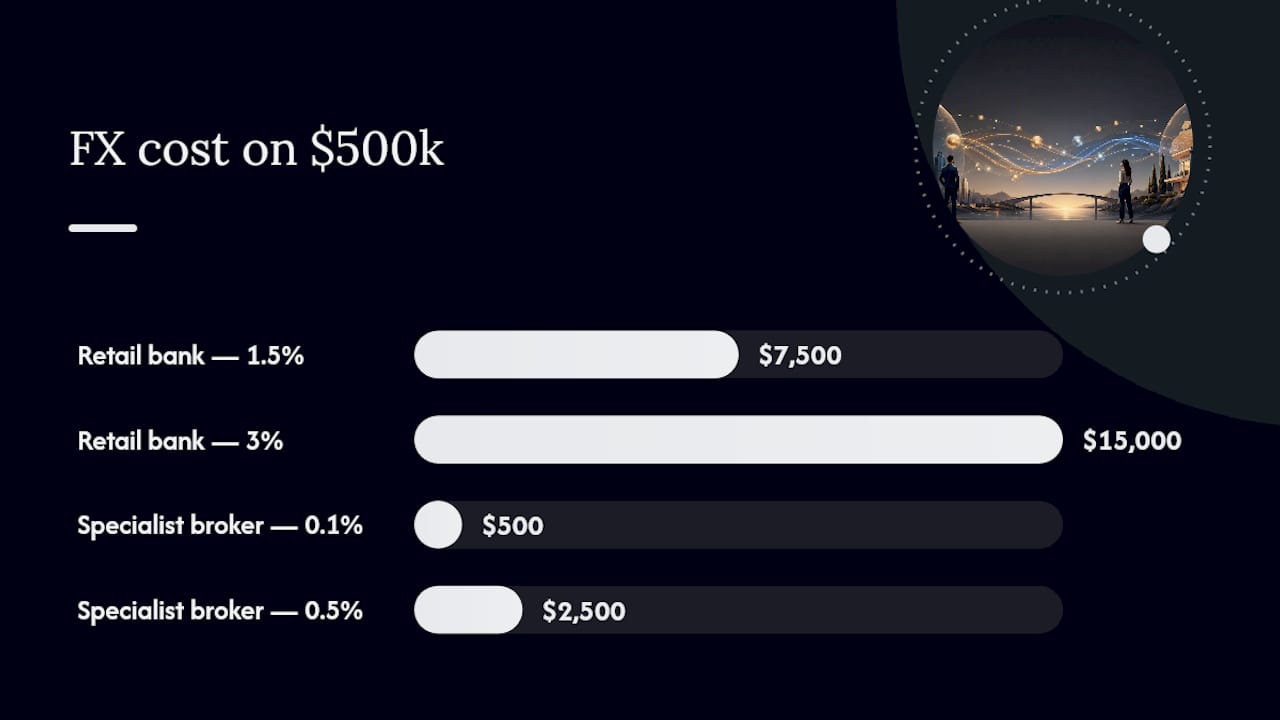
Then there’s friction on top of the pure rate risk. Retail banks routinely charge FX spreads of 1.5% to 3% on international transfers, while specialist FX brokers often quote spreads closer to 0.1% to 0.5% on comparable transaction sizes. On a $500,000 repatriation, that gap alone can mean several thousand dollars staying in your pocket instead of a bank’s margin. Tax treatment adds another layer: some jurisdictions tax capital gains on the local sale price, others recalculate gains in your home currency, and the timing of repatriation can shift which tax year a gain falls into. Model this before you sign a sale contract, not after.
What Are the Best Tools for Hedging FX Risk in Property?
Once you know which exposures you’re carrying, you have a real toolkit to manage them. None of these are exotic; they’re standard instruments adapted to a property investor’s timeline.
- Forward contracts let you lock today’s exchange rate for a transaction that settles on a future date, typically requiring a deposit and running for a fixed tenor. These are the workhorse tool for a known completion date. If you know you owe €400,000 in 90 days, a forward removes the guesswork entirely.
- Options give you the right, but not the obligation, to convert at a set rate. They cost more upfront (a premium) but protect your downside while still letting you benefit if the currency moves in your favor. Worth it when you have genuine uncertainty about whether the deal will close.
- Swaps exchange cash flows in two currencies over time. Institutions use them for large, ongoing financing structures, but individual investors rarely touch them. The minimum size and complexity make them impractical outside a fund or corporate treasury context.
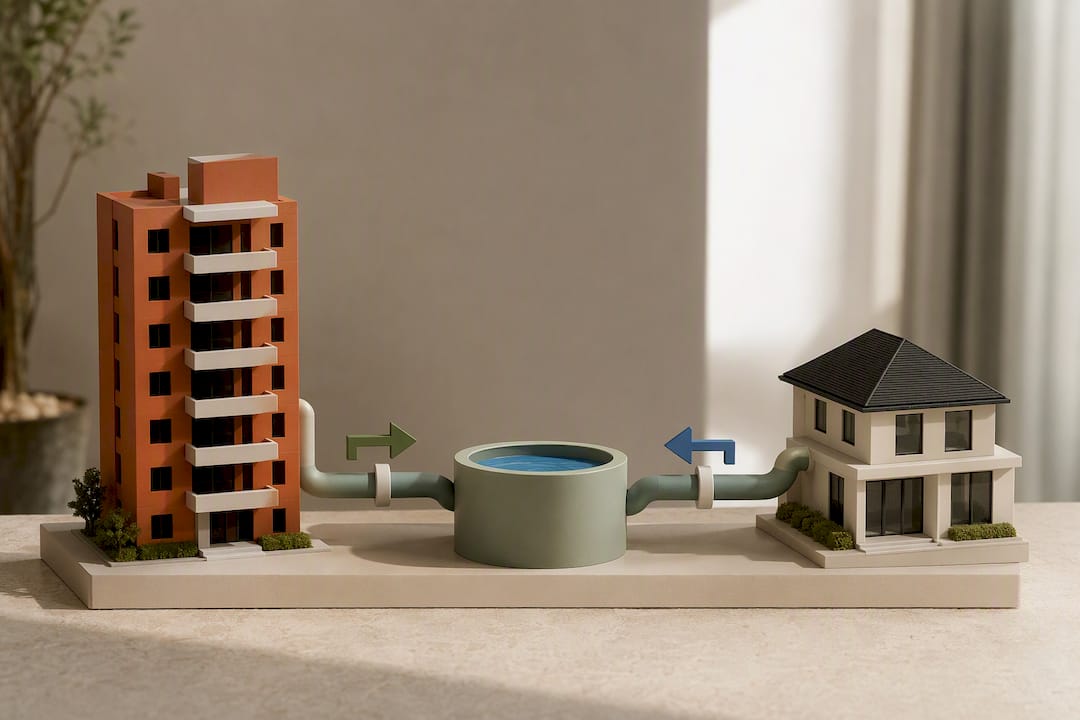
- Local-currency financing is the most underused tool available to direct investors. Borrowing your mortgage in the same currency as your rental income creates a natural hedge, since the loan and the income move together. The World Bank’s treasury guidance on this exact mechanism shows why matching asset and liability currency reduces the need for repeated conversions altogether.
- Multi-currency accounts, recurring transfer schedules, and tranching are the operational backbone. Holding a euro-denominated account lets you receive rent without converting immediately; scheduling recurring transfers smooths out timing luck; tranching a large conversion into three or four chunks avoids betting everything on one day’s rate.
On provider choice: banks are convenient but expensive, RICS guidance on protecting real estate from currency volatility points to the same conclusion practitioners have reached for years, which is that hedging decisions should weigh cost and liquidity against the specific cash flow being protected, not be applied blanket-style to everything.
Pro Tip: If you’re financing locally anyway, ask your lender directly whether the loan can be structured to match your rental currency. It often costs nothing extra and quietly does the hedging work for you.
How Do You Decide What to Hedge and How Much?
Not every dollar of exposure deserves the same treatment. A workable framework has four steps.
- Map every exposure by amount and date. List your deposit, staged payments, loan installments, expected annual rental repatriation, and projected exit proceeds, each with a rough timing window.
- Set your objective. Are you trying to eliminate volatility entirely (appropriate for a tightly leveraged deal where a bad FX move could trigger a margin problem) or just smooth it out over a long hold?
- Apply a hedge ratio. The Investment Property Forum’s research supports a practical rule: hedge near-certain, short-term obligations like a completion payment at or close to 100% if the cost is reasonable, and treat long-term economic exposure more selectively, often somewhere between 0% and 50%, reviewed periodically rather than fixed forever.
- Price in the real costs. Forward pricing reflects the interest rate differential between the two currencies, so it isn’t free even when no fee is charged. Add broker spreads, option premiums if you go that route, and the risk of rollover costs if a forward needs extending because completion slips.
Match the instrument’s tenor to the actual cash-flow date. MSCI’s research on currency hedging in real estate benchmarks flags mismatched tenors, hedging a five-year hold with a three-month forward, as an avoidable source of both cost and ineffectiveness. And in some emerging markets, this entire framework runs into a wall: thin liquidity and capital controls can make forwards expensive or simply unavailable, forcing you toward natural hedges like local financing instead. If you’re evaluating opportunities in less liquid markets, our guide on investing in emerging markets covers those constraints in more depth.
What’s the Step-by-Step Checklist for Managing FX Risk?
Treat this as a running process, not a one-time task.
- Before you sign anything, model your returns at the current spot rate, then again at 10% and 20% adverse moves. If a 20% adverse move turns the deal unprofitable, reconsider the entry price or the leverage.
- At reservation or contract stage, decide whether to secure a forward for the completion balance. If the amount is large, tranche the conversion into stages rather than converting it all on one date.
- During the hold period, set a recurring transfer schedule for rental income and keep a local-currency reserve to cover maintenance, taxes, and management fees without forced conversions at bad rates.
- Ahead of exit, get quotes from at least two or three providers, model net proceeds after spreads and any applicable tax, and lock the rate once the sale is contractually binding, not before.
- Once a year, review whether your hedges are still doing their job and whether your exposure map has changed.
Pro Tip: Keep a simple spreadsheet logging every conversion rate you actually received against the spot rate that day. Over a few years, it tells you exactly how much bank spreads are costing you, and whether it’s time to switch providers.
Who’s Behind This Guidance?
This article draws on practical, portfolio-first thinking developed by Aman Aboobucker, a Singapore-based real estate consultant operating Aesthetic Havens under ERA Realtors. Aman works with investors expanding into residential, commercial, and international property, with a focus on wealth progression strategies that account for real-world friction, currency movement very much included, rather than textbook assumptions.
Client case studies and specific certification details will be added here as they’re finalized. If you’re weighing an overseas purchase and want a second set of eyes on the currency math before you sign anything, reach out through Aesthetic Havens to talk through the specifics of your deal.
An Investor’s Bottom Line on Currency Risk
If you take one thing from this, it’s this: quantify your exposures, match your liability currency to your asset currency wherever you can, and fix the rate on anything you’re contractually committed to pay or receive. The mistakes I see most often are investors ignoring repatriation timing until the sale is already done, accepting whatever rate their home bank offers on a six-figure transfer because switching providers feels like a hassle, and over-hedging a ten-year hold with instruments built for ninety-day certainty. When the exposure is large or the market is illiquid, get a specialist FX broker and a property consultant involved before you sign, not after.
— Aman
Sources
- Managing Currency Risk in International Real Estate Investment (IPF)
- Protecting real estate from currency volatility (RICS)
- Currency risk & hedging in real estate benchmarks (MSCI)
- How to hedge currency risk (IG SG)
- Local-currency financing (World Bank Treasury)


