

Introduction
Food Ascent @ Tuas South delivers one of Singapore’s most compelling sub-$2M industrial property opportunities for investors targeting the food manufacturing sector in 2026. Located at 45 Tuas South Avenue 1, this purpose-built B2 food factory development by SoilBuild offers 125 units ranging from 198 sqm to 1,654 sqm – with smaller and mid-sized units falling squarely within the under-$2-million investment threshold that scalable portfolio builders are targeting this year.
This article covers the investment fundamentals of Food Ascent, breaks down which unit sizes qualify under the $2M budget, examines financing strategies, rental yield projections, and scalable acquisition approaches for 2026. The target audience includes mid-size investors evaluating industrial property in Singapore’s Tuas district, F&B operators seeking dedicated food factory space, and portfolio builders looking for entry-level strata industrial assets with growth potential.
The direct answer: Units between approximately 198–250 sqm (roughly 2,100–2,700 sqft) at Food Ascent are transacting between S$1.07 million and S$2.06 million, with recent transactions for smaller units recorded around S$1.07 million to S$2.06 million. At prevailing rates of S$580–S$800 psf, investors can secure purpose-built food production facilities well within the sub-$2M range.
After reading this article, you will understand:
-
Which Food Ascent unit types and sizes fit under the $2M investment ceiling
-
How 2026 market positioning and Singapore’s food security policies affect demand
-
Realistic rental yield projections and revenue generation models
-
Phased investment strategies for scaling an industrial food factory portfolio
-
Key risks, financing structures, and actionable next steps
Understanding Industrial Investment at Food Ascent
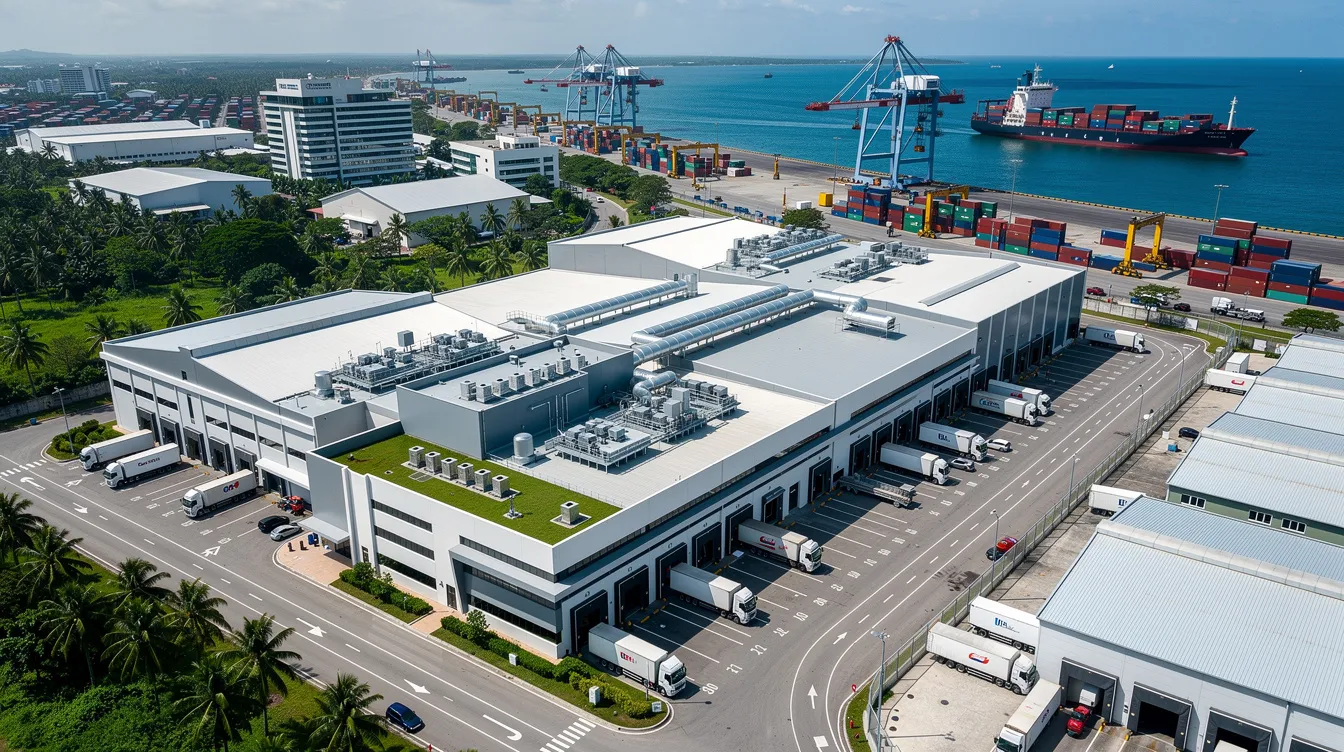
Food Ascent is a B2-graded ramp-up food factory development situated at 45 Tuas South Avenue 1 (Singapore 639427). The project spans approximately 12,425 sqm of site area with a gross floor area of about 31,063 sqm. It features a modern 8-storey ramp-up design for easy access, and completion of Food Ascent is expected between late 2026 and early 2027 depending on construction progress. The facility is designed specifically for food operators and logistics, distinguishing it from conventional industrial warehousing.
The property has a 60-year leasehold tenure, commencing 4 January 1999. By 2026, approximately 33 years remain on the lease – a critical data point that affects depreciation curves, bank loan eligibility, and long-term resale positioning. Investors need to factor in that leasehold industrial properties with declining tenure tend to moderate in capital appreciation over time, though strong sector demand can counterbalance this effect.
Investment Fundamentals
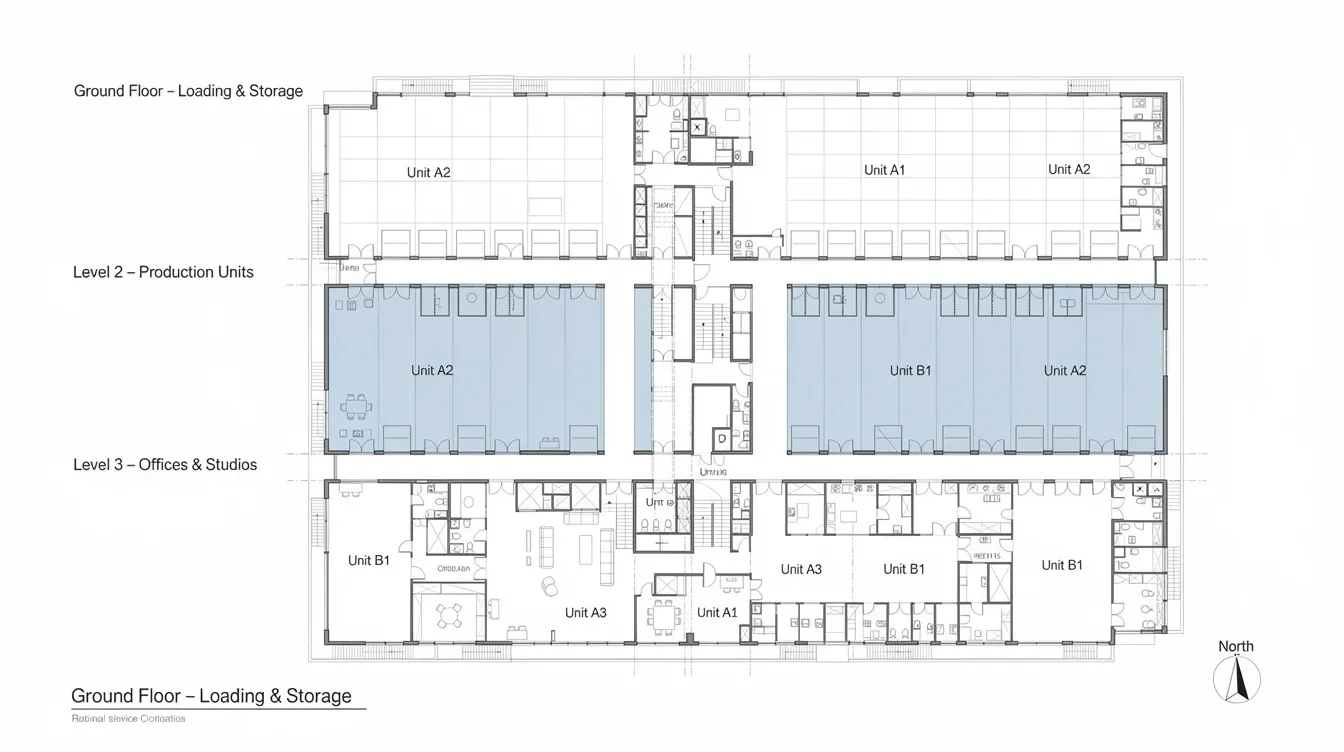
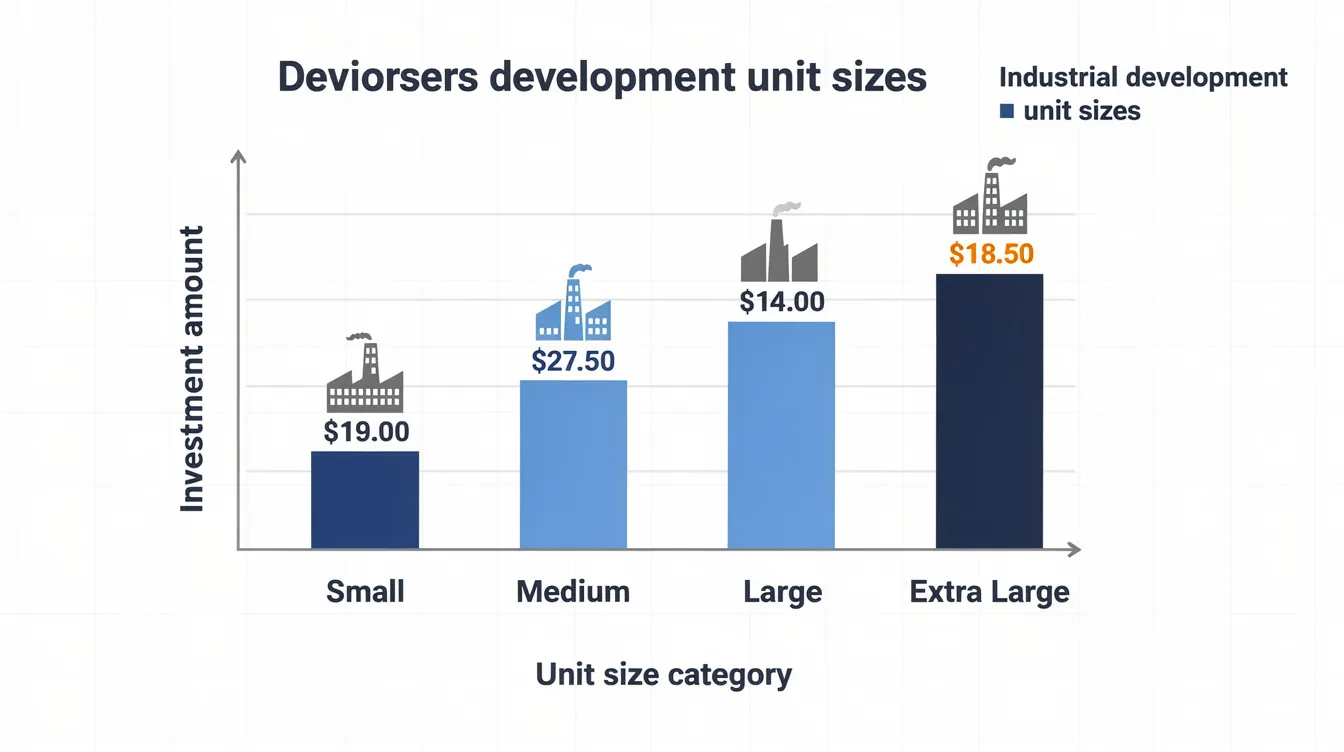
Scalable industrial investment in the Singapore context means the ability to acquire strata units incrementally, build a multi-unit portfolio, and achieve economies of scale within a specific sector. Food Ascent offers 125 units ranging from 198 sqm to 1,654 sqm, and modular unit configurations allow scalable operations for food businesses. This range creates a clear investment ladder: Type D units (~198–225 sqm) serve as entry-level acquisitions, Type B and C units (~235–256 sqm) represent mid-tier holdings, and Type A units (~1,228–1,654 sqm) are large-format spaces suited to established operators.
The investment model targets scalable industrial investments under $2 million, making smaller Type B, C, and D units the primary focus. Food Ascent aims to attract smaller business operators looking for ready-to-use industrial real estate – and this same dynamic benefits investors who can secure units at lower capital outlay and rent them to these operators.
Market Positioning in Tuas South Avenue 1 in 2026
Food Ascent enters the market at a time when Singapore’s food security initiatives are actively driving demand for domestic food production capacity. Government policies encouraging local food manufacturing – reinforced by the country’s strategic need to reduce reliance on imports from Malaysia and other countries – create a structural tailwind for purpose-built food factory developments.
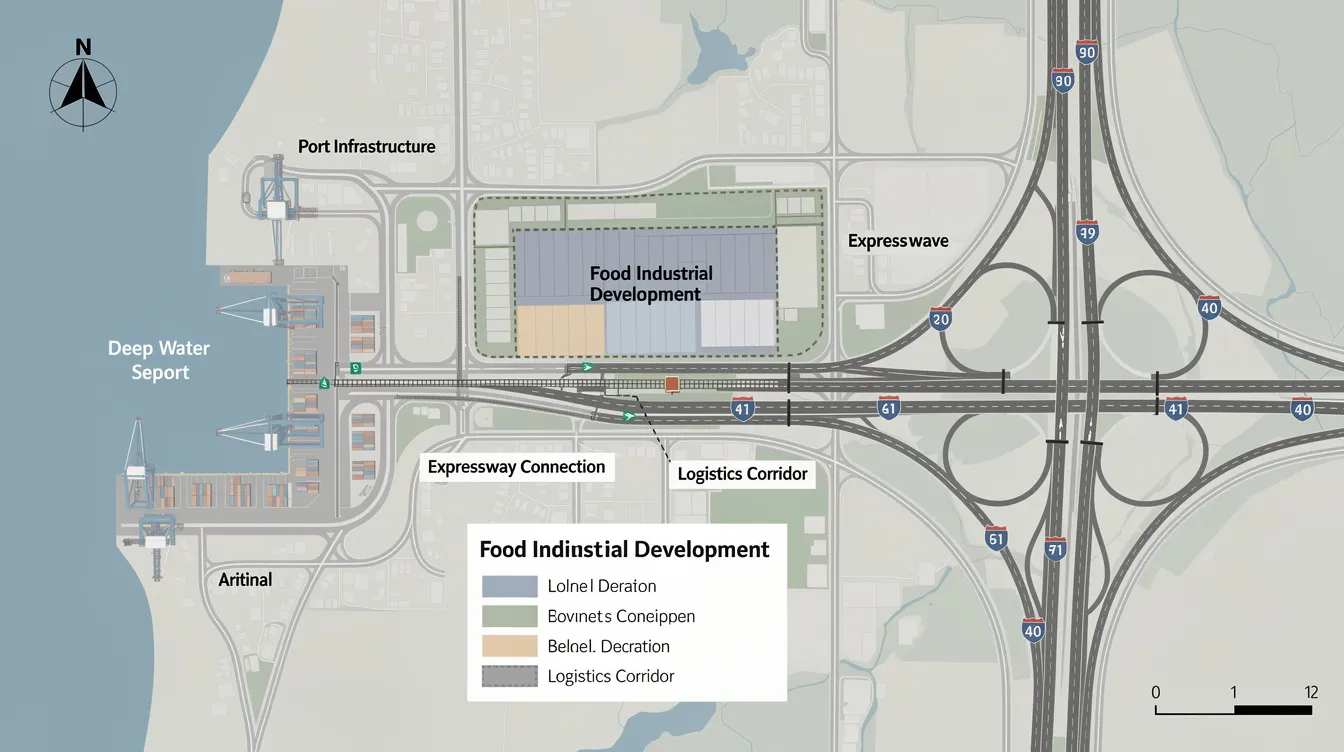
Food Ascent is strategically positioned between Tuas Mega Port and Tuas Second Link, a boon for businesses that depend on efficient logistics and distribution. The site is close to the future Tuas Mega Port, and it is a 4-minute drive from Tuas West Road MRT station and 5 minutes from the Tuas Second Link. This close proximity to major expressways including the AYE and PIE, combined with arterial road connections, makes Food Ascent ideal for businesses requiring efficient cross-border logistics. Proximity to the Tuas Port also supports operators connected to nearby factories in the wider Tuas industrial ecosystem, especially those managing raw material imports and finished-product distribution.
Tuas South has limited available industrial land which increases competition for such facilities – a supply constraint that supports both pricing and occupancy rates for new developments like Food Ascent.
With the foundational project characteristics established, the next step is examining exactly which units and pricing structures fall within the sub-$2M investment window.
Investment Opportunities Under $2M
The viability of Food Ascent as a sub-$2M investment hinges on matching specific unit categories to current market pricing. Recent sale data from SRX and other transaction platforms confirms that multiple unit types within the development meet this threshold comfortably.
Food Factory Unit Size Categories for Sub-$2M Investment
For investors working within a $2M budget, the viable unit categories are:
-
Type D units (~198–225 sqm / ~2,130–2,420 sqft): These represent the most accessible entry point. At prevailing rates of S$580–S$700 psf, Type D units price between approximately S$1.24M and S$1.69M – well within budget. Some units have been listed at ~S$1.1–1.3 million for approximately 2,100–2,200 sqft, offering substantial headroom.
-
Type B and C units (~235–256 sqm / ~2,530–2,750 sqft): Mid-range units transacting at S$600–S$750 psf fall between roughly S$1.52M and S$2.06M. Units at the lower end of this psf range remain under the $2M ceiling. In January 2026, a unit of approximately 2,669 sqft sold for ~S$1.81 million (~S$680 psf), and another ~2,154 sqft unit sold for approximately S$1.54–1.55 million (~S$716 psf).
-
Near-threshold acquisitions: A 2,573 sqft (~239 sqm) ramp-up unit with mezzanine sold at S$1,988,888 (~S$773 psf) in mid-2026, demonstrating that even larger units with premium features can fit just under the $2M mark.
The typical price per sqft for sale units at Food Ascent ranges between approximately S$580 to S$890 psf, depending on size, floor level, orientation, and demand conditions. Based on this data, units under 250 sqm are the most realistically purchasable under S$2M.
Financing Strategies
Industrial property financing for B2 food factory units follows specific parameters:
-
Loan-to-Value (LTV) ratios: Banks typically offer 65–75% LTV for industrial strata units, depending on the borrower’s profile and the property’s remaining lease tenure. With ~33 years remaining, Food Ascent sits at a threshold where some banks may apply more conservative ratios.
-
Down payment requirements: Expect 25–35% down payment. For a S$1.5M unit, this means S$375,000–S$525,000 in cash or CPF (if eligible).
-
Cash-on-cash considerations: Beyond the purchase price, investors must budget for service charges, maintenance fees, property tax, and potential fit-out costs. Food-grade fit-outs – including equipment for cold storage, ventilation, and compliance with NEA and Singapore Food Agency standards – can add significant capex. Compliance with Singapore Food Agency standards is essential for food processing operations in these units.
Pre-approval from lenders specializing in industrial property is strongly recommended before committing to a specific unit, as pricing and GST-inclusive costs can vary between listings.
Revenue Generation Models
Rental yield projections for Food Ascent units reveal attractive gross returns for the sub-$2M segment:
-
Street median rent for industrial space on Tuas South Avenue is approximately S$1.32 psf/month, though Food Ascent’s purpose-built food factory design commands a premium.
-
Asking rents for specific Food Ascent units of ~2,200–2,300 sqft range from approximately S$5,500 to S$9,000 per month, corresponding to ~S$2.40–3.65 psf – significantly above the street median.
-
Yield calculation example: A 2,500 sqft unit purchased at S$1.5M and rented at S$2.50 psf generates approximately S$6,250/month or S$75,000/year gross – a 5.0% gross yield. After factoring property tax, vacancy periods, and maintenance, net yields typically settle between 3.5–4.5%.
-
Owner-occupier scenario: Businesses operating central kitchens or food processing facilities benefit from operational control, purpose-built infrastructure (the facility has high floor loading capacities of 15.0 kN/m²), and potentially favourable tax treatment. The trade-off is illiquidity and concentration risk.
Key investment viability points: Gross yields of 4–6% are achievable on sub-$2M units; net yields of 3.5–4.5% align with Singapore industrial market norms; tenants in the food sector tend toward longer lease commitments given fit-out investment requirements.
The next section explores how to structure these individual unit acquisitions into a scalable portfolio strategy.
Scalable Investment Strategies for 2026
Building a scalable industrial portfolio at Food Ascent requires a structured approach that balances capital deployment, tenant diversification, and exit timing. The development’s 125-unit inventory and modular design create natural pathways for phased growth.
Phased Investment Approach
A disciplined, staged acquisition strategy maximizes capital efficiency while managing risk:
-
Initial single unit purchase (198–250 sqm range): Acquire one Type D or smaller Type B/C unit at S$1.2–1.7M. This establishes a foothold with manageable capex, allows the investor to learn the operational dynamics of food factory tenanting, and generates rental cashflow from day one. The development provides 40-foot container accessibility at ground level and two-way ramp-up access for heavy vehicles – features that support tenant operations immediately.
-
Portfolio expansion with adjacent or similar-sized units: After stabilizing the first unit (typically 12–18 months), acquire a second unit – ideally adjacent or on the same floor. Consolidating units reduces per-unit management overhead and increases appeal to larger tenants who need more food factory space for expanded operations.
-
Operational scaling through tenant diversification: With two or more units, diversify across different tenant types – food production operators, central kitchens, packaging businesses, cold storage operators. This reduces single-tenant vacancy risk and builds a more resilient income stream across different sub-sectors of the food sector.
-
Exit strategy options for capital appreciation: Monitor lease decay versus market demand. Optimal exit windows typically occur when infrastructure projects (such as Tuas Mega Port completion) catalyze area-wide price appreciation. Food Ascent facilitates efficient last-mile distribution through arterial road connections, a feature that will become increasingly valuable as the broader Tuas logistics ecosystem matures.
Investment Comparison Analysis
|
Criterion |
Food Ascent (198–500 sqm units) |
Alternative Tuas Industrial Developments |
Existing Tuas Secondary Market |
|---|---|---|---|
|
Unit Size Range |
198–500 sqm (strata) |
Varies; typically 200–1,000 sqm |
Mixed; often larger formats |
|
Investment Range |
S$1.07M–S$2.06M |
S$800K–S$2.5M |
Median ~S$1.44M per unit |
|
Indicative PSF |
S$580–S$890 psf |
S$400–S$700 psf |
~S$265 psf (5-year median) |
|
Gross Rental Yield |
4–6% |
3–5% |
3–4% |
|
Completion/Availability |
2026–2027 |
Varies |
Immediate |
|
Purpose-Built for Food |
Yes – SFA-ready design |
Partially; requires retrofit |
Rarely |
The data shows that Food Ascent commands a premium over the broader Tuas industrial market on a psf basis – the median Tuas sale price of ~S$265 psf is significantly lower. However, the purpose-built food factory design, SFA-ready infrastructure, and strategically located position justify this premium through higher rental rates and lower tenant fit-out requirements. The facility’s design supports food manufacturing rather than conventional warehousing, giving it a structural advantage for this specific sector.
For investors prioritizing yield and sector-specific demand over absolute psf value, Food Ascent represents a stronger value proposition than generic industrial alternatives in the district.
Common Investment Challenges and Solutions
Industrial property investment in Singapore’s food manufacturing sector carries specific risks that investors must address proactively.
Financing Gap for Industrial Properties
B2 industrial units with ~33 years of remaining lease can face tighter lending criteria. Banks may cap LTV at 65% rather than 75%, requiring larger cash outlay. The solution lies in approaching specialized industrial property lenders, presenting comprehensive cashflow projections that include confirmed or pipeline tenants, and demonstrating sector knowledge. Bundling financing for multiple units can sometimes unlock better terms.
Tenant Acquisition in New Developments
New developments like Food Ascent face the cold-start problem – no existing tenant ecosystem to attract new operators. Pre-leasing strategies are critical. Investors should leverage the developer’s network and engage commercial brokers specializing in food factory and central kitchen operators. Target tenants include food production companies, catering operators, meal-prep businesses, and cold chain logistics firms. The evolution of Singapore’s food delivery and cloud kitchen sector continues to generate demand for such spaces.
Timing Market Entry in 2026
With completion of Food Ascent expected in 2026–2027, investors face timing decisions around booking versus waiting for TOP. Early booking typically secures better unit selection and pricing. However, units purchased closer to or after completion allow physical inspection and more accurate fit-out costing. Strategic booking based on current market pricing – with the understanding that Tuas South has limited available industrial land which increases competition – generally favours earlier commitment for premium units.
Monitor key macro indicators: JTC industrial rent index movements, SFA licensing pipeline data, and Tuas Mega Port construction milestones. These signals will inform whether the broader Tuas area is appreciating or plateauing.
Conclusion and Next Steps
Food Ascent @ Tuas South represents a viable and structured pathway for scalable industrial investing under $2M in 2026. With units from approximately S$1.07M to just under S$2M, purpose-built food factory infrastructure, and a strategically located site between Singapore’s major port and cross-border logistics corridors, the development offers a defensible entry point into the island’s food manufacturing real estate sector.
Immediate next steps:
-
Check current unit availability – Review active listings on platforms like CommercialGuru and SRX for up-to-date pricing and unit selection
-
Secure financing pre-approval – Approach 2–3 banks with industrial lending capabilities; prepare cashflow models based on S$5,500–S$9,000/month rental scenarios
-
Schedule a site visit – Physical inspection of completed or near-completed units will clarify fit-out requirements, ceiling heights, power configurations, and ramp-up access logistics
-
Engage specialized advisory – Work with industrial property consultants who understand SFA compliance, food factory tenanting, and Tuas South market dynamics
Related topics worth exploring include broader Tuas industrial portfolio diversification as the Tuas Mega Port development progresses, Singapore’s “30 by 30” food security policy implications for factory demand, and comparative analysis of food factory investments across the breeze of new developments entering the market in the Tuas district through 2027.
Additional Resources
-
Personalized investment analysis: Contact AESTHETIC HAVENS for a consultation tailored to your budget, risk profile, and Food Ascent unit preferences
-
Unit availability and pricing updates: The Food Ascent project page provides current floor plans, unit configurations, and development specifications
-
Financing planning: Build your own cash-on-cash return models using the pricing data points outlined above – purchase costs of S$1.07–2.06M, rental yields of S$5,500–9,000/month, and down payment requirements of 25–35%
-
Regulatory compliance: Review SFA and NEA licensing requirements before committing to a food factory acquisition – compliance costs should be factored into your total investment budget

