

Introduction
Skye@Tuas is a purpose-built industrial development positioned directly within the growth corridor of Singapore’s S$20 billion Tuas Mega Port – one of Singapore’s most significant infrastructure investments this century. As the mega port consolidates all of the nation’s container operations by the 2040s, industrial development properties in the Tuas corridor stand to benefit from decades of escalating logistics demand, tenant competition for modern industrial space, and sustained capital appreciation driven by infrastructure-led growth.
This article examines the investment case for Skye Tuas within the context of the upcoming Tuas Mega Port expansion. It covers port development timelines, specific growth drivers for industrial property in western Singapore, the technical and locational advantages of the Skye@Tuas development, and actionable strategies for investors and owner occupiers targeting long-term industrial capital growth. The target audience includes industrial property investors, logistics operators evaluating facilities, and businesses seeking port-adjacent operations in Singapore’s western corridor.
The direct answer: Skye@Tuas offers immediate proximity to the Tuas Mega Port’s phased completion – with 247 industrial units and 62 commercial units purpose-built for heavy duty logistics, manufacturing, and port-adjacent operations – positioning investors for sustained capital growth as the port scales to 65 million TEUs annually by the 2040s.
Key outcomes from this article:
-
Understanding the Tuas Mega Port expansion timeline and its direct impact on industrial demand
-
Identifying why Skye@Tuas specifications exceed most existing industrial stock in the region
-
Evaluating growth potential across short-, medium-, and long-term investment horizons
-
Accessing actionable investment strategies aligned with port development phases
Understanding the Tuas Mega Port Logistics Expansion
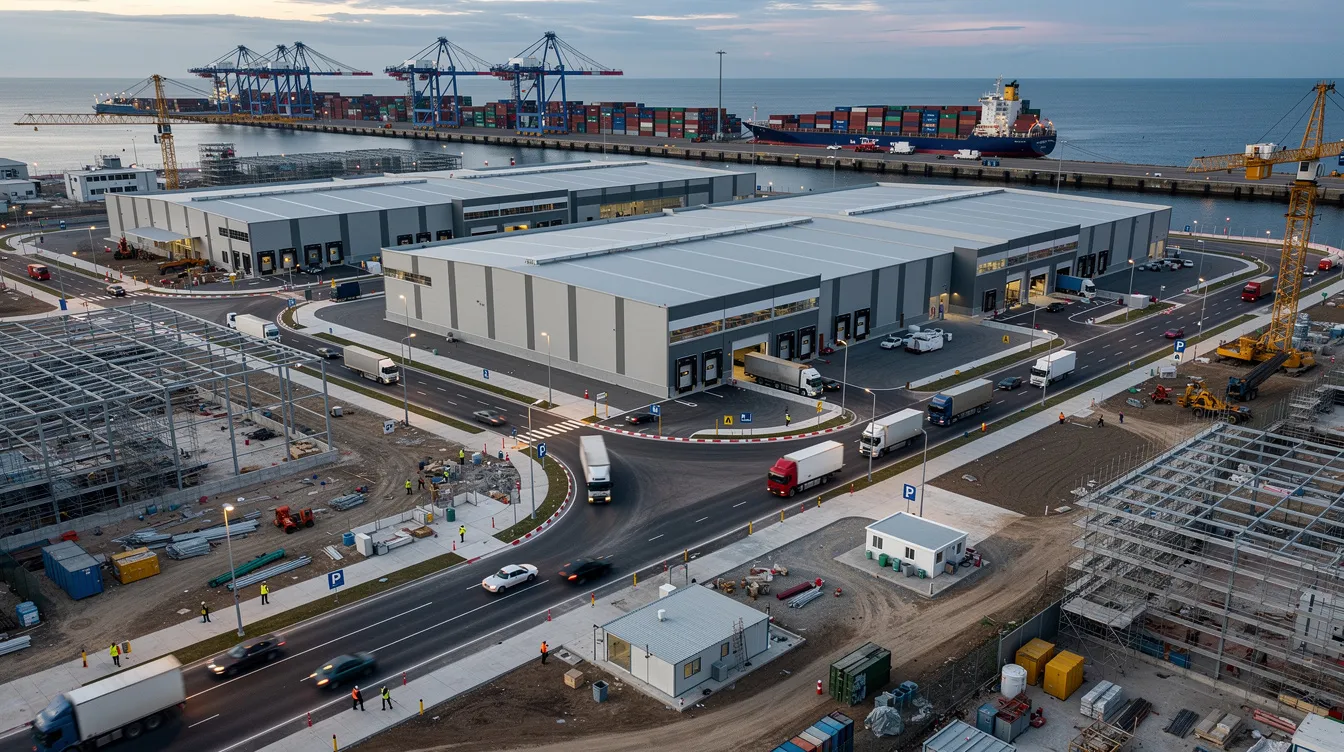
The Tuas Mega Port is the world’s largest fully automated container terminal system under development. Managed by the Maritime and Port Authority of Singapore (MPA), it will consolidate operations currently spread across Tanjong Pagar, Keppel, Brani, and Pasir Panjang into a single mega port spanning approximately 1,337 hectares – equivalent to roughly 3,300 football fields – with 29 kilometres of wharf structures. The Tuas Mega Port is a major economic catalyst for Singapore’s industrial corridor, and the Tuas zone is transitioning into a primary economic gateway due to deliberate government planning.
For industrial property investors, the port authority’s expansion creates a structural demand shift. As handling capacity scales from current levels to 65 million TEUs annually, every phase generates downstream requirements: warehousing, freight forwarding, container handling, 3PL operations, marine-offshore support, and advanced manufacturing. This demand anchors directly to industrial facilities within close proximity to port terminals – making developments like Skye@Tuas central to the logistics infrastructure buildout.
Phase 1 Completion Impact (2021–2027)
Phase 1 of the Tuas Mega Port occupies approximately 414 hectares, with 70% built on reclaimed land. Since operations commenced in September 2022, the port has already handled roughly 25 million TEUs across 14 operational berths. Full operationalisation of Phase 1 – with 21 deep-water berths targeting approximately 20 million TEUs per annum – is expected by 2027.
This ramp-up is already driving measurable demand for nearby industrial facilities. According to JLL research, logistics and warehouse stock in western Singapore surged from approximately 47.0 million sq ft in 4Q12 to roughly 81.8 million sq ft by 2Q23 – a 74% increase over a decade. Demand for logistics and warehousing in the Tuas area consistently outpaces supply, with projected new warehouse supply in the Western Planning Region averaging only about 2.1 million sq ft per year (2023–2026), while historical net absorption averaged approximately 2.9 million sq ft per year (2013–2022). For B2 industrial developments completing in this window, immediate rental yield opportunities and high occupancy rates are directly tied to Phase 1 port activity.
Full Port Integration by 2040
Phases 2 and 3 will progressively expand automation, container throughput, and terminal capacity. Reclamation for Phase 2 began in March 2018 with caisson works and seawalls underway. By the 2040s, all city-area terminals – Tanjong Pagar, Keppel, and Brani – will be fully relocated to Tuas, completing the consolidation. The Tuas Mega Port aims for an eventual capacity of 65 million TEUs annually, nearly doubling Singapore’s current throughput.
This long term trajectory means industrial land scarcity in the Tuas corridor will intensify over two decades. As automation, AI-driven logistics, and sustainability mandates reshape the supply chain landscape, only modern, high-specification facilities will capture premium rents and capital appreciation. Limited supply of newer ramp-up B2 projects boosts investment potential for developments that are already built to meet these demands. The infrastructure convergence at Tuas – port, expressways, MRT, cross-border links – creates an unprecedented logistics hub with long term relevance for industrial investors.
Skye@Tuas Strategic Positioning for Port-Adjacent Growth
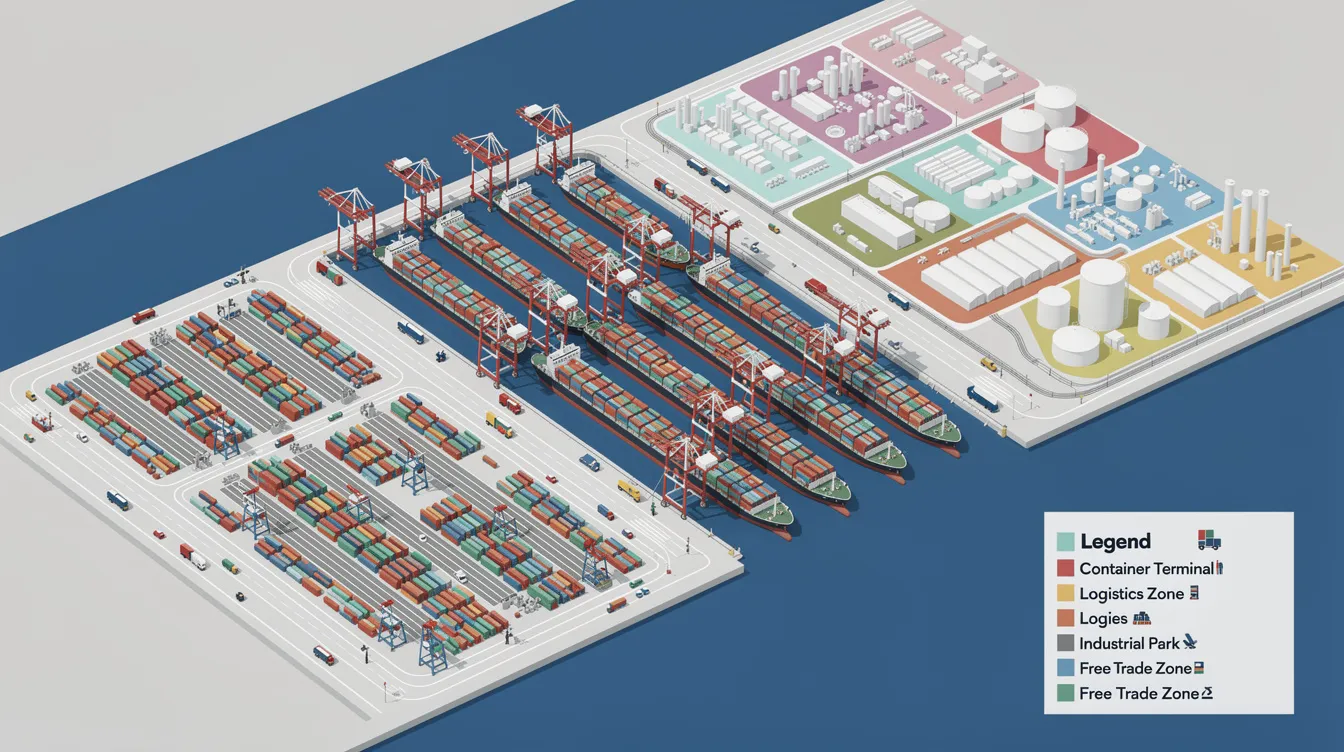
The Tuas Mega Port’s expansion is expected to drive demand for industrial space – but not all industrial space is created equal. Skye@Tuas at Tuas Link Close is engineered specifically for the operational, logistical, and technical demands of a port-adjacent diverse business ecosystem. The development caters to logistics operators, manufacturers, marine-offshore firms, e-commerce fulfilment centres, and precision engineering businesses that require convenient access to port terminals, heavy vehicle infrastructure, and modern building specifications.
Direct Logistics Connectivity
The development is minutes from Tuas Mega Port terminals. Geographic proximity to the Tuas Mega Port reduces inland transport overhead, and proximity to high-volume shipping lanes translates to faster logistics turnaround times. Skye @ Tuas is next to Tuas Link MRT station, with Skye @ Tuas featuring a direct link-bridge to the MRT – a feature that substantially reduces logistics operational costs while improving workforce accessibility for businesses operating across shifts.
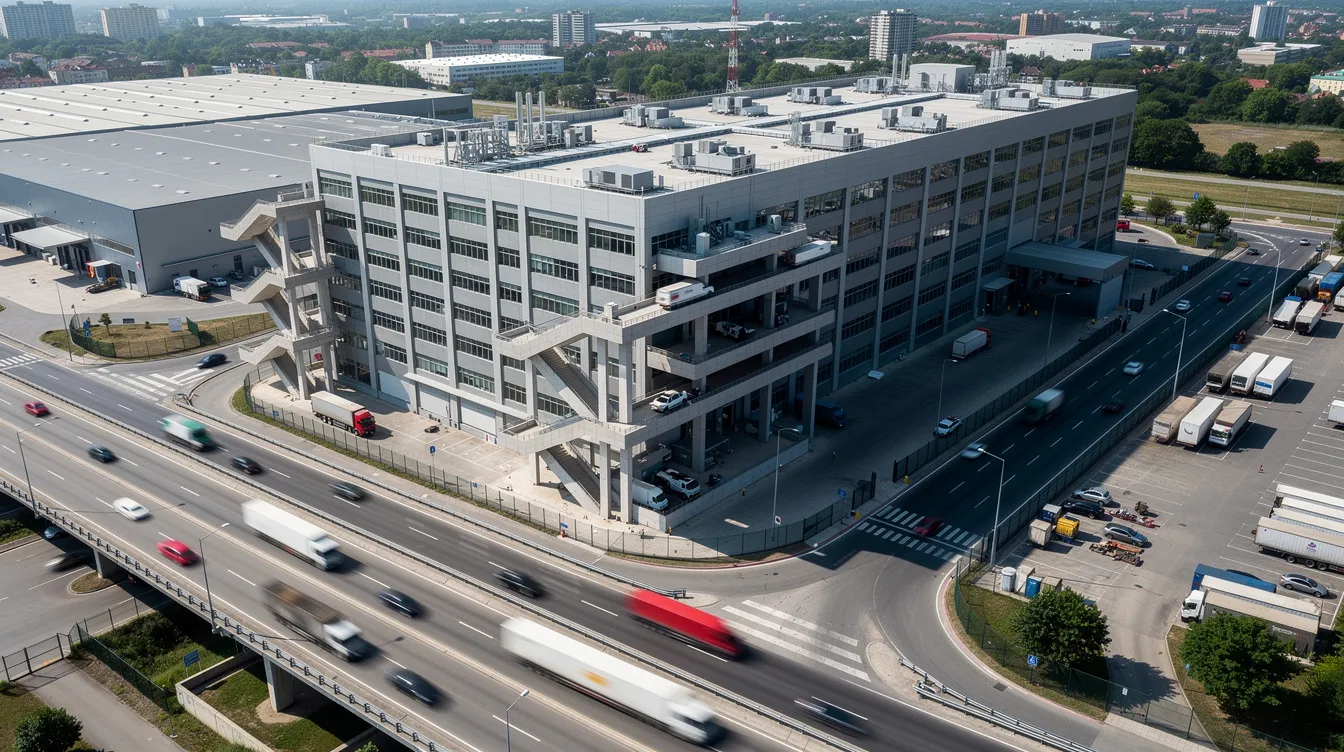
Skye@Tuas has a ramp-up design for easy vehicle access. Next-generation ramp-up facilities allow direct container access to every industrial floor, with a continuous vehicular ramp enabling heavy vehicle movement to all nine stories. Two of three levels of parking decks are designated exclusively for heavy vehicle use, supporting the heavy duty logistics operations that port-adjacent tenants require. The clustering of companies near the Tuas Mega Port can enhance operational efficiency across the supply chain.
Infrastructure Convergence Point
The project is near major expressways AYE and PIE. The intersection of the Ayer Rajah Expressway (AYE), Pan Island Expressway (PIE), Tuas Link MRT, and direct port access routes creates excellent connectivity that is difficult to replicate elsewhere in Singapore. Close proximity to Ayer Rajah Expressway corridors ensures rapid distribution across the island, while proximity to the Tuas checkpoint and the Malaysia-Singapore Second Link supports cross-border logistics operations – expanding the potential tenant base to firms operating across both countries. Tuas checkpoint close proximity is a distinct advantage for businesses with Malaysia-based supply chain operations.
B2 Zoning Advantages for Industrial Space
Skye@Tuas holds B2 General Industrial zoning, supporting heavy industrial use including port-related activities, freight forwarding, container handling, and automated logistics operations. The project details reveal specifications that exceed most existing industrial stock in western Singapore:
-
Floor loading: The floor loading capacity is 25kN/m², enabling optimised floor loading for heavy manufacturing equipment and oversized equipment requirements. Facilities with high floor-loading capacities are suited for heavy manufacturing.
-
Ceiling heights: Ceiling heights range from 8 to 12.95 meters, with ceiling heights reaching 12.95 m on select levels – supporting vertical storage, vertical storage needs for high-bay racking, and automated storage systems. The average ceiling height across floors provides flexibility for diverse industrial operations.
-
EV infrastructure: Each unit includes at least one EV car charger, with provision for EV truck charger installations. Skye@Tuas includes electric vehicle charging infrastructure for trucks, supporting green transportation options and aligning with PSA’s net-zero targets for Tuas Port by 2050. Modern industrial spaces in the Tuas corridor integrate electric vehicle charging provisions.
-
Higher electrical capacity: The development incorporates key provisions for future power intensive operations, with higher electrical capacity supporting automation, robotics, and advanced manufacturing. Key provisions also support flexible reconfigurations as tenant needs evolve, and enable potential conversion of spaces for changing industrial demands.
The facility supports logistics, manufacturing, and warehousing businesses, with Skye@Tuas offering 247 industrial units 62 as part of its overall project scale, alongside a commercial component that includes 62 commercial units 3 canteens to create a self-contained diverse business ecosystem. Enhanced specifications in developments attract high-value industrial tenants who prioritise operational efficiency and future growth capability, especially in a scheme that combines industrial units 62 commercial space within one integrated environment.
Long-Term Industrial Capital Growth Analysis
Understanding the strategic positioning of Skye@Tuas is essential – but quantifying the growth potential across investment horizons is what separates informed decisions from speculative ones. Efficient supply chains are critical for the development of port-linked logistics, and the data supports a compelling case for port-adjacent Tuas industrial assets.
Port Expansion Growth Timeline
Aligning investment horizons with port development phases creates a framework for evaluating returns:
-
2024–2027 (Phase 1 completion): Sharp growth in demand for logistics zones near operational berths. The project is expected to complete in Q1 2027, positioning Skye@Tuas to capture first-mover occupancy as Phase 1 reaches full operational capacity with 21 berths. Industrial property prices rose approximately 5.0% in 2025, up from 3.5% in 2024, reflecting accelerating demand in logistics and manufacturing sectors.
-
2028–2035 (Intermediate expansion): Phase 2 and 3 ramp-up, further relocation of city-area terminals, and intensifying automation requirements drive demand for modern, high-specification industrial space. The integration of digital protocols minimizes administrative delays in logistics, increasing the premium for automation-ready facilities.
-
2036–2040 (Full consolidation): Complete port integration creates Singapore’s dominant logistics hub. Land scarcity for suitably zoned B2 properties in the Tuas corridor will support sustained industrial property appreciation. Tuas is a key industrial and logistics zone in Singapore with protected industrial zoning near critical infrastructure.
-
2040+ (Mature operations): Full 65 million TEU handling capacity supporting premium industrial rents and capital values in an established logistics corridor with future growth embedded in the port’s operational maturity.
Industrial Demand Drivers Comparison
|
Growth Factor |
Traditional Industrial Zones |
Tuas Port-Adjacent Properties |
|---|---|---|
|
Cargo Volume Growth |
Moderate regional trade increase |
65M TEU capacity driving exponential demand |
|
Automation Requirements |
Limited infrastructure for robotics; lower ceiling heights |
Purpose-built for automated logistics; high ceiling specifications and optimised floor loading |
|
Land Supply Constraints |
Redevelopment pressure from residential conversion |
Protected industrial zoning near critical port infrastructure |
|
Rental Growth Trajectory |
In line with market average (~1–3%) |
Premium growth driven by supply-demand imbalance |
|
Tenant Quality |
Mixed; some legacy occupiers |
High-value tenants attracted by port proximity and modern specifications |
The comparison underscores why port-adjacent properties with modern specifications – like Skye@Tuas – are structurally positioned to outperform. Colliers’ Q4 2025 industrial market report confirms that quality assets lead as prime logistics space tightens, with rental indices rising approximately 2.4% for the year and price indices up 1.4% quarter-on-quarter in Q4 – the strongest quarterly gain since 2015.
A real-world transaction validates institutional appetite: 51 Tuas View Link, a prime B2 site of approximately 456,810 sq ft, sold in February 2026 for S$121.1 million, signalling strong investor confidence in large-format, port-proximate Tuas industrial assets. Sustainability has also become a focus in the design of industrial developments near the port, as tenants increasingly require ESG-aligned facilities.
Common Investment Challenges and Strategic Solutions
Industrial property investment in Singapore’s evolving Tuas corridor presents distinct considerations. Understanding these challenges – and their solutions – is essential for building a resilient investment thesis.
Extended Investment Horizon Uncertainty
The 30-year leasehold tenure of Skye@Tuas requires investors to model returns across a multi-decade horizon that includes multiple port phases and potential market cycles.
Solution: Diversify tenant mix across logistics, manufacturing, e-commerce, and marine-offshore sectors. The B2 zoning and flexible reconfigurations enabled by Skye@Tuas specifications – including potential conversion of spaces for evolving industrial demands – allow the development to adapt as market needs shift. Stress-test residual value at year 20 and align financing tenor accordingly. Monitor MPA and PSA releases on berth operations and TEU throughput as leading indicators for demand.
Competition from Existing Industrial Stock
Older flatted factories in Jurong East, Bukit Batok, and Woodlands offer lower entry prices, and major developers like Boustead, Mapletree, and CapitaLand Ascendas are actively redeveloping facilities.
Solution: Focus on modern infrastructure advantages that older stock cannot match. Skye@Tuas provides electric vehicle charging (including EV truck charger provisions), automated ramp-up access to all nine stories, car parking facilities with heavy vehicle accommodation, 25 kN/m² floor loading, and high ceiling heights reaching 12.95 m on select levels. These specifications address oversized equipment requirements and modern automation needs. Nearby amenities including the Tuas Link MRT link-bridge, industrial canteen, and convenience shops reduce tenant operational friction – advantages that older stock in traditional logistics zones simply cannot replicate. Production equipped units with these specifications command rental premiums.
Capital Appreciation Timeline Concerns
Some investors worry that capital growth will only materialise after full port completion in the 2040s.
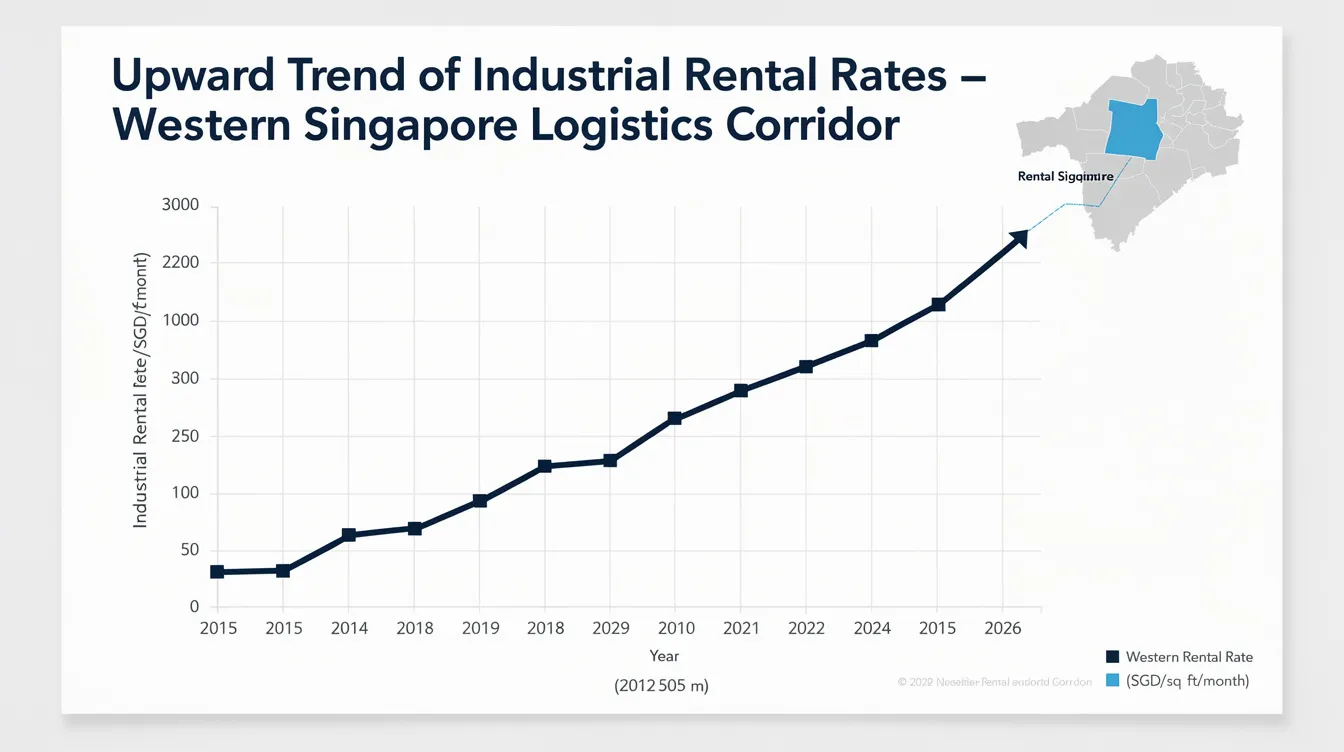
Solution: Target immediate rental yields from current port operations – Phase 1 is already handling millions of TEUs with 14 active berths expanding to 18 by 2027. Rental rates for prime logistics ground-floor space currently sit at approximately S$1.92 per sq ft per month, with 2026 rental growth projected at 1–3% led by modern, well-located assets. Each successive port phase unlocks additional appreciation – the investment thesis is not binary but compounding. Tuas is a key industrial zone with ongoing infrastructure improvements that support continuous value accretion.
Conclusion and Investment Action Plan
Skye@Tuas sits at the intersection of Singapore’s most consequential infrastructure project and a structural supply-demand imbalance in modern industrial space. The Tuas Mega Port’s phased expansion through 2040 creates a multi-decade growth runway. The development’s B2 zoning, 25 kN/m² floor loading, ceiling heights from 8 to 12.95 metres, nine stories with continuous heavy vehicle ramp access, EV infrastructure, and direct MRT connectivity deliver the specifications that port-adjacent tenants require – and that most existing Tuas industrial stock cannot provide.
Immediate next steps:
-
Conduct detailed due diligence on available units at Skye@Tuas, prioritising lower-floor units for faster occupancy and immediate rental yield from current port operations
-
Analyse cash flow projections against the port development timeline, modelling returns across Phase 1 completion (2027), intermediate expansion (2028–2035), and full consolidation (2040)
-
Secure financing aligned with the 30-year leasehold structure, stress-testing residual value assumptions and interest rate exposure
-
Evaluate tenant pre-commitment opportunities across logistics, manufacturing, e-commerce, and marine-offshore sectors to build a resilient income profile
Related exploration topics: Comparative analysis of other B2 industrial developments in the Tuas corridor, portfolio diversification strategies across Singapore’s industrial zones, and emerging automation and sustainability requirements shaping future-ready industrial investments.
Additional Investment Resources
-
Tuas Mega Port development timeline: The MPA’s official Port of the Future page provides updated capacity projections, phase milestones, and automation deployment schedules – essential reference for aligning investment timing
-
Industrial market benchmarks: Colliers and JLL publish quarterly industrial property reports covering rental indices, price movements, and supply pipeline data for western Singapore logistics zones
-
Skye@Tuas project details: Full technical specifications, unit configurations, and site plans are available at skye-tuas.com.sg – including floor loading ratings, three levels of parking configuration, and EV infrastructure details
-
Industrial automation trends: Rising demand for AGVs, robotics, high-bay automated storage, and digital supply chain integration is reshaping minimum specifications for industrial space – developments that do not accommodate these requirements face accelerating obsolescence

