


A bridging loan is the right short-term fix when you can prove your sale proceeds cover the gap and your TDSR still clears with the new mortgage running alongside. If those two conditions hold, a bridge lets you secure your next property without waiting for your current one to sell. If they don’t, you’re borrowing against a shortfall that may never close on time.
Before you apply, run three quick checks:
- OTP or S&P status: You need a valid Option to Purchase on the new property and a signed OTP or Sales & Purchase Agreement on the property you’re selling. Banks treat committed sale proceeds as the primary repayment source. A listing without a buyer is not enough.
- Net sale proceeds math: Subtract your outstanding mortgage balance, CPF refund obligations, agent commission, legal fees, and any seller’s stamp duty from your expected sale price. That net figure is what the bank will lend against, not the gross price.
- TDSR headroom: Your total debt servicing ratio must stay within the MAS-mandated 55% threshold even with the bridging obligation counted. Run this with a mortgage advisor before committing to an OTP.
Pro Tip: Ask your solicitor to confirm the net sale proceeds calculation in writing before you apply. Miscalculating CPF refunds and outstanding mortgage payoffs is the most common cause of last-minute shortfalls.
Key Takeaways
A bridging loan in Singapore works cleanly when net sale proceeds cover the facility in full and TDSR clears with both obligations running — everything else is a risk management question.
| Point | Details |
|---|---|
| Confirm net proceeds first | Subtract mortgage payoff, CPF refund, fees, and commission before applying — this is the figure the bank lends against. |
| Interest rates generally range between low to moderate levels annually. | Overlap duration drives total cost more than rate; shorten the gap between completions to reduce interest. |
| Six-month tenure is firm | Banks do not guarantee extensions; negotiate completion dates early to avoid needing one. |
| Choose your repayment structure | Capitalised interest protects monthly cashflow; simultaneous repayment lowers total cost for short overlaps. |
| Aesthetic Havens coordinates the transition | Aman’s team verifies proceeds, aligns completion dates, and sources multi-bank pricing before you commit to an OTP. |
Table of Contents
- How does a bridging loan work in Singapore?
- Who qualifies for a bridging loan in Singapore?
- What are the indicative bridging loan rates in 2026?
- How do banks size a bridging loan?
- How does repayment work and what does it do to your cashflow?
- What are the pros, cons, and risks of a bridging loan?
- What is the step-by-step application timeline?
- How can a property consultant reduce your bridging loan risk?
- The part most buyers get wrong about bridging loans
- Aesthetic Havens helps you time your property transition right
- Sources
How does a bridging loan work in Singapore?
A bridging loan in Singapore is a short-term, secured facility, typically capped at six months, that fills the completion-money gap between paying for your new property and receiving the proceeds from selling your existing one. Banks secure it against the new property and almost always bundle it with the new home loan application so both are assessed together.
The transaction flow looks like this:
- You exercise the OTP on the new property and need to pay the balance of the purchase price at completion.
- Your current property hasn’t completed its sale yet, so the proceeds aren’t in your account.
- The bank draws down the bridging facility to cover the shortfall at completion of the new purchase.
- When your old property completes, the solicitor uses the sale proceeds to repay the bridge automatically.
Capitalised interest vs. simultaneous repayment
The two repayment structures you’ll encounter differ in how they affect your monthly cashflow during the overlap period.
| Feature | Capitalised interest | Simultaneous repayment |
|---|---|---|
| How interest is paid | Rolled up and settled at completion of old property sale | Paid monthly alongside new home loan |
| Monthly cashflow impact | Lower during overlap period | Higher — two obligations running at once |
| Total interest cost | Slightly higher (interest compounds) | Slightly lower if overlap is short |
| Best suited for | Buyers with tight monthly cashflow | Buyers with strong income buffer |
Capitalised interest is the more common structure in Singapore because most upgraders are already stretching to service the new mortgage. Simultaneous repayment makes sense if your income comfortably absorbs both obligations and you want to minimize total interest paid.
Who qualifies for a bridging loan in Singapore?
Eligibility is tighter than most buyers expect. Banks approve bridges based on the strength of your sale, not just your income.
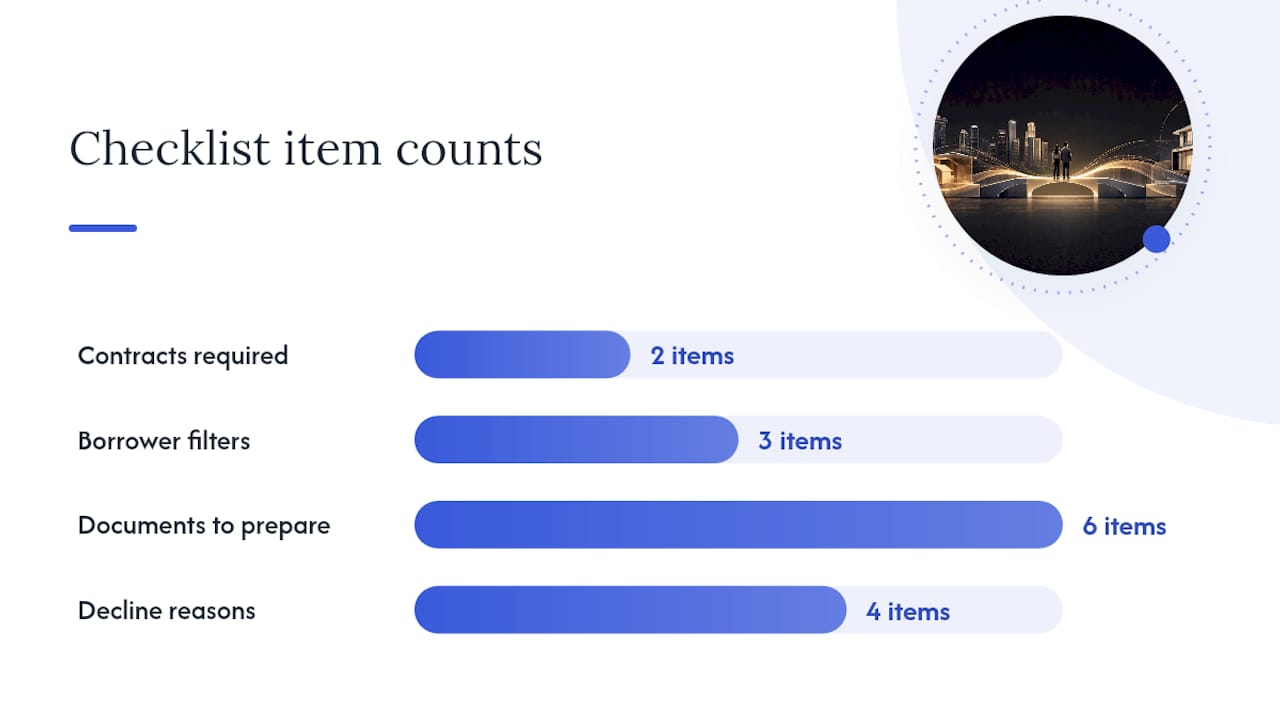
Contracts you must have in place:
- A valid OTP or signed S&P Agreement for the new property you’re buying.
- A signed OTP or S&P Agreement for the property you’re selling. A property merely listed for sale, without a committed buyer, will not satisfy most lenders.
Borrower filters banks typically apply:
- Proof of income: recent payslips (usually three months) and your latest Notice of Assessment from IRAS.
- Clean credit record: outstanding defaults or a heavily utilized credit profile will trigger a decline.
- Nationality and residency: Singapore Citizens and Permanent Residents face standard eligibility criteria. Foreigners may face higher deposit requirements and more limited product access — check the foreigner-specific rules before applying.
Documents to prepare:
- NRIC or passport
- CPF statement showing Ordinary Account balance and any housing withdrawal history
- Outstanding home loan statement for the property being sold
- OTP or S&P for both properties
- Three months’ payslips and latest NOA
- Solicitor contact details for both transactions
Common reasons applications are declined:
- No committed buyer on the existing property at time of application.
- Net sale proceeds insufficient to repay the bridge in full.
- TDSR breach when both the bridge and the new mortgage are counted together.
- Adverse credit history or undisclosed liabilities.
What are the indicative bridging loan rates in 2026?
Indicative 2026 market rates run approximately 4%–5.25% per annum depending on the lender and pricing formula. That range sounds narrow, but on a S$300,000 bridge over five months, the difference between 4% and 5.25% is roughly S$1,875 in interest — worth shopping.
How banks price their bridging facilities
Lenders price bridges against one of three benchmarks:
- Prime Rate: A bank’s own internal reference rate, typically around 5.25%–5.5% currently, with the bridge priced at Prime or Prime minus a small discount.
- 3-Month SORA + spread: Standard Chartered, for example, has used a 3M SORA + 2.5% structure in market summaries. As SORA fluctuates, so does your effective rate.
- Fixed premium: Some lenders quote a flat rate for the bridge tenure rather than a floating formula.
Indicative bank pricing (2026)
Rates are indicative only. Confirm live pricing directly with each bank before applying.
Worked interest calculation
| Loan amount | Rate p.a. | Overlap period | Monthly interest | Total interest cost |
|---|---|---|---|---|
| S$200,000 | 4.25% | 3 months | ~S$708 | ~S$2,125 |
| S$200,000 | 4.25% | 5 months | ~S$708 | ~S$3,542 |
| S$300,000 | 5.00% | 4 months | ~S$1,250 | ~S$5,000 |
| S$300,000 | 5.00% | 6 months | ~S$1,250 | ~S$7,500 |
The pattern is clear: the overlap duration drives cost more than the rate itself. Shorten the gap between your two completions and the interest bill shrinks fast.
Additional fees to budget:
- Processing fee: typically S$500–S$800, though some banks waive it when the bridge is packaged with the home loan.
- Legal fees for the bridging facility: usually S$1,000–S$2,000, handled by your conveyancing solicitor.
- Valuation fee: may apply if the bank requires a fresh valuation of the new property.
How do banks size a bridging loan?
DBS and other major lenders typically cap the bridging facility at around 20% of the new property’s purchase price, though the actual limit is the lower of that cap and your expected net sale proceeds. The bank will not lend you more than you can repay from the sale.
Sizing rules in practice:
- The bridge covers the funding gap: the difference between what you owe at completion of the new purchase and what your cash plus CPF can cover before the sale proceeds arrive.
- Net sale proceeds are calculated after deducting the outstanding mortgage on the property being sold, CPF refund amounts, agent commission (typically 1%–2%), legal fees, and any outstanding property tax.
- Some banks apply a minimum loan size (often around S$50,000) and will not process a bridge below that threshold.
Property-type differences
The HDB vs. private property distinction matters for sizing and eligibility:
- HDB sellers upgrading to private: The bridge is sized against the HDB sale proceeds, which are typically clean and predictable. CPF refunds from the HDB sale reduce the net cash available, so factor them in early.
- Private-to-private buyers: Larger loan amounts, more lender options, and generally smoother processing. Cash over valuation (COV) situations, where the agreed price exceeds the bank’s valuation, reduce the loan-to-value the bank will support and may increase the bridge needed.
- Executive Condominium (EC) buyers: EC deferred payment schemes sometimes reduce the need for a bridge, but buyers upgrading from an HDB to an EC still face the same timing gap and eligibility rules.
How does repayment work and what does it do to your cashflow?
The bridge is repaid at completion of your old property’s sale. Your solicitor receives the sale proceeds, deducts the outstanding mortgage, CPF refund obligations, fees, and the bridging loan balance, and remits the remainder to you. You don’t manually transfer the money — the settlement is built into the conveyancing process.
TDSR impact
Banks count the bridging obligation when assessing your TDSR for the new home loan. Under MAS rules, your total monthly debt obligations (including the new mortgage and any bridging interest if you’re on simultaneous repayment) cannot exceed 55% of your gross monthly income. Capitalised interest structures reduce the monthly TDSR impact because no cash payment is due during the overlap, but the bank still stress-tests your ability to service both if the sale is delayed.
Monthly cashflow scenarios
| Structure | New mortgage (example) | Bridge obligation | Total monthly outflow |
|---|---|---|---|
| Capitalised interest | S$3,200 | S$0 (rolled up) | S$3,200 |
| Simultaneous repayment | S$3,200 | S$708 (interest only) | S$3,908 |
The S$708 figure above uses the S$200,000 at 4.25% example from the rates section. Your numbers will differ, but the structure of the choice stays the same: capitalised interest protects monthly cashflow; simultaneous repayment lowers total cost if the overlap is short.
CPF refund timing note: When your HDB or private property is sold, the CPF Board requires the housing withdrawal amount plus accrued interest to be refunded to your Ordinary Account before any cash proceeds are released. This refund reduces the net cash your solicitor has to work with at settlement. Factor CPF refund mechanics into your net proceeds calculation from day one, not as an afterthought.
What are the pros, cons, and risks of a bridging loan?
Consumer guides consistently frame bridging loans as gap financing: useful when timing forces your hand, expensive when used as a substitute for planning.
Pros:
- Lets you secure the new property without waiting for the old one to sell, which matters in a competitive market.
- Preserves your CPF OA balance for the new purchase rather than depleting it to cover a temporary gap.
- Keeps your cash buffer intact during the transition period.
Cons and risks:
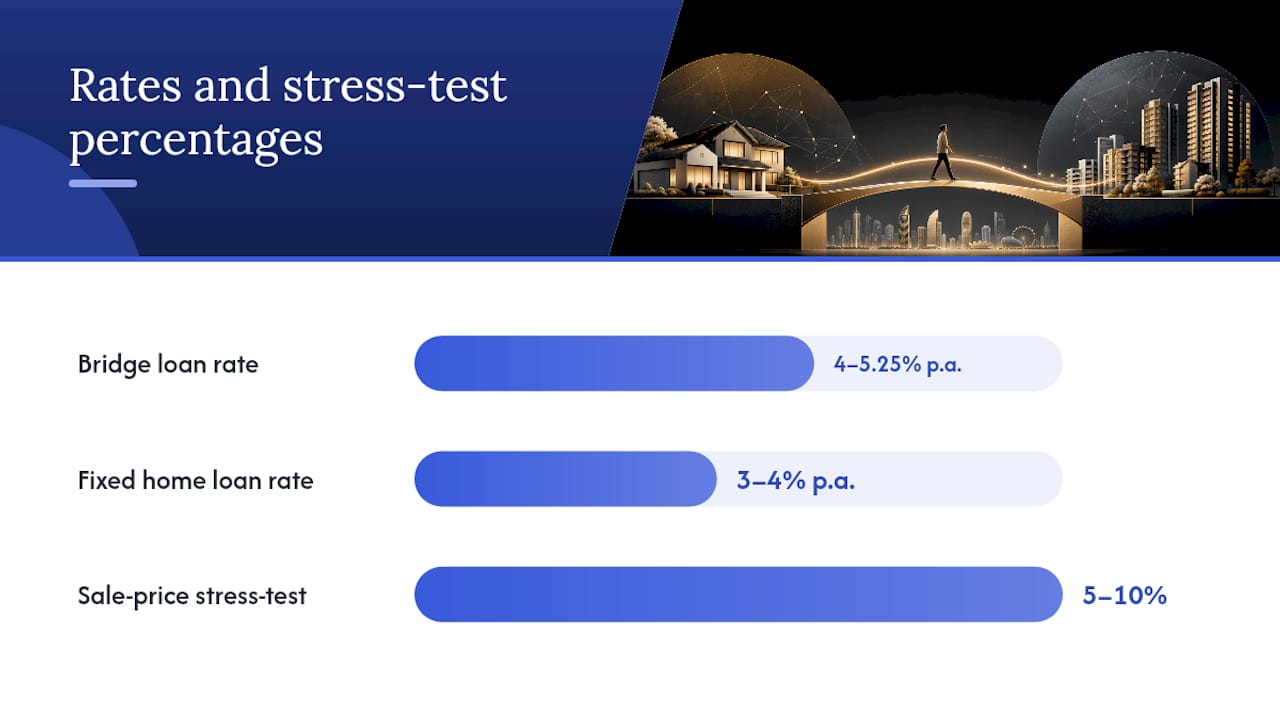
- Rates run higher than standard home loan rates, typically 4%–5.25% p.a. versus 3%–4% for a fixed home loan package.
- The six-month tenure is firm. If your old property sale is delayed, the bank does not guarantee an extension and may convert the facility to a more expensive arrangement.
- A buyer default on your existing property, or a renegotiated price, can leave you with a shortfall the bridge doesn’t cover.
- Simultaneous repayment adds real monthly pressure if your income is already stretched.
Alternatives worth testing first:
- CPF Ordinary Account: If your OA balance is sufficient to cover the completion gap, using it avoids interest entirely. Check whether the withdrawal reduces your retirement adequacy before committing.
- Temporary personal loan: Generally more expensive than a bridge but may work for small gaps. Not recommended for amounts above S$50,000–S$100,000.
- Vendor or developer flexibility: For new launches, some developers offer deferred payment schemes or progressive payment structures that reduce or eliminate the need for a bridge. Explore this before applying.
- Staged completion negotiation: If you’re buying resale, a longer completion period (e.g., 12 weeks instead of 8) gives your sale more time to complete, potentially eliminating the overlap entirely.
Risk mitigation:
- Stress-test your sale price at 5%–10% below your asking price and confirm the bridge still repays in full.
- Get your solicitor to issue an automatic settlement instruction so the bridge is repaid the moment sale proceeds arrive, with no manual step required.
- Keep a cash buffer of at least one to two months’ worth of combined mortgage and bridge interest in case of a short delay.
What is the step-by-step application timeline?
The process runs in parallel across two transactions. Keeping both solicitors coordinated is the single most important operational task.
- Exercise the OTP on the new property. Typically requires a 1% option fee, with the remaining 4% (for private property) due within the option period.
- Submit the bridging loan and new home loan application together. Most banks require both applications simultaneously. Bring all documents listed in the eligibility section.
- Bank processes valuation and credit checks. Allow 5–10 working days for approval in principle. The bank will value the new property and verify your sale documentation.
- Receive Letter of Offer. Review the tenure, rate, repayment structure, extension policy, and early repayment terms before signing.
- Legal documentation. Your solicitor prepares the mortgage and bridging facility documents. Both solicitors (for the purchase and the sale) need to be in contact at this stage.
- Drawdown at completion of new purchase. The bridge is drawn down on the completion date of your new property purchase to cover the funding gap.
- Old property completes. Sale proceeds flow to your solicitor, who settles the outstanding mortgage, CPF refund, fees, and the bridging loan balance in sequence.
- Bridge closed. Confirm with the bank that the facility is fully repaid and closed. Request a discharge letter.
Documents to have ready at each stage:
- At application: OTP/S&P for both properties, payslips, NOA, CPF statement, outstanding loan statement, ID.
- At legal stage: Solicitor details for both transactions, CPF withdrawal form, outstanding mortgage redemption statement.
- At completion: Confirmation of sale proceeds amount, CPF refund calculation from CPF Board.
Timing tip: Negotiate your new property’s completion date to fall at least two to three weeks after your old property’s expected completion. Even a small buffer reduces the chance of a genuine overlap and may eliminate the need for a bridge entirely. Review the new launch vs. resale timing trade-offs before locking in dates.
How can a property consultant reduce your bridging loan risk?
The biggest risks in a bridging transaction are not financial — they’re coordination failures. A sale that completes two weeks late, a CPF refund calculation that’s S$30,000 short, or a solicitor who doesn’t know the bridge needs to be settled before the cash is released: these are the scenarios that turn a manageable bridge into a stressful extension negotiation.
A consultant working on your transaction handles the following concretely:
- Net proceeds verification: Calculates expected net sale proceeds after mortgage payoff, CPF refund, commission, and legal fees before you commit to the OTP on the new property. This is the number the bank lends against, and getting it wrong at the start creates problems at completion.
- Completion sequencing: Coordinates with both solicitors to align completion dates so the overlap is as short as possible, reducing total interest cost.
- CPF documentation: Prepares the CPF withdrawal and refund documentation the bank needs to size the bridge correctly.
- Multi-bank pricing view: Approaches DBS, UOB, OCBC, Maybank, and Standard Chartered simultaneously to compare indicative rates and fee structures, rather than accepting the first offer.
- Cashflow stress-testing: Models the simultaneous repayment vs. capitalised interest scenarios against your actual income and monthly obligations so you choose the right structure before signing.
Pro Tip: Engage a consultant before you commit to the OTP on the new property, not after. Once the OTP is exercised, your timeline is fixed. A consultant brought in early can negotiate completion dates, verify your net proceeds, and approach banks in parallel — all of which are much harder to do once the clock is running.
The benefits of working with a property consultant extend well beyond the bridge itself: transaction coordination, lender introductions, and solicitor liaisons reduce friction at every stage of an upgrade transaction.
The part most buyers get wrong about bridging loans
Most buyers treat the bridging loan as a financing problem. It isn’t. It’s a timing problem that financing solves temporarily. The loan itself is straightforward; the risk lives entirely in the gap between your two completion dates.
What I see repeatedly is buyers who focus on the rate and miss the extension policy. A 0.25% difference in rate on a S$200,000 bridge over five months is about S$208. A one-month extension at a higher penalty rate on the same amount can cost three to four times that. Read the extension terms before you sign the Letter of Offer, not after you need one.
The other underappreciated risk is the CPF refund. Buyers consistently underestimate how much of their HDB sale proceeds go straight back to CPF with accrued interest. That refund is not discretionary — it happens before any cash reaches you. A consultant or solicitor who runs the CPF refund calculation upfront saves you from discovering a S$40,000 shortfall on completion day.
My practical advice: if your net sale proceeds cover the bridge with at least 15% to spare, and your TDSR clears comfortably, a bridge is a clean, well-understood product. If you’re relying on the sale price holding firm and the timeline running perfectly, consider whether a staged completion negotiation or a developer deferred payment scheme removes the risk entirely before you commit to borrowing.
Aesthetic Havens helps you time your property transition right
Timing two property transactions correctly is where most upgraders lose money or sleep. Aesthetic Havens, operated by Aman Aboobucker under ERA Realtors, works with Singapore buyers to coordinate exactly this: aligning sale and purchase completions, verifying net proceeds before OTP commitment, approaching multiple banks for bridging and home loan pricing, and keeping both solicitors on the same page throughout.
The practical difference is straightforward. Rather than applying to one bank and hoping the numbers work, you get a multi-bank pricing comparison, a CPF-adjusted net proceeds calculation, and a completion timeline built around your actual dates — before you’re locked in. For HDB upgraders moving to private property, or private-to-private buyers managing a cash over valuation situation, that upfront coordination typically saves more than the consultant’s fee in interest and avoided extension costs.
To get a clear picture of your bridging position before you exercise your next OTP, speak with a property consultant at Aesthetic Havens for an initial review and timing plan.
Sources
The figures and regulatory references in this article draw from the following primary sources. Check live rates directly with each bank before applying, as indicative pricing changes with benchmark movements.
- Bridging Loan Singapore 2026: How It Works & Rates – SingSaver
- Purchase your dream home with DBS Loans | DBS Singapore
- Notice 1107 Bridging Loans for the Purchase of Immovable Properties
- Bridging Loan Singapore 2026: HDB & Condo Timing Guide
- Bridging Loan Singapore: Bank Rates Comparison Guide | Homejourney | Homejourney Blog
- Cpf
- Bridging Loans Singapore for HDB Residential & Private …
This article provides general information only and is not a substitute for professional financial, legal, or mortgage advice. Confirm current rates, eligibility criteria, and regulatory requirements with your bank, solicitor, or a licensed financial advisor before making any property financing decisions.


