


Property cooling measures are government policies designed to slow residential real-estate demand, limit leverage, and preserve affordability before speculative activity destabilizes prices or household balance sheets. The headline instruments are Additional Buyer’s Stamp Duty (ABSD), Seller’s Stamp Duty (SSD), Total Debt Servicing Ratio (TDSR) caps, and Loan-to-Value (LTV) limits. Together, they raise the cost of buying, shrink the loan a buyer can take, and penalize quick resales. Rules come from regulators like the Monetary Authority of Singapore (MAS) and the Inland Revenue Authority of Singapore (IRAS) in Singapore, and from the FHFA, CFPB, HUD, and Fannie Mae/Freddie Mac in the United States.
Before you buy or advise a client, check these three things first:
- Cash requirements: ABSD (in Singapore) must be paid entirely in cash within 14 days of signing the Sales & Purchase Agreement. CPF funds cannot be used. Know the full upfront cash outlay before committing.
- Loan stress tests: Lenders apply a stressed interest rate above the actual market rate when calculating TDSR or DTI limits. That single assumption can cut your maximum loan by 10% or more.
- Holding-period taxes: SSD in Singapore and transfer/recording taxes in U.S. jurisdictions apply at sale. Short holding periods can wipe out gains. Model the exit before you enter.
Table of Contents
- What are property cooling measures and how are they categorized?
- How do cooling measures actually work in practice?
- How do U.S. equivalents compare to Singapore’s approach?
- Who gets affected, and what does it actually cost them?
- Practical checklist for buyers, investors, and agents
- Singapore case study: ABSD and TDSR as a combined policy package
- Key Takeaways
- The real advisory gap nobody talks about
- How Aesthetic Havens helps you navigate cooling measures
- Authoritative sources and further reading
What are property cooling measures and how are they categorized?
Governments have a short menu of tools when prices run too hot. Each category targets a different part of the demand or leverage equation.
Fiscal disincentives: stamp duties and transaction taxes
These raise the cost of buying outright. ABSD in Singapore layers an additional tax on top of the standard Buyer’s Stamp Duty (BSD), with rates that escalate by buyer profile. Foreign buyers face a high Additional Buyer’s Stamp Duty (ABSD) rate payable entirely in cash. Singapore Citizens purchasing a second property pay 20% ABSD; Permanent Residents buying their first pay 5%. Foreign buyers pay 60% ABSD on any property as of April 27, 2023. The U.S. equivalent is state and local transfer taxes, which vary widely by jurisdiction and are far lower in magnitude.
SSD targets the other end of the transaction. It penalizes sellers who exit too quickly, with graduated rates that fall the longer a property is held. SSD rates and holding periods were adjusted in July 2025, making short-term flipping more expensive than it was under the prior schedule.
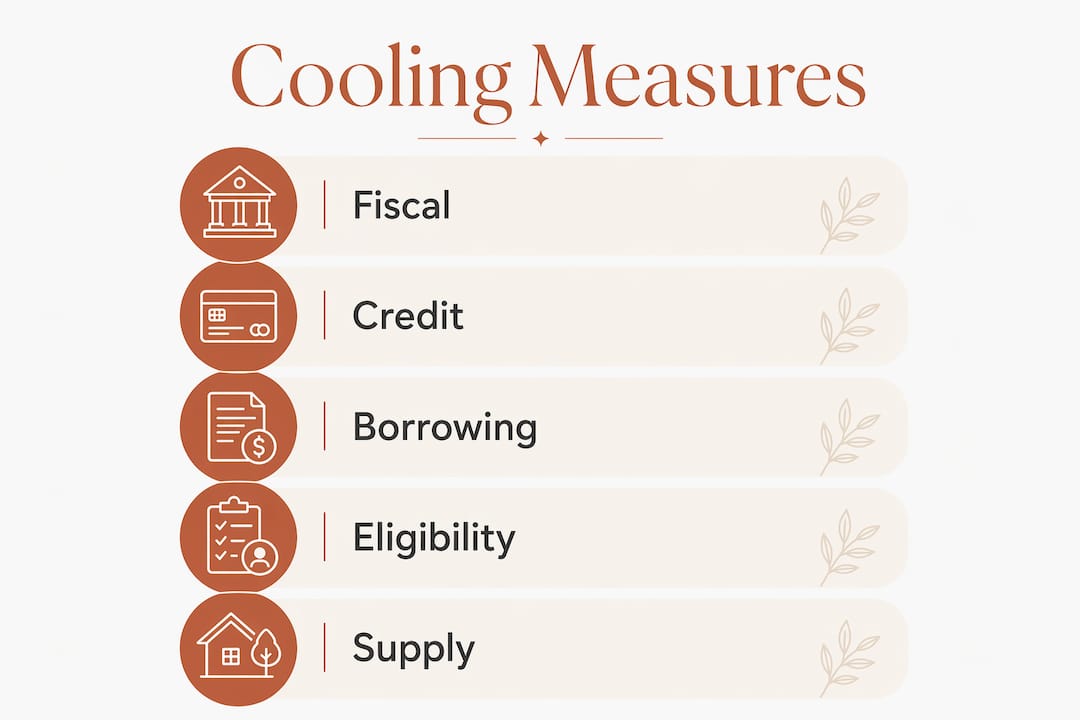
Credit guardrails: TDSR, MSR, and DTI limits
The TDSR caps total monthly debt obligations at a percentage of gross monthly income and uses a stress-test interest rate above prevailing market levels. That combination does two things: it limits how much a buyer can borrow, and it builds in a buffer against future rate rises. The Mortgage Servicing Ratio (MSR) adds a tighter 30% cap specifically for HDB flat purchases. In the U.S., Fannie Mae and Freddie Mac underwriting guidelines impose DTI limits that function similarly, though the specific thresholds and stress-test assumptions differ.

Borrowing limits: LTV and tenure caps
LTV limits set the maximum loan as a percentage of the property’s value. Lower LTV means a larger required down payment, which directly reduces purchasing power for buyers who are cash-constrained. Tenure caps limit how long a mortgage can run, which raises monthly repayments and further tightens affordability. Both tools reduce the leverage available to buyers without touching the purchase price directly.
Buyer eligibility rules: foreign-buyer restrictions and wait-out periods
Some measures restrict who can buy at all. In Singapore, foreigners are prohibited from purchasing HDB resale flats and most landed properties. A wait-out period introduced in 2022 requires private property downgraders to wait 15 months before buying an HDB resale flat, slowing demand migration from the private to the public market. The U.S. has no equivalent national foreign-buyer ban, though some states have enacted targeted restrictions on purchases by certain foreign nationals.
Supply-side responses
Demand-side tools work faster, but supply-side actions address the structural cause of price pressure. Governments can release state land for development, accelerate public housing construction, or adjust the cadence of land sales to increase future supply. These measures take years to affect prices but are often announced alongside fiscal tools to signal long-term intent.
| Measure Category | Mechanism | Typical Enforcement Body |
|---|---|---|
| ABSD / Stamp duties | Raises upfront purchase cost | IRAS (Singapore); state/local revenue authorities (U.S.) |
| SSD | Penalizes short holding periods at resale | IRAS (Singapore) |
| TDSR / DTI limits | Caps total monthly debt as % of income | MAS (Singapore); CFPB / Fannie-Freddie (U.S.) |
| LTV limits | Caps loan as % of property value | MAS (Singapore); FHFA / banking regulators (U.S.) |
| Foreign-buyer restrictions | Limits eligible buyer pool | MND / HDB (Singapore); state legislatures (U.S.) |
| Wait-out periods | Delays demand migration between segments | HDB / MND (Singapore) |
| Land supply / zoning | Increases future housing stock | URA (Singapore); local planning authorities (U.S.) |
Pro Tip: When advising a client, always ask the lender two specific questions: what stress-test interest rate they are using for the TDSR or DTI calculation, and whether any ABSD exemptions or transfer-tax concessions apply to the client’s profile. A one-percentage-point difference in the assumed rate can shift the maximum loan by a meaningful amount.
How do cooling measures actually work in practice?
The core causal claim is straightforward: cooling measures reduce speculative buying and limit leverage, which eases upward price pressure and lowers systemic risk for both borrowers and lenders. The transmission runs through four channels.
Raising transaction costs reduces the pool of marginal buyers. When ABSD adds 20–60% to the purchase price for certain buyer profiles, many investors recalculate their expected returns and step back. Transaction volumes fall faster than prices because sellers initially resist adjusting their asking price.
Lowering the maximum loan through LTV caps forces buyers to bring more cash to the table. For a buyer who was planning to maximize leverage, a tighter LTV can make a target property simply unaffordable, removing them from the market entirely.
Stress-test rates under TDSR reduce monthly affordability even when actual rates are low. Because TDSR uses a stressed rate above market levels, shifts in the assumed rate can reduce a borrower’s maximum loan significantly, often forcing buyers to consider smaller or less central properties.
SSD changes holding incentives. A seller who bought 12 months ago and faces a significant SSD charge on exit will either hold longer or price the property to absorb the tax. Both outcomes reduce speculative turnover.
What the evidence shows: Academic analysis of Singapore’s multi-round interventions found notable price corrections across public and private segments, with limited broader macroeconomic spillovers. Volumes fell quickly; prices adjusted more slowly, particularly where supply was constrained.
Timing matters. Transaction volumes typically drop within weeks of an announcement because buyers and sellers reprice their expectations immediately. Price-level adjustments take longer, sometimes 6–18 months, and may be partial when supply is tight. Luxury segments in prime locations tend to see sharper volume drops because foreign and investor demand is more elastic to cost increases. Mass-market segments, where owner-occupiers dominate, are more insulated but still feel the effect of tighter credit rules.
The Council for Estate Agencies (CEA) notes that cooling measures are designed for sustainable price growth, not market crashes. That distinction matters for how advisors should frame the policy to clients: the goal is a safety valve, not a collapse.
How do U.S. equivalents compare to Singapore’s approach?
The U.S. lacks a unified national ABSD-style transaction tax. There is no federal policy that adds a percentage surcharge to a home purchase based on buyer nationality or ownership count. What exists instead is a patchwork of state and local tools, federal credit guardrails, and banking regulations that collectively produce some of the same effects.
U.S. policy levers that most closely map to Singapore measures:
- DTI limits in mortgage underwriting: Fannie Mae and Freddie Mac guidelines cap the debt-to-income ratio for conforming loans, functioning similarly to TDSR. The specific thresholds differ, and the stress-test assumptions vary by lender and product.
- State and local transfer taxes: New York, Washington D.C., and several other jurisdictions impose transfer taxes on real-estate transactions. Some cities have added mansion taxes or progressive rates on high-value sales. These are far lower than Singapore’s ABSD rates and do not vary by buyer nationality at the federal level.
- Vacancy and registration taxes: A small number of U.S. cities have experimented with vacancy taxes on empty properties to discourage speculative holding. These are local ordinances, not national policy.
- Zoning and supply-side controls: Local governments control land use and density. Restrictive zoning is often cited as a primary driver of U.S. housing affordability problems, and upzoning efforts in cities like Minneapolis and Portland represent a supply-side response analogous to Singapore’s land-release programs.
- Banking regulation: The FHFA, CFPB, and federal banking regulators set underwriting standards and capital requirements that limit lender risk-taking, which indirectly constrains the leverage available to buyers.
The fundamental legal difference is structural. Singapore’s government can implement a nationwide ABSD rate change overnight with immediate effect, as it did on April 27, 2023. In the U.S., the separation of powers between federal, state, and local governments means no single authority can impose a sweeping buyer surcharge across all jurisdictions. Federal housing finance agencies can tighten underwriting standards, but a Singapore-style nationality-based tax would face significant legal and political obstacles at the federal level.
Never assume Singapore’s cooling measures apply to a U.S. transaction. Always verify the specific transfer taxes, recording fees, and underwriting rules in the state and county where the property sits. A buyer relocating from Singapore to the U.S. may be surprised by how different the regulatory environment is — and by how much more leverage is available in the U.S. system by default.
Who gets affected, and what does it actually cost them?
Cooling measures do not hit all market participants equally. The impact depends on buyer profile, financing structure, and how long a property is held.
First-time buyers are often the least affected by ABSD in Singapore, since Singapore Citizens buying their first home are exempt. But TDSR still constrains them: the stress-test rate reduces the loan quantum, which can push a target property out of reach even when the buyer has sufficient income on paper.
Upgraders buying a second property face ABSD on the new purchase while still holding the first. The cash requirement is immediate and substantial. Many upgraders time their transactions to sell the first property before completing the second purchase, which requires careful coordination and carries execution risk.
Multiple-property owners and investors bear the highest ABSD rates. The April 2023 revision raised rates significantly for this group, and the 60% ABSD for foreign buyers effectively priced out most cross-border investors from the private residential market. Singapore Citizens purchasing a second property face a 20% ABSD rate, while Permanent Residents pay 5% on their first property and 30% on a second as of April 27, 2023. For investors, the total acquisition cost now includes ABSD, BSD, legal fees, and SSD risk on exit — a very different calculation than pre-2021.
Lenders face tighter underwriting requirements under TDSR and LTV rules, which reduce loan volumes but also reduce portfolio risk. The stress-test rate requirement means lenders must qualify borrowers at a higher rate than the actual loan rate, building in a buffer against default if rates rise.
Real estate agents see transaction volumes fall after major cooling rounds, which compresses commission income in the short term. Agents who understand the measures well enough to help clients navigate them — timing purchases, structuring transactions, and modeling total acquisition cost — retain clients through cooled markets better than those who cannot.

| Buyer Profile | ABSD Rate (Singapore, post-April 2023) | TDSR Cap | Typical LTV Limit |
|---|---|---|---|
| Singapore Citizen, 1st property | — | 55% of gross income | 70% |
| Singapore Citizen, 2nd property | 20% | 55% of gross income | 35% |
| Permanent Resident, 1st property | 5% | 55% of gross income | 70% |
| Permanent Resident, 2nd property | 30% | 55% of gross income | 35% |
| Foreigner, any property | 60% | 55% of gross income | 70% |
| Entity (company), any property | 60% | N/A | Up to 15% |
All figures are Singapore-specific. U.S. buyers should verify applicable transfer taxes and DTI limits with their lender and local authority.
A secondary effect worth noting: when private-market demand cools, some buyers migrate to the HDB resale market, pushing prices there upward. Advisors should anticipate this cross-market spillover when advising clients on timing and segment choice. The new launch vs. resale dynamics shift as well, with some cooled demand moving toward new launches where developer pricing may be more negotiable.
Practical checklist for buyers, investors, and agents
Start by running the numbers: cash on hand, a stress-tested mortgage scenario, and at least one alternative housing option if the primary target becomes unaffordable.
-
Verify upfront cash needs. Add together the down payment, ABSD (if applicable), BSD, legal fees, and any renovation budget. In Singapore, ABSD must be paid in cash within 14 days of signing the Sales & Purchase Agreement. CPF cannot be used. In the U.S., confirm state and county transfer taxes, title insurance, and closing costs before committing.
-
Run stress-tested mortgage scenarios. Ask your lender what interest rate they are using for the TDSR or DTI calculation. Model the loan quantum at that rate, not the current market rate. If the stressed rate is 4.5% and you were planning based on 3.5%, your maximum loan may be meaningfully lower than you expected.
-
Confirm holding-period taxes and resale penalties. In Singapore, SSD applies to private residential properties sold within a holding period, with rates that decrease over time. In the U.S., short-term capital gains tax applies to properties sold within 12 months. Know your exit cost before you enter.
-
Plan for alternative strategies. If the primary target is out of reach after running the numbers, consider rent-first while saving a larger down payment, joint ownership with a co-buyer, or a staggered purchase approach. For investors, property cash flow planning that accounts for acquisition taxes and financing costs is essential before committing capital.
-
Ask agents and lenders specific questions. What stress-test rate is the lender using? Does the buyer qualify for any ABSD exemptions or transfer-tax concessions? What is the estimated SSD or capital gains tax on a sale in 12, 24, and 36 months?
Pro Tip: Investors should build a total acquisition cost model that includes ABSD or transfer taxes, BSD, financing costs, SSD or capital gains tax on exit, and a vacancy buffer. The authoritative rule clarifications for Singapore come from IRAS and MAS directly; for U.S. transactions, the CFPB’s loan estimate disclosure and your state’s department of revenue are the primary sources.
For agents advising clients in a cooled market: disclose all applicable taxes and holding-period penalties in writing before the client makes an offer. Negotiation levers in a cooled market include price reductions to offset ABSD, seller-paid closing costs, and longer completion timelines that give buyers more time to liquidate existing assets.
Singapore case study: ABSD and TDSR as a combined policy package
This section describes Singapore’s regulatory framework. It is not U.S. law and does not apply to U.S. transactions.
Singapore’s cooling framework is a layered toolkit administered by MND and MAS, combining ABSD, SSD, TDSR, and LTV limits into a modular package where each instrument targets a different part of the demand or leverage problem. The package is designed to be tightened or loosened by adjusting individual components without dismantling the whole framework.
| Date | Measure | Key Change |
|---|---|---|
| — | ABSD introduced | Foreign buyers: 10% ABSD; first round of LTV tightening |
| — | ABSD Round 2 | Foreign buyers raised to 15% |
| July 2025 | ABSD Round 3 | Foreign buyers raised to 20% |
| December 2021 | ABSD Round 4 + TDSR tightened | Foreign buyers to 30%; TDSR reduced from 60% to 55% |
| April 27, 2023 | ABSD Round 5 | Foreign buyers to 60%; entities to 60% |
| July 2025 | SSD revised | Holding periods and graduated rates adjusted upward |
The mechanics in practice are worth understanding in detail. When a foreign buyer signs a Sales & Purchase Agreement in Singapore, the ABSD is due in cash within 14 days. At this high rate of ABSD, the cash requirement is substantial, often totaling a significant proportion of the purchase price, payable before completion. That single requirement effectively removed most foreign retail investors from the market after April 2023.
TDSR works differently. It does not appear as a line item on a purchase contract. Instead, it constrains the loan quantum a bank will approve. Because the stress-test rate is set above market levels, a buyer who qualifies for a SGD 1.5 million loan at the actual market rate may only qualify for SGD 1.35 million under the stressed calculation. That gap forces buyers to either increase their down payment or choose a less expensive property. For a detailed breakdown of how TDSR calculations work in practice, the TDSR buyer’s guide covers the mechanics step by step.
Academic research estimates that Singapore’s multi-round interventions produced price corrections of roughly 10–15% without triggering broader macroeconomic disruption. Transaction volumes fell sharply after each announcement, particularly in the Core Central Region (CCR) where foreign buyer exposure was highest. The April 2023 round was described by market participants as a shock: the jump from 30% to 60% for foreign buyers was announced without accompanying LTV or TDSR changes, making it the cleanest single-round test of ABSD’s effect. For more on how ABSD rates and exemptions apply by buyer profile, the ABSD rates and exemptions guide covers the full schedule.
Key Takeaways
Property cooling measures are government demand-management tools that raise transaction costs, limit leverage, and penalize short-term resale to preserve affordability and financial stability across residential markets.
| Point | Details |
|---|---|
| Core definition | Cooling measures raise buying costs, cap loan sizes, and penalize quick resales to slow speculative demand. |
| Top measures to watch | ABSD, TDSR (55% cap), LTV limits, and SSD are the four instruments with the most direct impact on buyer economics in Singapore. |
| Cash planning is critical | ABSD must be paid in cash within 14 days of signing; CPF cannot be used. Model full upfront cash needs before committing. |
| U.S. vs Singapore | The U.S. has no national ABSD equivalent; check state/local transfer taxes and lender DTI limits for your specific jurisdiction. |
| Aesthetic Havens advisory | Aesthetic Havens provides acquisition-cost modeling, lender liaison, and market briefings to help buyers and investors navigate cooling measures with confidence. |
The real advisory gap nobody talks about
Most commentary on cooling measures focuses on the rates and the rules. What gets less attention is the advisory gap: the space between what the regulations say and what a buyer actually needs to do to transact safely.
The TDSR rule is a good example. It is often described as a 55% income cap, which sounds simple. But the practical constraint for most buyers is not the 55% ceiling — it is the stressed interest rate the lender applies to get there. That rate is not publicly posted in a single place. Different lenders use different assumptions. A buyer who shops only one lender may be leaving borrowing capacity on the table, or may be qualifying for a loan they cannot actually service if rates move.
The same logic applies to ABSD timing. The 14-day cash payment rule is stated clearly in IRAS guidance, but many buyers discover it late in the transaction process, after they have already committed emotionally and financially to a property. An advisor who surfaces that requirement in the first conversation — before the client has seen a single unit — changes the entire financial preparation process.
For agents and advisors, the right posture in a cooled market is not to reassure clients that prices will recover. It is to help them understand their actual cost structure, model realistic exit scenarios, and make decisions with full information. That is what separates a transaction facilitator from a genuine property advisor. The real estate advisory framework that Aesthetic Havens applies puts that cost-structure conversation at the front of every client engagement, not the back.
How Aesthetic Havens helps you navigate cooling measures
Cooling measures change the numbers on every transaction. Aesthetic Havens gives buyers, investors, and agents a structured way to work through those numbers before they commit.

The consultancy’s buying advisory service covers the full acquisition cost picture: ABSD liability by buyer profile, TDSR stress-test scenarios across multiple lenders, SSD exposure on different exit timelines, and LTV implications for down payment planning. For investors weighing Singapore against other markets, the team provides cross-border comparisons that account for local transfer taxes and underwriting rules in each jurisdiction. For agents, Aesthetic Havens offers client briefing materials and negotiation frameworks calibrated to cooled-market conditions.
What the service covers:
- Upfront cash planning (ABSD, BSD, deposits, legal fees)
- Lender liaison and stress-test scenario modeling
- Acquisition-cost modeling including SSD risk on exit
- Market briefings on segment-level price and volume trends
- Resale strategy and timing advice under current holding-period rules
Ready to model your real acquisition cost before you sign anything? Book a consultation with Aesthetic Havens and get a clear picture of what cooling measures mean for your specific situation.
Authoritative sources and further reading
Verify current rules directly with the relevant regulator before transacting. Rules change, and secondary sources may lag official updates.
Singapore regulators (primary rule sources):
- Monetary Authority of Singapore (MAS) — TDSR notices, LTV guidelines, macroprudential policy updates
- Inland Revenue Authority of Singapore (IRAS) — ABSD and SSD rates, payment deadlines, exemption conditions
- Ministry of National Development (MND) / HDB — public housing eligibility, wait-out period rules, MSR guidelines
- Council for Estate Agencies (CEA) — practitioner guidance and policy commentary
Singapore analysis (commentary and research):
- Academic analysis of Singapore cooling measure effects — empirical price correction estimates (10–15% range)
- PJ.sg cooling measures guide — practitioner-oriented explainer of the six-tool framework
- Propkaki Singapore cooling measures guide — SSD rate schedules and recent changes
- Channel NewsAsia — market reaction reporting and practitioner commentary on ABSD rounds
U.S. equivalents (primary sources):
- Federal Housing Finance Agency (FHFA) — conforming loan limits and underwriting standards
- Consumer Financial Protection Bureau (CFPB) — mortgage disclosure rules, DTI guidance, loan estimate requirements
- U.S. Department of Housing and Urban Development (HUD) — FHA underwriting guidelines
- Fannie Mae / Freddie Mac selling guides — DTI limits and stress-test assumptions for conforming loans
Always check the regulator’s website directly for the most current rates and effective dates. This article reflects publicly available information as of July 2026 and is general information only, not professional legal, tax, or financial advice. Confirm applicable rules with a qualified professional for your specific situation.
Recommended
- Singapore Property Cooling Measures in 2025 | Aesthetic Havens
- Foreigner’s Guide to Buying Property in Singapore (2025 Regulations & Taxes) | Aesthetic Havens
- New Launch vs Resale 2026: Singapore Property Market Guide | Aesthetic Havens
- Singapore commercial real estate: Market guide for smart investors


