


A tenancy agreement is a legally binding contract between a landlord and a tenant that sets the terms of occupancy, including rent, duration, and each party’s obligations. Think of it as the rulebook for the rental relationship. Where a fixed-term lease locks in those rules for a set period, a periodic rental agreement renews automatically and allows either party to end it with proper notice.
Courts expect to see six core elements in any enforceable agreement: named parties, a property description, the term, rent amount and due date, security deposit conditions, and signatures of all adult tenants. Miss one of those, and enforcement gets complicated fast.

Table of Contents
- What should be in a tenancy agreement?
- How does a tenancy agreement differ from a lease?
- What are the main types of tenancy in the U.S.?
- What makes a tenancy agreement legally enforceable?
- What are the rights and obligations of landlords and tenants?
- How do security deposits and move-out inspections work?
- How does a tenancy end, and what happens if you break a lease?
- What mistakes do tenants and landlords most often make?
- A practical checklist and sample clauses for your contract
- Red flags and legal tips practitioners flag most often
- Key Takeaways
- Why contract clarity matters more than most people realize
- Authoritative sources for state-specific rules and required disclosures
What should be in a tenancy agreement?
A well-drafted rental contract does more than state the monthly rent. Each clause serves a specific legal function, and a missing clause is usually where disputes start.
The essential clauses:
- Parties. Full legal names of the landlord (or property management company) and every adult tenant who will live there. Unnamed occupants create gray areas around liability and eviction rights.
- Premises. The full street address, unit number, and any included storage or parking spaces. Vague descriptions cause disputes over what was actually rented.
- Term. Start date, end date (or a clear “month-to-month” statement), and what happens when the term expires.
- Rent. Dollar amount, due date (typically the 1st), grace period (commonly 3–5 days), and the late fee. Example language: “Rent is due on the 1st of each month. A late fee applies after the 5th.”
- Security deposit. Amount, where it is held, allowable deductions, and the return timeline. State law governs the maximum and the deadline.
- Permitted use and occupancy. Who may live there, whether guests can stay long-term, and any restrictions on business use.
- Pets and smoking. Vague “no pets” language without a defined penalty is hard to enforce. Specify the species, weight limit, pet deposit, and consequences for violations.
- Maintenance and repairs. Who handles what. Landlords typically cover structural repairs and appliances; tenants cover minor upkeep and damage they cause. A clause requiring tenants to report problems in writing within a set timeframe protects both sides.
- Utilities. List which utilities the landlord pays and which the tenant pays. Ambiguity here leads to unpaid bills and security-deposit fights.
- Right of entry. Most states require 24 hours’ written notice before a landlord enters for non-emergency repairs. Spell it out.
- Subletting. Whether the tenant may sublet, and under what conditions. Silence on this point can create legal headaches.
- Notice and termination. How much notice each party must give to end the tenancy, and in what form (written, delivered how).
- Dispute resolution. Whether disputes go to mediation first, and which state’s law governs.
- Required disclosures. Federal law requires a lead-based paint disclosure for homes built before 1978. Many states add their own mandatory disclosures.
A complete lease checklist should confirm all of these are present before anyone signs.

How does a tenancy agreement differ from a lease?
The terms “lease” and “rental agreement” are often used interchangeably, but they describe different legal arrangements with meaningfully different consequences.
A fixed-term lease vs. rental agreement comparison comes down to one word: stability. A lease locks both parties into set terms for the full period. A rental agreement renews automatically each period and allows either party to change terms or exit with proper notice.
| Dimension | Fixed-term lease | Month-to-month rental agreement |
|---|---|---|
| Term length | Typically several months to a couple of years | Renews each month automatically |
| Mid-term rent changes | Not permitted without mutual consent | Allowed with proper notice |
| Typical notice to terminate | At lease end (or per break clause) | 30 days in most states for month-to-month tenancies; 60 days in California for tenancies over one year |
| Common use case | Tenants wanting stability; landlords wanting predictable income | Flexible arrangements, transitional housing |
California is an example of a state-specific rule that requires longer notice in some cases. Most states have shorter default notice periods. Always check your state’s statute before assuming the standard notice period applies.
What are the main types of tenancy in the U.S.?
Understanding which type of tenancy you have determines your rights, your notice obligations, and what happens if you stay past the end date.
- Fixed-term tenancy. The most common residential arrangement. Both parties agree to a set end date, and neither can unilaterally change rent or rules during that period. A tenant who leaves early may owe rent through the end of the term unless the landlord re-rents the unit.
- Month-to-month (periodic) tenancy. Renews automatically each month under the same terms until one party gives proper notice. Landlords can raise rent or change rules with adequate notice (typically 30 days, though state law varies). This arrangement suits tenants in transition and landlords who want flexibility to reclaim the property.
- Tenancy at will. Either party can end the arrangement at any time, with or without notice, though most states impose a minimum notice period even for these informal arrangements. Tenancy at will often arises when a tenant moves in before a formal lease is signed.
- Holdover tenancy. This happens when a tenant stays past the lease end date without a new agreement. In many states, the tenancy automatically converts to month-to-month under the prior terms. A poorly drafted holdover clause, however, can expose the tenant to a penalty rent rate, sometimes double the regular monthly amount.
One important legal threshold: under the Statute of Frauds, a lease longer than one year must be in writing to be enforceable in court. Verbal month-to-month agreements can technically be binding, but proving their terms without documentation is genuinely difficult.
What makes a tenancy agreement legally enforceable?
A contract is only as strong as its formation. Courts look for four elements before enforcing a tenancy agreement: mutual assent (both parties genuinely agreed), consideration (something of value exchanged, typically rent for occupancy), lawful subject matter, and signatures.
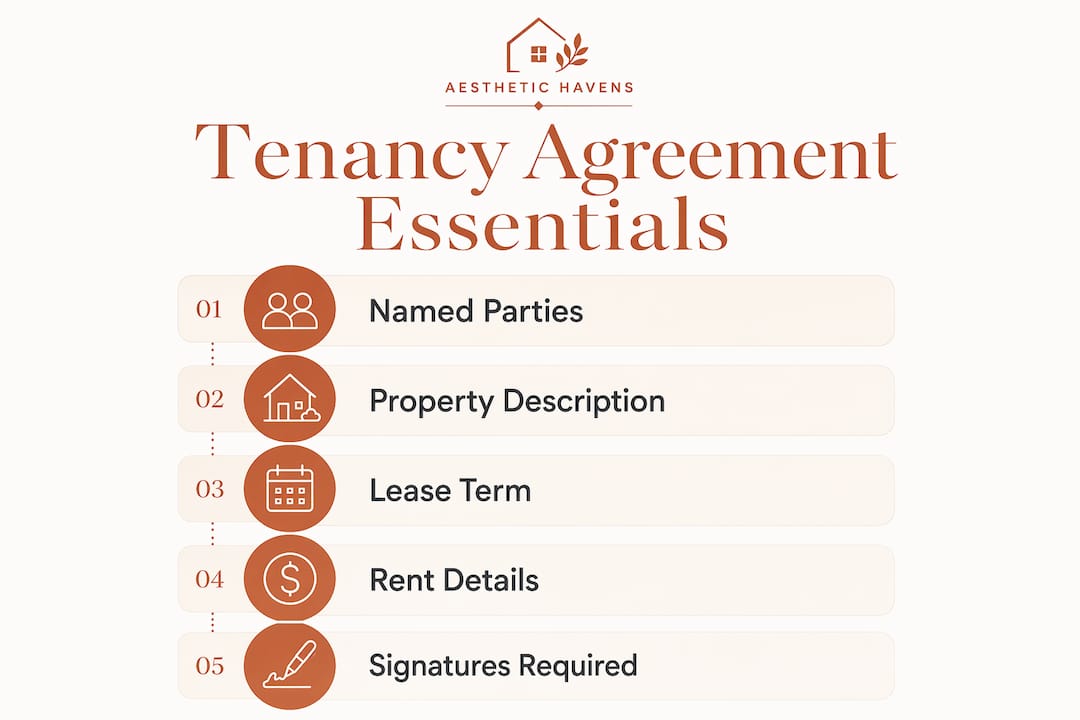
Missing signatures are the most common enforceability problem. If only one adult tenant signs and others live in the unit, the unsigned occupants may not be bound by the lease terms, which complicates eviction. Every adult who will reside in the property should sign.
The Statute of Frauds is the other major threshold. Any residential lease for more than one year must be in writing. An oral agreement for an 18-month tenancy is unenforceable even if both parties remember the exact terms. For month-to-month arrangements, oral agreements are technically valid, but they leave both parties exposed when memories diverge.
Vague or omitted clauses create a different problem: courts may fill gaps with state law defaults, which may not match what either party intended. A clause that says “tenant is responsible for repairs” without defining a dollar threshold or a reporting procedure is almost useless in court.
Pro Tip: Before signing, confirm that every adult occupant’s name appears on the agreement and that all signature lines are completed. An unsigned lease is not a lease.
What are the rights and obligations of landlords and tenants?
Both sides carry legal duties that exist whether or not the lease spells them out.
Landlord obligations:
- Maintain the unit in a habitable condition. The implied warranty of habitability requires working plumbing, heat, and weatherproofing at minimum. This protection cannot be waived by lease language, even if a tenant signs a clause attempting to disclaim it.
- Make repairs within a reasonable time after written notice from the tenant.
- Respect the tenant’s right to quiet enjoyment. Repeated unannounced entry or harassment can constitute constructive eviction.
- Provide all required disclosures. Federal law mandates a lead-based paint disclosure for pre-1978 housing. Many states add mold, bedbug history, or flood-zone disclosures.
- Comply with the Fair Housing Act, which prohibits discrimination based on race, color, national origin, religion, sex, familial status, and disability.
Tenant obligations:
- Pay rent in full and on time.
- Keep the unit reasonably clean and avoid damage beyond normal wear and tear.
- Follow the use restrictions in the lease (no unauthorized pets, no subletting without permission).
- Report maintenance problems promptly and in writing.
- Allow the landlord access for repairs with proper notice.
Documentation matters on both sides. A landlord who sends repair notices by email has a timestamp. A tenant who photographs a broken heater the day they report it has evidence. Courts favor the party with the paper trail.
How do security deposits and move-out inspections work?
The security deposit is the most litigated part of any tenancy. Getting it right starts at move-in, not move-out.
Your lease should state the deposit amount, where it is held (many states require a separate escrow account), what deductions are permitted, and the return deadline. State law governs the return timeline, and many jurisdictions require landlords to return the deposit with an itemized list of any deductions within a statutory window after move-out. Failing to meet that deadline can result in penalties, sometimes the full deposit amount regardless of actual damages.
Pro Tip: Conduct a joint move-in inspection with the landlord on day one. Photograph every scuff, stain, and imperfection with timestamps. Share the photos by email so there is a dated record both parties have seen.
At move-out, request a walk-through inspection before you hand over the keys. Many states give tenants the right to a pre-move-out inspection so they can fix issues before deductions are taken. If a landlord refuses to conduct one, document that refusal in writing.
When disputes arise, the process is: send a written demand letter first, then small claims court if the landlord does not respond. Bring the move-in report, timestamped photos, the lease, and any written communications. Courts respond well to organized evidence.
How does a tenancy end, and what happens if you break a lease?
Ending a tenancy correctly protects both parties. Doing it wrong can mean lost deposits, unpaid rent liability, or an eviction record.
For tenants giving notice:
- Check the lease for the required notice period and the required form (written notice is almost always required).
- Deliver notice in writing, by a method that creates a record: certified mail, email with read receipt, or personal delivery with a signed acknowledgment.
- Note the exact date notice is delivered. The notice period typically starts the day after delivery, not the day you write the letter.
- Continue paying rent through the end of the notice period.
- Schedule a move-out inspection and return all keys on or before the last day.
For landlords issuing termination notices:
- Identify the legal basis: non-payment, lease violation, or end of term.
- Use the correct notice type for your state (pay-or-quit, cure-or-quit, or unconditional quit).
- Serve notice by a method your state recognizes as valid (personal service, posting and mailing, or certified mail).
- Wait out the statutory cure period before filing for eviction.
When a tenant breaks a lease early:
Most states require landlords to make a reasonable effort to re-rent the unit and mitigate damages. A tenant who breaks a lease is not automatically liable for every remaining month of rent if the landlord could have re-rented the unit. Document re-listing efforts.
For month-to-month tenancies, California requires 60 days’ notice for tenancies over one year; most other states require 30 days. Statutory notice periods are minimums, not suggestions.
One firm rule: self-help evictions are illegal everywhere in the United States. A landlord who changes the locks, shuts off utilities, or removes a tenant’s belongings without a court order faces significant liability. If a tenant refuses to leave, the landlord must file for eviction through the courts.
What mistakes do tenants and landlords most often make?
Most tenancy disputes trace back to something that could have been caught before signing.
Common tenant mistakes:
- Signing without reading the full agreement, including addenda.
- Failing to document preexisting damage at move-in.
- Relying on verbal promises from a landlord. If it is not in writing, it does not exist legally.
- Ignoring vague clauses like “tenant agrees to maintain the property in good condition” without a defined standard.
Common landlord mistakes:
- Using a generic online template without checking state-specific requirements.
- Omitting required disclosures, which can create liability and affect enforceability.
- Writing a right-of-entry clause that does not specify the required notice period.
- Failing to include a clear holdover clause, leaving rent terms ambiguous if the tenant stays past the end date.
Pro Tip: Any change to the lease after signing must be a written amendment signed by both parties. A landlord who verbally agrees to allow a pet, or a tenant who verbally agrees to pay for a repair, has no enforceable agreement without a signed document.
When a dispute escalates beyond a demand letter, mediation is often faster and cheaper than small claims court. Many cities and counties offer free or low-cost landlord-tenant mediation. If the amount in dispute exceeds the small claims limit in your state (which varies from $2,500 to $25,000), you will need an attorney.
A practical checklist and sample clauses for your contract
Before signing any rental contract, run through this checklist. Every item should be clearly addressed in the document.
- Full legal names of all parties (landlord and every adult tenant)
- Complete property address, including unit number and any included spaces
- Clear statement of term: fixed end date or “month-to-month”
- Rent amount, due date, grace period, and late fee
- Security deposit amount, holding account, allowable deductions, and return timeline
- Maintenance responsibilities for both parties, with a repair-reporting procedure
- Right-of-entry notice requirement (24 hours is standard; confirm your state’s rule)
- Subletting policy: permitted, prohibited, or permitted with written landlord consent
- Renewal and holdover terms: what happens at lease end
- All required state and federal disclosures (lead-based paint for pre-1978 homes)
- Signatures of the landlord and all adult tenants
Sample clause language (plain English):
Rent and late fee: “Tenant agrees to pay $[amount] on the 1st of each month. Rent not received by the 5th is subject to a late fee of $[amount]. Landlord will accept payment by [method].”
Security deposit return: “Landlord will return the security deposit, less any itemized deductions for unpaid rent or damages beyond normal wear and tear, within [X] days of move-out, as required by [State] law.”
Right of entry: “Landlord will provide at least 24 hours’ written notice before entering the premises for non-emergency inspections or repairs. In case of emergency, Landlord may enter without notice.”
Holdover: “If Tenant remains in possession after the lease end date without a signed renewal, the tenancy converts to month-to-month under the same terms, with either party able to terminate on 30 days’ written notice. Holdover rent remains $[amount] per month.”
Customize these snippets for your state’s specific rules. If you are unsure whether a clause complies with local law, consult a licensed attorney or a tenant rights organization in your area before signing.
Red flags and legal tips practitioners flag most often
Experienced landlord-tenant practitioners see the same drafting problems repeatedly. These are the ones worth knowing before you sign or draft anything.
A “good behavior” clause with no definition is nearly unenforceable. Courts have consistently found that vague conduct requirements give landlords too much discretion over deposit deductions. Replace vague rules with explicit language on pets, smoking, subletting, and noise levels.
Unnamed adult occupants are a serious gap. If a person lives in the unit but did not sign the lease, they may not be bound by its terms. Evicting an unnamed occupant can require a separate legal process in some states.
Missing lead-based paint disclosure language is not just a technicality. For homes built before 1978, the federal disclosure requirement is mandatory. Omitting it can expose a landlord to federal liability.
Overly broad indemnity clauses, where a tenant agrees to hold the landlord harmless for essentially anything, are frequently unenforceable. Courts will not enforce clauses that attempt to waive the implied warranty of habitability or shift statutory landlord duties to the tenant.
Pro Tip: Check for a holdover clause before signing. If the lease is silent on what happens when the term ends, you may face a holdover penalty rate rather than a clean month-to-month conversion. Practitioners advise reading the holdover terms carefully — a poorly drafted clause can mean paying significantly more than your standard monthly rent if you stay even one day past the end date.
One more: require that the lease spell out how and when tenants must report repair problems. A lease that says “landlord will make repairs” without a reporting procedure leaves both parties guessing about timelines and responsibility.
Key Takeaways
A tenancy agreement is a legally binding contract that protects both landlord and tenant, but only when it is written clearly, signed by all parties, and compliant with state and federal law.
| Point | Details |
|---|---|
| Written agreement is critical | Leases over one year must be in writing under the Statute of Frauds; oral agreements are difficult to enforce. |
| All adults must sign | Unsigned occupants may not be bound by lease terms, complicating eviction and liability. |
| Habitability cannot be waived | The implied warranty of habitability applies regardless of lease language in most U.S. states. |
| Deposit disputes start at move-in | Timestamped photos and a signed move-in report are the strongest evidence in small claims court. |
| Notice periods vary by state. For month-to-month tenancies, the standard termination notice is 30 days in most states, but California requires 60 days for tenancies over one year. |
Why contract clarity matters more than most people realize
There is a tendency, on both sides of a rental relationship, to treat the lease as a formality. You sign it, you file it, and you never look at it again until something goes wrong. That is exactly when the gaps show up.
What strikes me most, working across property transactions in different markets, is how often disputes come down not to bad faith but to ambiguity. A landlord who genuinely believed the tenant was responsible for a repair. A tenant who genuinely believed the pet deposit was refundable. Neither party was lying. The lease just did not say.
Precise tenancy language is not about distrust. It is about giving both parties a shared reference point when memory and interpretation diverge, which they always do eventually. A well-drafted agreement that specifies repair-reporting timelines, defines normal wear and tear, and spells out the holdover terms is not a legal weapon. It is a dispute-prevention tool.
For landlords managing multiple properties, the role of property management in enforcing lease terms and maintaining documentation is worth considering seriously. For anyone navigating complex tenancy arrangements or cross-border investments, working with a property consultant who understands both the legal framework and the practical realities of the market makes a measurable difference.
The bottom line: read the lease before you sign it. Every clause. If something is vague, ask for clarification in writing. If something is missing, add it. The five minutes you spend on that is worth more than any legal fee you might pay later.
Authoritative sources for state-specific rules and required disclosures
When you need to verify local requirements, these are the resources worth bookmarking.
Federal resources:
- HUD Fair Housing: The U.S. Department of Housing and Urban Development publishes fair housing guidance and complaint procedures at hud.gov. This is the primary source for anti-discrimination rules under the Fair Housing Act.
- EPA Lead-Based Paint Disclosure: The Environmental Protection Agency provides the required disclosure form and landlord obligations for pre-1978 housing at epa.gov/lead.
- Cornell Law School Legal Information Institute (LII): The LII Wex dictionary at law.cornell.edu/wex is a reliable starting point for definitions of legal terms including rental agreement, implied warranty of habitability, and Statute of Frauds.
Model acts and state statutes:
- Uniform Residential Landlord and Tenant Act (URLTA): Many states have adopted URLTA in whole or in part. It sets statutory minimums for habitability, notice periods, and security deposit handling. Check whether your state is a URLTA state, as it affects which defaults apply when a lease is silent.
- State legislature websites: Every state publishes its landlord-tenant statutes online. Search “[your state] landlord tenant act” to find the governing statute. Pay particular attention to sections on security deposit limits, required disclosures, notice periods, and habitability.
Practical legal resources:
- FindLaw (findlaw.com): Offers plain-English summaries of landlord-tenant law by state, including notice requirements and eviction procedures.
- Nolo (nolo.com): Detailed state-by-state guides on lease requirements, tenant rights, and security deposit rules. Particularly useful for understanding state-specific disclosure obligations.
- Local tenant rights organizations: Most major cities have a tenant rights hotline or legal aid organization that can advise on local ordinances, which sometimes impose stricter rules than state law.
This article is general information, not legal advice. Tenancy laws vary significantly by state and locality. Confirm current requirements with your state’s landlord-tenant statute or a licensed attorney before signing or drafting any rental agreement.


