


Real estate investing follows a clear sequence: assess your finances, choose a strategy, research markets and properties, secure financing, perform due diligence, close the deal, and manage your asset. Most beginners complete that full cycle in 3–6 months, including a 30–60 day closing period after going under contract. The four core strategies worth knowing from day one are buy and hold, house hacking, flipping, and REITs. Each one suits a different combination of capital, time, and risk tolerance.
Here is the essential sequence at a glance:
- Step 1: Assess your credit score, savings, and debt-to-income ratio
- Step 2: Choose an investment strategy that fits your capital and goals
- Step 3: Research target markets and identify candidate properties
- Step 4: Run the numbers using the 1% rule, cap rate, and cash-on-cash return
- Step 5: Secure financing (conventional loan, FHA, DSCR, or other)
- Step 6: Perform due diligence, negotiate, and go under contract
- Step 7: Close the deal and set up your property management system
- Step 8: Monitor performance and plan your next move
Which real estate investing strategy fits you as a beginner?
The first real decision in any property investment process is not which house to buy. It is which strategy to pursue. Getting that wrong costs far more than overpaying for a property.
Active vs. passive investing
Active investing means you are directly involved: finding deals, managing tenants, or overseeing renovations. Passive investing means your capital does the work while someone else handles operations. Neither is superior. The right choice depends on how much time you have and how hands-on you want to be.
Active strategies:
- Buy and hold: You purchase a property, rent it out, and collect monthly cash flow while the asset appreciates over time. This is the most common starting point for long-term wealth building. Capital requirement is moderate to high; risk is moderate if you buy in a stable market.
- Flipping: You buy a distressed property, renovate it, and sell for a profit, typically within 6–12 months. Returns can be strong, but the capital requirement is high and the risk is significant. Renovation cost overruns kill margins fast.
- House hacking: You live in one unit of a multi-family property (or rent out spare bedrooms) while tenants cover part or all of your mortgage. House hacking lets you access owner-occupied financing with lower down payments and gain hands-on management experience with tenants nearby. It is widely regarded as the most practical entry point for new investors with limited capital.
Passive strategies:
- REITs (Real Estate Investment Trusts): You buy shares in a company that owns income-producing properties, similar to buying stock. No property management, no large down payment, and you can start with a few hundred dollars. The tradeoff is less control and returns tied to market sentiment. For a deeper look at how REITs fit a beginner portfolio, the role of REITs in property investment is worth understanding before you commit capital.
Pro Tip: If you are unsure where to start, house hacking gives you the best of both worlds: lower upfront costs, real management experience, and a live-in safety net if a unit sits vacant.
How to assess your financial readiness before investing
Skipping this step is the single most common reason beginners fail on their first deal. You need to know your numbers before you ever look at a listing.
The four financial pillars lenders and experienced investors check first:
- Credit score: Most conventional investment loans require a score of 680 or higher. FHA loans (used in house hacking scenarios) allow scores as low as 580 with a 3.5% down payment.
- Down payment: Investment properties typically require a significant down payment. FHA owner-occupied financing can require a much lower down payment.
- Reserves: Lenders want to see several months of mortgage payments in liquid savings after closing. This protects you if a tenant leaves or a major repair hits.
- Debt-to-income ratio (DTI): Most lenders cap debt-to-income ratios at a moderate percentage. High student loans or car payments can disqualify you even with a strong income.
The total capital requirement surprises most beginners. A $150,000 property realistically requires $40,000–$55,000 in total liquidity when you account for the down payment (20–25%), closing costs (2–4%), and reserves. Budget for all three before you start shopping.
Pro Tip: Build your reserve fund separately from your down payment savings. Lenders verify both, and depleting reserves at closing leaves you one bad month away from financial stress.

How to select and evaluate investment properties
Location is not just a cliché. It is the variable that determines whether a property generates cash flow or bleeds money for years. The best property in the wrong market is still a bad investment.
Core selection criteria:
- Rent-to-price ratio: The 1% rule states that monthly rent should be roughly proportional to the purchase price, aiming for a certain minimum ratio. A $200,000 property should rent for $2,000/month or more. Markets where this is achievable tend to be in the Midwest and Southeast rather than coastal cities.
- Neighborhood quality: Look at school ratings, crime data, vacancy rates, and job market trends. A neighborhood on the way up is more valuable than one already at its peak.
- Property condition: Older properties with deferred maintenance eat cash flow. Budget for a professional inspection before making any offer.
Key investment metrics every beginner should analyze before buying:
| Metric | What It Measures | Target Range |
|---|---|---|
| 1% Rule | Monthly rent vs. purchase price | Rent ≥ 1% of price |
| Net Operating Income (NOI) | Annual rental income minus operating expenses | Positive; higher is better |
| Cap Rate | NOI divided by property value | 5%–10% for most markets |
| Cash-on-Cash Return | Annual cash flow divided by cash invested | 8%–12% is a solid target |
Verifying comparable sales (comps) is non-negotiable. Pull recent sales data from county records or a licensed agent, not just listing sites. Listing prices are aspirational; closed sales are reality. For a structured approach to selecting investment property, working through each metric systematically prevents emotional buying decisions.
Pro Tip: Run the numbers on at least 20–30 properties before making your first offer. The exercise trains your eye for what a real deal looks like versus a mediocre one dressed up with fresh paint.
What financing options are available for beginner investors?
Financing is where many beginners either get stuck or make expensive mistakes. The loan type you choose affects your down payment, monthly payment, and long-term flexibility.
Main loan types for new investors:
- Conventional loans: The standard choice for investment properties. Require 20–25% down, a credit score of 680+, and full income documentation. Interest rates are typically lower than alternative products.
- FHA loans: Available only for owner-occupied properties, making them ideal for house hacking. Down payments as low as 3.5% with a qualifying credit score. You must live in one unit for at least one year.
- DSCR loans: Debt Service Coverage Ratio loans qualify borrowers based on the property’s rental income covering the mortgage at 1.0x–1.25x, with no personal income underwriting. This makes them well-suited for self-employed investors or those building a portfolio beyond their first property.
- Hard money loans: Short-term, asset-based loans used primarily by flippers. Fast to close but carry high interest rates and fees. Not appropriate for buy-and-hold strategies.
- Seller financing: The seller acts as the lender, often with flexible terms. Rare but powerful when you find a motivated seller willing to negotiate.
Common financing questions beginners ask:
Can I use a conventional loan for my first rental property? Yes, if you are not living in it. You will need 20–25% down and strong credit. If you plan to live in one unit, FHA financing opens with a much lower down payment.
What credit score do I need? Conventional investment loans typically require 680 or higher. DSCR loans vary by lender but often start at 620–640 since the property’s income is the primary qualifier.
How do DSCR loans work in practice? The lender divides the property’s expected monthly rent by the monthly mortgage payment. A ratio of 1.25 means the rent covers the mortgage with 25% to spare. Understanding mortgage preparation steps before you apply saves time and avoids surprises at underwriting.
Managing rental properties and tracking your investment
Owning a rental property and managing it well are two different skills. Most beginner investors underestimate the second one.
Landlord fundamentals:
- Tenant screening: Run credit checks, verify income (aim for 3x monthly rent), check rental history, and call previous landlords. A bad tenant costs far more than a vacant unit.
- Lease agreements: Use a state-specific lease that complies with local landlord-tenant law. Generic templates from the internet create legal exposure. The National Apartment Association publishes lease resources that reflect current legal standards.
- Maintenance systems: Set up a dedicated email or property management software for maintenance requests. Responding within 24 hours protects your legal standing and keeps good tenants.
- Rent collection: Automate it. Platforms like Buildium, AppFolio, or even a simple bank transfer setup eliminate the awkward monthly chase.
- Expense tracking: Keep a separate bank account for each property. Every repair, insurance payment, and mortgage payment should run through it. This makes tax time straightforward and gives you a clear picture of actual cash flow.
Deciding between self-management and hiring a property manager usually comes down to scale and geography. A single local property is manageable yourself. Multiple properties, or anything out of state, often justifies a manager who charges 8–12% of monthly rent.
Pros and cons of real estate investing for beginners
Real estate builds wealth, but it is not passive income in the way social media makes it look. Going in with clear expectations prevents costly surprises.
Advantages:
- Cash flow: A well-purchased rental generates monthly income after all expenses, including the mortgage.
- Equity building: Each mortgage payment reduces your loan balance while the property (ideally) appreciates.
- Tax benefits: Depreciation, mortgage interest deductions, and the ability to defer capital gains through a 1031 exchange are legitimate advantages unavailable to stock investors.
- Inflation hedge: Rents and property values historically rise with inflation, protecting purchasing power over time.
- Leverage: You control a $200,000 asset with $40,000–$50,000 of your own money. No other common investment class offers that ratio.
Disadvantages:
- Illiquidity: You cannot sell a property in an afternoon the way you can sell a stock. Exiting takes months.
- Capital requirements: The upfront cost is high compared to other asset classes.
- Management burden: Tenants, repairs, and vacancies demand time and attention, especially in the early years.
- Market risk: Local economic downturns, rising interest rates, or oversupply can compress values and rents.
- Concentration risk: A single property in a single market is not a diversified portfolio.
Common mistakes beginners make in real estate investing
Most first-time investors do not fail because they picked the wrong property. They fail because of decisions made before they ever made an offer.
Mistakes that derail beginners:
- Analysis paralysis: Studying the market indefinitely without acting. Practicing daily deal analysis for several weeks builds the confidence and pattern recognition needed to act decisively when a real opportunity appears.
- Overleveraging: Borrowing the maximum the lender will approve leaves no margin for vacancy, repairs, or rate changes. Borrow conservatively on your first deal.
- Ignoring reserves: Closing without adequate cash reserves is the fastest path to a forced sale. Budget for 3–6 months of expenses beyond closing costs.
- Skipping due diligence: Waiving inspections in a competitive market is understandable but dangerous. At minimum, get a sewer scope and a roof inspection on any older property.
- Chasing perfection: Waiting for the perfect deal means waiting forever. Successful investing focuses on deals that meet your minimum predefined criteria, not ones that check every box on an idealized list.
- Underestimating total costs: Property taxes, insurance, vacancy, maintenance, and property management fees typically consume 35–50% of gross rent. Run your numbers on actual expenses, not optimistic projections.
- Going it alone: Trying to learn every discipline simultaneously (legal, tax, construction, finance) slows progress. Build a team instead.
Expert insights on building a solid foundation before your first deal
The investors who close their first deal confidently are rarely the ones who studied the most. They are the ones who built a foundation first and then acted on it.
What that foundation looks like in practice:
- One strategy, mastered: Pick buy and hold, house hacking, or flipping. Learn it deeply before you consider the others. Spreading attention across multiple strategies at the start produces shallow knowledge of all of them.
- A functional team: At minimum, you need a real estate agent who works with investors (not just homebuyers), a lender who understands investment financing, and a contractor you can trust for repair estimates. For a structured approach to assembling your investment team, treat it as a prerequisite, not an afterthought.
- Daily deal analysis: Run the numbers on one property every day for 30–60 days before you make your first offer. You will develop an instinct for what a deal looks like that no book can teach.
- Defined minimum criteria: Know your floor before you start negotiating. Minimum cash-on-cash return, maximum purchase price, minimum rent-to-price ratio. Without these, emotion drives decisions.
Starting with single-family homes is the most common expert recommendation for beginners. They are easier to finance, easier to manage, and easier to sell than multi-family or commercial properties. The learning curve is real but manageable.
Pro Tip: Treat your first property as a paid education, not a get-rich-quick vehicle. If it cash flows modestly and teaches you the process, it has done its job.
How long does it realistically take to buy your first investment property?
Most beginners underestimate the timeline. Rushing it creates mistakes; understanding it creates confidence.
A realistic schedule for a first investment property breaks down like this:
Months 1–2: Foundation phase
Set your investment goals, choose your strategy, and get pre-approved for financing. Use this time to run daily deal analyses and build your team. Do not skip pre-approval. Sellers and agents take you seriously only when you have a lender letter in hand.
Months 2–4: Market research and property search
Identify your target market using job growth data, population trends, and rental vacancy rates. Start making offers once your analysis confirms a market meets your criteria. Expect to submit multiple offers before one is accepted, especially in competitive markets.
Months 4–6: Under contract through closing
Once under contract, the 30–60 day closing period covers inspections, appraisal, final loan approval, and title work. Use this time to line up property management or a tenant if the property will be vacant at closing.
The full process from decision to keys in hand typically runs 3–6 months. Investors who try to compress it below 60 days usually skip steps that cost them later.
Legal and tax considerations every new investor should understand
Real estate has more favorable tax treatment than almost any other asset class, but only if you set things up correctly from the start.
Legal structure: Many investors hold properties in a Limited Liability Company (LLC) to separate personal assets from investment liabilities. An LLC does not eliminate risk, but it limits exposure if a tenant sues. Consult a real estate attorney before your first closing to decide whether an LLC makes sense for your situation and state.
Key tax advantages:
- Depreciation: The IRS allows residential rental property to be depreciated over 27.5 years. On a $200,000 property, that is roughly $7,272 in annual paper losses that offset rental income, even if the property is cash-flowing positively.
- Mortgage interest deduction: Interest paid on investment property loans is deductible against rental income.
- 1031 exchange: When you sell an investment property, you can defer capital gains taxes by rolling the proceeds into a like-kind property within 180 days. This is one of the most powerful wealth-building tools in real estate.
- Pass-through deductions: Under current tax law, many real estate investors qualify for a 20% deduction on qualified business income through pass-through entities.
Practical steps: Open a dedicated bank account for each property before your first tenant moves in. Track every expense with receipts. Work with a CPA who specializes in real estate, not a generalist. The tax code rewards organized investors and punishes disorganized ones.
Exit strategies and planning for future investments
Every property you buy should have a planned exit before you close. Markets change, personal circumstances shift, and the strategy that made sense at purchase may not make sense in five years.
Common exit strategies:
- Long-term hold and refinance: Hold the property, let it appreciate, then do a cash-out refinance to pull equity for the next purchase. This is the most common wealth-building path for buy-and-hold investors. Understanding how to refinance investment property for better rates is a skill worth developing early.
- Sell outright: Straightforward but triggers capital gains taxes. Best used when the market has peaked locally or the property no longer fits your portfolio goals.
- 1031 exchange: Sell and roll proceeds into a larger or better-located property, deferring taxes and compounding equity. Requires strict timing and a qualified intermediary.
- Seller financing your exit: When you sell, you become the lender. The buyer pays you monthly installments, creating income and spreading your tax liability over time.
Planning for your second and third property starts at the first closing. Track your equity position, cash-on-cash return, and net operating income quarterly. When equity reaches a threshold that funds a second down payment, you have a decision point. The investors who build portfolios do not wait for perfect conditions. They create systems that generate the next opportunity from the current one. For a practical framework on expanding your real estate portfolio, the principles are consistent regardless of market conditions.
The complete step-by-step process from start to first closing
This is the full sequence, consolidated into a single reference you can work through in order.
Step 1: Set clear investment goals
Define what success looks like. Monthly cash flow target, total number of properties in five years, preferred strategy. Vague goals produce vague results.
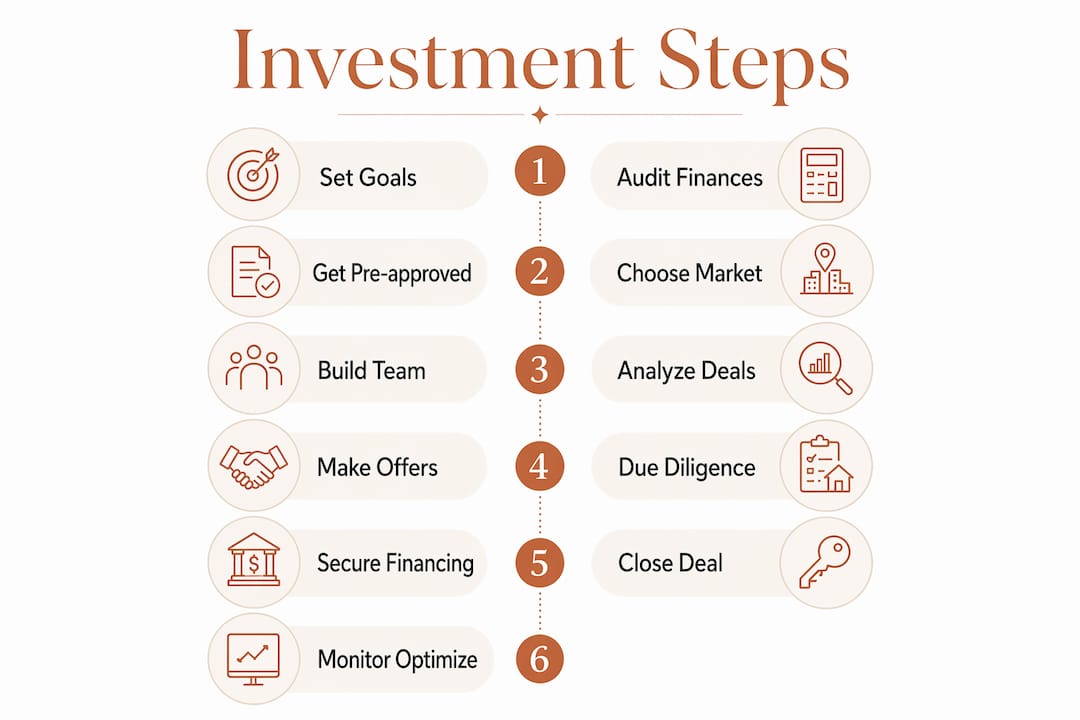
Step 2: Audit your finances
Pull your credit report, calculate your DTI, and total your liquid savings. Know exactly what you have before you talk to a lender.
Step 3: Get pre-approved
Speak with at least two lenders before choosing one. Compare rates, fees, and loan products. A pre-approval letter is your entry ticket to serious deal negotiations.
Step 4: Choose your market
Research cities and neighborhoods using job growth, population trends, rental demand, and price-to-rent ratios. Local knowledge matters, but data confirms it.
Step 5: Build your team
Investor-friendly agent, lender, real estate attorney, CPA, and contractor. Assemble these relationships before you need them urgently.

Step 6: Analyze deals daily
Run the numbers on properties in your target market every day. Use the 1% rule, cap rate, and cash-on-cash return as your filters. This practice is what separates confident buyers from hesitant ones.
Step 7: Make offers
Once a property meets your minimum criteria, make an offer. Include inspection contingencies. Expect negotiation.
Step 8: Perform due diligence
Hire a licensed inspector. Review title history, HOA documents if applicable, and local rental regulations. Verify actual rent comps, not the seller’s projections.
Step 9: Secure final financing
Submit all required documents promptly. Respond to lender requests within 24 hours to avoid closing delays.
Step 10: Close and set up management
Sign closing documents, fund the transaction, and receive keys. Have your lease template, tenant screening criteria, and maintenance contact list ready before day one.
Step 11: Monitor and optimize
Review cash flow monthly. Track expenses against projections. Adjust rent at lease renewal based on current market rates. Revisit your exit strategy annually.
Key Takeaways
Real estate investing rewards preparation: investors who assess their finances, choose one strategy, and build a team before making offers consistently outperform those who rush to buy without a foundation.
| Point | Details |
|---|---|
| Total capital needed | A $150,000 property requires $40,000–$55,000 in total liquidity for down payment, closing costs, and reserves. |
| Realistic timeline | The full process from decision to closing typically takes 3–6 months, including a 30–60 day closing period. |
| Best beginner strategy | House hacking combines owner-occupied financing benefits with hands-on management experience and lower upfront costs. |
| DSCR loan advantage | DSCR loans qualify on rental income at 1.0x–1.25x coverage, bypassing personal income documentation for eligible investors. |
| Aesthetic Havens guidance | Aesthetic Havens provides property investment resources and expert advisory to help beginners select and evaluate their first property. |
What most beginner guides get wrong about starting in real estate
The standard advice is to “start small and learn as you go.” That framing is half right and half dangerous. Starting small is correct. Learning as you go, without a foundation, is where beginners lose money they cannot afford to lose.
The piece most guides skip is the 60-day preparation window before your first offer, not 60 days of reading books. Sixty days of running real deal analyses on real properties in your real target market. That practice is what converts theoretical knowledge into pattern recognition. When a deal appears that actually meets your criteria, you recognize it in minutes instead of spending weeks second-guessing yourself.
The other thing guides consistently understate is the team. New investors treat the agent, lender, and attorney as service providers they hire when needed. The investors who move faster and make fewer mistakes treat those relationships as infrastructure they build before they need them. Your agent should be sending you off-market leads. Your lender should be advising you on which loan structure fits your next purchase, not just the current one.
Real estate is not complicated. It is just slow and capital-intensive, which means mistakes are expensive and take time to correct. The investors who succeed are not smarter. They are more prepared, more patient, and more willing to run the numbers on a hundred properties before they buy one.
Ready to invest with expert guidance behind you?
Knowing the steps is one thing. Executing them in a real market, with real capital on the line, is where most beginners benefit from professional support.

Aesthetic Havens gives beginner investors direct access to property advisory expertise across residential, commercial, and international markets. Rather than piecing together advice from generic sources, you get structured guidance on selecting investment property that fits your financial profile and goals. Whether you are evaluating your first rental, exploring REITs, or planning a multi-property portfolio, the advisory resources at Aesthetic Havens are built for investors who want to move with confidence, not guesswork. Explore the full real estate wealth creation strategies guide to see how a structured approach to property investment translates into long-term results.


