


The role of URA in property splits into two distinct entities that share an acronym but operate in entirely different jurisdictions. The Urban Redevelopment Authority (URA) is a local government agency, most prominently Singapore’s national land-use planning authority, responsible for shaping cities through zoning, property acquisition, and redevelopment oversight. The Uniform Relocation Assistance Act (URA), codified at 42 U.S.C. § 4601, is a federal U.S. law that protects people displaced by government-funded property acquisitions. Knowing which URA applies to your situation determines everything from what permissions you need to what compensation you are owed.
Here is a quick breakdown of each entity’s core function:
- Urban Redevelopment Authority: Plans and regulates land use, issues planning permissions, oversees property redevelopment, and enforces property use guidelines at the local level.
- Uniform Relocation Assistance Act: A federal U.S. statute that guarantees just compensation, relocation assistance, and advisory services to persons displaced by federally funded projects.
- Jurisdictional scope: The Urban Redevelopment Authority operates at the city or national level (Singapore being the primary example); the Uniform Relocation Assistance Act applies wherever federal financial assistance touches a U.S. property acquisition project.
- Who they affect: The Urban Redevelopment Authority affects developers, property owners, and businesses seeking to use or change property; the Uniform Relocation Assistance Act protects homeowners, tenants, and businesses displaced by government-funded acquisitions.
How the Urban Redevelopment Authority shapes property acquisition and redevelopment
The Urban Redevelopment Authority’s mandate goes well beyond issuing permits. It controls what gets built, where, and for what purpose, making it the single most consequential body for anyone buying, developing, or repurposing property in its jurisdiction.
Land-use regulation and planning permission
Every property sits within a zoning category defined by the URA Master Plan, which is reviewed periodically to reflect evolving city goals. Changing a property’s approved use, say from a retail shop to a commercial school, requires planning permission from URA before any tenancy or renovation begins. A common and costly mistake: assuming a previously approved use remains valid indefinitely. URA requires a fresh assessment for each change, because planning intentions shift over time.
Property acquisition and disposition
When the Urban Redevelopment Authority acquires land for redevelopment, it follows a structured process: site identification, valuation, negotiation with owners, and formal acquisition notices. Disposition of state land follows similar rigor, with URA coordinating with the Singapore Land Authority (SLA) on land betterment charges that may apply when use intensity increases.
Multi-agency collaboration
URA does not work in isolation. Change-of-use assessments involve the Singapore Land Authority, Land Transport Authority (LTA), Singapore Police Force (SPF), and the National Environment Agency (NEA). Each agency evaluates whether a proposed use meets its own requirements, from traffic impact to fire safety, before URA grants approval.
Short-term accommodation restrictions
One of the URA’s most enforced property guidelines covers residential use. Residential properties must be used for long-term residency, with short-term rentals of fewer than three consecutive months prohibited. Violations carry real penalties, and URA actively monitors compliance.
Market transparency
The URA also publishes private residential transaction data, including price indices and rental figures, giving buyers and investors a factual basis for decisions. For anyone navigating Singapore’s private property market, this data is a primary research tool.
What the Uniform Relocation Assistance Act does for displaced persons
The Uniform Relocation Assistance Act exists because federally funded projects, from highway expansions to urban renewal programs, routinely require acquiring private property and displacing the people who live or work there. Congress passed the Act to make sure that process is fair.
Legislative authority
The Act is codified at 42 U.S.C. §§ 4601–4655 and implemented through 49 CFR Part 24, the federal regulation that spells out exactly how agencies must conduct acquisitions and relocations. The U.S. Department of Housing and Urban Development (HUD) administers compliance and provides oversight across federal programs.
Who qualifies as a displaced person
A displaced person under the Act is any individual, family, business, farm, or nonprofit organization that moves from real property, or moves personal property from real property, as a direct result of a federally funded acquisition, rehabilitation, or demolition project. Renters qualify just as property owners do.
Core protections and benefits
- Just compensation: Property owners receive payment based on fair market value, established through a formal appraisal process.
- Relocation advisory services: Displaced persons receive counseling and referrals to comparable replacement properties.
- Moving cost reimbursements: Actual, reasonable moving expenses are covered, or a fixed moving cost schedule applies.
- Replacement housing payments: Homeowners and tenants may receive supplemental payments to cover the gap between their old housing cost and the cost of comparable replacement housing.
- Business relocation assistance: Businesses displaced by covered projects can receive reestablishment payments and actual moving costs.
HUD’s oversight role
HUD oversees URA compliance and administers federal programs that fund property acquisition and relocation. Agencies receiving federal funds, called recipients and subrecipients, must follow HUD’s Handbook 1378 and document every step of the process. Failure to comply can result in loss of federal funding.
Key acquisition and relocation processes under the Uniform Relocation Assistance Act
Compliance with the federal URA is procedurally demanding. The sequence of steps matters as much as the substance of each one.

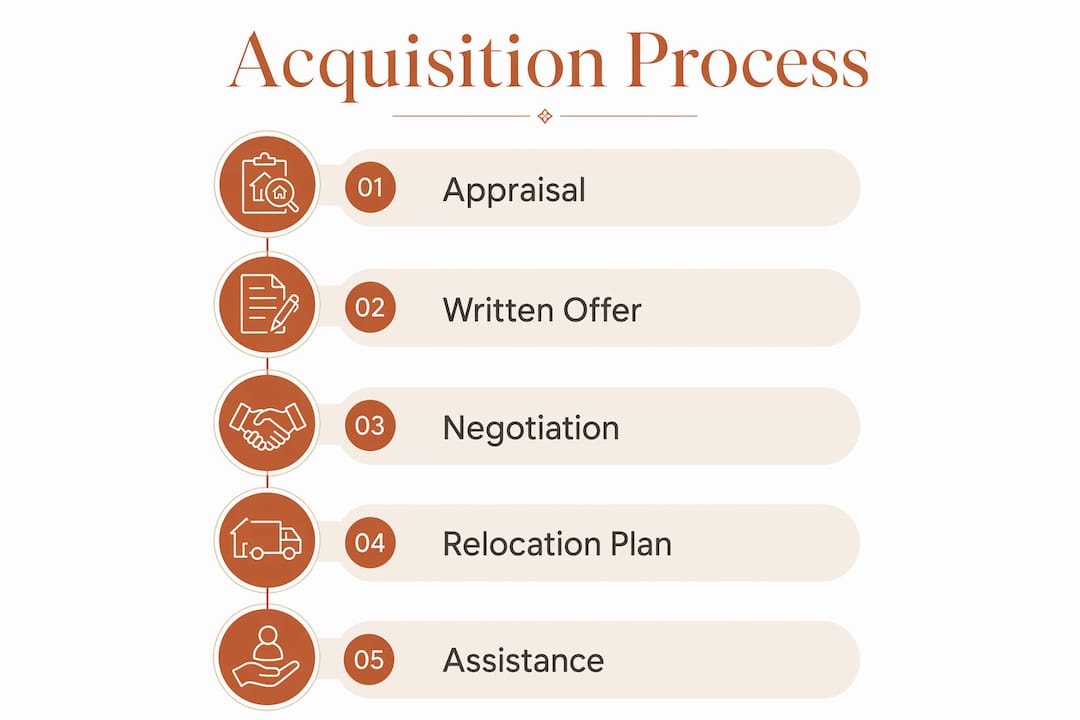
Step 1: Appraisal
Before making any offer, the acquiring agency must commission an independent appraisal of the property at fair market value. The property owner has the right to accompany the appraiser during the inspection. A review appraisal is required when the initial appraisal is disputed or when the acquisition value exceeds a certain threshold.
Step 2: Written offer
The agency must provide a written offer of just compensation to the owner before initiating negotiations. This offer must be no less than the approved appraisal value. The owner receives a summary statement explaining the basis for the offer.
Step 3: Negotiation and acquisition notice
Proper URA acquisition procedures require good-faith negotiation before any condemnation action. If negotiations fail, the agency may proceed with eminent domain, but only after exhausting negotiation requirements. Formal acquisition notices must precede any displacement.
Step 4: Relocation planning
Agencies must develop a relocation plan before displacing anyone. The plan identifies all displaced persons, documents their needs, and outlines the assistance they will receive. Advisory services begin at this stage, not after displacement.
Step 5: Relocation assistance delivery
Moving cost reimbursements, replacement housing payments, and advisory services are delivered according to documented eligibility. Timelines are strict: a displaced person generally cannot be required to move until at least 90 days after receiving a written notice of the date by which the move must occur, and comparable replacement housing must be available before that deadline.
Common compliance pitfalls
- Starting acquisition activities before completing appraisals.
- Failing to notify tenants separately from property owners.
- Triggering URA requirements inadvertently: federal financial assistance anywhere in a project activates URA obligations, even if federal funds do not directly pay for the acquisition itself.
- Inadequate documentation of advisory services and payments.
Community benefits from Urban Redevelopment Authority activities
The Urban Redevelopment Authority’s work produces outcomes that extend well beyond individual property transactions. Its redevelopment programs target blight elimination, economic opportunity, and the rehabilitation of underused properties for productive community use.
Economic revitalization
URA-led redevelopment creates jobs during construction and generates long-term employment through the businesses that occupy redeveloped sites. Expanding the tax base is an explicit goal: bringing vacant or underperforming land into productive use increases assessed values and generates revenue for public services.
Land recycling and blight elimination
Vacant properties and blighted sites represent lost potential. URA programs identify these parcels, acquire them where necessary, and facilitate their transformation into housing, commercial space, or community facilities. The process follows redevelopment laws that govern responsible disposition, preventing speculative holding and ensuring sites reach productive use within defined timelines.
Neighborhood character and amenity
Not every redevelopment project involves demolition and new construction. URA conservation guidelines protect historically and architecturally significant buildings, requiring that renovations preserve character-defining features. This balance between renewal and preservation shapes the livability of urban neighborhoods over decades.
Addressing social displacement tensions
Urban renewal goals and community stability can pull in opposite directions. Redevelopment that raises property values may price out existing residents and businesses, a tension that responsible URA policy addresses through affordable housing requirements, community consultation, and phased relocation planning. The importance of URA in development lies partly in how it manages these competing pressures.
Frequently asked questions about URA’s role in property
What is the difference between the Urban Redevelopment Authority and the Uniform Relocation Assistance Act?
The Urban Redevelopment Authority is a local government planning agency that regulates land use, issues planning permissions, and oversees redevelopment. The Uniform Relocation Assistance Act is a U.S. federal law that protects people displaced by federally funded property acquisitions. They share an acronym but have no legal or operational connection.
When does the Uniform Relocation Assistance Act apply to a project?
The Act applies whenever federal financial assistance is used anywhere in a project, not just when federal funds directly pay for the acquisition. A project receiving a federal grant for construction, for example, triggers URA obligations for any displacement the project causes.
Who counts as a displaced person under the federal URA?
Any individual, family, business, farm, or nonprofit that moves from property as a direct result of a federally funded acquisition, rehabilitation, or demolition qualifies. Tenants and owners both qualify, and the displacement does not have to be involuntary to trigger eligibility.
Does the Urban Redevelopment Authority require planning permission for all renovations?
Not all renovations require planning permission, but any work that changes a property’s approved use, alters its external appearance significantly, or involves structural changes typically does. URA’s Landed Housing e-Advisor helps homeowners assess what approvals their specific project needs before committing to contractors.
What triggers a change-of-use application under the Urban Redevelopment Authority?
Any shift from one approved use category to another, such as converting a shop to a restaurant or a warehouse to a gym, requires a change-of-use application. URA assesses each application against the Master Plan zoning, prevailing guidelines, and compatibility with neighboring properties.
Can a property owner appeal a URA acquisition decision?
Under the Uniform Relocation Assistance Act, property owners who disagree with the compensation offered may request a review and, if unsatisfied, pursue administrative appeals. The agency must document its response. Under local Urban Redevelopment Authority processes, owners typically have formal channels to contest acquisition valuations through the relevant land acquisition tribunal or appeals board.
How URA regulatory frameworks influence property markets and redevelopment
The impact of URA on real estate operates at two levels: the rules that govern individual transactions and the broader market signals those rules send to investors and developers.
Balancing vibrancy and livability
The Urban Redevelopment Authority views its role as actively shaping city development rather than passively regulating it. Zoning decisions, activity-generating use requirements in key precincts, and conservation policies all reflect deliberate choices about what kind of city URA wants to produce. For investors, this means URA’s planning intentions are as important as current market prices when assessing a property’s long-term value.
Tools for feasibility assessment
URA’s SPACE portal maps zoning categories, land-use constraints, and planning parameters across the city. Developers and investors use it for preliminary due diligence before committing to a site. Checking SPACE early can reveal whether a planned use is permissible, whether activity-generating use requirements apply, and what development controls govern the site’s buildable area.
AML/CFT compliance requirements
Property developers operating under URA’s jurisdiction must implement anti-money laundering controls as part of their sales processes. For higher-risk purchasers, including foreign politically exposed persons and buyers from jurisdictions flagged by the Financial Action Task Force, developers must conduct Enhanced Customer Due Diligence, verifying both source of wealth and source of funds. This adds a compliance layer to large property transactions that developers cannot skip.
Market behavior and redevelopment outcomes
URA regulations and property values move together in predictable ways. Areas rezoned for higher density or mixed use typically see land values rise as development potential increases. Conversely, conservation designations can constrain redevelopment options, which affects pricing for affected properties. Understanding URA’s regulatory signals is part of reading the market accurately.
Pro Tip: Before committing to any property acquisition or change-of-use project in a URA-regulated jurisdiction, run the site through the SPACE portal and confirm the Master Plan zoning. A five-minute check can prevent months of wasted planning and negotiation.
Timeline and procedural steps for property acquisition and relocation
Understanding the sequence of events under both URA frameworks helps you anticipate obligations and avoid delays.
Urban Redevelopment Authority acquisition timeline
| Stage | Action | Typical timeframe |
|---|---|---|
| Site identification | URA identifies land for acquisition or redevelopment | Varies by project |
| Valuation | Independent appraisal of affected properties | 4 weeks |
| Notification | Formal acquisition notice issued to owners | Before negotiation begins |
| Negotiation | Offer made and negotiated with property owners | 4 weeks |
| Acquisition | Legal transfer of title, payment of compensation | Upon agreement or tribunal order |
| Redevelopment | Site preparation, tender, and construction | Project-dependent |
Uniform Relocation Assistance Act timeline
| Stage | Action | Requirement |
|---|---|---|
| General information notice | Inform occupants of potential acquisition | As early as feasible |
| Appraisal | Commission independent property valuation | Before written offer |
| Written offer | Deliver just compensation offer to owner | Before negotiations |
| Negotiation | Good-faith discussions with owner | Required before condemnation |
| Notice of relocation | Written notice of required move date | At least 90 days before displacement |
| Relocation assistance | Deliver moving costs, housing payments, advisory services | Before and during move |
| Documentation | Record all payments, notices, and advisory contacts | Ongoing through project close |
The 90-day notice requirement under the federal URA is firm. Agencies that skip or shorten it face compliance findings that can jeopardize federal funding for the entire project.
Real-world examples of URA policies applied in redevelopment projects
Both URA frameworks have shaped major redevelopment outcomes. These examples illustrate how the rules work in practice.
Singapore’s Marina Bay development
The Urban Redevelopment Authority’s long-term planning for Marina Bay transformed reclaimed land into one of Asia’s most recognized business and mixed-use districts. URA designated the area for high-density commercial and residential development, set design guidelines for building heights and setbacks, and coordinated with multiple agencies to deliver infrastructure. The Master Plan zoning drove private investment by giving developers certainty about what could be built and where.
U.S. highway expansion and residential displacement
Federal highway projects funded through the Federal Highway Administration routinely trigger Uniform Relocation Assistance Act obligations. When a state department of transportation acquires residential properties for a highway widening, every displaced homeowner and tenant is entitled to the full range of URA protections: appraisal-based compensation, relocation advisory services, moving cost reimbursements, and replacement housing payments. States that fail to follow 49 CFR Part 24 procedures risk losing federal highway funds, which creates a strong compliance incentive.
HUD-funded urban renewal in U.S. cities
Community Development Block Grant (CDBG) projects funded through HUD frequently involve property acquisition and tenant displacement. Because federal financial assistance flows through the grant, the Uniform Relocation Assistance Act applies to every acquisition and displacement the project causes, regardless of whether the specific acquisition activity is directly funded by the grant. HUD’s oversight role includes reviewing subrecipient compliance, auditing relocation files, and requiring corrective action when procedures are not followed.
Change-of-use redevelopment in Singapore’s shophouse districts
Singapore’s conservation shophouse districts illustrate how URA balances preservation with economic use. Owners who want to convert a shophouse from residential to food and beverage use must apply for planning permission, demonstrate compatibility with neighboring uses, and obtain clearances from agencies including the Singapore Food Agency and the Singapore Civil Defence Force. URA’s contextual assessment means approval is not guaranteed, and owners who begin renovation before receiving a decision risk having to undo completed work.
Key Takeaways
The role of URA in property spans two distinct frameworks: local planning authority over land use and development, and federal law protecting displaced persons in U.S. government-funded acquisitions.
| Point | Details |
|---|---|
| Two separate URA entities | The Urban Redevelopment Authority governs planning and redevelopment; the Uniform Relocation Assistance Act protects displaced persons under federal U.S. law. |
| Federal URA trigger | Any use of federal financial assistance anywhere in a project activates Uniform Relocation Assistance Act obligations, not just direct acquisition funding. |
| 90-day displacement notice | Displaced persons under the federal URA must receive written notice at least 90 days before their required move date. |
| Planning permission requirement | Changing a property’s approved use under the Urban Redevelopment Authority requires a fresh assessment for each change, regardless of prior approvals. |
| AML/CFT compliance | Property developers under URA jurisdiction must conduct Enhanced Customer Due Diligence on high-risk purchasers, including foreign politically exposed persons. |
Navigating URA regulations and property acquisition processes is genuinely complex, whether you are dealing with Singapore’s planning framework or a federally funded U.S. project. A qualified property consultant can map the specific obligations that apply to your situation, identify compliance risks early, and help you move through acquisition or redevelopment without costly procedural errors.

Recommended
- The URA Master Plan 2025: Your Ultimate Guide to Singapore’s Future Property Hotspots and Value Growth | Aesthetic Havens
- Unlocking Value: The Top 5 Undervalued Singapore Neighbourhoods for Property Investment in 2025 | Aesthetic Havens
- CCR vs OCR in 2026: Where is the Better Value for Money? | Aesthetic Havens
- The Ultimate Guide to Smarter Singapore Property Investments in 2025 | Aesthetic Havens


