What is property asset progression, and how does it work?
Property asset progression is the practice of unlocking equity from your current property and reinvesting it into a better-performing asset. You sell or refinance what you own, capture the accumulated value, and put that capital to work in a property with stronger growth potential or higher rental yield. Done well, each move builds on the last, compounding your wealth faster than simply holding one property forever.
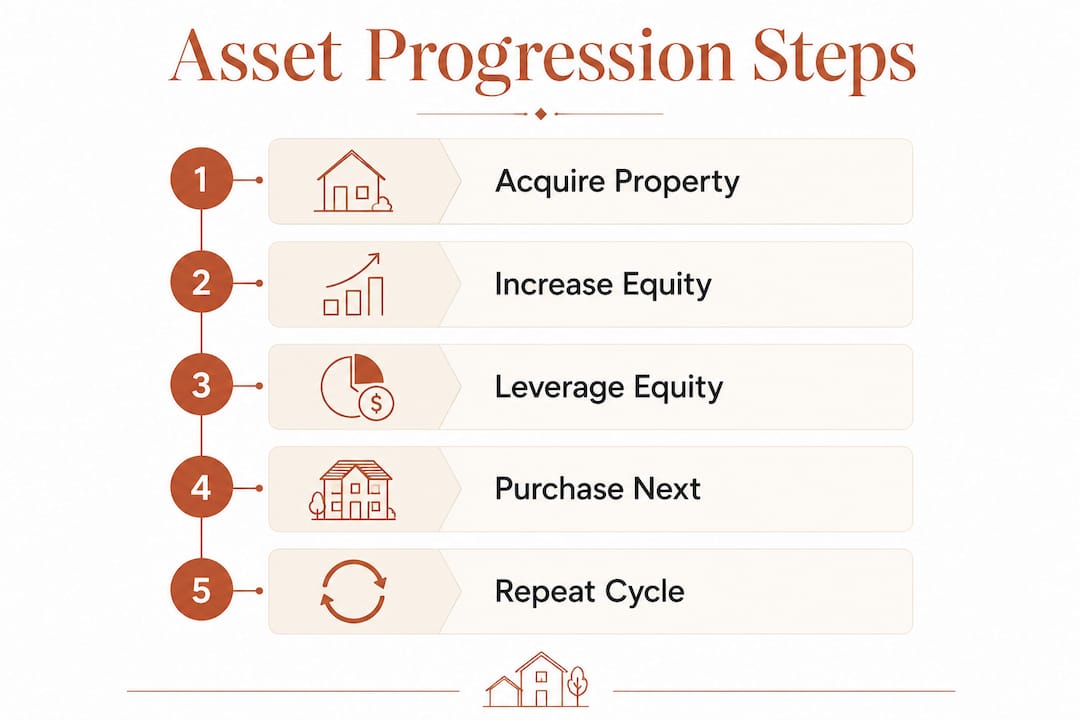
The process runs through four core stages:
- Acquisition: Buying a property that fits your budget, goals, and local market conditions
- Improvement: Adding value through renovations, better tenancy management, or repositioning the asset
- Leveraging: Refinancing to extract equity, or using the property’s increased value as collateral for the next purchase
- Sale: Selling when the timing and numbers justify moving capital into a higher-yield or higher-growth opportunity
What separates progression from passive ownership is intent. You are actively managing a portfolio, not just waiting for prices to rise. Each stage feeds the next, and the goal is to own better assets over time, not simply more of them. For a deeper look at how this builds long-term wealth, property wealth progression covers the mechanics in detail.
Key benefits of adopting property asset progression strategies
The clearest advantage is that you grow wealth on borrowed money. When a property appreciates, your return is calculated on your equity, not the full purchase price. Borrowing at 75% LTV means a 5% rise in property value can translate to a 20% return on the equity you actually put in. That multiplier is what makes real estate different from most other asset classes.

Beyond leverage, property also acts as a hedge against inflation. Real estate prices and rents have historically risen faster than inflation over long periods, meaning your asset holds purchasing power while your fixed mortgage debt shrinks in real terms.
Other benefits worth knowing:
- Rental income provides cash flow that can cover holding costs and fund the next acquisition
- Portfolio diversification across property types and locations reduces exposure to any single market downturn
- Tax deductions on mortgage interest, depreciation, repairs, and property taxes can meaningfully reduce your annual tax bill
- Equity recycling through the BRRRR method (Buy, Rehab, Rent, Refinance, Repeat) lets you scale without needing fresh capital for every deal
Pro Tip: Active management yields higher returns than passive vehicles like REITs, but it demands real time and operational effort. Be honest about how much involvement you can sustain before committing to a hands-on strategy.
Why property is a strong choice for asset progression in the U.S.
The U.S. real estate market offers a combination of factors that few other asset classes can match for wealth building. Mortgage financing at competitive rates lets you control a large asset with a fraction of its value upfront. That structural feature, leverage unique to real estate, is why a $60,000 down payment on a $300,000 property can generate far more long-term wealth than $60,000 sitting in an index fund, even when unleveraged returns are similar.
Rental demand across major U.S. metros remains strong, driven by housing affordability constraints that keep many households renting longer. That demand supports both occupancy rates and rent growth, which feeds directly into your progression timeline.
Tax advantages add another layer:
- Depreciation deductions let you write off a portion of the property’s value each year, reducing taxable income even when the property is appreciating
- Mortgage interest deductions on investment properties lower your effective cost of borrowing
- 1031 exchanges allow you to defer capital gains tax when you sell one investment property and reinvest the proceeds into another, a powerful tool for progression
- Entity structuring through an LLC can separate personal liability from investment risk and may offer additional tax planning flexibility
“Successful asset progression tailors strategy choice to investor risk tolerance, time horizon, and income goals.” — Top real estate investment strategies
For investors just building their first portfolio, understanding what a property portfolio is before adding leverage is a practical first step.
Common pitfalls that derail property asset progression
Overleveraging is the fastest way to stall a progression plan. Taking on too much debt relative to your rental income leaves no buffer when a tenant vacates, a repair bill arrives, or interest rates shift. Holding costs beyond the mortgage, including maintenance, insurance, property taxes, and vacancy periods, can quietly erode returns that looked solid on paper.
Market timing is another area where investors get hurt. Real estate cycles typically span several years, and buying near a peak can mean years of flat or negative returns before the next growth phase. Holding properties for at least five years and diversifying your purchase timing across the cycle reduces this risk considerably.
Watch out for these specific traps:
- Insufficient due diligence: Skipping a thorough inspection or ignoring local zoning and rental regulations can turn a promising deal into a money pit
- Overcapitalizing on renovations: Spending more on improvements than the local market will reward at resale is a common mistake, especially in lower-price-point neighborhoods
- Ignoring cash flow: A property that only works if it appreciates is a speculation, not a progression strategy
- Regulatory blind spots: Tax law changes, rent control ordinances, and short-term rental restrictions can materially change a property’s income profile after you buy it
“Taking on too much debt without adequate cash flow creates negative cash flow, risk of default, and financial instability.” — Top real estate investment strategies
How to apply property asset progression step by step
Progression is not a single transaction. It is a repeating cycle, and each pass through the cycle should leave you holding a stronger asset than before.
-
Audit your current position. List every property you own, its current market value, outstanding mortgage balance, rental income, and annual holding costs. This gives you a clear picture of available equity and cash flow before you make any moves.
-
Improve the asset’s value. Targeted renovations, better property management, or converting to a higher-yield use (such as adding a rental unit) can increase both the property’s market value and its income. Focus improvements that the local market will actually reward at resale or refinance.
-
Refinance or sell to unlock equity. Once the property has appreciated or been improved, a cash-out refinance lets you extract equity without selling. Selling makes sense when the capital can generate a meaningfully better return elsewhere, or when the property no longer fits your portfolio goals.
-
Reinvest in a higher-performing asset. Use the extracted equity as a down payment on a property with stronger growth fundamentals, better yield, or both. Strategy choice matters here: buy-and-hold suits long-term growth, fix-and-flip targets short-term gains, and BRRRR is built for capital-light scaling.
-
Repeat the cycle. Each successful progression move increases your equity base, which funds the next acquisition at a larger scale.
“Execution and timing is everything when you are operating a real estate business. If it’s a rental property, the longer it’s not rented, the more it’s costing you.” — BiggerPockets
A practical example: A homeowner buys a single-family rental for $250,000 with $62,500 down. Over four years, the property appreciates and targeted renovations push its value to $320,000. A cash-out refinance at 75% LTV yields roughly $177,500 in new financing, enough to pay off the original mortgage and pull out $50,000+ in equity. That equity funds the down payment on a duplex with stronger cash flow, and the cycle begins again. For guidance on choosing the right next property, selecting investment property for maximum returns walks through the key criteria.
How to align property asset progression with your financial plan
Property investment works best when it fits inside a broader financial picture, not when it drives the whole plan. An effective progression strategy accounts for personal cash flow, risk tolerance, and tax position, not just capital growth potential.
Key areas to integrate:
- Tax planning: Time your sales to minimize capital gains exposure, use 1031 exchanges to defer taxes on reinvested proceeds, and work with a CPA who specializes in real estate to maximize depreciation benefits
- Liquidity management: Property is illiquid. Keep a cash reserve covering at least three to six months of holding costs across your portfolio so a vacancy or repair does not force a distressed sale
- Retirement alignment: Decide early whether your goal is cash flow now, equity growth for a future lump sum, or a combination. Buy-and-hold with gradual debt paydown tends to suit investors building toward retirement income
- Risk tolerance: Higher-yield strategies like short-term rentals or house hacking require more active management and carry more regulatory exposure. Match the strategy to what you can realistically sustain
Pro Tip: Before refinancing or acquiring your next property, consult a fee-only financial advisor and a real estate-focused CPA together. The tax implications of a cash-out refinance or a 1031 exchange can significantly change the net return on your next move.
If you are managing multiple properties and finding the operational side harder to track, a professional after-hours property management service can reduce tenant friction and protect your cash flow without requiring you to be available around the clock.
Key Takeaways
Property asset progression builds wealth by reinvesting equity from existing properties into higher-performing assets, with leverage, timing, and tax planning determining how fast and how far your portfolio grows.
| Point | Details |
|---|---|
| Leverage amplifies returns | Borrowing at 75% LTV can turn a 5% property gain into a 20% return on your equity. |
| Four core stages drive progression | Acquisition, improvement, leveraging, and sale form the repeating cycle of portfolio growth. |
| Holding costs erode returns | Maintenance, insurance, taxes, and vacancy must be budgeted before any deal looks viable. |
| Market cycles span several years | Buying near a peak can mean years of flat returns; holding for 5+ years reduces timing risk. |
| Tax tools extend your gains | 1031 exchanges, depreciation deductions, and entity structuring can materially improve net returns. |
Ready to put a progression plan into practice? Working with an experienced advisor who understands both the U.S. market and your personal financial position makes a measurable difference at every stage. Learn why a property consultant can help you avoid costly missteps and move faster toward your portfolio goals.