


A collective sale is a legal process where a supermajority of owners in a strata-titled development sell the entire property to a single buyer, typically a developer. Known formally in Singapore as an en bloc sale, it operates under the Land Titles (Strata) Act and requires either 80% or 90% owner consent depending on the development’s age. Owners who participate can receive 30% to 80% above prevailing market value. The Collective Sale Committee (CSC) manages the process, while the Strata Titles Board (STB) oversees legal compliance and adjudicates disputes.
What is the collective sale process in Singapore?
The collective sale process runs from committee formation through to final payout and typically takes 12–24 months to complete. That timeline surprises many owners who expect a faster resolution. Each stage has legal requirements that must be met precisely.
Step 1: Form the Collective Sale Committee
Owners vote at a general meeting to elect the CSC. This committee carries fiduciary duties to all owners and must act in good faith throughout. Members set the reserve price, appoint lawyers and marketing agents, and manage negotiations on behalf of the entire development.

Step 2: Draft and sign the Collective Sale Agreement
The CSC prepares the Collective Sale Agreement (CSA), which sets out the sale terms, apportionment method, and reserve price. Owners then sign the CSA to register their consent. The committee has up to 12 months to collect the required signatures before the CSA lapses.
Step 3: Launch a public tender
Once sufficient consent is gathered, the CSC launches a public tender. Developers submit bids, and the CSC evaluates offers against the reserve price. The highest qualifying bid wins, provided it meets or exceeds the reserve.
Step 4: Apply to the Strata Titles Board
If consent is below 100%, the CSC must apply to the STB for an Order of Sale. The STB reviews whether the process followed good faith standards and hears any minority objections. A sale that passes this review receives a binding order covering all owners, including dissenters.
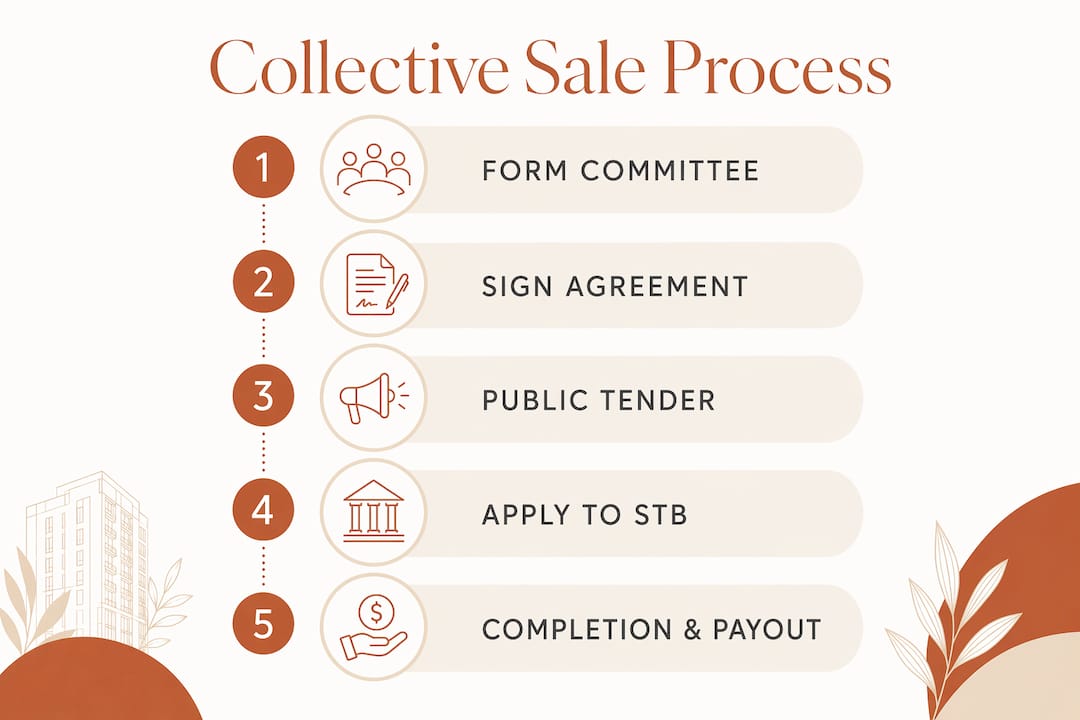
Step 5: Completion and payout
After the STB issues its Order of Sale, it typically takes 9–12 months before owners receive net proceeds. Mortgage repayments, CPF accrued interest, and procedural formalities account for most of that delay. Owners should plan their finances and relocation well before this stage.
Pro Tip: Start planning your next property purchase the moment the CSA is signed. Waiting until payout leaves you scrambling in a competitive market.
What are the legal thresholds and consent requirements?
Consent thresholds under the Land Titles (Strata) Act follow a clear rule: 80% for developments aged 10 years or older, and 90% for those under 10 years. The age of a development is measured from the date of its Temporary Occupation Permit (TOP), not the purchase date of any individual unit.
The dual threshold test
Singapore law applies a dual test. Consent must reach the required percentage by both share value AND strata floor area. Failing either measure fails the entire consent requirement, even if the other passes comfortably.
| Threshold | Development age | Measured by |
|---|---|---|
| 80% | 10 years or older | Share value AND strata floor area |
| 90% | Under 10 years | Share value AND strata floor area |
This dual structure prevents large-unit owners from dominating the vote purely through share value, and vice versa. It protects owners with smaller units who might otherwise be outvoted by a handful of penthouse holders.
Once the threshold is met, minority owners are legally bound by the majority’s decision. That makes early, informed participation critical. Waiting to see how others vote can leave you with no meaningful say in the outcome.
Pro Tip: Check your development’s TOP date early. A development that just crossed the 10-year mark qualifies for the lower 80% threshold, which makes organizing consent significantly easier.
How are proceeds from a collective sale divided among owners?
Proceeds apportionment is one of the most contested parts of any collective sale. Three main methods exist, and the CSC must choose one and disclose it clearly in the CSA.
- Method 1: Pure share value. Each owner receives a proportion based on their unit’s share value relative to the total. Simple developments with uniform unit types suit this method well.
- Method 2: Strata area. Proceeds are split by each unit’s floor area as a share of total strata area. This benefits larger units regardless of their share value.
- Method 3: Weighted formula. This method blends share value, unit size, and independent valuation. It is used for developments with uneven unit mixes to produce equitable payouts across diverse unit types.
Method 3 is the most common choice in practice because most Singapore developments contain a mix of studio, two-bedroom, and larger units. A pure share value split would undercompensate owners of large units, while a pure area split would disadvantage those with high-value smaller units. The weighted formula reduces objections and smooths STB approval.
Your net payout is not the gross apportionment figure. Outstanding mortgage balances are repaid directly from proceeds. CPF funds used for the purchase, plus accrued interest, are returned to your CPF account rather than paid out as cash. Plan your post-sale finances around the net cash figure, not the headline number.
The premium potential is real. A successful collective sale can yield 30% to 80% above prevailing market value. That premium reflects the developer’s willingness to pay for land at scale, free from the complications of individual unit negotiations. For investors holding aging properties in prime locations, this premium is the core financial case for participation.
Pro Tip: Request an independent valuation of your unit before the CSA is signed. Knowing your unit’s standalone market value gives you a clear benchmark to evaluate the apportionment offer.
What costs, risks, and pitfalls should owners know about?
Professional fees for lawyers, marketing agents, and valuers typically run 0.5% to 1.0% of the total sale price. These fees are deducted from gross proceeds before apportionment. On a $100 million sale, that means $500,000 to $1 million comes off the top before any owner receives a dollar.
Common pitfalls that derail collective sales include:
- Missing the long-stop date. The CSA has an expiry date. If the sale does not complete by then, the agreement lapses and the entire process must restart.
- Ignoring minority owner rights. The STB takes good faith obligations seriously. Procedural shortcuts or unfair treatment of dissenters can cause the STB to reject the sale outright.
- Underestimating the cooling-off period. Owners who sign the CSA have a five-day cooling-off period to withdraw. Miscounting signatures that later lapse can stall consent collection.
- Misjudging payout timing. Owners who assume they will receive funds shortly after the tender award are routinely caught off guard. The 9–12 month post-approval delay is standard, not exceptional.
The STB acts as a regulatory gatekeeper. It will not approve a sale where the CSC breached its fiduciary duties, failed to follow proper procedures, or treated minority owners unfairly. A rejected application wastes months of effort and legal fees. Owners should monitor the CSC’s conduct throughout the process, not just at the signing stage.
For minority owners who object, the STB provides a formal channel to raise concerns. Valid grounds include financial loss relative to market value, or evidence that the CSC acted in bad faith. The STB weighs these objections against the collective benefit to the majority. Understanding joint ownership sale processes in comparable legal systems shows how similar safeguards protect dissenting owners across different jurisdictions.
Pro Tip: Keep written records of every CSC meeting and communication. If a dispute reaches the STB, documented evidence of fair process is your strongest defense.
What practical steps should owners and investors take?
Knowing the theory is one thing. Acting on it at the right time is what separates owners who benefit from those who feel blind sided.
- Assess your development’s eligibility. Check the TOP date, the total number of units, and current market conditions. Developments in prime districts with aging infrastructure and high land value are the strongest candidates.
- Engage early with the CSC. Attend general meetings and vote on committee members. The CSC’s competence and integrity directly determine the quality of the sale outcome. Passive owners lose influence at this stage.
- Read the Collective Sale Agreement carefully. The CSA defines your rights, the apportionment method, the reserve price, and the timeline. Do not sign without understanding every clause. Engage a property lawyer to review it if needed.
- Know your cooling-off period. You have five days after signing the CSA to withdraw without penalty. Use that window to get independent advice if you have doubts.
- Plan your relocation and finances. Identify your next property before the tender closes. The en bloc investment timeline from sale initiation to payout is long, and the Singapore property market moves fast.
- Engage a property consultant. A consultant with collective sale experience can evaluate your unit’s apportionment, flag procedural risks, and help you plan the transition to your next property.
Key Takeaways
A collective sale under Singapore’s Land Titles (Strata) Act requires dual consent thresholds by share value and strata area, delivers a potential premium of 30%–80% above market value, and takes 12–24 months from committee formation to final payout.
| Point | Details |
|---|---|
| Consent thresholds | 80% for developments 10+ years old; 90% for those under 10 years, measured by share value AND strata area. |
| Premium potential | Owners can receive 30%–80% above market value, minus professional fees of 0.5%–1.0%. |
| Payout timeline | Expect 9–12 months after the STB Order of Sale before net proceeds arrive in your hands. |
| CSC fiduciary duty | The Collective Sale Committee must act in good faith; breaches cause the STB to reject the sale. |
| Apportionment method | Method 3 weighted formula is the most equitable choice for developments with mixed unit types. |
What I’ve learned from watching collective sales up close
Most homeowners I speak with think a collective sale is simply a vote. It is not. It is a legal process with strict procedural requirements, fiduciary obligations, and a regulatory body that will reject the sale if anything is done wrong. The owners who benefit most are the ones who treat it like a business transaction from day one.
The emotional side is real and often underestimated. Many owners have lived in their units for decades. The financial premium is attractive, but the disruption of relocating, finding a new home in a competitive market, and adjusting to a different neighborhood carries genuine costs that no spreadsheet captures. I always encourage owners to weigh both sides honestly.
The CSC is the most critical variable in any collective sale. A well-organized committee with experienced legal and marketing advisors moves efficiently and minimizes disputes. A poorly run committee creates delays, triggers STB scrutiny, and sometimes kills the sale entirely. If you are voting for CSC members, choose people with financial literacy and a track record of fair dealing, not just the most vocal advocates for a quick sale.
Regulations in Singapore have tightened over the years, and the STB applies rigorous scrutiny to minority objections. That is a good thing. It means the process, when followed correctly, is genuinely fair. Owners who engage early, read the CSA carefully, and seek professional advice consistently get better outcomes than those who wait and react.
— Aman
Working with a property consultant on your collective sale
Navigating a collective sale without professional support is possible, but it is rarely the best approach. The financial stakes are high, the legal requirements are specific, and the timeline is long enough that one misstep can cost months of progress.
Aesthetic Havens, operated under ERA Realtors, provides end-to-end advisory for homeowners and investors at every stage of the collective sale process. From evaluating your development’s eligibility and reviewing the CSA to planning your next property purchase after payout, the team brings hands-on experience to each step. Understanding why professional guidance matters for buyers and sellers is the first step toward a smoother transaction. Reach out to Aman directly to discuss your development’s potential and map out a plan that protects your interests from committee formation through to final settlement.
FAQ
What is a collective sale in Singapore?
A collective sale, or en bloc sale, is a legal process where a supermajority of strata-titled property owners sell their entire development to a single buyer under the Land Titles (Strata) Act.
How does the consent threshold work for a collective sale?
Consent must reach 80% for developments aged 10 years or older, and 90% for newer ones, measured by both share value and strata floor area simultaneously.
How long does a collective sale process take?
The full process typically takes 12–24 months from committee formation to final payout, with an additional 9–12 months after the STB Order of Sale before owners receive net proceeds.
Can minority owners block a collective sale?
Minority owners can raise objections with the Strata Titles Board, but once consent thresholds are met, the STB can issue a binding Order of Sale that covers all owners, including dissenters.
What premium can owners expect from a collective sale?
A successful collective sale can yield owners 30%–80% above prevailing market value, with professional fees of 0.5%–1.0% deducted from gross proceeds before distribution.


