


A property title is the legal document that defines who owns a piece of land or building and the extent of that ownership. In Singapore, property title types explained through the lens of the Singapore Land Authority (SLA) and the Residential Property Act (RPA) determine not just what you own, but how long you own it, who is eligible to buy it, and what you can do with it. Getting this wrong costs buyers far more than legal fees. For anyone buying, investing, or planning an estate in Singapore, understanding the different property title categories is the first step toward making a sound decision.
What are the main property title types in Singapore?
Singapore land tenure falls into four primary categories: freehold, 999-year leasehold, 99-year leasehold, and shorter-term commercial leases. Each carries distinct legal characteristics and market implications that directly affect price, financing, and long-term value.
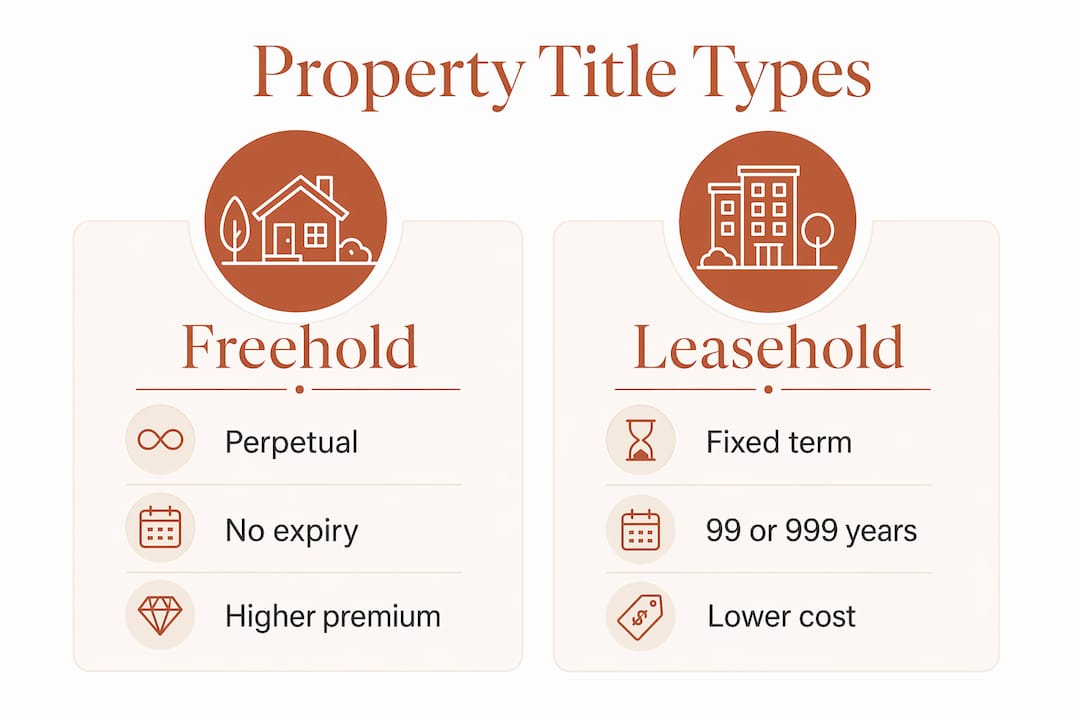
Freehold
Freehold, formally called an estate in fee simple, grants perpetual ownership with no expiry date. That permanence is the main reason freehold properties command a 15–25% price premium over 99-year leasehold equivalents. Buyers often treat freehold as the gold standard for estate planning across generations. The critical caveat: freehold does not protect against compulsory acquisition by the state. Singapore’s Land Acquisition Act allows the government to acquire any land, freehold or otherwise, with statutory compensation. Freehold secures your rights against lease expiry, not against state action.

999-year leasehold
A 999-year leasehold is functionally close to freehold for any practical planning horizon. These titles trade at a 5–10% premium over standard 99-year leaseholds. Most buyers treat them as near-equivalent to freehold, and banks generally do too.
99-year leasehold
The 99-year leasehold is the most common title type for private condominiums and Housing Development Board (HDB) flats in Singapore. As the lease shortens, financing tightens. CPF usage is restricted when the remaining lease falls below 35 years, and mortgage loan-to-value ratios tighten as the lease decays further. Buyers of older leasehold properties must account for this when projecting resale value.
| Tenure type | Typical premium | CPF restriction | State acquisition risk |
|---|---|---|---|
| Freehold | 15–25% above 99-year | None | Yes, with compensation |
| 999-year leasehold | 5–10% above 99-year | None | Yes, with compensation |
| 99-year leasehold | Baseline | Below 35 years remaining | Yes, with compensation |
| Short-term commercial lease | Below baseline | Not applicable | Yes, with compensation |
Pro Tip: When comparing a freehold and a 99-year leasehold property at similar prices, calculate the effective cost per year of remaining tenure. A freehold unit at S$1.5 million often works out cheaper per usable year than a 60-year-old leasehold at S$1.1 million.
How do ownership eligibility and restrictions affect different title types?
Singapore’s Residential Property Act draws a firm line between who can buy what. The rules vary significantly depending on your citizenship status and the specific title structure of the property.
Singapore Citizens face the fewest restrictions. They may purchase any residential property type freely, including standalone landed homes on freehold or leasehold titles.
Singapore Permanent Residents (PRs) must apply for approval from the Land Dealings Approval Unit before buying standalone landed property. That approval is not guaranteed and is rarely granted for speculative purchases. Landed property constitutes about 5% of residential dwellings in Singapore, which makes the restriction more significant than it sounds.
Foreigners are generally prohibited from buying mainland landed property outright. Sentosa Cove is the one designated zone where foreigners may apply to purchase landed homes, though ministerial approval is still required.
The key exception that many buyers miss is strata-landed housing. Strata-landed properties, such as cluster houses and townhouses within a development, carry a strata title rather than a standalone Torrens title. Strata-landed units are legally strata lots, which exempts them from the strict landed ownership restrictions under the RPA. This means PRs and foreigners can purchase strata-landed homes without special approval.
Here is a quick eligibility summary:
- Singapore Citizens: May buy all residential title types freely, including standalone landed freehold and leasehold.
- Singapore PRs: May buy private condominiums and strata-landed homes freely. Standalone landed homes require Land Dealings Approval Unit approval.
- Foreigners: May buy private condominiums and strata-landed homes freely. Standalone landed homes are generally prohibited, with Sentosa Cove as the limited exception requiring ministerial approval.
- HDB flats: Subject to separate HDB eligibility rules regardless of citizenship, including income ceilings and ownership restrictions.
Pro Tip: If you are a PR or foreigner drawn to landed-style living, a strata-landed cluster house gives you the garden, the garage, and the private entrance without the approval process. Check the foreigner buying rules before assuming any property is off-limits.
How do property title types intersect with planning and zoning?
Owning a title does not automatically grant the right to develop or change a property’s use. The Urban Redevelopment Authority (URA) Master Plan controls what any piece of land can be used for and how intensively it can be developed.
The Master Plan assigns each plot a zoning category, such as residential, commercial, or mixed-use, along with a Gross Plot Ratio (GPR). The GPR determines how much floor area can be built relative to the land area. Higher GPR zones carry greater en-bloc sale potential and investment value. A freehold residential plot in a high-GPR zone is a fundamentally different asset from a freehold plot in a low-density conservation area, even if both titles look identical on paper.
The practical implication: your title tells you who owns the land. The Master Plan tells you what that ownership is actually worth for development. Reviewing URA zoning alongside the title is not optional for investors. A property with a clean freehold title but a restrictive conservation zoning may have almost no redevelopment upside.
Pro Tip: Cross-reference the SLA title search with the URA Master Plan’s Gross Plot Ratio before making any offer on a property you intend to redevelop or hold for en-bloc potential. Both documents together tell the full story.
What due diligence is essential for property title verification?
Title verification is the process of confirming that the seller has the legal right to transfer ownership and that no hidden claims exist against the property. In Singapore, this process runs through the SLA’s land register under the Torrens title system.
The Torrens system grants indefeasibility, meaning registered interests take precedence after completion. What it does not guarantee is protection against unregistered interests or physical defects. A boundary encroachment, an unregistered tenancy, or a restrictive covenant buried in an old title deed can all survive a clean title search.
The standard due diligence process for a Singapore property transaction follows these steps:
- Engage a conveyancing solicitor before signing anything. Solicitors conduct the SLA land register search and flag encumbrances, mortgages, and caveats.
- Conduct the first title search just before signing the Option to Purchase (OTP). This confirms the seller’s title is clean at that point.
- Repeat the title search before completion. Title searches must be repeated before completion to catch any new encumbrances registered between OTP and handover. Relying on a single search exposes buyers to unexpected liabilities.
- Verify discharge of registered mortgages. Registered mortgages must be discharged on completion. Confirm this is built into the completion conditions.
- Remove any caveats. Caveats lodged by non-completing parties must be withdrawn before ownership transfers cleanly.
For context on cost: transaction costs including legal due diligence can exceed S$100,000 on a S$1.5 million property. That figure covers stamp duties, legal fees, and related charges. Skipping or rushing due diligence to save a few thousand dollars in legal fees is a false economy.
The Torrens system provides strong legal certainty. It does not replace physical inspections or specialist legal advice for uncovering risks that sit outside the register.
Key Takeaways
Singapore property title types determine ownership duration, buyer eligibility, financing conditions, and development potential, making title literacy the foundation of every sound real estate decision.
| Point | Details |
|---|---|
| Four main tenure types | Freehold, 999-year, 99-year leasehold, and short-term commercial leases each carry distinct price premiums and financing rules. |
| Freehold is not absolute | Freehold protects against lease expiry but not against state compulsory acquisition under the Land Acquisition Act. |
| Strata title bypasses RPA restrictions | PRs and foreigners can buy strata-landed homes without approval, unlike standalone landed properties. |
| Zoning shapes real value | URA Master Plan GPR zoning determines development potential beyond what the title alone grants. |
| Two title searches are required | Conduct searches before OTP signing and again before completion to catch newly registered encumbrances. |
What I’ve learned from watching buyers get title wrong
Most buyers treat the title type as a checkbox rather than a decision framework. They ask “freehold or leasehold?” and stop there. The more consequential questions are about eligibility, financing trajectory, and zoning alignment.
I have seen PRs fall in love with a standalone landed home, make an offer, and then discover the approval process is far from automatic. I have also seen foreigners walk away from perfectly legal strata-landed purchases because they assumed all landed property was off-limits. Both mistakes come from the same root cause: not reading the title structure carefully before forming a preference.
The Torrens system gives buyers real legal protection once a title is registered. But the risks that sit outside the register, unregistered tenancies, physical encroachments, restrictive covenants, are exactly the ones that cause the most expensive surprises. A clean title search is necessary. It is not sufficient.
My consistent advice: pair every title search with a physical inspection and a zoning review. Treat those three steps as one unit, not three separate tasks. And for any transaction above S$1 million, the cost of a thorough conveyancing solicitor is the cheapest insurance you will buy.
— Aman
Working with a property consultant on title and eligibility
Understanding title types is one thing. Applying that knowledge to a specific property, under your specific eligibility profile, in a market that moves quickly, is where professional guidance pays for itself.
At Aesthetic Havens, Aman works with buyers to verify title structures, confirm eligibility under the Residential Property Act, and cross-check URA zoning before any offer is made. That process has prevented costly mistakes for buyers who assumed a property was available to them when it was not. If you want to understand how a property consultant helps buyers navigate title verification, eligibility rules, and due diligence, that resource covers the full scope of what professional advisory looks like in practice. Getting the title right from the start protects every dollar you put into the transaction.
FAQ
What is a property title in Singapore?
A property title is the legal record of ownership registered with the Singapore Land Authority under the Torrens title system. It confirms who owns the property and identifies any encumbrances, mortgages, or caveats attached to it.
What is the difference between freehold and 99-year leasehold?
Freehold grants perpetual ownership with no expiry, while 99-year leasehold grants ownership for a fixed term. Freehold properties typically command a 15–25% price premium, but both types remain subject to state compulsory acquisition.
Can foreigners buy landed property in Singapore?
Foreigners are generally prohibited from buying standalone landed property on the Singapore mainland. Strata-landed homes are the main exception, as they carry a strata title that falls outside the Residential Property Act’s landed ownership restrictions.
How many times should I conduct a title search?
Conduct a title search twice: once before signing the Option to Purchase and again before completion. This catches any new encumbrances registered between those two points and protects against unexpected liabilities.
Does a 999-year leasehold work the same as freehold?
For most practical purposes, yes. A 999-year leasehold trades at a 5–10% premium over 99-year leaseholds and carries no CPF usage restrictions. Banks and buyers treat it as functionally equivalent to freehold for financing and estate planning purposes.


