


Property tax is an ad valorem tax levied by local governments on the assessed value of real estate, designed to fund public services like schools, police, and infrastructure. Every homeowner, buyer, and investor in the US pays it, yet few fully understand how it is calculated, why it changes, or how to reduce it. This guide breaks down property tax explained in plain terms, covering the mechanics of assessment, the factors that shift your bill year to year, and the practical implications for anyone making a real estate decision.
What is property tax and how does it work?
Property tax is defined as a recurring charge on real property, calculated as a percentage of the property’s assessed value. Local governments use it as a primary revenue source for community services. That means every dollar you pay goes toward roads, sewers, street lighting, schools, and emergency services in your area.
The tax is not based on what you paid for your home. It is based on the assessed value assigned by your local tax authority, which may differ significantly from market value. Assessment cycles vary by jurisdiction, and the rate applied to that value is set by your local government each year based on its budget needs.

Property tax bills typically arrive annually or semi-annually. Most homeowners pay through a mortgage escrow account, which spreads the cost into monthly installments. Understanding this structure is the first step toward managing it effectively.
How is property tax calculated?
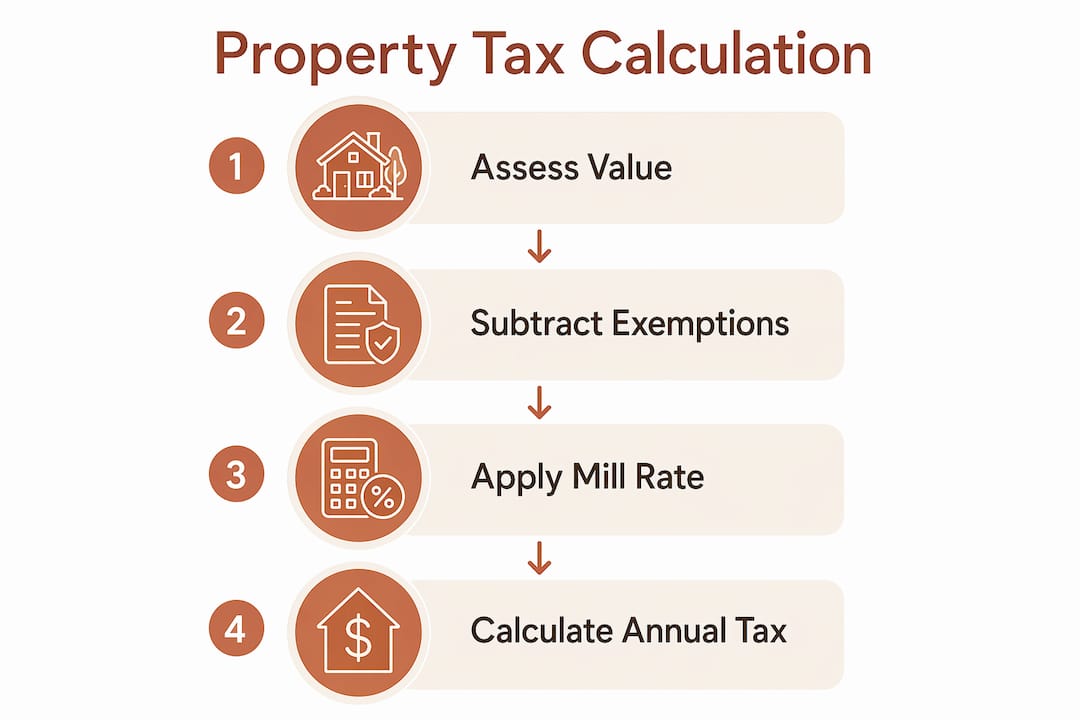
The formula for calculating your annual property tax bill has three components: assessed value, exemptions, and the mill rate.
-
Determine the assessed value. Your local assessor estimates the market value of your property, then applies an assessment ratio to arrive at the taxable assessed value. In many jurisdictions, the assessed value is a fraction of market value, which means your tax bill can rise independently of actual price movements in the market.
-
Subtract eligible exemptions. Common exemptions reduce the taxable base. A homestead exemption, for example, removes a fixed dollar amount from the assessed value before the rate is applied.
-
Apply the mill rate. The mill rate (also called the millage rate) is the tax rate expressed per $1,000 of assessed value. A mill rate of 0.005 applied to a $200,000 assessed value produces a $1,000 annual tax bill. That example illustrates how even small rate changes compound quickly across higher property values.
The full formula is: (Assessed Value minus Exemptions) x Mill Rate = Annual Tax.
Pro Tip: Request your property’s assessment card from the local assessor’s office. It lists the data used to calculate your value, and errors in square footage or bedroom count are more common than most owners realize. Correcting them can reduce your bill.
Understanding property valuation is closely tied to understanding your tax exposure. The two figures move together, and knowing how your assessor arrives at a number gives you real leverage.
What causes property tax to change over time?
Property tax bills are not fixed. Several variables push them up or down from year to year, and knowing which ones apply to you prevents surprises.
- Reassessment cycles. Assessments happen annually in some jurisdictions, while others reappraise every three years. A long gap between reassessments means your bill can jump sharply when the cycle resets, especially in a rising market.
- Mill rate adjustments. Local governments revise mill rates each budget year. When a city needs more revenue for schools or infrastructure, the rate goes up, even if your property value stayed flat.
- Property improvements. Adding a bedroom, finishing a basement, or building a pool increases your assessed value. Assessors typically pick up permitted improvements during the next reassessment cycle.
- Property condition changes. Damage from fire, flooding, or structural deterioration can lower assessed value and reduce your bill. Filing for a reassessment after significant damage is a legitimate and often overlooked option.
- Special assessments. Local governments occasionally levy one-time charges for specific projects, such as a new sidewalk or sewer line serving your street. These appear as separate line items and are not part of the standard mill rate calculation.
Financial experts treat property taxes as dynamic liabilities rather than fixed costs. That framing matters for long-term budgeting, especially for investors modeling returns over a five or ten year hold period.
Who pays property taxes and what exemptions are available?
The property owner on record on the assessment date is legally responsible for the tax bill. Tax responsibility transfers to the new owner at closing when a property is sold, and this affects how closing costs and credits are negotiated between buyer and seller.
Several exemption programs reduce the taxable burden for eligible owners:
- Homestead exemption. Available in most US states for primary residences. It removes a set dollar amount or percentage from the assessed value before the rate is applied.
- Senior citizen exemptions or deferrals. Homeowners aged 61 and older may qualify for reduced rates or deferred payment programs. These programs exist specifically to help retirees manage housing costs on fixed incomes.
- Veteran exemptions. Many states offer partial or full exemptions for qualifying veterans and their surviving spouses.
- Disability exemptions. Owners with qualifying disabilities can apply for reduced assessments in most jurisdictions.
Many older homeowners miss out on senior exemptions simply because they do not apply before the deadline. Proactive exemption management is one of the most direct ways to reduce a tax bill without appealing the assessment itself.
Pro Tip: Check your county assessor’s website each january for exemption application deadlines. Most programs require annual renewal, and missing the window by even one day means waiting another full year.
Real estate agents play a key role in flagging these programs at closing. Working with an experienced agent, as outlined in this guide to real estate agents in Singapore, reflects the same principle that applies globally: local expertise catches what generic advice misses.
How do property taxes affect buyers, homeowners, and investors?
Property tax has a direct and measurable impact on the cost of ownership at every stage. The table below summarizes how it affects each group differently.
| Stakeholder | Key impact | What to watch |
|---|---|---|
| First-time buyers | Tax bill may jump after purchase due to reassessment | Request current and prior year tax bills before closing |
| Existing homeowners | Escrow shortages raise monthly mortgage payments | Monitor annual escrow analysis statements from your lender |
| Real estate investors | Tax costs reduce net operating income and ROI | Model tax increases into five-year cash flow projections |
| Sellers | Prorated taxes affect net proceeds at closing | Review home sale proceeds planning before listing |
For buyers, the most important nuance is reassessment at purchase. Property tax bills can increase immediately after a sale because the purchase price triggers a new assessment. A home that was taxed on a $180,000 assessed value may be reassessed at the $320,000 sale price, producing a substantially higher bill in the first year of ownership.
For homeowners with mortgages, escrow shortages are the most common source of unexpected cost increases. When property taxes rise mid-year, the lender covers the shortfall and then recovers it through higher monthly payments in the following year. Owners who are not watching their annual escrow analysis often discover this only when the new payment amount arrives.
For investors, property tax belongs in every ROI model. Learning how to select investment property requires factoring in not just current tax rates but the realistic trajectory of those rates over the hold period.
Key Takeaways
Property tax is an ad valorem charge on assessed real estate value, calculated using the mill rate formula, and it directly affects the total cost of ownership for buyers, homeowners, and investors alike.
| Point | Details |
|---|---|
| Core definition | Property tax is levied by local governments on assessed real estate value to fund public services. |
| Calculation formula | Annual tax equals assessed value minus exemptions, multiplied by the local mill rate. |
| Bills change over time | Reassessments, mill rate adjustments, and property improvements all shift your annual bill. |
| Exemptions reduce liability | Homestead, senior, veteran, and disability exemptions can meaningfully lower taxable value. |
| Buyers face reassessment risk | Purchase prices often trigger immediate reassessment, raising the tax bill in the first year of ownership. |
What I tell every buyer before they sign
Most buyers ask me about mortgage rates and monthly payments. Almost none ask about property taxes until they get their first escrow analysis and realize their payment went up by $200 a month. That gap in awareness is one of the most expensive mistakes I see in real estate.
My honest view is that property tax deserves the same scrutiny as the purchase price itself. I always pull three years of tax history on any property before advising a client to make an offer. That history reveals reassessment patterns, special assessments, and whether the current owner benefits from an exemption that the buyer will not qualify for. Losing a senior exemption at closing can add thousands of dollars to the annual bill overnight.
The appeals process is also underused. If your assessed value looks high relative to comparable sales in your neighborhood, you have the right to contest it. The process varies by jurisdiction, but the burden of proof is not as high as most owners assume. I have seen successful appeals reduce annual bills by meaningful amounts, and the filing cost is usually minimal.
REALTORS® consistently advise buyers to consult local experts because regional differences in tax calculation and closing customs are significant. What applies in Texas does not apply in California, and what applies in the US does not apply in Singapore. The principle holds everywhere: know your local rules before you commit.
— Aman
Property tax planning is part of smart property ownership
Navigating property tax without professional support often leads to missed exemptions, reassessment surprises, and ROI calculations that do not hold up. A property consultant who knows your local market can identify tax exposure before you buy, flag exemption programs you qualify for, and advise on the appeal process if your assessment looks inflated.

At Aesthetic Havens, Aman Aboobucker and the ERA Realtors team provide buyers and investors with clear, numbers-based guidance that includes property tax analysis as part of every transaction review. Whether you are purchasing your first home or expanding a portfolio across borders, understanding the full cost of ownership starts with the right advice. Learn more about the benefits of property consulting and how it applies to your situation.
FAQ
What is property tax based on?
Property tax is based on the assessed value of real estate, as determined by a local government assessor. The assessed value is multiplied by the local mill rate to produce the annual tax bill.
Is property tax deductible on federal taxes in the US?
State and local property taxes are deductible on federal income tax returns, subject to the $10,000 SALT deduction cap introduced by the Tax Cuts and Jobs Act of 2017. Consult a tax advisor to confirm eligibility based on your filing situation.
How is property tax calculated for a new purchase?
After a sale, the local assessor typically reassesses the property at or near the purchase price. This sale-triggered reassessment often produces a higher tax bill than the previous owner paid, sometimes significantly so.
Who qualifies for property tax exemptions?
Common qualifying groups include primary homeowners (homestead exemption), seniors aged 61 and older, veterans, and owners with qualifying disabilities. Eligibility rules and application deadlines vary by state and county.
Can you appeal a property tax assessment?
Yes. Property owners can formally contest their assessed value through the local assessor’s office or a review board. A successful appeal requires evidence that the assessed value exceeds fair market value, such as recent comparable sales data.


