


High yield properties are defined by their ability to generate rental income that represents a strong return relative to the purchase price, measured through cap rates, cash-on-cash returns, and rent-to-price ratios. Knowing how to find high yield properties separates investors who build real wealth from those who simply own real estate. The difference comes down to applying the right financial metrics, choosing markets with genuine demand, and sourcing deals through channels most investors overlook. This guide covers every step, from calculating returns to screening deals fast.
How to find high yield properties: key financial metrics
The first number every investor needs is the cap rate. Cap rate equals net operating income divided by the property’s purchase price. Experienced investors target 6–10% cap rates for high-yield rental properties in 2026, with returns below 4% considered marginal and above 12% considered excellent but market-specific. That range tells you whether a property generates enough income to justify its price before financing enters the picture.
Cash-on-cash return measures what your actual cash investment earns each year. It equals annual pre-tax cash flow divided by total cash invested, including your down payment and closing costs. Investors targeting 8–12% cash-on-cash returns are chasing the sweet spot between strong income and manageable risk. This metric matters most for investors using financing, because it reflects the real return on money you actually put in.

Net operating income, or NOI, is gross rental income minus all operating expenses before debt service. Operating expenses typically run 35–50% of gross rent, depending on local taxes, property age, and management costs. That range is wide enough to swing a deal from profitable to marginal, so using local data rather than national averages is non-negotiable.
A quick mental filter uses the gross rent multiplier: multiply monthly rent by 12, then divide by the listing price. Properties below a 5% cap rate on this quick calculation deserve rejection before you spend another hour on analysis. This filter alone eliminates the majority of listings that will never pencil out.
Pro Tip: Adjust your expense assumptions upward by 10–15% when analyzing properties in high-tax states. Local property taxes and insurance can push expense ratios past 50%, which destroys yields that look attractive on paper.
What makes a market right for high rental yields?
Choosing the right market matters more than choosing the right property. A mediocre property in a strong rental market outperforms a well-priced property in a declining one. The reason is simple: tenant demand drives occupancy, and occupancy drives income.
The strongest rental markets share a consistent set of characteristics:
- Employment anchors. Hospitals, universities, military bases, and government centers create steady, recession-resistant tenant demand. These institutions do not relocate, and their employees need housing year-round.
- Population growth. Markets with net in-migration generate new rental demand without requiring existing tenants to move. Rising headcount supports rent growth over time.
- Rent-to-price ratios above 6%. Rent-to-price ratios over 6% signal genuine rental territory. Ratios below 5% indicate a market driven by appreciation, not income.
- Controlled price growth. When property prices consistently outpace rent growth, cap rates deteriorate and cash flow sustainability weakens. This is the single most common trap for yield-focused investors entering hot markets.
- Reasonable tax and insurance costs. Local property taxes and management fees heavily affect net yield. High-tax states can push expense ratios past 50%, turning a 7% gross yield into a 3% net yield.
The signs of profitable real estate markets go beyond surface-level data. Vacancy rates, average days on market for rentals, and local wage growth all feed into whether a market sustains the yields you model today.
Weak market signals include: rapid price appreciation with flat rents, declining population, single-industry employment bases, and rising vacancy rates. Any one of these factors can erode a yield that looked strong at purchase.
Where to source high-yield investment properties
Most investors browse the same MLS listings and wonder why they cannot find deals. The reality is that the best high return real estate rarely sits on public listing platforms at attractive prices. Sourcing requires a deliberate pipeline built across multiple channels.
Effective sourcing methods include:
- MLS filtering with price-to-rent screens. Set alerts for properties priced below the median in target zip codes, then apply the gross yield filter immediately. Speed matters because other investors run the same screens.
- Off-market prospecting. Targeting absentee or high-equity owners directly via cold calls or direct mail is labor-intensive but consistently yields better price-to-rent ratios than open market listings. These sellers often prioritize a clean, fast transaction over maximum price.
- Wholesalers and investor networks. Wholesalers contract properties below market value and assign those contracts to buyers. Quality varies widely, so vet every deal independently.
- Auction platforms and foreclosure lists. Distressed properties can offer below-market entry prices, though they carry condition risk that must be priced into your analysis.
- Local property managers. Property managers know which landlords are tired, which buildings have deferred maintenance, and which neighborhoods are seeing rent increases. That intelligence is not available on any platform.
Relying solely on publicly listed properties limits your ability to find truly high-yield deals. The 100:10:3:1 rule captures the volume reality: you need to evaluate roughly 100 leads to close 1 worthwhile deal. Building a pipeline is not optional. It is the job.
Pro Tip: Call two or three local property managers before you analyze a single listing. Ask them what rents are actually achieving, which neighborhoods have the lowest vacancy, and which property types attract the most reliable tenants. That 20-minute call replaces hours of online research.
How to screen and analyze rental properties before you buy
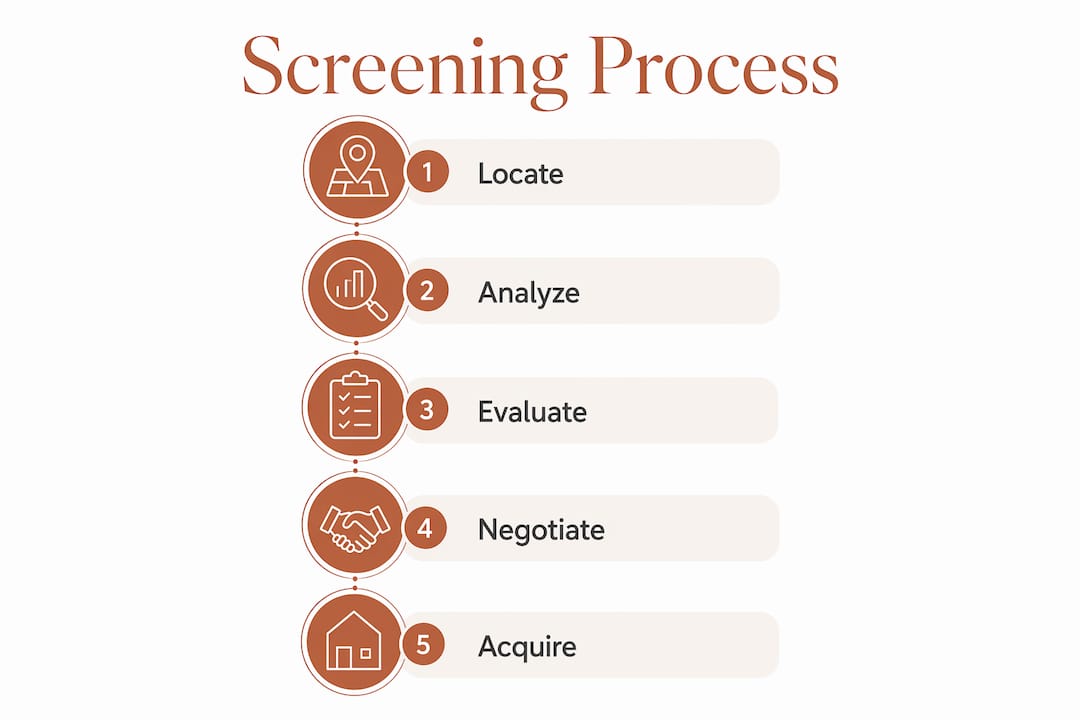
Screening fast and accurately is what separates investors who close deals from those who study them indefinitely. A repeatable process removes emotion and keeps analysis consistent.
- Gather rent comps and listing price. Pull three to five comparable active rentals within a half-mile radius. Use the median rent, not the highest, as your income assumption.
- Estimate gross annual income. Multiply median monthly rent by 12. Apply a 5–8% vacancy allowance to get effective gross income.
- Calculate NOI. Subtract operating expenses from effective gross income. Use local tax data, actual insurance quotes, and a management fee of 8–10% of collected rent.
- Apply the cap rate filter. Divide NOI by the listing price. Reject anything below your target threshold before proceeding.
- Calculate cash-on-cash return. Subtract annual debt service from NOI, then divide by total cash invested. This number tells you what your money actually earns.
- Stress-test the model. Run conservative scenarios at 55% occupancy and optimistic scenarios at 75% occupancy. Deals that only work under optimistic assumptions carry high risk. Deals that survive conservative assumptions are worth pursuing.
The table below summarizes the screening process and the metrics that matter at each step.
| Screening step | Key metric | Rejection threshold |
|---|---|---|
| Rent comp analysis | Median market rent | No comparable rentals nearby |
| Gross income estimate | Effective gross income | Vacancy above 10% in the market |
| Expense calculation | Operating expense ratio | Above 55% of gross rent |
| Cap rate filter | Cap rate | Below 5% |
| Cash-on-cash check | Cash-on-cash return | Below 7% |
| Stress test | Conservative occupancy scenario | Deal fails at 55% occupancy |
Common pitfalls include ignoring property tax increases after purchase, overestimating rent based on asking prices rather than achieved rents, and omitting capital expenditure reserves. Budget at least 5–10% of gross rent annually for repairs and replacements. Skipping this line item is the most common reason investors underperform their projections.
For a deeper look at valuing rental properties before committing capital, working through a structured valuation framework prevents the most expensive mistakes.
Key Takeaways
Finding high-yield properties requires combining rigorous financial screening with targeted market selection and active deal sourcing across multiple channels.
| Point | Details |
|---|---|
| Target the right metrics | Aim for 6–10% cap rates and 8–12% cash-on-cash returns as your baseline thresholds. |
| Choose markets over properties | Strong employment anchors and population growth sustain rental demand better than any individual property feature. |
| Screen expenses with local data | Operating expenses range from 35–50% of gross rent; use actual local tax and insurance figures, not national averages. |
| Build a multi-channel pipeline | Combine MLS alerts, off-market prospecting, and wholesaler relationships to generate consistent deal flow. |
| Stress-test every deal | Models that survive conservative occupancy assumptions are reliable; those that only work at optimistic projections are not. |
What I have learned from years of finding yield-focused deals
The investors I see struggle most are the ones who fall in love with a property before they finish the numbers. They find a well-located building, imagine it full of tenants, and then reverse-engineer the math to make it work. That approach produces losses, not income.
The discipline that actually works is market-first thinking. I spend more time analyzing a city or district than I spend analyzing any individual listing. If the market fundamentals are right, average properties perform well. If the fundamentals are wrong, even a perfectly priced property will underperform. The rental yield forecast for 2026 reinforces this: top-performing districts share structural demand drivers, not just attractive listing prices.
The second mistake I see constantly is underestimating expenses. Investors use the 50% rule as a ceiling rather than a floor. In high-tax jurisdictions, 55–60% expense ratios are common. When you model a deal at 40% expenses and reality delivers 55%, your cash-on-cash return can drop from 10% to near zero. Use real numbers, not optimistic ones.
Finally, the investors who build real portfolios treat deal sourcing as a daily habit, not an occasional search. They call property managers, maintain relationships with wholesalers, and send direct mail consistently. Volume is not glamorous, but it is what produces the deals worth buying.
— Aman
How Aesthetic Havens helps investors find profitable properties
Identifying high-yield rental properties takes more than a spreadsheet. It requires current market intelligence, local expense data, and access to deals before they reach public platforms.

Aesthetic Havens, operated under ERA Realtors, provides real estate advisory services across residential, commercial, and international markets. Whether you are evaluating your first investment or expanding an existing portfolio, working with a property consultant gives you access to market analysis, yield benchmarking, and deal evaluation support that most investors cannot build independently. The team at Aesthetic Havens connects investors with properties and markets aligned to their return targets, backed by professional advisory grounded in current data.
FAQ
What is a good rental yield for an investment property?
Experienced investors target cap rates of 6–10% and cash-on-cash returns of 8–12% for high-yield rental properties. Returns below 4% are generally considered marginal for income-focused investors.
How do I calculate cap rate on a rental property?
Divide the property’s net operating income by its purchase price. For example, a property generating $18,000 NOI purchased for $250,000 produces a 7.2% cap rate.
Why do operating expenses matter so much for yield?
Operating expenses typically consume 35–50% of gross rent, and in high-tax states they can exceed 50%. A small change in expense assumptions has an outsized effect on net yield and cash-on-cash return.
What is the best way to find off-market rental properties?
Targeting absentee owners and high-equity owners through direct mail and cold calls consistently produces better price-to-rent ratios than browsing public listings. Local property managers are also a reliable source of off-market leads.
How do I stress-test a rental property investment?
Model the deal at conservative occupancy (around 55%) and at an optimistic level (around 75%). Any deal that only works under optimistic assumptions carries high risk and should be approached with caution.


