


Property tenure in Singapore defines how long and under what legal terms you can own residential property, and it falls into three main categories: freehold, 999-year leasehold, and 99-year leasehold. Explaining tenure types in Singapore matters because the category you buy into directly shapes your financing options, resale value, and long-term wealth strategy. The 99-year leasehold is by far the most common type, covering most HDB flats and new private developments. Freehold properties are rare, concentrated in prime districts, and carry a price premium that reflects their permanence. Getting this right before you sign anything is one of the most consequential decisions you will make as a buyer.
What are the main types of property tenure in Singapore?
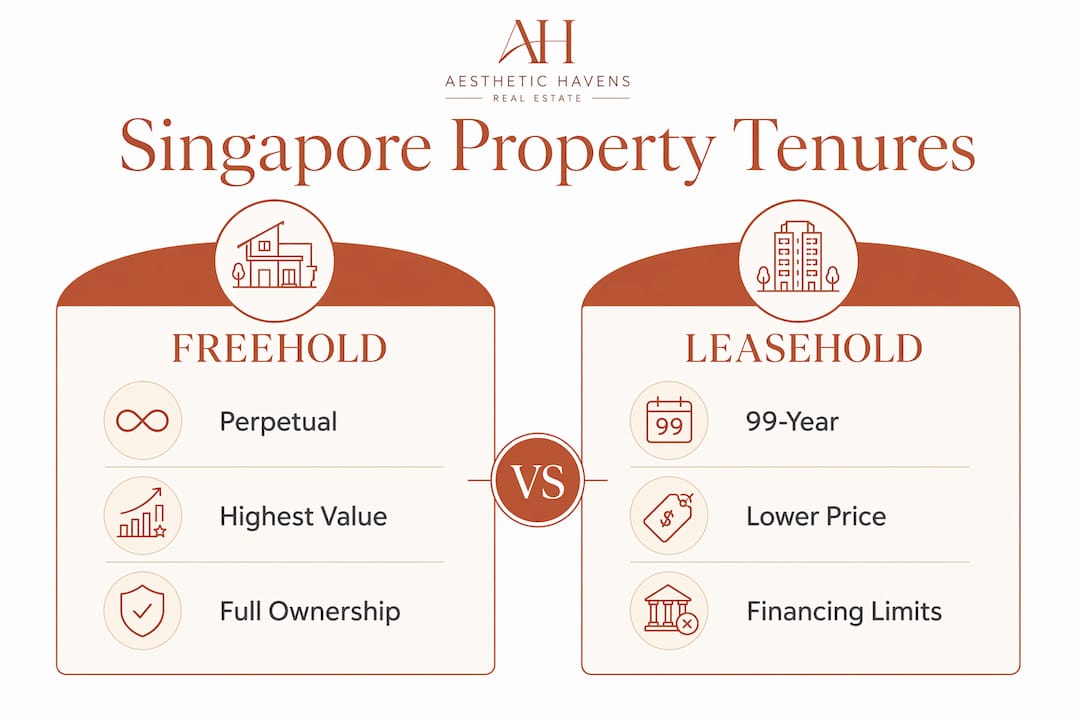
Singapore residential property tenure in 2026 divides into three distinct types, each with different ownership durations and legal implications. Freehold ownership is perpetual, meaning you own the land and building indefinitely. The 999-year leasehold is a colonial-era structure that functions almost identically to freehold for practical purposes. The 99-year leasehold is the dominant type, applying to HDB flats and the vast majority of new private condominiums.

Freehold
Freehold gives you permanent ownership with no expiry date on your title. That said, freehold is not entirely immune to government intervention. Under the Land Acquisition Act, the government retains the right to acquire any land compulsorily, with compensation paid to owners. This means freehold offers strong practical permanence but not absolute legal protection. Freehold properties are rare, concentrated in prime districts, and carry a price premium that reflects their scarcity.
999-year leasehold
The 999-year leasehold is largely a historical artifact from Singapore’s colonial period. Banks and the CPF Board treat 999-year leasehold properties identically to freehold for loan-to-value ratios and financing eligibility. For most buyers, the distinction between freehold and 999-year leasehold is academic. You are unlikely to encounter this tenure type in new launches.
99-year leasehold
The 99-year leasehold covers HDB flats and most new private developments. The lease begins from the date the government grants the land to the developer, not from the date you purchase the unit. That distinction matters because a 10-year-old development already has only 89 years remaining on its lease when you buy it. Lease decay accelerates as the remaining term drops, and this directly affects your financing and resale options.
| Tenure type | Duration | Typical property | Financing treatment |
|---|---|---|---|
| Freehold | Perpetual | Landed, older condos | Standard bank and CPF rules |
| 999-year leasehold | 999 years | Colonial-era properties | Treated as freehold by banks and CPF |
| 99-year leasehold | 99 years | HDB, new condos | Subject to lease decay restrictions |
Pro Tip: Always check the lease commencement date on the title, not just the remaining years. A 99-year property built in 2000 has roughly 73 years left in 2026, which already triggers some CPF and bank restrictions.
How do joint tenancy and tenancy-in-common affect your ownership?
Beyond the type of tenure on the title, how you co-own a property with another person shapes your rights, your estate plan, and your tax exposure. Singapore law recognizes two main co-ownership structures: joint tenancy and tenancy-in-common.
Joint tenancy operates on the right of survivorship. If one owner dies, the surviving owner automatically inherits the full property, regardless of what a will says. This structure is the default for married couples buying HDB flats. It is clean and simple, and it protects a surviving spouse from contested inheritance claims.
Tenancy-in-common assigns each owner a distinct, defined share of the property. Those shares can be equal or unequal, and each owner can sell, mortgage, or bequeath their share independently. Tenancy-in-common is preferred by investment partners and non-married buyers because it allows flexible fractional ownership and inheritance through a will.
Key differences between the two structures:
- Joint tenancy: No distinct shares, right of survivorship applies, cannot leave your portion in a will
- Tenancy-in-common: Defined shares, each owner controls their portion, inheritance follows the will or intestacy rules
- HDB default: Joint tenancy for married couples, tenancy-in-common available for non-family buyers
- Investment use: Tenancy-in-common supports asymmetric share splits for tax and estate planning
Legal experts recommend joint tenancy for couples to secure automatic property transfer to a surviving spouse. Tenancy-in-common suits investors and blended families who need more control over how their share passes on death.
Pro Tip: Asymmetric tenancy-in-common splits, such as a 99/1 share arrangement, are used for tax planning but face IRAS scrutiny if structured solely to avoid stamp duty. The penalties for abuse are severe, so get proper legal advice before using this structure.
What practical factors should buyers know about tenure and value?
Tenure type has a direct and measurable impact on price, financing, and long-term returns. Understanding these factors protects you from buying a property that looks affordable today but becomes difficult to sell or finance in 15 years.
1. Entry price difference. Leasehold properties are priced 5–15% lower at entry compared to freehold equivalents in the same area. That gap reflects the finite ownership period and the risk of lease decay. For buyers with a medium-term horizon, this discount can be an advantage.
2. Lease decay and Bala’s Curve. Bala’s Curve is a depreciation model that shows how leasehold property values decline as the remaining lease shortens. The curve is not linear. Value drops sharply once the lease falls below 60 years, and again below 40 years. Below these thresholds, banks tighten loan-to-value ratios and CPF usage becomes restricted.
3. CPF and bank financing rules. CPF withdrawal eligibility depends on the remaining lease covering the youngest buyer to age 95. If the math does not work, CPF usage is capped or denied entirely. Banks apply similar logic when setting loan-to-value limits. A property with 40 years remaining is significantly harder to finance than one with 75 years left.
4. Investment horizon alignment. Market analysts advise matching tenure to your time horizon: leasehold for a 5–15 year hold, freehold for multi-generational wealth transfer. Buying a 99-year leasehold property with 60 years remaining and planning to hold it for 30 years puts you in a difficult resale position.
5. Estate planning. Freehold property passes to heirs with no expiry concern. Leasehold property transfers the remaining lease term, which shrinks with every passing year. Families planning to pass property to children or grandchildren should factor this into their legacy planning decisions.
What special or rare tenure types exist in Singapore?
Most buyers will only encounter freehold or 99-year leasehold properties. A small number of exceptions exist, and knowing them prevents confusion when you see unusual lease terms in listings.
999-year leasehold properties are colonial-era relics. They are rare in the current market and treated as freehold equivalents by banks and the CPF Board for all practical financing purposes. If you find one, treat it as freehold for your planning.
60-year and 30-year leases exist primarily for commercial and industrial properties. Rare 60-year and 30-year leases come with stricter financing conditions and significant CPF limitations. Residential buyers almost never encounter these, but investors looking at shophouses or mixed-use properties may see them.
| Tenure type | Common use | Financing | CPF eligibility |
|---|---|---|---|
| 999-year leasehold | Colonial residential | Same as freehold | Full eligibility |
| 60-year leasehold | Commercial, industrial | Restricted | Limited or none |
| 30-year leasehold | Industrial | Very restricted | Generally not eligible |
These shorter leases are not suitable for most residential buyers. They exist to serve specific commercial and industrial land allocation purposes. If you see a residential property listed with a 60-year lease, treat it as a specialist purchase and seek professional advice before proceeding.
Key takeaways
Singapore property tenure determines ownership duration, financing access, and long-term value, making it one of the most consequential factors in any residential purchase or investment decision.
| Point | Details |
|---|---|
| Three main tenure types | Freehold, 999-year leasehold, and 99-year leasehold cover nearly all Singapore residential properties. |
| Lease decay is real | Bala’s Curve shows value drops sharply below 60 and 40 remaining years, tightening CPF and bank access. |
| Co-ownership structure matters | Joint tenancy suits married couples; tenancy-in-common gives investors and non-married buyers more flexibility. |
| Price gap exists | Leasehold properties typically cost 5–15% less than freehold at entry, reflecting the finite ownership period. |
| Match tenure to your goal | Use leasehold for medium-term holds of 5–15 years; choose freehold for multi-generational wealth transfer. |
Why I think most buyers underestimate lease decay
Most buyers focus on price per square foot and location. Very few think carefully about the lease clock ticking in the background. I have seen families buy a 99-year leasehold property with 65 years remaining, planning to live there for 20 years and then pass it to their children. By the time the children inherit it, the property has 45 years left. That is already in the danger zone for CPF use and bank financing. The children cannot easily sell it, cannot easily refinance it, and cannot easily use CPF to buy it out. What looked like a family asset becomes a liability.
Freehold is not always the answer. If you are an investor with a 10-year horizon, paying a freehold premium makes no financial sense. The 5–15% discount on leasehold is real money, and a well-located leasehold property in a strong district will hold value across a medium-term hold. The mistake is not choosing leasehold. The mistake is choosing leasehold without understanding what happens to that asset at year 60.
The co-ownership structure is equally underestimated. I have seen investment partners buy under joint tenancy because it felt simpler, only to realize later that neither can sell their share independently. Tenancy-in-common is almost always the right call for non-married buyers, and the 99/1 split structure deserves careful legal review before you use it. IRAS watches these arrangements closely, and the penalties for arrangements that look like duty avoidance are not trivial.
My advice is simple. Match your tenure type to your actual holding period and your actual family situation. Get a lawyer to review your co-ownership structure before you sign. And if you are buying a leasehold property, run the Bala’s Curve numbers before you commit.
— Aman
How a property consultant helps you choose the right tenure
Tenure decisions carry long-term financial consequences that are difficult to reverse once you have signed the option to purchase. A qualified property consultant maps your holding period, family situation, and financial profile to the tenure type that actually fits your goals.
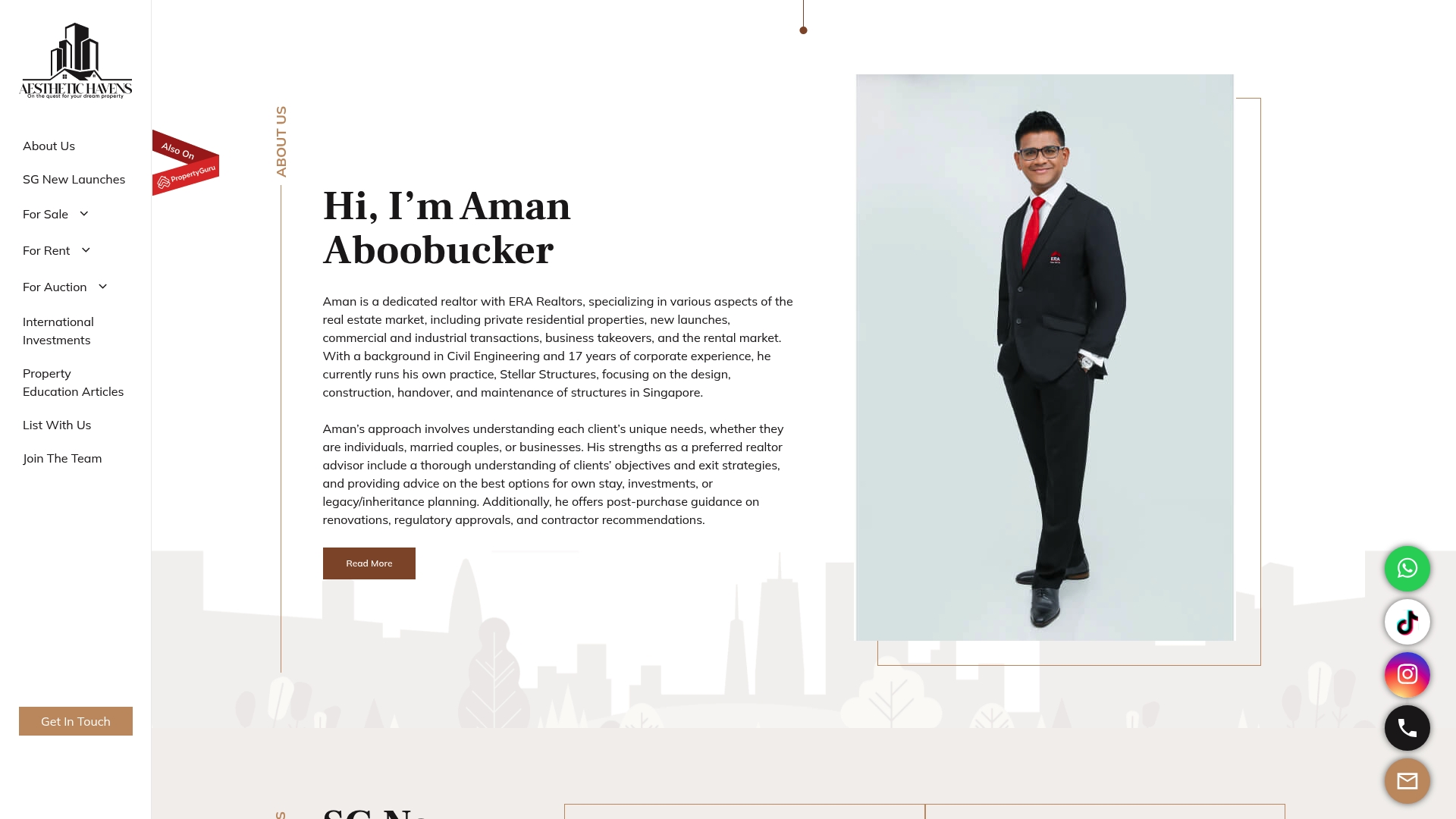
At Aesthetic Havens, Aman Aboobucker works with buyers and investors across Singapore to cut through the complexity of tenure types, co-ownership structures, and CPF rules. Whether you are buying your first home or building a property portfolio, understanding why professional guidance matters can save you from costly mistakes that take decades to surface. Reach out to Aesthetic Havens for a direct, no-pressure consultation on how tenure fits into your property plan.
FAQ
What is property tenure in Singapore?
Property tenure in Singapore defines how long and under what legal terms you own a property. The three main types are freehold, 999-year leasehold, and 99-year leasehold.
Is freehold always better than leasehold in Singapore?
Freehold suits long-term and multi-generational ownership, but leasehold properties cost 5–15% less at entry and perform well for medium-term investment horizons of 5–15 years.
What is Bala’s Curve and why does it matter?
Bala’s Curve measures how leasehold property values depreciate as the remaining lease shortens. Value drops sharply below 60 and 40 remaining years, restricting CPF use and bank financing.
What is the difference between joint tenancy and tenancy-in-common?
Joint tenancy gives the surviving owner full property rights on death; tenancy-in-common assigns distinct shares that each owner can sell or bequeath independently through a will.
Can I use CPF to buy a 99-year leasehold property?
CPF use is permitted if the remaining lease covers the youngest buyer to age 95. If the lease is too short to meet that threshold, CPF withdrawal is capped or denied entirely.
Recommended
- New Launch vs Resale 2026: Singapore Property Market Guide | Aesthetic Havens
- Foreigner’s Guide to Buying Property in Singapore (2025 Regulations & Taxes) | Aesthetic Havens
- The Ultimate Executive Condominium (EC) Eligibility Guide for 2026 Buyers | Aesthetic Havens
- Singapore Property Market: Navigating the Transition – A Definitive Forecast for 2025-2026 | Aesthetic Havens


