


Rental property valuation is a data-driven estimate of a property’s current market worth, calculated from its income generation potential, comparable sales, and operating costs. Knowing how to value rental property accurately separates investors who build wealth from those who overpay and underperform. The three core methods every serious investor uses are the Sales Comparison Approach, the Income Approach (including Cap Rate and Gross Rent Multiplier), and the Cost Approach. Tools like Rentometer, professional appraisal reports, and cash flow calculators support each method. No single method is definitive; layered analysis reduces the risk of incomplete data and leads to more confident buy or hold decisions.
How to value rental property: the three core methods
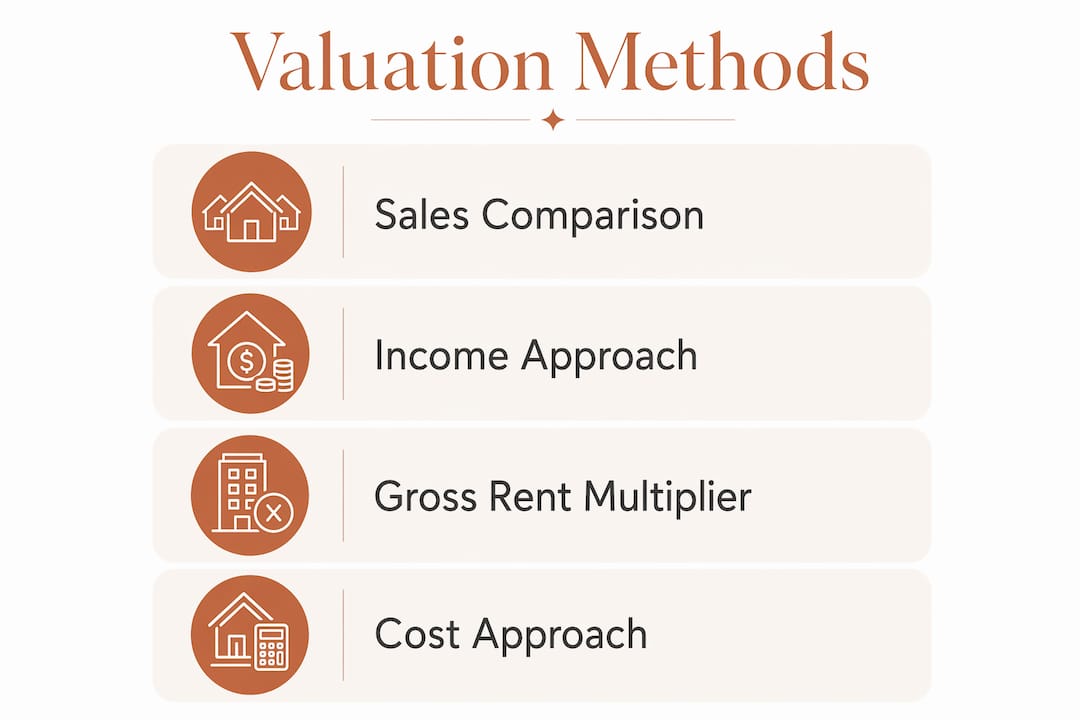
The Sales Comparison Approach, the Income Approach, and the Cost Approach each answer a different question about a property’s worth. Using all three together gives you a far more reliable picture than any one method alone.
| Method | Best Used For | Key Metric |
|---|---|---|
| Sales Comparison | Standard residential rentals with active market | Price per sq ft vs. recent comps |
| Income Approach | Income-producing properties, multifamily | Net Operating Income / Cap Rate |
| Gross Rent Multiplier | Quick screening and initial deal filtering | Purchase Price / Annual Gross Rent |
| Cost Approach | New builds or unique properties with few comps | Replacement cost minus depreciation |

Sales Comparison Approach
The Sales Comparison Approach values a property by comparing it to three to five recently sold, similar properties in the same neighborhood. Comps should match on bedroom and bathroom count, square footage, condition, and location. Recency matters: 3 to 5 comps within three blocks and sold within the last three to six months produce the most reliable baseline. A two-bedroom condo in a high-demand district that sold for $450,000 tells you far more than a comp from 18 months ago in a different zip code.
Income Approach and Cap Rate
The Income Approach calculates value from the property’s earning power. You calculate Net Operating Income (NOI) by subtracting all operating expenses from gross rental income, then divide NOI by the local market Cap Rate to arrive at estimated value. For example, a property generating $24,000 NOI in a market with a 6% Cap Rate is worth approximately $400,000. This method is the standard for multifamily and commercial rental assets. You can learn more about cap rate and GRM metrics as part of a broader yield analysis.
Gross Rent Multiplier as a screening tool
The Gross Rent Multiplier (GRM) is a fast filter, not a final answer. Divide the asking price by the annual gross rent: a property listed at $300,000 collecting $24,000 per year has a GRM of 12.5. Lower GRM signals better initial value, but GRM ignores expenses entirely. Use it to eliminate deals quickly, then apply the Income Approach to the survivors.
Cost Approach for unique properties
The Cost Approach estimates what it would cost to rebuild the property from scratch, then subtracts depreciation. It works best for new construction or properties so unique that comparable sales simply do not exist. For standard rental homes in active markets, this method plays a supporting role rather than a primary one.
How to gather and analyze accurate rental and sales comps
Accurate comps are the foundation of any credible rental property appraisal. A weak comp set produces invalid return metrics, no matter how sophisticated your spreadsheet is.
The most important discipline here is running two separate comp sets: one for estimating market value (sales comps) and one for estimating rental income (rental comps). This two-tiered approach is what separates professional underwriting from amateur guesswork. Mixing the two or skipping one entirely is how investors end up with inflated income projections attached to an overpriced purchase.
Follow these steps to build a reliable comp set:
- Match property characteristics precisely. Comps must align on bedroom count, bathroom count, square footage (within 10 to 15%), property type, and overall condition. Older unit comps should be used for older properties. A renovated unit in a newer building is not a valid comp for a 1970s unrenovated apartment.
- Limit geography aggressively. Aim for comps within three blocks or the same immediate sub-market. Crossing a major road or school district boundary can invalidate a comp entirely.
- Enforce a recency filter. Only use sales closed or rentals signed within the last three to six months. Markets shift fast, and older data embeds stale assumptions into your model.
- Cross-check rental rates with Rentometer. Rentometer aggregates rental listings and lease data by zip code and bedroom count, giving you a fast sanity check against your comp set. Professional appraisal reports provide a deeper layer of verification for larger acquisitions.
- Adjust for condition and amenities. If your target property lacks parking or has an older kitchen compared to a comp, apply a downward adjustment to the comp’s rent or price before using it.
Pro Tip: Call two or three local property managers and ask what a unit like yours would rent for today. Property managers price units daily and often have more current data than any online platform.
Why expense accounting makes or breaks your valuation
Phantom cash flow is the most dangerous number in real estate investing. It appears when investors count gross rent as income without accounting for every real cost the property generates.
The expenses you must include in any rental property valuation are:
- Debt service: Your mortgage principal and interest payment, calculated at current interest rates. Rising rates in 2026 have materially increased this line item for leveraged buyers.
- Property taxes: Use the post-purchase reassessed figure, not the current owner’s bill. Taxes can jump from $3,000 to $7,200 annually after a sale in many jurisdictions. That $4,200 difference erases months of cash flow.
- Insurance: Landlord insurance, not homeowner’s insurance. Budget this separately and get an actual quote before closing.
- Property management fees: Typically 8 to 12% of collected rent. Even self-managing investors should model this cost to understand the true value of their time and to stress-test the deal if they ever need to hire out.
- Vacancy allowance: A standard 5 to 8% vacancy rate accounts for turnover, lease-up periods, and unexpected vacancies. Assuming 100% occupancy is not conservative analysis. It is wishful thinking.
- Repairs and maintenance: Budget 1% of property value annually as a baseline for ongoing maintenance costs.
- Capital expenditures (CAPEX): CAPEX covers replacement of major systems with finite lives: roof, HVAC, water heater, appliances, flooring. Budget 5% of rent for newer properties and 10% for older ones as a CAPEX reserve. Ignoring CAPEX is the single most common reason investors overestimate cash flow.
“A five-minute call to the local county assessor before purchase can safeguard investors from unexpected tax reassessments that erode cash flow.” — Galleon
Pro Tip: Before making any offer, call the local assessor’s office and ask directly: “If this property sells at X price, what will the new assessed value and annual tax bill be?” Most assessors will give you a reliable estimate on the spot.
The role of property management in controlling these costs is often underestimated. A skilled manager reduces vacancy duration, handles maintenance efficiently, and protects your NOI.
How to calculate cash-on-cash return and set your maximum offer
Cash-on-cash return is annual pure cash flow divided by total cash invested. It is the most practical metric for comparing rental deals because it reflects your actual out-of-pocket return, not a theoretical yield. A strong cash-on-cash return typically falls between 8% and 12%. Deals below 8% require a compelling appreciation thesis to justify the risk.
Here is a step-by-step example:
- Estimate gross annual rent. A two-bedroom unit renting at $2,200 per month generates $26,400 per year.
- Subtract all operating expenses. Property taxes ($4,800), insurance ($1,200), management at 10% ($2,640), vacancy at 6% ($1,584), repairs ($2,000), and CAPEX at 8% ($2,112) total $14,336.
- Calculate NOI. $26,400 minus $14,336 equals $12,064 NOI.
- Subtract annual debt service. A $280,000 mortgage at 7% over 30 years costs approximately $22,356 per year. In this example, the deal produces negative cash flow at that price point, which tells you the purchase price is too high or the rent is too low.
- Back-calculate your maximum allowable offer (MAO). Back-calculating from your target return is the most practical way to set a bid. If you need $8,000 annual cash flow on $80,000 invested to hit a 10% cash-on-cash return, work backward from that number to determine the maximum purchase price that makes the math work.
| Scenario | Annual Cash Flow | Cash Invested | Cash-on-Cash Return |
|---|---|---|---|
| Base case | $8,000 | $80,000 | 10.0% |
| 10% vacancy increase | $5,640 | $80,000 | 7.1% |
| $150/month rent drop | $6,200 | $80,000 | 7.8% |
| 20% repair cost buffer | $7,200 | $80,000 | 9.0% |
Stress-testing these assumptions by modeling a 10% vacancy increase, a 20% repair cost buffer, and a $150 monthly rent reduction shows you how much margin of safety the deal actually carries. If the deal still works under all three pressures simultaneously, you have a genuinely resilient investment.
Pro Tip: When projecting long-term value, assume 3 to 4% annual appreciation rather than recent market peaks. Conservative appreciation assumptions prevent you from buying a deal that only works if prices keep climbing.
For investors expanding beyond Singapore, understanding international rental ROI using these same frameworks helps evaluate cross-border opportunities with the same rigor.
Key takeaways
Accurate rental property valuation requires combining the Sales Comparison, Income, and Cost approaches with thorough expense accounting and stress-tested cash flow analysis.
| Point | Details |
|---|---|
| Use multiple valuation methods | Combine Sales Comparison, Income Approach, and GRM to reduce blind spots in any single method. |
| Run two separate comp sets | Build independent sales comps and rental comps to avoid invalid return projections. |
| Account for CAPEX explicitly | Budget 5% to 10% of rent as a CAPEX reserve or your cash flow figures will be overstated. |
| Call the assessor before buying | Confirm post-sale tax reassessment figures to avoid cash flow surprises after closing. |
| Back-calculate your offer price | Use your target cash-on-cash return to set a maximum allowable offer, not the other way around. |
What most investors get wrong about valuation
Most investors I work with arrive at their first deal with a number in mind and then build the analysis backward to justify it. That is not valuation. That is confirmation bias with a spreadsheet attached.
The discipline that actually protects your capital is running the expense model before you fall in love with a property. CAPEX is the line item that surprises people most. A roof replacement, an HVAC system, and a water heater in the same year can cost $25,000 to $40,000 on a single-family rental. If you have not reserved for it, that cost comes directly out of your equity.
Tax reassessment is the second trap. I have seen investors model a deal using the seller’s current tax bill, close on the property, and then receive a reassessment notice that adds $4,000 or more to their annual expenses. That one call to the assessor takes five minutes and can save you from a deal that looks profitable on paper but bleeds cash in practice.
My strongest advice: run your stress test before you run your base case. If the deal only works under perfect conditions, it is not a deal. The properties worth buying still generate acceptable returns when vacancy is higher, rents are lower, and repairs cost more than expected. That margin of safety is what you are actually paying for when you select an investment property with discipline.
— Aman
Get expert valuation support from Aesthetic Havens
Valuing a rental property accurately takes more than a formula. It takes current market data, local knowledge, and the experience to know when numbers are telling the truth.

At Aesthetic Havens, Aman and the ERA Realtors team provide investors with data-driven comparable analysis, appraisal coordination, and financial modeling tailored to your target market. Whether you are evaluating your first rental acquisition in Singapore or expanding a portfolio across multiple markets, the advisory resources on the site give you the professional foundation to make confident, well-priced offers. Reach out directly for a personalized consultation and get the numbers right before you commit.
FAQ
What is the best method for valuing a rental property?
The Income Approach using Net Operating Income and Cap Rate is the most widely used method for rental property appraisal, but combining it with the Sales Comparison Approach and Gross Rent Multiplier produces the most reliable valuation.
How much does a rental property appraisal cost?
Appraisal costs range from $500 to $1,200 for condos and small multifamily properties, $700 to $1,500 for 2 to 4 unit buildings, and $2,000 to $3,500 or more for larger multi-unit assets.
What is a good cash-on-cash return for rental property?
A cash-on-cash return between 8% and 12% is the standard benchmark for a strong rental deal. Returns below 8% require a clear appreciation thesis to justify the investment risk.
How do I determine the right rent price for my property?
Use Rentometer to pull rental comps by zip code and bedroom count, then cross-check with at least three local property managers for current market rates. Match comps on condition, size, and location to set a defensible rent figure.
Why do property taxes matter so much in rental valuation?
Post-sale tax reassessments can increase annual property taxes by thousands of dollars, directly reducing cash flow. Calling the local assessor before closing confirms the actual post-purchase tax liability and prevents costly surprises.


