


A property portfolio is defined as a collection of multiple real estate investment assets held by an individual or entity, structured to generate income and build long-term wealth. Unlike owning a single rental property, a portfolio operates as a coordinated system where each asset contributes to a shared financial goal. Most lenders classify an investor as a portfolio landlord once they hold four or more mortgaged properties, triggering stricter underwriting criteria. Understanding what a property portfolio is, how lenders define it, and why diversification matters gives new investors a clear framework before committing capital.
What is a property portfolio and how do lenders define it?
A property portfolio, also called a real estate investment portfolio, is any grouping of income-producing properties managed together under one ownership strategy. The term covers everything from two rental apartments in the same city to a mix of residential, commercial, and industrial assets spread across multiple countries.
Lenders draw a sharper line. No fixed legal threshold exists for what constitutes a portfolio, but the industry standard is four or more mortgaged properties. Once you cross that line, most mortgage lenders apply portfolio landlord criteria, which means they assess your entire property holdings, not just the individual property being financed. That shift changes how much documentation you need, how your rental income is stress-tested, and what loan-to-value ratios you can access.
The distinction between a single buy-to-let owner and a portfolio landlord is more than semantic. Portfolio landlords face greater regulatory scrutiny, especially in markets like the UK and Singapore where tax treatment and financing rules differ by ownership scale. Lenders also pay close attention to ownership structure. Holding properties in a limited company rather than personal name affects how mortgage interest is treated, how profits are taxed, and how easily you can reinvest returns.
- Single property owner: One mortgage, assessed on personal income and that property’s rental yield.
- Portfolio landlord (4+ properties): All mortgaged properties assessed together; lenders review aggregate debt, total rental income, and overall portfolio risk.
- Limited company structure: Mortgage interest treated as a business expense; preferred by investors scaling beyond five properties for tax efficiency.
Pro Tip: If you are approaching your fourth mortgaged property, speak with a specialist broker before completing the purchase. The underwriting criteria change significantly at that threshold, and preparation prevents financing delays.
Why owning multiple properties beats a single investment
The core advantage of a property investment portfolio over a single asset is income stability. When one property sits vacant, rental income from the others continues. That buffer is the difference between a temporary setback and a cash flow crisis.
“A property portfolio is not just a collection of assets but a financial engine designed to operate through economic ups and downs by leveraging diversification for survival and growth.” (Gateex)
The benefits compound as the portfolio grows. Here is how multiple properties create advantages that a single asset simply cannot replicate:
- Income resilience. Vacancy in one property does not stop your income stream. A portfolio of five properties with one vacant still generates 80% of its potential rental income.
- Financing leverage. Equity built in existing properties can be released through remortgaging to fund new acquisitions. Equity release via remortgaging is one of the most underused strategies for accelerating portfolio growth without requiring fresh capital every time.
- Economies of scale. A property manager handling five of your properties charges less per unit than five separate managers. Insurance, maintenance contracts, and accounting costs all reduce on a per-property basis as the portfolio grows.
- Appreciation across markets. Properties in different cities or regions do not all peak and trough at the same time. Holding assets in multiple markets means some are always appreciating even when others are flat.
Experts suggest owning 3 to 6 properties to generate meaningful passive income, with geographic diversification typically beginning around the tenth property. That progression is not accidental. It reflects how portfolio investors naturally shift from income generation to risk management as their holdings grow.
How does property portfolio diversification reduce risk?

Diversification is the single most effective risk management tool available to property investors. Portfolios diversified by location and property type experienced 35% less volatility during market corrections, and more than 70% of real estate investors hold multiple property types to increase resilience. Those numbers reflect a structural advantage, not luck.
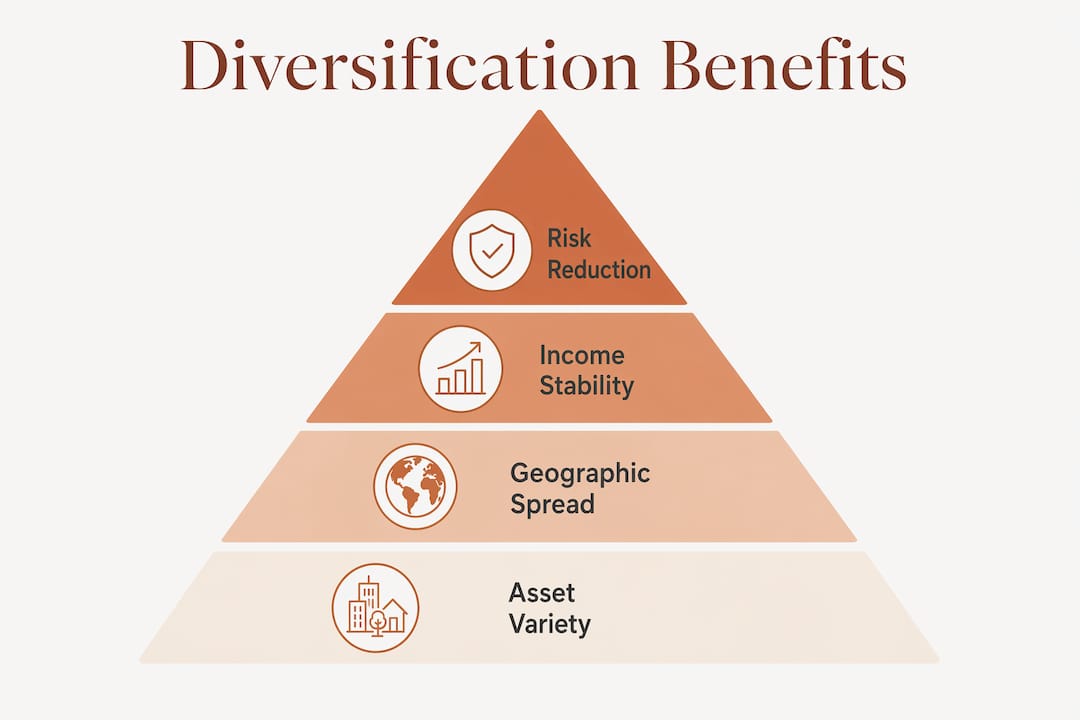
Geographic diversification outperforms asset-type diversification for long-term risk reduction. A localized economic shock, a new zoning law, or a single employer leaving a city can devastate a portfolio concentrated in one area. Spreading holdings across two or three markets with different economic drivers insulates you from those shocks. Learning more about international property investment is one way to extend that geographic logic beyond domestic borders.
Asset-type diversification adds a second layer of protection. Residential properties provide steady demand but lower yields. Commercial properties offer higher yields but more tenant turnover risk. Industrial assets tend to have longer leases and lower management intensity. Mixing these types smooths the income curve across economic cycles.
Pro Tip: Do not diversify for its own sake. Each new property type or market should meet the same return criteria as your existing holdings. Diversification that lowers your average yield without reducing risk is just dilution.
The table below shows how portfolio composition typically shifts as investors scale:
| Portfolio size | Primary allocation | Secondary allocation | Geographic spread |
|---|---|---|---|
| 1 to 3 properties | Single-family residential (80%+) | None | Single market |
| 4 to 6 properties | Single-family residential (60%) | Condos or duplexes (40%) | 1 to 2 markets |
| 7 to 10 properties | Mixed residential (50%) | Commercial or industrial (50%) | 2 to 3 markets |
| 10+ properties | Balanced mix across types | International or niche assets | 3+ markets |
A portfolio brought to scale typically includes 2 to 3 different property types with allocations shifting toward commercial and mixed-use assets as the investor’s experience and capital base grow.
How to start and grow a property portfolio sustainably
Building a property portfolio requires a planned strategy, not a series of opportunistic purchases. Scaling successfully depends on leverage management, equity timing, and risk diversification working together from the start.
Follow these steps to build with intention:
- Set clear financial targets. Define what you want the portfolio to produce: monthly passive income, total asset value, or retirement funding by a specific year. Vague goals produce vague portfolios.
- Research markets before capital. Identify markets with strong rental demand, population growth, and infrastructure investment. Buying in a familiar neighborhood is comfortable but often suboptimal. Read about selecting investment property to apply a structured selection framework.
- Structure your financing from the beginning. Decide early whether to hold properties personally or through a limited company. Larger portfolios require formal ownership structures such as limited companies to optimize tax treatment and financing access. Changing structure later is costly and complicated.
- Use equity to fund growth. Once your first or second property has appreciated, remortgage to release equity and use it as a deposit on the next acquisition. This approach compounds growth without requiring new savings at every stage.
- Build systems before you need them. Transitioning from a hands-on landlord to a portfolio operator means adopting property management software, formal lease templates, and compliance tracking. Portfolio landlords must systematize processes to maintain service quality, especially beyond ten properties.
The operational shift is where most new portfolio investors underestimate the challenge. Managing three properties personally is manageable. Managing ten without systems is a full-time job with no vacation. Tools like property management platforms, automated rent collection software, and professional letting agents are not luxuries at scale. They are what keep the portfolio functioning as a business rather than a collection of individual problems.
Understanding your landlord responsibilities before scaling is equally important. Compliance requirements multiply with each property added, and regulatory breaches become more costly as the portfolio grows.
Key takeaways
A property portfolio is most effective when built with a clear income target, a diversification plan across locations and property types, and a financing structure designed for scale from the start.
| Point | Details |
|---|---|
| Portfolio definition | Four or more mortgaged properties typically triggers portfolio landlord classification by lenders. |
| Diversification benefit | Geographic and asset-type diversification reduces portfolio volatility by up to 35% during market corrections. |
| Equity as growth fuel | Remortgaging existing properties to release equity is the most practical way to fund new acquisitions without fresh savings. |
| Ownership structure matters | Limited company structures offer tax and financing advantages that personal ownership cannot match at scale. |
| Systems over hustle | Portfolios beyond ten properties require formal management software and processes to remain profitable and compliant. |
What I’ve learned building portfolios across markets
Most investors I work with make the same early mistake: they treat their second and third property the same way they treated their first. They pick a familiar area, use the same lender, and manage everything personally. That approach works until it doesn’t, usually around property four or five when the complexity multiplies faster than the income.
The mindset shift that actually changes outcomes is treating the portfolio as a business from day one, not from the day it becomes unmanageable. That means setting up the right ownership structure before you need it, not after you’ve already bought three properties in your personal name. It means choosing your second market based on fundamentals, not because a friend mentioned it at dinner.
I’ve also seen investors over-diversify too early. Buying one property in five different cities sounds sophisticated, but it creates five separate management challenges with no economies of scale in any of them. Depth in two or three markets beats breadth across ten.
The investors who build the most resilient portfolios are not the ones who found the best deals. They are the ones who built the best systems, chose the right structures, and stayed patient enough to let equity compound before expanding again. Short-term thinking produces short-term portfolios.
— Aman
Ready to build your property portfolio with expert guidance?
Building a property investment portfolio is one of the most reliable paths to long-term financial independence, but the decisions you make in the first two or three acquisitions shape everything that follows. Getting the ownership structure, market selection, and financing strategy right from the start is far easier with professional support than correcting mistakes later.

Aesthetic Havens, operated by Aman Aboobucker under ERA Realtors, provides real estate advisory services tailored specifically for investors building or expanding their portfolios in Singapore and internationally. Whether you are evaluating your first investment property or planning your next acquisition, the Aesthetic Havens team offers market intelligence, financing guidance, and hands-on support at every stage of your portfolio journey.
FAQ
What is a property portfolio in simple terms?
A property portfolio is a collection of two or more real estate properties owned by the same individual or entity for investment purposes, typically structured to generate rental income and long-term capital growth.
How many properties do you need for a property portfolio?
There is no fixed legal minimum, but lenders typically classify an investor as a portfolio landlord once they hold four or more mortgaged properties, applying stricter underwriting criteria at that point.
What are the main benefits of a property portfolio?
The primary benefits include income resilience through diversification, financing leverage via equity release, economies of scale in management costs, and reduced volatility compared to holding a single investment property.
What should you include in a property portfolio?
A well-structured portfolio typically includes a mix of residential property types such as single-family homes, condos, and duplexes, with assets spread across at least two geographic markets to reduce local economic risk.
Is a limited company better for holding a property portfolio?
For portfolios of five or more properties, a limited company structure generally offers better tax treatment and financing flexibility, since mortgage interest is treated as a business expense and profits can be reinvested more efficiently.


