


Property management is defined as the operational oversight and asset stewardship of rental properties, covering tenant relations, financial management, maintenance, legal compliance, and owner reporting to maximize income and preserve long-term value. For homeowners, landlords, and real estate investors, understanding the role of property management is the difference between a property that performs and one that quietly erodes your wealth. The Institute of Real Estate Management (IREM) recognizes professional property management as a discipline governed by fiduciary standards, not just a service. Platforms like MRI Software have documented how management quality directly shapes net operating income (NOI) and investor returns. Whether you own one unit or a multifamily portfolio, the quality of management execution determines your outcome.
What are the primary functions and responsibilities of property management?
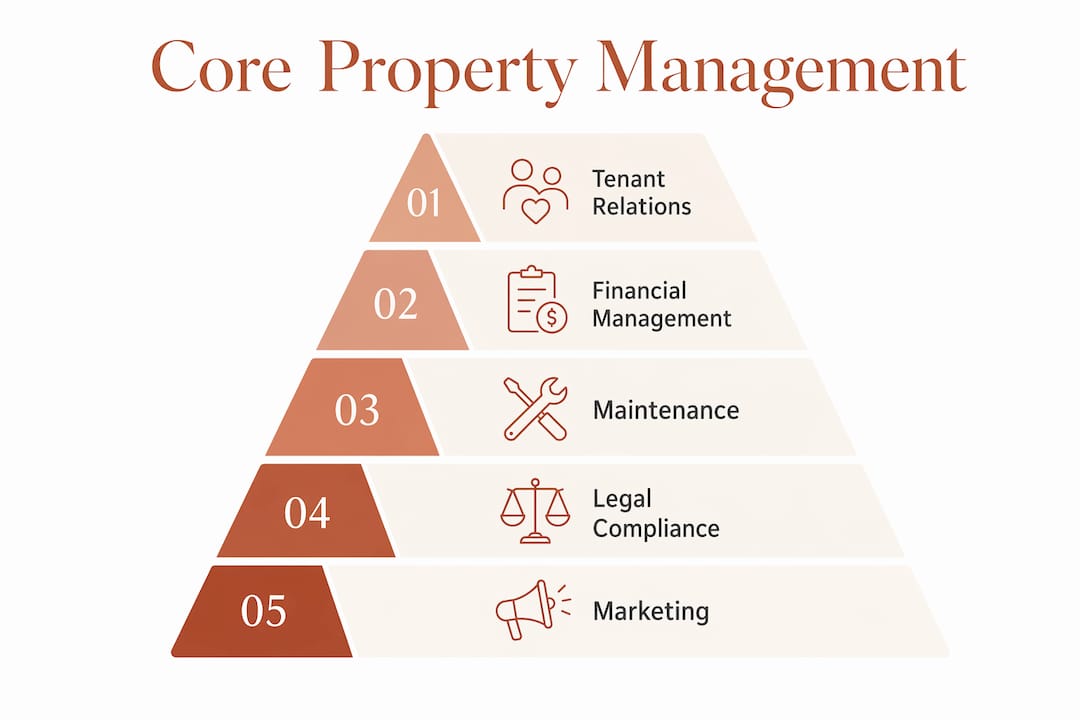
Eight core functional areas define the scope of professional property management: tenant relations, financial management, maintenance, legal compliance, marketing, inspections, owner reporting, and risk management. Each function is interdependent. A failure in one, say, poor tenant screening, creates cascading problems across the others.
Tenant relations covers everything from initial screening and lease execution to ongoing communication and retention strategies. A property manager who handles tenant concerns promptly reduces turnover, which is the single largest controllable cost in rental operations.
Financial management includes rent collection, trust account administration, expense tracking, and monthly owner statements. Property managers process trust-account rent collections segregated from operating funds, a legal requirement in most jurisdictions that protects both owner and tenant.
Maintenance and repairs span routine upkeep, vendor coordination, and emergency response. A well-run maintenance program prevents small issues from becoming capital expenditures. Risk management rounds out the picture, covering insurance coordination, safety inspections, and contingency planning.

Here is how property management responsibilities differ across property types:
| Property type | Core focus | Key challenges |
|---|---|---|
| Single-family residential | Tenant stability, upkeep | Long vacancy periods, owner-occupant expectations |
| Multifamily residential | Occupancy rate, resident experience | High turnover, maintenance volume |
| Commercial | Lease compliance, CAM reconciliation | Complex leases, tenant improvement costs |
| Industrial | Structural maintenance, zoning compliance | Specialized repairs, regulatory requirements |
Pro Tip: When interviewing a property manager, ask specifically how they handle maintenance authorization thresholds and how they document owner communication. These two areas reveal operational discipline faster than any credential.
Why is property management important for rental income and property value?
Tenant retention is the most underestimated profit lever in rental real estate. A positive tenant experience lowers turnover, reduces vacancy periods, and cuts the costs of re-leasing, all of which compound into measurable income growth over time. Most landlords focus on acquisition price and ignore the retention math entirely.
The financial case for professional management becomes stark when you factor in eviction risk. A single eviction can cost a landlord between $3,500 and $10,000, including legal fees, lost rent, and turnover expenses. That figure alone often exceeds an entire year of management fees. Professional screening processes, which include credit checks, rental history verification, and income validation, exist precisely to prevent that outcome.
Preventive maintenance is the other major value driver. Properties managed with scheduled inspections and proactive repairs retain their market value longer and command higher rents. Deferred maintenance, by contrast, accelerates depreciation and creates liability exposure.
The importance of property management also extends to tax reporting accuracy. Detailed financial statements produced by a competent manager give investors clean records for depreciation claims, expense deductions, and capital gains calculations. Sloppy bookkeeping costs money at tax time and during refinancing.
“Successful multifamily investing is heavily dependent on effective management execution, which controls expenses and enhances resident retention and NOI.” — Emaret Capital Group
The functions of property management, when executed well, do not just protect income. They actively grow it.
How do property managers uphold fiduciary responsibilities and legal compliance?
Property managers are fiduciary agents legally required to uphold loyalty, care, and disclosure owed to property owners under common law agency principles. This is not a soft ethical standard. It is a legal obligation with real consequences for breach.
Here is what fiduciary compliance looks like in practice:
- Loyalty: The manager acts solely in the owner’s financial interest, avoiding conflicts of interest such as steering repairs to affiliated vendors at inflated rates.
- Care: Decisions are made with the diligence a reasonable professional would apply, including timely maintenance responses and accurate financial reporting.
- Disclosure: Material facts affecting the property or tenancy, including legal notices, damage reports, and market changes, are communicated to the owner without delay.
- Financial segregation: Rent collected is held in a dedicated trust account, separate from the manager’s operating funds, as required by most state and national licensing bodies.
- Decision thresholds: Management contracts typically authorize routine repairs under a defined dollar amount, commonly $200 to $500, without requiring explicit owner approval. This prevents costly delays on urgent repairs.
Licensing requirements vary by jurisdiction. In Singapore, property managers operating under ERA Realtors must comply with the Council for Estate Agencies (CEA) regulations. In the United States, most states require a real estate broker’s license to manage properties for others. The Fair Housing Act adds a federal compliance layer for U.S. residential managers, prohibiting discrimination based on race, religion, national origin, sex, disability, or familial status.
Understanding landlord roles in leasing and the legal framework around them is not optional. Violations carry fines, civil liability, and license revocation.
Pro Tip: Always request a copy of your property manager’s trust account reconciliation reports quarterly. A manager who resists this request is a red flag, regardless of their track record.
Self-management vs. hiring professional property managers
Self-managing a single rental unit demands about 96 hours annually, roughly two and a half full-time work weeks, accounting for ongoing tasks and tenant turnover. That figure assumes nothing goes wrong. Add a difficult tenant, a plumbing emergency, or a lease dispute, and the time cost escalates sharply.
The decision framework comes down to four variables:
- Portfolio size: Beyond one or two units, the administrative load of self-management typically exceeds the cost of professional fees.
- Geographic distance: Owners managing properties in a different city or country face compounding risk from delayed maintenance responses and limited local vendor relationships.
- Opportunity cost: If your hourly rate in your primary profession exceeds what a property manager charges per hour of work delivered, self-management is a net loss.
- Legal exposure: Landlord-tenant law is jurisdiction-specific and changes frequently. A single compliance error, such as an improper notice period or an illegal lease clause, can trigger costly disputes.
Hiring a property manager is generally worthwhile beyond one or two units or when the owner’s time carries high opportunity cost, converting active landlord labor into passive income. Hybrid models exist for owners who want partial control. Some managers offer leasing-only services, handling tenant placement and lease execution while the owner handles day-to-day operations. Others offer full-service management with tiered fee structures based on portfolio size.
Technology has shifted the calculus somewhat. Property management software platforms allow self-managing landlords to automate rent collection, maintenance requests, and lease renewals. But software does not replace local market knowledge, vendor networks, or legal expertise.
Pro Tip: Before signing a management agreement, calculate your true self-management cost: multiply your hourly rate by 96 hours, then add estimated legal and vacancy risk. Compare that number to annual management fees. The math usually surprises landlords.
How effective property management drives long-term investment success
A strong property management team is crucial in multifamily investing and can significantly influence net operating income and investor returns. The acquisition price matters, but operator execution determines whether that acquisition performs or underperforms over a five to ten year hold period.
The connection between daily operations and investment outcomes is direct. Consider two identical multifamily properties acquired at the same price. Property A is managed by a team with proactive maintenance schedules, structured tenant screening, and monthly owner reporting. Property B is managed reactively, with deferred repairs and high turnover. Within three years, Property A commands higher rents, carries lower vacancy, and has a higher appraised value. The difference is management quality, not market conditions.
| Operational factor | Impact on investment |
|---|---|
| Tenant retention rate | Reduces vacancy loss and re-leasing costs |
| Preventive maintenance | Lowers capital expenditure and extends asset life |
| Accurate financial reporting | Supports refinancing, tax planning, and sale preparation |
| Vendor management | Controls operating expenses and improves service quality |
| Resident satisfaction | Drives lease renewals and referral-based occupancy |
Investors who want to maximize property returns need to treat management selection with the same rigor applied to acquisition analysis. Reviewing a manager’s average vacancy rate, eviction frequency, and maintenance response times gives a clearer picture of future NOI than any pro forma spreadsheet.
Capital improvement planning is another area where professional management adds measurable value. A competent manager identifies when a roof replacement, HVAC upgrade, or common area renovation will yield higher rents or reduce insurance premiums, and presents that analysis to the owner with cost projections. That kind of forward planning is what separates asset appreciation from asset decay.
Key takeaways
Effective property management is the operational foundation that determines whether a rental property generates consistent income or quietly loses value over time.
| Point | Details |
|---|---|
| Core functions span eight areas | Tenant relations, financial management, maintenance, compliance, marketing, inspections, reporting, and risk management all require active oversight. |
| Fiduciary duty is a legal standard | Property managers must uphold loyalty, care, and disclosure as agents acting on behalf of property owners. |
| Eviction risk justifies professional fees | A single eviction costs $3,500 to $10,000, often exceeding a full year of management fees. |
| Self-management costs 96 hours per year | Time opportunity cost makes professional management financially rational for most landlords beyond one or two units. |
| Execution drives NOI and asset value | Management quality, not just acquisition price, determines long-term investment performance. |
Why I think most investors underestimate the management decision
After years of working with property owners and investors across Singapore and internationally, the pattern I see most often is this: buyers spend months analyzing acquisition opportunities and then spend about two hours selecting a property manager. That imbalance is where wealth quietly disappears.
The property management responsibilities that seem administrative, like maintenance authorization thresholds, trust account reconciliation, and tenant communication protocols, are actually the mechanics of your return. When those mechanics fail, you do not just lose a tenant. You lose months of income, accumulate deferred maintenance costs, and sometimes face legal exposure that no acquisition discount can offset.
What I have also observed is that the best managers are not necessarily the cheapest or the most prominent. They are the ones who communicate proactively, enforce lease terms consistently, and treat your property as if it were their own asset. That last quality is rare and worth paying for.
Technology is changing property management tasks in ways that benefit owners. Automated rent collection, digital maintenance tracking, and real-time financial dashboards reduce friction and improve transparency. But technology amplifies a good manager’s effectiveness. It does not compensate for a poor one.
My recommendation: evaluate your property manager annually, not just at contract renewal. Review their vacancy rates, maintenance response times, and financial reporting quality. The right property agent or manager is one of the highest-leverage decisions you will make as a property investor.
— Aman
How Aesthetic Havens supports your property investment goals
Aesthetic Havens, operated by Aman Aboobucker under ERA Realtors, provides Singapore-based property owners and investors with expert guidance across buying, selling, leasing, and investment strategy. Whether you are assessing a new acquisition or evaluating your current rental portfolio’s performance, the team brings market intelligence and professional advisory to every decision.

From property leasing guidance to full investment strategy support, Aesthetic Havens connects landlords and investors with the expertise needed to protect and grow their assets. If you are weighing the benefits of hiring property managers or planning your next acquisition, visit Aesthetic Havens to speak with Aman directly and get advice tailored to your portfolio.
FAQ
What does property management do for landlords?
Property management handles tenant screening, rent collection, maintenance coordination, lease enforcement, and financial reporting on behalf of property owners. The goal is to maximize rental income and protect asset value while reducing the owner’s time commitment.
What are the main functions of property management?
The eight core functions are tenant relations, financial management, maintenance, legal compliance, marketing, inspections, owner reporting, and risk management. Each function directly affects occupancy rates, operating costs, and long-term property value.
How much does self-managing a rental property cost in time?
Self-managing a single unit requires approximately 96 hours per year under normal conditions. That figure rises significantly during tenant turnover, maintenance emergencies, or lease disputes.
What fiduciary duties does a property manager owe the owner?
A property manager owes the owner loyalty, care, and full disclosure as a fiduciary agent under common law. This includes segregating rental funds in a trust account and reporting all material facts affecting the property.
When does hiring a property manager make financial sense?
Professional management becomes financially rational beyond one or two units, or when the owner’s time carries high opportunity cost. Given that a single eviction can cost up to $10,000, management fees typically represent a lower risk than self-management for most landlords.


