

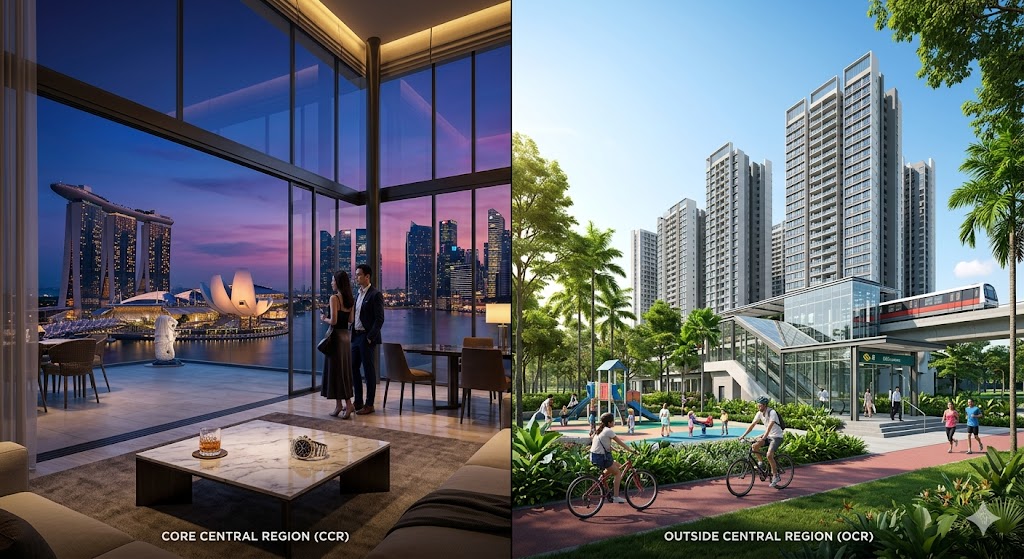
CCR vs OCR in 2026: Where is the Better Value for Money?
SEO Title: CCR vs OCR in 2026: Where is the Better Value for Money?
Meta Description: Discover where the better value for money lies in the Singapore property market. We comprehensively compare CCR vs OCR in 2026 for investors.
Focus Keyphrase: CCR vs OCR in 2026.
Tags: Singapore property market, condo buying guide, real estate SEO, value for money, URA Master Plan.
Introduction to Singapore Real Estate
The Singapore property market remains highly dynamic today. Investors face complex choices regarding capital deployment. Evaluating CCR vs OCR in 2026 is absolutely critical. Buyers actively seek the better value for money. This detailed report analyzes current real estate trends thoroughly. We provide a comprehensive condo buying guide. Furthermore, we explore upcoming infrastructure developments. These factors heavily influence future property valuations.
Transitioning into 2026, market paradigms are shifting rapidly. Historical property assumptions require immediate and careful re evaluation. Understanding distinct regional characteristics is essential for success. Singapore divides its private residential market into three zones. First, the Core Central Region (CCR) represents luxury.1 Second, the Rest of Central Region (RCR) borders the city.2 Third, the Outside Central Region (OCR) encompasses the suburbs.2
Historically, the CCR commanded massive pricing premiums. However, recent market data indicates a structural adjustment.3 A notable price moderation has occurred centrally.3 In contrast, OCR new launches continually establish price benchmarks.3 Consequently, the traditional price gap is steadily narrowing. This dynamic presents entirely unique investment opportunities.
Market Overview and HDB Resale Impact
In the first quarter of 2026, trends shifted. The overall private residential price index rose by 0.9%.4 This was a slight acceleration compared to late 2025.4 The previous quarter saw a 0.6% increase.4 However, price growth was highly uneven across segments.4
Landed property prices actually decreased by 0.4%.4 Conversely, non-landed property prices increased by 1.3%.6 This reversed a 0.2% decline in the previous quarter.4 The market is not running away uncontrollably.4 However, it is also not showing clear cooling signals.4
Meanwhile, the HDB resale market showed surprising weakness. The HDB Resale Price Index fell by 0.10%.6 This occurred in Q1 2026.6 Crucially, this marked the first quarterly decline since Q2 2019.6 Prices remained 1.19% higher year-on-year, however.6
This HDB decline impacts the private market significantly. HDB flats accommodate 77.2% of resident households.6 Upgraders rely on strong HDB selling prices for capital. If HDB prices soften, upgrader purchasing power drops. Consequently, demand for OCR mass-market condos might weaken slightly. Investors must monitor this crucial macroeconomic indicator closely.
The Core Central Region (CCR) Deep Dive
The CCR represents the absolute pinnacle of Singapore real estate. It includes postal districts 9, 10, 11, Downtown Core, and Sentosa.1 It caters primarily to high-net-worth individuals and foreigners. However, its historical growth trajectory has slowed recently.
From Q3 2020 to Q3 2025, CCR prices grew 27%.1 This growth was substantially lower than the OCR.1 In January 2026, the CCR experienced a strategic correction. URA figures showed a 3.2% price decrease.3 This specific price moderation reversed previous slight gains.3
Consequently, sophisticated investors noticed a clear value discrepancy.3 Wealthy buyers began rotating capital back into the core.3 They targeted established addresses in Districts 9 and 10.3
By the first quarter of 2026, stability returned. CCR prices increased by 0.6% quarter-on-quarter.4 This reflected a changing developer launch strategy. New CCR launches featured lower price quantums.5 Developers introduced much more efficient unit layouts.5 Therefore, these units enticed more local buyers successfully.5
Financial Impact of CCR Adjustments
Luxury real estate deals involve massive capital outlays. Therefore, modest percentage shifts translate into substantial absolute savings. Consider a premium CCR condominium valued at $4,000,000. A 3.2% correction removes $128,000 from the asking price.3
This price reduction offers profound financial benefits immediately. Firstly, it lowers the initial cash downpayment required.3 It also reduces Central Provident Fund (CPF) utilization.3 Secondly, investors borrow much less capital from banks.3
This instantly improves long-term rental yield calculations.3 Finally, it provides a wider buffer against interest rate fluctuations.3 Currently, average CCR prices sit around $2,650 to $3,208 PSF.1 Typical two-bedroom units range from $2.3 million to $3.2 million.7
The Outside Central Region (OCR) Deep Dive
The OCR is the traditional residential heartland of Singapore. It is the most accessible entry point for private housing.2 Young families and HDB upgraders flock here heavily.2 They prioritize affordability and suburban convenience greatly.
Surprisingly, the OCR exhibits the fastest recent price growth. From 2020 to 2025, OCR non-landed prices surged 46%.1 This aggressive momentum continued strongly into 2026. In Q1 2026, OCR properties led national growth.2 Prices rose by a sharp 2.2% quarter-on-quarter.2
Suburban Shifts Driving OCR Prices
This massive surge does not happen in a vacuum. It highlights highly resilient and stubborn local demand.2 Buyers actively prioritize larger floor plans today.2 They value proximity to suburban transport hubs deeply.2
Furthermore, developers face elevated land and construction costs.2 When new suburban projects launch, they set benchmark prices.2 Consequently, they pull surrounding resale median prices upward.2 Average OCR prices range from $1,650 to $2,154 PSF.1 A typical two-bedroom unit costs $1.1 million to $1.7 million.7
However, distinct risks exist within the OCR market. Significant supply challenges loom heavily on the horizon.1 An oversupply in the OCR could cap future appreciation.1 Analysts warn that appreciation might stagnate at 1-2%.1 Therefore, careful project selection is absolutely critical for buyers.
The Rest of Central Region (RCR) Analysis
The RCR encompasses districts like 3, 4, 5, 7, and 15.1 It offers a diverse mix of established residential enclaves.8 It serves as a middle ground between the CCR and OCR. RCR properties appeal to a very wide range of buyers.8
Investors seek capital appreciation and rental income here.8 Families look for convenient, well-connected central locations.8 The RCR provides accessible entry prices without compromising connectivity.8
In Q1 2026, RCR prices increased by 0.8%.4 From 2020 to 2025, cumulative RCR growth reached 47%.1 This made it the sweet spot for balanced returns.1 Average RCR prices range from $2,180 to $2,695 PSF.1 Freehold projects in prime RCR locations remain highly sought-after.9
The Narrowing Price Gap Phenomenon
Analyzing CCR vs OCR in 2026 requires understanding price gaps. Historically, CCR properties commanded massive premiums over suburban homes. The peak CCR-RCR median unit price gap was 80% in 2006.10
Today, this dynamic is fundamentally undergoing a structural adjustment.3 The price gap has significantly narrowed in recent years.1 In Q1 2025, the CCR-RCR gap was just 1.0%.1 The CCR-OCR gap compressed to merely 16.3%.1 The median transacted unit price gap was 10% in 2025.10
This unprecedented convergence recalibrates buyer psychology entirely.10 Prospective buyers are reassessing relative value propositions.10 They question whether trading up to the CCR makes sense.10 When mass-market condos cost nearly as much as luxury units, buyers pause.
Why is the Gap Closing?
Several factors drive this historic price compression today. First, improved island-wide connectivity enhances suburban appeal.1 Second, decentralized employment hubs bring high-paying jobs outward.1 Third, sustained suburban demand from HDB upgraders pushes prices higher.1
Conversely, stringent cooling measures suppress CCR growth severely. The Additional Buyer’s Stamp Duty (ABSD) targets foreign investors heavily.10 Foreigners traditionally purchase CCR luxury properties.10 Consequently, foreign demand plummeted, slowing CCR price appreciation.11
| Region | Average PSF (2026) | Typical 2-Bedroom Price | Buyer Pool |
| CCR | $2,650 – $3,208 | $2.3M – $3.2M | HNW / Foreigners |
| RCR | $2,180 – $2,695 | $1.6M – $2.3M | Investors / Upgraders |
| OCR | $1,650 – $2,154 | $1.1M – $1.7M | Mass Market / Families |
Data combined from multiple expert analyst reports.1
Rental Market and Vacancy Rates
Investors must analyze rental yields when comparing regions. Capital appreciation is only one component of total returns. Cash flow generation remains equally vital for sustainability.
The rental market stabilized in early 2026. The overall private residential rental index rose marginally by 0.3%.4 This followed a 0.5% decline in the preceding quarter.4 Non-landed rents increased by 0.4% specifically.4
However, regional rental performance diverged quite noticeably. High-end CCR rents outperformed, growing by 1.8% previously.12 Meanwhile, mass market OCR rents rose by just 0.1%.12 Interestingly, mid-tier RCR rents actually fell by 0.2%.13
Vacancy Rates
Vacancy rates provide crucial context for these rental shifts. The islandwide vacancy rate fell to 6.0% in 4Q25.14 This was fueled by robust net new demand.14 Demand outstripped the low net new supply during that quarter.14
In the OCR submarket, vacancy rates tightened significantly. They fell from 4.4% to 4.1% in Q1 2026.15 Conversely, the Orchard submarket continued to underperform.15 Vacancy rates there increased from 6.6% to 7.1%.15 This was attributed to numerous store closures in the area.15
Yield Comparisons
The yield curve perfectly inverts the price curve.7 The OCR delivers the absolute highest gross rental yields. Conversely, the CCR delivers the lowest gross yields.7
OCR properties typically achieve gross rental yields of 4.0% to 6.0%.16 This segment appeals massively to young families and budget-conscious expatriates. Therefore, investor pockets near MRT interchanges are highly crowded.7
In contrast, CCR rental yields remain relatively suppressed. Yields typically range between 2.5% and 3.5%.16 The high absolute purchase prices dilute the percentage return.16 For instance, District 9 yields approximately 3.0%.18
| Region | Estimated Gross Rental Yield | Primary Tenant Profile |
| OCR | 4.0% – 6.0% | Local families, mid-tier expats |
| RCR | 3.5% – 4.5% | Young professionals, expats |
| CCR | 2.5% – 3.5% | High-net-worth expats, executives |
Rental data consolidated from regional market averages.16
Property Cooling Measures and Stamp Duties
The government actively manages housing affordability through strict regulations. Understanding these cooling measures is mandatory for property investment. Evaluating CCR vs OCR in 2026 requires calculating these heavy taxes.
As of early 2026, authorities signaled no new cooling measures.11 However, they closely monitor the market for overheating.11 If prices experience an unsustainable spike exceeding 10%, interventions might occur.11 The current measures remain highly formidable.
Additional Buyer’s Stamp Duty (ABSD)
The April 2023 ABSD hikes remain fully active in 2026.19 These rates curb foreign capital inflows effectively.11 They prioritize resident homebuyers over foreign investors.11
Foreigners must pay a punitive 60% ABSD on any residential purchase.19 Singapore Citizens pay 20% ABSD on their second property.19 They pay 30% on their third or subsequent properties.19 Entities and trusts face a massive 65% ABSD rate.19
This 60% ABSD heavily impacts the CCR market segment.10 Total stamp duty for a foreigner reaches 64% of the purchase price.20 For a $3 million condo, ABSD alone is $1.8 million.20
Seller’s Stamp Duty (SSD) Updates
The government also tightened Seller’s Stamp Duty in July 2025.21 This move specifically targeted short-term property flippers.21 It curbed speculation in the uncompleted new launch market.21
The holding period for maximum SSD relief extended to 4 years.21 If a property is sold within one year, a 12% tax applies.21 Selling between three and four years incurs a 2% tax.21 Therefore, buyers must adopt a medium-to-long-term holding strategy today.
Financial Frameworks: TDSR and MSR
Financing frameworks strictly limit borrowing capacity in Singapore. The Total Debt Servicing Ratio (TDSR) remains capped at 55%.22 Total monthly debt obligations must stay under 55% of income.22 This includes mortgages, car loans, and credit cards.23 Student loans and personal loans are also included.23
Buyers must use a conservative stress-test interest rate.22 This rate is typically 4% to 4.5% for calculations.22 Consequently, leveraging is tightly controlled, ensuring macroeconomic stability.
Furthermore, Executive Condominiums (ECs) face an even stricter rule. The Mortgage Servicing Ratio (MSR) limits mortgage payments to 30%.24 This makes obtaining a sufficient loan significantly harder for EC buyers.
Housing Supply Pipeline and Developer Bids
Future supply serves as a massive moderating force on prices.4 Analyzing the supply pipeline reveals potential risks for the OCR.
At the end of Q1 2026, 42,561 approved units existed.4 Out of these, 17,032 units remained entirely unsold.4 Additionally, roughly 30,300 upcoming launch units sit in inventory.4
Over the next few years, about 55,800 private housing units will complete.4 Approximately 27,300 units will finish by 2028.4 Another 28,500 units will complete from 2029 onwards.4 Specifically, 6,282 new private units will complete in 2026.13 This is significantly below the 10-year average of 10,837 units.13
Government Land Sales (GLS) Inject
The Government Land Sales program aggressively injects supply. The 1H2026 GLS Confirmed List added approximately 4,600 units.4 This volume is 50% above the historical decade average.4
Recent GLS tenders showed highly varied results.12 Developers are exercising greater caution in their land banking activities.12 The Dunearn Road GLS site drew nine competitive bids.12 The Bayshore Road site garnered eight strong bids.12
In contrast, other sites drew lukewarm responses. The Lentor Gardens site attracted only two bids.12 It fetched a lower bid price compared to historical levels.12 Developers are cautious because development costs remain highly elevated.12
Consequently, buyers will have significantly more options soon.5 Sellers and landlords will find the market far less forgiving.5 The balance between housing supply and demand is steadily normalizing.5
URA Draft Master Plan 2025: Regional Focus
The URA Draft Master Plan 2025 charts Singapore’s development trajectory.25 It guides land use policies for the next 10 to 15 years.25 Real estate investors must align purchases with these governmental plans. The Master Plan focuses on improving suburban and fringe areas heavily.
Emerging Northern and Eastern Hubs
In the North, Chencharu emerges as a massive new housing district. It will offer 10,000 homes and extensive green amenities.25 Residents will enjoy proximity to the North-South Corridor.26 A dedicated Chencharu Link bus corridor will speed up travel.26
The draft suggests a significant residential expansion in Yishun.27 Possibly an additional 38,600 units will arrive in the long term.27 The Orchid Country Club waterfront area will convert to residential.27 Khatib Camp may also make way for residential developments.27
In the East, Bayshore debuts as a premium waterfront village.28 It will feature 12,500 homes beside East Coast Park.28 It is supported by an integrated transport hub and central park.25 Defu represents a powerful transport-led growth story.28 Served by the upcoming Defu MRT, its value will rise.28
Central and Western Transformations
In the Central Region, Turf City transformation is highly anticipated. A recent land parcel nearby is expected to yield 280 units.29 Its low-rise character enhances its long-term positioning tremendously.29 Newton will see 5,000 new homes built around an urban village.25
The West Region benefits from massive healthcare and sports integrations. The new Central Manpower Base at Bukit Gombak adds public amenities.30 It includes a football field, running trail, and childcare center.30 Clementi Stadium will be comprehensively redeveloped by 2030.30 New polyclinics will open in Jurong East, Clementi, and Tengah.30
Infrastructure: Upcoming MRT Lines
Transport infrastructure directly impacts real estate valuations immediately. Several major rail projects will complete between 2026 and 2035. This expansion drastically improves OCR connectivity, justifying higher property prices.
The Circle Line Stage 6 opens in mid-2026.31 It closes the loop between HarbourFront and Marina Bay.31 The Thomson-East Coast Line Stage 5 opens in late 2026.31 The Downtown Line 3 extension also completes in 2026.31
Looking ahead, the Jurong Region Line (JRL) opens progressively from 2028.32 A new JRL station, JS2A, will open in the mid-2030s.31 The Cross Island Line Phase 1 completes in 2030.32 The Cross Island Line Phase 3 construction commences next year.31
Infill stations are also planned for existing lines. Brickland station will commence service in 2034.33 Sungei Kadut station will follow in 2035.33 Hume station already opened successfully in February 2025.33
Cross-Border Connectivity: The RTS Link
The Rapid Transit System (RTS) Link is a monumental cross-border project. It connects Bukit Chagar in Johor Bahru to Woodlands North.34 This impacts northern OCR property valuations significantly.
The RTS Link is targeted to commence passenger service by January 2027.35 By April 2026, 90% of construction was already completed.35 Rail system works were about 56% completed.37
The fully automated system will carry 10,000 passengers per hour.34 Each train can typically hold 607 people.37 The peak-hour frequency is an impressive 3.6 minutes.37 The rail operator will submit fare proposals in Q3.36
Co-located Customs, Immigration and Quarantine (CIQ) facilities ensure seamless travel.38 Passengers clear immigration only once at their departure point.38 This project fundamentally transforms the Woodlands region permanently. It brings immense economic benefits and increases OCR property desirability.34
Foreigner Property Purchase Guide
Foreigners face significant hurdles when buying property in Singapore. The 60% ABSD line kills most luxury deals immediately.20 Total stamp duty is 64% of the purchase price.20
However, some exemptions exist based on Free Trade Agreements (FTAs). For a US citizen buying a first home, the ABSD is zero.20 Total stamp duty becomes just $119,600 instead of $1,919,600.20 The exemption only applies to the first residential property.20 A second property incurs the full 60% rate.20
Landed property presents an even tougher challenge. To buy a landed home outside Sentosa Cove, approval is needed.20 Foreigners must apply to the Land Dealings Approval Unit (LDAU).20 The criteria are incredibly tight. Buyers must be Permanent Residents for at least 5 years.20 They must show significant economic contribution to Singapore.20
| Cost Component | Amount on $3M Condo | % of Price |
| Purchase Price | $3,000,000 | 100% |
| Buyer’s Stamp Duty | $119,600 | 4.0% |
| ABSD (Foreigner) | $1,800,000 | 60% |
| Legal Fees | $3,000 to $5,000 | 0.2% |
| Property Valuation | $300 to $700 | < 0.1% |
Data reflects standard foreigner purchase costs in 2026.20
Executive Condominium (EC) Market
Executive Condominiums (ECs) present a unique hybrid housing option. They are built by private developers but subject to HDB rules.24 They cater to the sandwich class of Singaporeans.
The household income ceiling for ECs is $16,000 per month.24 At least one applicant must be a Singapore Citizen.24 Crucially, financing relies on the strict 30% MSR, not TDSR.24
Furthermore, a new rule affects EC sites closing after 8 May 2026. The Minimum Occupation Period extended from 5 to 10 years.24 Owners cannot sell on the open market for a full decade.24 Deferred payment schemes are no longer available.24 Buyers must follow the Normal Payment Scheme strictly.24
Step-by-Step Condo Buying Guide
Buying a private condo requires a highly structured approach. Families constantly calculate if incomes can support housing aspirations.2 This definitive condo buying guide ensures seamless execution.
Step 1: Financial Eligibility and Bank AIP
Before browsing showrooms, buyers must verify financial eligibility.23 Understand the stringent 55% TDSR framework completely.23 Secure an Approval in Principle (AIP) from a banking institution.23 This process usually takes 1 to 3 days.23 The AIP guarantees the maximum loan quantum available.
Step 2: Shortlisting and Viewing
Shortlist projects based on location and developer track record.23 Analyze actual transaction caveats of nearby projects thoroughly.4 Do not rely solely on national price index generalizations.4 For resale condos, arrange viewings and compare asking prices.4 Sellers must be realistic, as buyers possess extensive data.4
Step 3: Making an Offer and Securing the OTP
Once a property is selected, make a formal offer.39 Upon agreement, the buyer pays an Option Fee.39 For new launches, this booking fee is 5%.23 For resale properties, it is usually 1%.
Step 4: Conveyancing and Stamp Duties
Contact a conveyancing lawyer immediately to handle legal documentation.39 Buyers have a strict 21-day window to exercise the OTP.23 Upon exercising, buyers sign the Sale & Purchase Agreement.23
Buyers must pay the remaining downpayment. This is usually 15% for new launches.23 Within 14 days of exercising the OTP, stamp duties are payable.23 The Buyer’s Stamp Duty (BSD) is a mandatory government tax.39
Let be the property price. The maximum LTV ratio is .
Therefore, the minimum downpayment is calculated as:
At least must be in cash, while can use CPF.24
Step 5: Completion and Key Collection
For a resale condo, completion takes 10 to 12 weeks.39 During this final appointment, the bank releases the loan.40 The lawyer finalizes the title transfer, and buyers collect keys.39 For uncompleted launches, buyers follow a progressive payment schedule.23
Real Estate SEO Strategies in 2026
Modern property marketing relies heavily on Real Estate SEO. About 96% of homebuyers initiate property searches online today.41 If agents do not rank highly, they lose deals.41 Seven out of ten searchers never scroll past page one.41
Effective SEO involves optimizing content for high-intent queries.42 Keyword targeting must focus on specific, local phrases.42 Examples include “new launch condo Singapore 2026”.42
Global SEO tools often fail in Singapore’s compact market. Filtering for local search volume is absolutely essential.43 Long-tail keywords often drive highly qualified local pipelines.43
Moreover, mobile optimization is absolutely critical. Singaporeans predominantly browse property listings on smartphones while commuting.42 An optimized Google Business Profile helps businesses stand out.42 Sharing blogs on Singapore market trends drives organic traffic efficiently.42
A recent success case study illustrates this power well. Ryan worked with freelance writers to rank 5 article topics.44 Providing writers with a good debrief is key to success.44 SEO boosts traffic, enhances brand recognition, and drives conversions.45
Investment Strategies: CCR vs OCR in 2026
Where is the better value for money? The answer depends entirely on the investor’s specific deployment strategy. Both regions offer compelling but contrasting value propositions today.
The OCR Strategy (Broader Market Momentum)
The OCR remains the sweet spot for maximum capital growth. Its 46% historical growth showcases immense momentum.1 For cash flow investors, OCR properties offer the best value.16 Yields of 4% to 6% are highly attractive.16
An investor might purchase a new mass-market condo for $2,500,000.3 They will likely pay peak prices per square foot.3 However, the tenant pool is restricted mostly to local families.3
Capital appreciation faces immense headwinds from upcoming supply. The massive pipeline of 55,800 units could saturate the market.4 If transaction volumes exceed 20,000 units, the government might intervene.1 Therefore, OCR buyers must prioritize locations near MRT interchanges.7
The CCR Strategy (The Value Proposition)
Sophisticated investors increasingly recognize the CCR as a value play. The recent 3.2% price correction creates a strategic entry point.3 The expanding price gap attracts capital back to central districts.3
Instead of buying expensive OCR units, investors pivot centrally. They direct capital into meticulously maintained CCR resale units.3 This strategy secures property at a fair discount following corrections.3
This deployment yields a prestigious central location immediately.3 It taps into a robust international tenant pool of expatriates.3 Most importantly, it acquires a fundamentally resilient asset.3 As the compressed price gap eventually normalizes, CCR assets will appreciate.3
For wealth preservation and long-term value, the CCR is superior. It offers stability over aggressive, speculative growth.1
Conclusion
The Singapore property landscape in 2026 presents a fascinating dichotomy. Analyzing CCR vs OCR in 2026 requires looking beyond headline numbers. Prudence is required due to uncertain macroeconomic outlooks.4
The OCR offers undeniable momentum and robust rental yields. It is supported heavily by Master Plan developments and MRT lines. However, the looming supply pipeline poses a significant threat. Mass market prices have surged so high that resistance is forming.
Conversely, the CCR represents an extraordinary value proposition today. The recent price correction makes luxury properties unusually attractive. Sophisticated investors are quietly rotating capital back into the core. They secure prestigious assets at relative discounts, shielded by moats.
Ultimately, where is the better value for money? For investors seeking immediate, high-yield cash flow, the OCR remains dominant. However, for buyers focused on capital preservation and asset resilience, the CCR is superior. Prudent financial calculation and strategic asset selection remain the ultimate keys.
Works cited
- CCR vs RCR vs OCR: Where Should You Buy a Condo in …, accessed June 6, 2026, https://propertynet.sg/ccr-rcr-ocr-where-to-buy-condo-singapore-2026/
- Q1 2026 Property Prices Are Up: How the OCR Surge Impacts You – PropertyGuru, accessed June 6, 2026, https://www.propertyguru.com.sg/property-guides/ura-private-property-prices-q1-2026-pjx-98370
- An Analysis of the Core Central Region: The 3.2% Price Adjustment …, accessed June 6, 2026, https://www.propertyguru.com.sg/property-guides/ccr-property-price-singapore-2026-pjx-98327
- URA Q1 2026 Property Statistics Guide – Little Big Red Dot, accessed June 6, 2026, https://littlebigreddot.com/ura-q1-2026-property-statistics-private-home-prices-guide/
- Singapore Property Market 1Q2026: Latest Housing Stats, Condo Prices, Supply And Demand – Stacked Homes, accessed June 6, 2026, https://stackedhomes.com/q1-2026-singapore-private-residential-analysis/
- Singapore’s Residential Property Market Analysis 2026, accessed June 6, 2026, https://www.globalpropertyguide.com/asia/singapore/price-history
- CCR vs RCR vs OCR: Singapore’s Three Property Regions Explained (2026), accessed June 6, 2026, https://lovelyhomes.com.sg/ccr-rcr-ocr-singapore-property-regions-explained-2026/
- RCR Property Guide 2026 – Rest of Central Region Investment Insights, accessed June 6, 2026, https://singaporenewproperty.net/rest-of-the-central-region-rcr-in-singapore/
- CCR OCR RCR in Singapore 2026 – Condo Regions, Price – Property Launcher, accessed June 6, 2026, https://propertylauncher.sg/ccr-ocr-rcr/
- CCR market came back swinging, but can it go the distance? – Singapore Property News, accessed June 6, 2026, https://www.edgeprop.sg/property-news/ccr-market-came-back-swinging-can-it-go-distance
- Singapore Property Cooling Measures 2024 2025 2026 Complete Timeline, accessed June 6, 2026, https://new-condo-launch.sg/singapore-property-cooling-measures-2024-2025-2026-complete-timeline/
- Cushman & Wakefield’s Comments for URA’s Release of 2nd Quarter Real Estate Statistics, accessed June 6, 2026, https://www.cushmanwakefield.com/en/singapore/insights/cw-comments-for-uras-release-of-2nd-quarter-real-estate-statistics
- Comments On Ura Real Estate Statistics For Q1 2026 | SG …, accessed June 6, 2026, https://www.cushmanwakefield.com/en/singapore/insights/comments-on-ura-real-estate-statistics-for-q1-2026
- JLL commentary on URA 4Q25 real estate statistics, accessed June 6, 2026, https://www.jll.com/en-sea/newsroom/jll-commentary-on-ura-real-estate-statistics
- Commentary on URA Q1 2026 statistics – Office, Retail, and Residential | CBRE Singapore, accessed June 6, 2026, https://www.cbre.com.sg/press-releases/commentary-on-ura-q1-2026-statistics
- Explore CCR, RCR and OCR In Singapore’s Property Regions, accessed June 6, 2026, https://propsbit.com.sg/ccr-rcr-and-ocr-in-singapore/
- OCR vs RCR vs CCR New Launch Condo Singapore 2026 — Which Should You Buy?, accessed June 6, 2026, https://new-condo-launch.sg/ocr-vs-rcr-vs-ccr-new-launch-condo-singapore-2026/
- Rental Yields in Singapore’s Prime Districts: Investor’s Guide 2025, accessed June 6, 2026, https://sgluxuryhomes.com.sg/rental-yields-in-singapores-prime-districts/
- Will Singapore Introduce New Cooling Measures in 2026? A Data-Driven Analysis, accessed June 6, 2026, https://propertynet.sg/will-the-singapore-government-introduce-new-cooling-measures-in-2025/
- Buying Property in Singapore as a Foreigner: The Complete 2026 Guide, accessed June 6, 2026, https://aiproperty.sg/blog/buying-property-singapore-foreigner-2026
- Singapore Property Cooling Measures 2026: Impact on Financing & Your Borrowing Power, accessed June 6, 2026, https://www.homejourney.sg/blog/singapore-property-cooling-measures-2026-impact-financing-202602181101
- Singapore Property Cooling Measures 2026: What Changed and What It Means for Buyers, accessed June 6, 2026, https://www.jjproperty.com.sg/market-insights/market-updates/singapore-property-cooling-measures-2026-what-changed-and-what-it-means-for-buye/
- First-Timer Buying Condo Singapore 2026: Step-by-Step Guide, accessed June 6, 2026, https://new-condo-launch.sg/first-timer-buying-condo-singapore-2026-complete-step-by-step-guide/
- Executive Condominium Buying Guide Singapore 2026: Eligibility, Rules and Costs, accessed June 6, 2026, https://lovelyhomes.com.sg/executive-condominium-buying-guide-2026/
- How URA’s Draft Master Plan 2025 Will Shape the Next Decade – SRI – Singapore Realtors Inc., accessed June 6, 2026, https://www.sri.sg/insights/135
- URA 2025 Draft Master Plan: 6 Under The Radar Changes You May Have Missed, accessed June 6, 2026, https://stackedhomes.com/ura-2025-master-plan-6-missed-changes/
- About URA Draft Masterplan 2025: Is There Going to Be Even More New Residential Areas in Yishun and Whether Yishun’s Transport Network Can Support It? : r/singapore – Reddit, accessed June 6, 2026, https://www.reddit.com/r/singapore/comments/1ljzqeh/about_ura_draft_masterplan_2025_is_there_going_to/
- The URA Master Plan 2025: Your Ultimate Guide to Singapore’s Future Property Hotspots and Value Growth | Aesthetic Havens, accessed June 6, 2026, https://aesthetichavens.com.sg/blog/the-ura-master-plan-2025-your-ultimate-guide-to-singapores-future-property-hotspots-and-value-growth/
- SRI – Singapore Realtors Inc., accessed June 6, 2026, https://www.sri.sg/insights/169
- More Convenient and Connected Homes | URA Master Plan, accessed June 6, 2026, https://www.uradraftmasterplan.gov.sg/regional-plans/west/more-convenient-and-connected-homes/
- Factsheet: The Next Phase of Rail Development – Land Transport Authority (LTA), accessed June 6, 2026, https://www.lta.gov.sg/content/ltagov/en/newsroom/2026/3/news-releases/next-phase-of-rail-development.html
- Network – SGTrains.com, accessed June 6, 2026, https://www.sgtrains.com/network.html
- List of Singapore MRT lines – Wikipedia, accessed June 6, 2026, https://en.wikipedia.org/wiki/List_of_Singapore_MRT_lines
- RTS Link April 2026: 90% Completed, 8 Months to Opening – YouTube, accessed June 6, 2026, https://www.youtube.com/watch?v=B4NC2hQ2JIA&vl=en
- Johor Bahru–Singapore Rapid Transit System – Wikipedia, accessed June 6, 2026, https://en.wikipedia.org/wiki/Johor_Bahru%E2%80%93Singapore_Rapid_Transit_System
- RTS Link on track for Jan 2027 launch despite global energy pressures, says Malaysia transport minister – CNA, accessed June 6, 2026, https://www.channelnewsasia.com/asia/malaysia-singapore-rts-link-anthony-loke-2027-launch-6036446
- JB-Singapore RTS Link targeted to start service in Dec 2026, will run from 6am to 12am, accessed June 6, 2026, https://www.youtube.com/watch?v=t0s4FWjAsRw
- Johor Bahru – Singapore Rapid Transit System Link – Land Transport Authority (LTA), accessed June 6, 2026, https://www.lta.gov.sg/content/ltagov/en/upcoming_projects/rail_expansion/JB-Singapore_RTS_link.html
- How to Buy a Resale Condo in Singapore (2026 Guide) – Ohmyhome, accessed June 6, 2026, https://ohmyhome.com/en-sg/blog/condo-buying-timeline-how-buy-resale-condo-singapore/
- Singapore Condo Buying Guide 2026: Budget, Loan, Fees, and Red Flags | SGInfoProperty, accessed June 6, 2026, https://sginfoproperty.com/blog/condo-buying-guide-2026
- Top 8 Strategies For Real Estate SEO – Singapore – Leading Solution, accessed June 6, 2026, https://theleadingsolution.com/resources/real-estate-seo/
- SEO for Real Estate – Singapore – Incepte, accessed June 6, 2026, https://www.incepte.com/seo-for-real-estate/
- Keyword Research for SEO: Singapore Guide (2026) – ALF Design Group, accessed June 6, 2026, https://www.alfdesigngroup.com/post/keyword-research-seo
- Real Estate SEO Success Case Study: How This Agent Ranked On Google Page 1 In 4 Months, accessed June 6, 2026, https://seowithsenthil.com/blog/real-estate-seo-success-case-study/
Mastering Real Estate SEO: A Guide for Singapore Realtors – YouTube, accessed June 6, 2026, https://www.youtube.com/watch?v=-VFRlARSziI

