

The 2026 MOP Wave: Strategic Impacts on Private Property Prices
Executive Overview of the 2026 Supply Wave
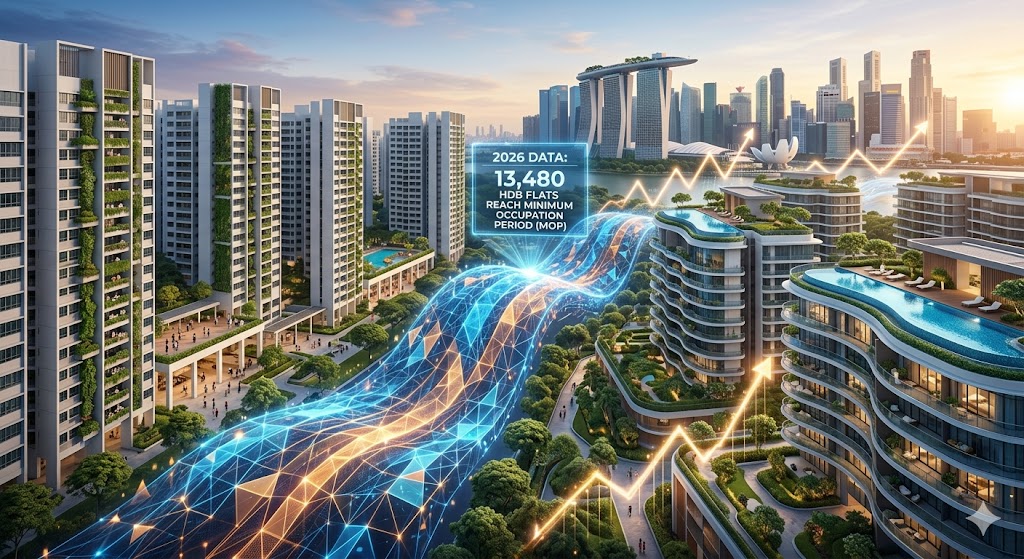
The Singapore property market faces a major structural shift. This transformation occurs throughout 2026. A massive volume of public housing units matures. Exactly 13,480 HDB flats will reach maturity.1 They clear their five-year Minimum Occupation Period (MOP).2 Consequently, this event represents a monumental supply injection. The volume marks a staggering 93 percent jump from 2025.1 Previously, only 6,970 flats reached MOP in 2025.1 This sudden surge creates profound ripple effects. These effects touch all local real estate sectors.
Market dynamics are transforming rapidly today. Sellers no longer hold absolute monopoly power. Conversely, buyers now enjoy unprecedented leverage.2 The expanded supply pipeline is heavily concentrated. It impacts specific regional geographic clusters.4 This geographic concentration alters pricing strategies entirely. Furthermore, it rewrites the financial calculus for HDB upgraders. Private property prices will react to this liquidity. This report analyzes all critical market impacts. The data reveals critical shifts in buyer behavior. It exposes emerging vulnerabilities in mass-market resale pricing. Additionally, it highlights sustained resilience in private suburban condominiums.
Anatomy of the 2026 Minimum Occupation Period Cohort
The sheer scale of the 2026 MOP wave demands quantification. The 13,480 flats stem from pandemic-era construction. Between 2019 and 2021, HDB accelerated building programs.5 These delayed Build-To-Order (BTO) projects are completing now.6 They finally enter the open resale market.6 However, this supply is not distributed evenly. It is heavily clustered in specific housing estates.
Spatial Distribution and Regional Concentrations
Five key towns account for massive supply volumes. They hold roughly 80 percent of all completions.7 This creates highly localized supply gluts. Consequently, Punggol faces the most severe downward pressure.8 This town receives 3,222 newly eligible flats.1 This accounts for nearly 23.9 percent of total supply.7 Queenstown follows closely behind with 2,409 units.4 Tampines contributes another 2,133 units to the market.4 Toa Payoh adds 1,594 new units.4 Finally, Bedok provides 1,440 eligible units.7
The table below illustrates this exact geographic distribution. It highlights the incoming 2026 supply by town.7
| HDB Estate Town | Projected MOP Volume (2026) | Percentage of Total |
| Punggol | 3,222 | 23.9% |
| Queenstown | 2,405 | 17.8% |
| Tampines | 2,133 | 15.8% |
| Toa Payoh | 1,594 | 11.8% |
| Bedok | 1,440 | 10.7% |
| Yishun | 456 | 3.4% |
| Bukit Panjang | 350 | 2.6% |
| Sengkang | 330 | 2.4% |
| Geylang | 319 | 2.4% |
| Sembawang | 310 | 2.3% |
| Hougang | 285 | 2.1% |
| Kallang / Whampoa | 243 | 1.8% |
| Bukit Batok | 221 | 1.6% |
| Woodlands | 172 | 1.3% |
| Total | 13,480 | 100.0% |
Micro-Market Cluster Risks
This specific distribution fundamentally changes neighborhood pricing power. In previous years, buyers faced severe listing shortages. A single high-floor unit triggered aggressive bidding wars.5 The 2026 landscape is entirely different now. Buyers can easily view five comparable units simultaneously.2 They can view them in identical housing blocks.2 This completely destroys the seller’s geographic monopoly.2
Specific residential projects highlight this localized pricing risk. Tampines GreenVerge will release massive unit volumes soon.9 It releases exactly 1,106 four-room flats simultaneously.9 It also releases 612 five-room flats.9 Alkaff Oasis in Bidadari creates similar cluster dynamics.2 SkyResidence at Dawson injects huge supply into Queenstown.9 Sellers in these specific clusters must price realistically.5 Overpricing leads to immediate buyer abandonment.
Emerging Estate Hotspots
Several specific HDB projects reach MOP status in 2026. Waterfront I and II at Northshore transform Punggol.10 Northshore StraitsView adds further supply to the area.9 Meanwhile, SkyOasis at Dawson elevates the Queenstown market.9 Bedok Beacon provides new options in mature estates.9 Bedok South Horizon offers connectivity near future MRT lines.9 Kallang Residences provides highly coveted city-fringe living options.9 Pine Vista brings fresh supply into Geylang.9 All these projects reshape local transaction volumes.
Deconstructing the HDB Resale Price Index Softening
Macroeconomic data already reflects this immense supply-side pressure. The HDB Resale Price Index (RPI) fell significantly. Flash estimates show a 0.1 percent quarterly decline initially.5 However, final data points to a 0.6 percent dip.12 This statistical dip occurred in Q1 2026.12 It is numerically small but symbolically massive. It is the first quarterly decline since Q2 2019.5 It abruptly ends a historic 27-quarter continuous growth streak.12
Time-on-Market and Negotiation Leverage
This index drop signals a deeper structural rebalancing. Overall market velocity is slowing down considerably. The typical time-on-market has expanded for most listings. High-supply estates previously saw flats sell rapidly. They sold within 6 to 8 weeks.5 This timeframe has now stretched to 12 weeks.5 Consequently, buyers simply have heavily reduced bidding urgency.5 They possess vastly improved negotiating power today.5
Prices in highly concentrated clusters are softening visibly. A standard four-room flat in Punggol Northshore illustrates this. In early 2024, such units fetched roughly $730,000.5 By Q2 2026, indicative prices dropped noticeably.5 They fell to between $695,000 and $710,000.5 This represents a tangible softening of $35,000.5 Sellers must absorb this harsh market reality quickly. Chasing peak 2024 valuations merely wastes precious time.5
The Million-Dollar Premium Paradox
A fascinating paradox exists within this cooling market. The broader index is undoubtedly softening overall. However, the premium flat segment breaks historic records. Q1 2026 saw an unprecedented 412 million-dollar transactions.5 A five-room unit at SkyTerrace at Dawson sold high. It commanded a massive $1.7 million price tag.4 Another unit at City Vue at Henderson broke records. It reached a staggering $1.728 million valuation.12
This pricing divergence is driven by strict market segmentation.13 Million-dollar transactions involve highly specific, scarce housing assets.13 Buyers target large five-room or executive layouts exclusively.4 They seek mature estates with extensive local amenities. They demand unblocked views and long remaining leases.2 Supply for these premium units remains fundamentally constrained.13
Therefore, the index decline is driven by mass markets.5 High volumes of standard non-mature flats drag averages down.5 The median price for non-mature four-room flats fell.5 It dropped by 0.7 percent to $608,000.5 This structural decoupling defines the 2026 resale environment. It proves the MOP wave is not crashing prices.11 It selectively corrects overvalued mass-market assets instead.
The Upgrader Calculus: Transition Economics
Every MOP-eligible flat owner is a theoretical property upgrader.5 The primary question remains their actual affordability. The financial mechanics of upgrading are notoriously complex. They involve heavy taxation and strict loan limits. They also involve mandatory CPF refund obligations. However, baseline upgrader equity remains extremely robust overall.11
Equity Accumulation and Capital Gains
The bearish market case assumes falling HDB prices. Bears believe this traps potential HDB upgraders completely.6 However, this logic ignores historical baseline purchase prices.6 The 2026 upgrader cohort bought their flats cheaply. A typical BTO buyer in 2021 paid $410,000.5 Even with softened 2026 valuations around $695,000, gains persist.5 Sellers still realize massive capital gains ultimately.5 They earn profits nearing $285,000 to $300,000.5
Older buyer cohorts possess even greater accumulated equity. Owners buying in 2014 secured five-room flats cheaply. They paid around $400,000 for these large units.6 These specific units currently transact near $850,000 today.6 After settling a typical $250,000 outstanding mortgage, proceeds remain.6 These sellers easily clear $600,000 in net proceeds.6 Even a $50,000 price drop leaves them highly liquid.6 This immense liquidity drives the private property market.6
Upfront Capital Outlay Requirements
Upgrading to a private condominium demands severe upfront capital. The transition is never a simple lateral financial move. A detailed case study clarifies this massive financial burden. We examine an ELTA condominium priced at $1.698 million.15 This reflects a typical two-bedroom compact residential unit.15
The basic financial formula calculates total upfront purchase costs. The formula adds the purchase price to related taxes. For a $1.698 million property, taxes are exceptionally high. Buyer’s Stamp Duty (BSD) is roughly $54,120.15 Mandatory legal conveyancing fees add approximately $3,000.15 Consequently, the total required purchase capital becomes $1.755 million.15
Buyers must produce massive upfront cash and CPF. A mandatory 25 percent downpayment requires $424,500.15 At least 5 percent must be pure cash.15 This pure cash portion equals exactly $84,900.15 Renovation buffers consume another $40,000 easily.15 Total upfront liquid capital required exceeds $521,620.15 Thankfully, HDB sale proceeds comfortably cover this amount.16
Debt Servicing and Regulatory Friction
Generating the downpayment is only the very first hurdle. Buyers must also survive strict regulatory loan assessments. The Total Debt Servicing Ratio (TDSR) strictly caps borrowing.16 Total monthly debt repayments cannot exceed strict limits. They must remain under 55 percent of gross income.16 Banks calculate this using a strict stress-test rate.16 This rate assumes a 4 percent interest environment.16
Consider a typical household earning $15,000 monthly.15 A 75 percent loan on a condo creates obligations. Borrowing $1.27 million requires substantial monthly servicing capabilities. The monthly mortgage repayment reaches roughly $6,080.15 This consumes 40 percent of gross monthly income immediately.15 While within TDSR limits, this creates extreme financial pressure.15 Any income loss triggers immediate mortgage default risks.
Understanding the CPF Refund Trap
Many HDB upgraders miscalculate their actual cash proceeds. They forget the mandatory CPF refund mechanism entirely. When selling an HDB, CPF usage must be refunded. The principal amount borrowed from CPF must return. Furthermore, accrued interest must also be fully refunded.16
This accrued interest compounds silently over five years. It reduces the actual cash-in-hand a seller receives. If a flat sells for $600,000, proceeds seem large. However, outstanding bank loans might consume $250,000. The CPF refund might consume another $150,000 easily. Therefore, actual cash proceeds might only reach $157,287.16 Upgraders must calculate this CPF trap very carefully.
Spillover Dynamics: The Private Residential Impact
Massive HDB equity extraction directly feeds private property sectors. HDB resale softness is largely irrelevant to private developers.6 These two distinct property markets are structurally decoupling.5 Private home prices actually rose in early 2026. The Urban Redevelopment Authority (URA) index climbed higher. It rose by 0.9 percent in Q1 2026.17
The Outside Central Region (OCR) Surge
The Outside Central Region (OCR) experienced the sharpest growth. OCR private property prices surged heavily.5 They rose by 2.2 percent in a single quarter.5 This region serves as the primary upgrader battleground.14 HDB upgraders typically target specific property price bands. They buy properties priced between $1.2 million and $1.8 million.18 The OCR perfectly matches this specific affordability quantum.
Upgraders prioritize family space and suburban transport connectivity.17 They bypass luxury central district units almost entirely. CCR (Core Central Region) prices remained completely flat. They saw zero to 0.5 percent growth recently.14 The CCR is suppressed by punishing foreign stamp duties.14 Therefore, 2026 private market growth is entirely domestic. It is fueled almost exclusively by the MOP wave.17
The Private Supply Wave Headwind
However, private prices face their own massive supply headwinds. The government carefully calibrated land sales for years. These sales aimed to match projected upgrader demand precisely. Consequently, an estimated 12,400 private units will complete.14 They will enter the market throughout 2026.14 This completion figure is astonishingly high historically. It sits nearly 65 percent above ten-year averages.14
This represents the largest single-year private supply pipeline. It is the biggest pipeline seen in over a decade.14 It directly threatens the private residential rental market. Private rents are already softening due to rising vacancies.14 Rents are projected to decline by 2 percent annually.14 Vacancy rates in the RCR are approaching 10 percent.14 Upgraders must carefully evaluate their future exit strategies. Buying a private condo for rental yield is risky.14
The Policy Shock: May 8 Executive Condominium Rules
On May 8, 2026, the government intervened drastically.19 The Ministry of National Development announced severe new rules.19 These rules affect new Executive Condominiums (ECs) heavily. They apply to all new government land tenders closing subsequently.20 This policy intervention fundamentally alters the upgrader transition pathway.16
Doubling the Minimum Occupation Period
The most critical change is the MOP extension. Previously, new EC buyers faced a five-year MOP.21 The new regulations violently double this restriction immediately. The MOP is now strictly 10 years.19 Owners cannot sell or rent out the entire unit.19 They cannot buy private property for a full decade.19
Furthermore, the timeline for full privatization is delayed. It has been pushed from 10 years to 15 years.19 Foreigners cannot purchase these specific units until year fifteen.19 The government also increased the first-timer buyer quota.21 This prioritizes genuine new families over older HDB upgraders.
Financial Squeeze: Removing Deferred Payments
The financial pathway into ECs was also tightened. The Deferred Payment Scheme (DPS) was completely abolished.20 Historically, DPS allowed buyers to pay 20 percent upfront.22 They could defer the remaining 80 percent until completion.22 This was a massive cashflow lifeline for upgrading owners.22
Buyers must now utilize the Normal Payment Scheme exclusively.22 Payments are strictly tied to progressive construction milestones.22 This creates severe cashflow friction for transitioning families. Upgraders must service their existing HDB mortgage simultaneously. They must also service the new progressive EC loan.22 Financial planning margins have been drastically reduced overall.22
Strategic Impact on Upgrader Behavior
These changes instantly redefine the EC asset class. ECs are no longer viable short-term stepping stones.22 They are strictly enforced long-term family owner-occupier homes.22 Short-term flippers are entirely filtered out of this market.22
This policy shock redirects upgrader demand immediately. Upgraders seeking five-year exit strategies must pivot quickly. They will largely abandon upcoming new EC launches. Instead, they will target older resale ECs. Alternatively, they will buy standard OCR private condos.14 This redirected demand provides a massive secondary price boost. It pushes OCR resale prices higher artificially. It creates a strong price floor for older suburban units.
Structural Supply Gaps and Plus/Prime Models
The government actively manipulates long-term housing demographic pipelines. The May 2026 EC rules mirror previous strict interventions. In late 2023, HDB introduced new flat classifications.18 They created the Plus and Prime BTO models.18 These classifications carry harsh 10-year MOP restrictions.18 They also enforce strict subsidy clawbacks upon resale.5 Furthermore, they impose strict $14,000 resale income ceilings.5
The 2035-2040 Upgrader Pipeline Gap
The standard 2026 MOP cohort operates under older rules.5 They face only a traditional 5-year restriction.5 They will freely enter the private market today. However, the Plus and Prime rules create demographic cliffs.18
Standard BTO buyers from 2026 will upgrade eventually. They will upgrade around 2034 or 2035.18 Conversely, Plus and Prime buyers are legally locked in.18 They cannot upgrade until roughly 2039 or 2040.18 This creates an unprecedented gap in the upgrader pipeline.18 Between 2035 and 2040, potential private buyers will vanish.18
Developers and long-term investors must map this cliff carefully. Properties targeting upgraders will face severe demand droughts later.18 Smart investors will aim to liquidate assets before 2032.18 The peak upgrader wave from pandemic BTOs ends then.18 After 2032, the market enters a barren demographic zone.18
HDB Grant Utilization and Income Ceilings
Upgraders must also navigate changing housing grant structures. First-time buyers receive the Enhanced Housing Grant (EHG). The EHG provides up to $80,000 in housing subsidies.5 Families also utilize the Proximity Housing Grant (PHG). The PHG offers up to $30,000 for living near parents.14
However, strict income ceilings dictate market eligibility. Buyers earning over $14,000 cannot buy standard BTOs.5 Buyers earning over $16,000 cannot buy new ECs.14 These high-income earners are forced into the private market. This sustains baseline demand for OCR private condominiums continuously.
Macroeconomic Headwinds and Interest Rate Trajectories
Real estate values do not operate in a vacuum. Broader macroeconomic conditions strongly dictate transition viability. Inflationary pressures and volatile interest rates define 2026.
The SORA Easing Cycle
Interest rates are finally demonstrating downward momentum globally. The 3-month Singapore Overnight Rate Average (SORA) peaked previously. It hit roughly 3.72 percent in early 2024.14 It has steadily eased to approximately 2.48 percent recently.14 Analysts forecast further gradual easing throughout the year.14 Rates may settle between 2.30 and 2.40 percent eventually.14
This easing cycle is critical for upgrader survival. Lower rates mechanically increase TDSR borrowing limits significantly. They reduce monthly mortgage burdens substantially for families.11 However, severe geopolitical risks remain a persistent market threat.24 Any sudden re-acceleration of global inflation could reverse trends. It could force SORA back above 3 percent quickly.14 This would instantly cripple upgrader affordability and stall momentum.14
Additional Buyer’s Stamp Duty (ABSD) Restrictions
Taxation remains the heaviest anchor on market transaction volume. The ABSD framework strictly limits multiple property ownership.5 Singapore Citizens face a brutal 20 percent ABSD penalty. This applies strictly to their second residential property.16 Permanent Residents face a higher 30 percent ABSD penalty.5 Foreigners are functionally exiled by a 60 percent penalty.5 Corporate entities face an astronomical 65 percent tax rate.5
Upgraders must sell their HDB flats to avoid taxes. If a citizen keeps their HDB, costs skyrocket. Buying a $1 million condo triggers immense tax liabilities. They owe a non-negotiable $200,000 cash ABSD payment.16 This forces nearly all upgraders into specific transaction sequences. They must execute a strict “sell-first, buy-later” sequence.5 This structural constraint prevents hoarding affordable public housing.
ABSD Exemptions and Remissions
Certain exemptions exist within the strict ABSD tax framework. Married couples can claim ABSD remission under specific conditions. They must buy a replacement home before selling their first.5 They must sell the first property within six months.16 This six-month clock starts at the new property completion.25
Nationals under Free Trade Agreements enjoy special tax privileges. Citizens of the United States pay exactly zero ABSD. They pay 0 percent on their first residential property.5 Nationals of Iceland, Liechtenstein, Norway, and Switzerland enjoy this too.5 However, the vast majority of local upgraders face strict taxation.
Rental Market Dynamics and Softening Yields
The rental market is experiencing its own structural shift. It directly impacts investors holding private condominiums for yield. The massive 12,400 private unit supply wave depresses rents.
Private Rental Softening
Private residential rents are definitively softening in 2026. The rent-to-income limits for tenants have been completely breached. Tenants simply cannot afford pandemic-era rental pricing anymore.14 Consequently, private rents are projected to decline steadily. They will drop between 1 and 2 percent annually.14
Vacancy rates highlight this growing landlord vulnerability clearly. The Core Central Region (CCR) vacancy rate exceeds 10 percent.14 The Rest of Central Region (RCR) approaches 10 percent.14 Only the OCR remains slightly tighter at 7 percent.14 Landlords must adjust their rental yield expectations immediately. The golden era of landlord-favored peak pricing has ended.14
HDB Rental Stability
Conversely, the HDB rental market remains surprisingly stable. HDB approved 9,535 rental applications in Q1 2026.7 This was merely a 0.2 percent quarterly decrease.7 Median rents remain highly robust across various housing estates. A four-room flat in Queenstown commands $4,150 monthly.7 A similar flat in Bukit Merah fetches $3,900 monthly.7 Standard three-room flats in Jurong West fetch $2,300 monthly.12
This stability results from displaced BTO buyers needing homes. Over 19,600 new BTO flats will launch in 2026.7 These buyers face wait times of three to four years. They must rent housing while waiting for BTO completion.18 This demographic provides a solid floor for HDB rentals.
Future BTO Pipeline and Supply Moderation
The government continuously balances supply to prevent market crashes. The HDB MOP wave is massive, but carefully managed. HDB will launch 19,600 new BTO flats in 2026.7 This includes highly anticipated launches in Bishan and Berlayar.7
This massive BTO pipeline provides buyers with viable alternatives. They do not have to chase overpriced resale units. Shorter waiting time BTOs are also being launched actively. Projects in Tampines and Sembawang offer rapid construction timelines.26 Some projects complete within 36 to 42 months now.5 This pulls marginal buyers completely out of the resale market.5
Furthermore, the Open Booking of Flats (OBF) regime continues. It replaces the older Sale of Balance Flats system.5 OBF injects 7,800 near-complete flats into the market annually.5 These units are priced 20 percent below resale equivalents.5 This continuous supply caps how high resale sellers can price.
Market Forecasts and Strategic Segment Outlook
The synthesis of these forces provides clear market trajectories. We can map the outlook for late 2026 accurately. The era of rampant double-digit capital appreciation is over. The market enters a phase of volume-led, sustainable moderation.4
HDB Resale Market Projections
The HDB resale sector remains stable but geographically bifurcated. Overall transaction volumes will likely rise steadily.14 The 13,480 MOP units guarantee very high market liquidity.14 However, actual price growth will decelerate very sharply. Total full-year 2026 RPI growth will remain highly subdued. It will likely range between 0 and 2 percent.5 This is a massive drop from 10 percent in 2022.5
Premium flats will continue to defy market gravity.4 Million-dollar transactions will persist in central mature nodes.4 Conversely, standard units in non-mature towns face stagnation. Sellers in Punggol must recalibrate their expectations immediately.5
Private Property Segment Forecasts
The private residential market exhibits distinct regional pricing divergence. The table below synthesizes the forecasted performance across segments.14
| Market Segment | Projected Price Momentum | Volume Outlook | Primary Drivers and Risks |
| OCR Private Condo | +1.0% to +2.0% pa | Stable to Up | Driven by HDB upgrader demand; faces supply headwinds.14 |
| RCR Private Condo | +0.5% to +1.0% pa | Stable | Supported by SORA easing; threatened by rising vacancy.14 |
| CCR Private Condo | 0.0% to +0.5% pa | Flat to Down | Suppressed heavily by 60% foreign ABSD; severe yield compression.14 |
| New Executive Condo | +1.0% to +3.0% pa | Up | Boosted by $16k income ceiling; dampened by 10-year MOP rules.14 |
| Private Rental | -1.0% to -2.0% pa | Stable | Pressured by 12,400 new completions; rent-to-income limits reached.14 |
| Landed Residential | +1.0% to +2.0% pa | Stable | Supported by citizen-only buying rules and extreme tight supply.14 |
The data confirms the OCR will outperform other segments.14 Upgrader liquidity is almost entirely focused on this region.14 However, overall private home prices will grow quite modestly. Analysts project overall 2026 growth between 2.5 and 4.5 percent.27 This reflects a highly balanced, highly sustainable market trajectory.28 It mirrors the 3.9 percent growth seen in 2024.27
Final Strategic Conclusions
The 2026 HDB MOP wave is not a destructive tsunami. It is a highly engineered, policy-driven market rebalancing event.5 The injection of 13,480 units succeeds in cooling inflation.5 It destroys localized seller monopolies in places like Punggol.2 Buyers finally possess genuine negotiation leverage and real choice.5
Simultaneously, massive accumulated equity ensures private market stability continuously. HDB sellers transition with massive cash and CPF reserves.6 This capital flows directly into OCR private condominiums reliably.17 The government’s May 8 EC interventions channel this wealth.19 By removing short-term speculative EC flipping, demand stabilizes.22
Investors must abandon outdated pandemic-era flipping strategies immediately. The future belongs to those who understand deep segmentation. One must separate mass-market stagnation from premium asset resilience.5 One must map the impending 2035 upgrader demographic gap.18 The 2026 property market rewards rigorous, meticulous financial planning. Unjustified optimism will be swiftly punished by extended vacancies.
Works cited
- HDB MOP Strategy 2026: What to Do When Your Flat Reaches Minimum Occupation Period, accessed June 6, 2026, https://propertynet.sg/hdb-mop-strategy-2026-what-to-do-when-flat-reaches-minimum-occupation-period/
- How the 2026 HDB MOP Supply Wave Impacts Your Housing Budget – PropertyGuru, accessed June 6, 2026, https://www.propertyguru.com.sg/property-guides/hdb-mop-flats-2026-supply-wave-pjx-98390
- Over 13,400 HDB flats to reach MOP in 2026; analysts say supply could moderate resale price growth | The Straits Times, accessed June 6, 2026, https://www.straitstimes.com/singapore/housing/over-13400-hdb-flats-to-reach-mop-in-2026-analysts-say-supply-could-moderate-resale-price-growth
- The Impact of 13,480 HDB Flats Reaching MOP in 2026 On Buyers and Sellers – Ohmyhome, accessed June 6, 2026, https://ohmyhome.com/en-sg/blog/13480-hdb-flats-reaching-mop-in-2026-what-this-means-for-buyers-and-sellers/
- 13480 HDB Flats Reaching MOP in 2026: What the Supply Wave Means for Buyers and Sellers, accessed June 6, 2026, https://lovelyhomes.com.sg/hdb-mop-supply-wave-2026-13480-flats/
- The HDB MOP Wave Was Supposed To Drag Prices Down — But …, accessed June 6, 2026, https://reviewhomes.sg/read/singapore-property-2026-2027-outlook-market-commentary
- HDB Resale Price Index Drops In 1Q 2026, The First Decline Since 2019 — Here’s Why, accessed June 6, 2026, https://stackedhomes.com/q1-2026-singapore-hdb-resale-price-analysis/
- 13480 HDB Flats Hit MOP in 2026 — Will the Resale Supply Wave Actually Crash Prices?, accessed June 6, 2026, https://www.insightsdigest.sg/article/13480-hdb-flats-hit-mop-in-2026-will-the-resale-supply-wave-actually-crash-prices
- Flats That Could Attain MOP In 2026 And Where To Find Them, accessed June 6, 2026, https://www.propnex.com/picks-details/1133/flats-that-could-attain-mop-in-2026-and-where-to-find-them
- HDB BTO MOP 2025 & 2026 – Best picks within a 10-minute walk to MRT & LRT stations, accessed June 6, 2026, https://www.99.co/singapore/insider/hdb-bto-mop-2025-2026-near-mrt-lrt-stations/
- The 2026 HDB Upgrader Window: Why 13500 New MOP Flats Change Everything, accessed June 6, 2026, https://propertynet.sg/2026-hdb-upgrader-window-13500-mop-flats-change-everything/
- HDB Resale Market Q1 2026: Prices Dip 0.6% | LovelyHomes, accessed June 6, 2026, https://lovelyhomes.com.sg/hdb-resale-market-q1-2026-price-dip/
- HDB Resale Market Q1 2026: First Decline in 7 Years – Home | Lovelyhomes.com.sg, accessed June 6, 2026, https://lovelyhomes.com.sg/hdb-resale-market-q1-2026-analysis/
- Singapore Property Market Outlook H2 2026: Supply Wave, Rate Easing and What to Watch, accessed June 6, 2026, https://lovelyhomes.com.sg/singapore-property-market-outlook-h2-2026/
- Can You Upgrade From An HDB To A $1.8M Condo In 2025? Here’s …, accessed June 6, 2026, https://stackedhomes.com/hdb-to-1-8m-condo-upgrade-2025/
- Upgrade from HDB to Condo: Ultimate Step-by-Step Guide (2026 …, accessed June 6, 2026, https://propseller.com/blog/guides-insights/upgrade-hdb-condo-ultimate-guide/
- Q1 2026 Property Prices Are Up: How the OCR Surge Impacts You – PropertyGuru, accessed June 6, 2026, https://www.propertyguru.com.sg/property-guides/ura-private-property-prices-q1-2026-pjx-98370
- How 19,600 BTO Flats Will Reshape Singapore’s Property Market in …, accessed June 6, 2026, https://launches.sg/article/how-19600-bto-flats-will-reshape-singapores-property-market-in-2026
- Minimum occupation period for executive condos doubled; first-timer quota, priority expanded – CNA, accessed June 6, 2026, https://www.channelnewsasia.com/singapore/executive-condominiums-ec-mop-doubled-first-timer-quota-priority-expand-no-dps-6106466
- Strengthening The Executive Condominium Housing Scheme and Supporting First-Time Home Buyers – Ministry of National Development (MND), accessed June 6, 2026, https://www.mnd.gov.sg/newsroom/press-releases/view/strengthening-the-executive-condominium-housing-scheme-and-supporting-first-time-home-buyers
- The Era Of “Flip After 5 Years” ECs Is Over — Here’s What …, accessed June 6, 2026, https://stackedhomes.com/singapore-ec-rules-mop-10-years-dps-removed-2026/
- New EC (Executive Condominium) Rule in Singapore: MOP doubled, DPS removed, and Higher Priority for First-Timers – real-agent.ai, accessed June 6, 2026, https://real-agent.ai/guides/new-ec-executive-condominium-rule-in-singapore-mop-doubled-dps-removed-and-higher-priority-for-first-timers
- New EC Rules 2026: 10-Year MOP, No DPS & What It Means For Singapore Homeowners | Executive Condo – YouTube, accessed June 6, 2026, https://www.youtube.com/watch?v=ga2fD8SYuC0
- 2026 Singapore Real Estate Market Outlook – CBRE, accessed June 6, 2026, https://www.cbre.com.sg/insights/reports/2026-singapore-real-estate-market-outlook
- HDB MOP to condo upgrade: the full timeline, cost, and cashflow map – Winfred Quek, accessed June 6, 2026, https://winfredquek.com/insights/hdb-mop-upgrade-timeline
- Why 2026 is the Best Year to Buy HDB Resale (The MOP Wave) – YouTube, accessed June 6, 2026, https://www.youtube.com/watch?v=pTkFoWjQpf4
- Private Residential Market Outlook | 2026 – OrangeTee, accessed June 6, 2026, https://www.orangetee.com/ResearchHubFiles/Items/584/20251127103146-84323930Private%20Residential%20Market%20Outlook%20Final%202.pdf
Singapore’s Residential Property Market Analysis 2026, accessed June 6, 2026, https://www.globalpropertyguide.com/asia/singapore/price-history

