


Most investors who write off office real estate right now are making a timing mistake. While headlines focus on vacancy rates and remote work, owner-user purchases surged to $8.9 billion in 2026, representing 15.6% of total office deals. Tax incentives, valuation resets, and returning office demand have quietly created one of the more compelling entry points in commercial real estate. If you are an investor or business owner asking why choose office space investment right now, the answer involves more than just yield. It involves strategy, timing, and knowing exactly where the market is headed.
Table of Contents
- Key takeaways
- Why choose office space investment in 2026
- The financial case for office investment
- Operational strategy and asset management
- How office compares to other commercial assets
- My perspective on office investment after 2026
- Ready to explore office investment with expert guidance?
- FAQ
Key takeaways
| Point | Details |
|---|---|
| Market timing is favorable | Valuation resets and better lending conditions have opened a rare window for office investors. |
| Tax incentives are real | Bonus depreciation and cost segregation can significantly reduce your upfront tax burden. |
| Location determines performance | High-quality CBD assets outperform suburban or secondary office spaces across occupancy and returns. |
| Lease terms protect cash flow | Office leases run 3 to 10 years, far longer than residential, providing income stability. |
| Active management adds returns | Subleasing unused space and optimizing floor plans can meaningfully boost your investment yield. |
Why choose office space investment in 2026
The narrative that office real estate is a dying asset class does not match what the data shows. The office sector has reached an inflection point where stabilized cash yields now exceed borrowing costs, creating positive leverage for investors who move with conviction.
Return-to-office mandates from major employers have strengthened demand, particularly for collaborative, tech-enabled spaces where teams actually want to work. This is not a uniform recovery. It is selective. Buildings that offer modern amenities, strong transit access, and central business district addresses are filling up. Those that do not are being converted or demolished, which is quietly tightening the supply of quality inventory.
That supply constraint matters more than most investors realize. As older, obsolete buildings exit the market, the remaining high-quality assets carry more pricing power. Investors who target prime CBD locations are not buying into the same risk profile as those chasing discounted suburban buildings with no foot traffic and aging infrastructure.
| Market Indicator | Current Condition | Investor Implication |
|---|---|---|
| CBD office vacancy | Stabilizing in top-tier markets | Lower risk for quality assets |
| Lending sentiment | Improving in 2026 | Better leverage opportunities |
| Supply pipeline | Constrained as conversions reduce stock | Pricing power for existing owners |
| Return-to-office trend | Accelerating with mandates | Rising tenant demand |
Pro Tip: Before analyzing yields, check the building’s age, amenity profile, and transit score. Those three factors now predict performance better than asking rent alone.
The financial case for office investment
The financial advantages of investing in office space go beyond rental income. They involve a structural tax position that most residential investors never access.

Commercial real estate leases typically run 3 to 10 years, compared to the standard 12-month residential lease. That gap in lease duration translates directly into income predictability. When your tenant signs a five-year lease with annual escalations built in, you are not repricing the asset every year or absorbing short-term vacancy pain.
The tax angle is where it gets genuinely interesting for business owners who buy their own space. Bonus depreciation and Section 179 deductions allow you to offset significant upfront costs in the year of purchase, rather than spreading deductions across decades. Paired with a cost segregation study, this can reduce your effective tax liability in year one substantially. The caveat is critical: bonus depreciation is a deferral tool, not a free pass. You will owe those taxes upon sale unless you structure around it, which is why a tax professional should be part of your investment team from day one.
For those weighing different approaches, here is how direct ownership compares to office REITs:
| Factor | Direct Ownership | Office REITs |
|---|---|---|
| Capital required | High (down payment + closing costs) | Low (buy shares) |
| Control | Full (decisions, improvements, tenants) | None |
| Tax benefits | Full access to depreciation, cost segregation | Dividend income taxed differently |
| Liquidity | Low (months to sell) | High (sell shares daily) |
| Management effort | Active and ongoing | Passive |
Direct ownership offers more control and potential returns but requires larger capital commitment. REITs give you passive exposure with liquidity, which suits investors who want office sector participation without operational responsibility.
Here are the core financial benefits of office real estate to keep in mind:
- Longer lease terms mean fewer vacancy gaps and more predictable annual income
- Triple net leases in commercial properties push operating expenses to tenants, protecting your cash flow
- Appreciation potential in quality CBD assets has historically tracked well against inflation
- Tax depreciation tools reduce taxable income in the near term when used correctly
- Business owners who occupy their own space build equity instead of paying rent to someone else
Pro Tip: Ask your accountant about a cost segregation study before your first office purchase. It reclassifies certain building components for faster depreciation, and the year-one savings can be substantial.
Operational strategy and asset management
Owning office space is not a passive activity, and investors who treat it like one tend to underperform. The operational decisions you make before and after purchase have a direct impact on your returns.
One of the most overlooked pre-purchase steps is finalizing your floor plan before you close. Locking in the floor plan before investing prevents you from paying for space you cannot actually use or lease. Dead square footage costs money in taxes, maintenance, and carrying costs without contributing income. Spend the time upfront to map exactly how the space will be used.
Once you own the building, space utilization becomes an ongoing priority. Here is a practical framework for managing your office investment effectively:
- Audit your occupancy rate quarterly. Know which floors or suites are generating income and which are sitting idle.
- Sublease underutilized areas. Renting out extra desks or meeting rooms generates supplemental income while you grow into the space.
- Screen tenants by lease commitment. Prefer tenants willing to sign three-year or longer terms. Short-term tenants increase your administrative burden and create income gaps.
- Invest in amenity upgrades over cosmetic improvements. A high-speed fiber connection, shared collaboration areas, and good lighting retain tenants more reliably than a fresh coat of paint.
- Build a maintenance reserve. Commercial properties have mechanical systems, elevators, and shared infrastructure that residential properties do not. Budget for it specifically.
Businesses occupying quality office space also see measurable operational gains. Firms with dedicated space report 20% higher employee retention and 15% faster client acquisition than fully remote counterparts. For a business owner who is also an investor, that operational edge compounds the financial return.
How office compares to other commercial assets
Understanding the advantages of investing in office space requires honest comparison with the alternatives. Office does not win on every dimension, but it wins on the dimensions that matter most to long-term investors.
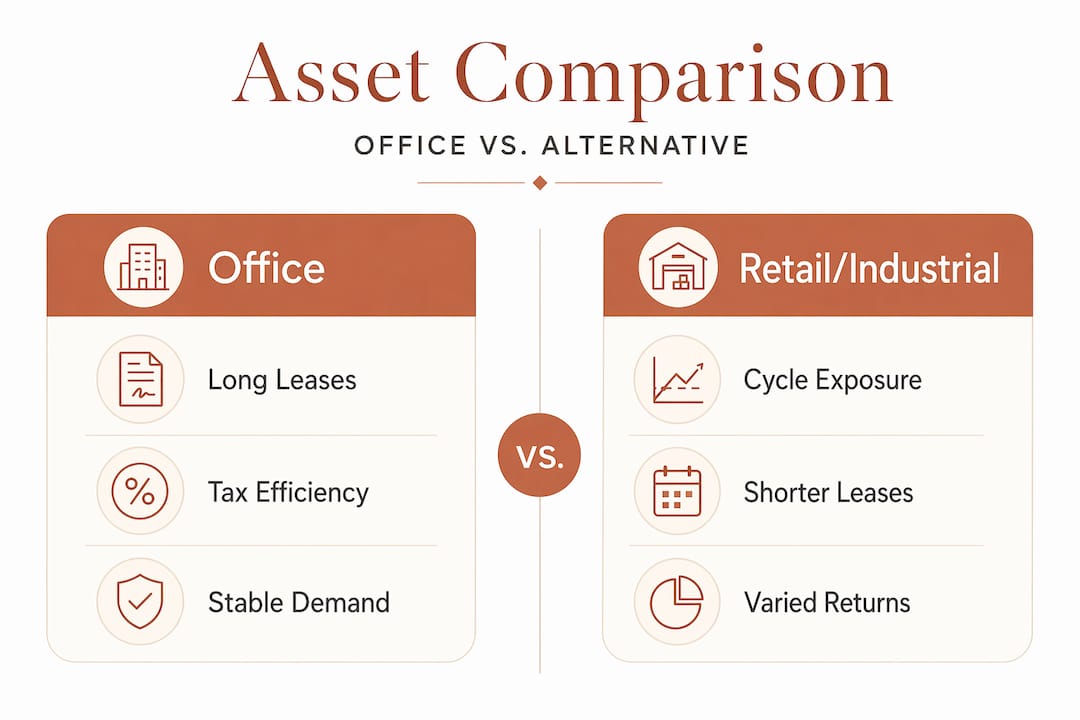
Retail property offers high-street visibility but carries significant exposure to consumer spending cycles and e-commerce disruption. Industrial and logistics assets are performing strongly in 2026, with lower vacancy and strong tenant demand. But cap rates in that sector have compressed substantially, meaning you pay more for every dollar of income. The entry point for quality industrial is harder to justify now than it was three years ago.
Co-working and flex space presents an interesting comparison. You can invest in a building and offer flex leases to attract startups and freelancers. The trade-off is that flex tenants churn faster and your effective rent per square foot fluctuates. For investors who want predictable income, a traditional office lease with a credit tenant is a more defensible position.
Here is where office space investment stands against the alternatives on key criteria:
- Lease stability: Office wins with 3 to 10 year terms versus flex or retail month-to-month arrangements
- Tax advantages: Office and industrial both allow depreciation, but office offers more cost segregation opportunities due to complex fit-outs
- Income per square foot: Office in prime CBD locations competes well against retail for high-quality tenants
- Management intensity: Office requires more management than industrial but less physical maintenance than retail
- Liquidity: All direct commercial property is illiquid. If liquidity matters, the DSCR loan structure through specialized office investment financing can help you optimize leverage without overextending capital
For those exploring the full spectrum of commercial property benefits across asset types, the office sector in 2026 offers a genuinely competitive position relative to alternatives, particularly for investors with a five-year or longer holding horizon.
My perspective on office investment after 2026
I will be direct with you: I have watched investors avoid office real estate entirely because the headlines scared them off, and I have watched other investors make money quietly in the same period. The difference was not luck. It was selectivity.
In my experience, the investors who struggle with office are the ones who chase yield in secondary markets or buy buildings with aging systems because the price looks cheap. Those properties require capital expenditure you did not budget for, and tenants have more options than ever. The discount reflects the risk accurately.
What I have found actually works is focusing on buildings that tenants want to stay in. Transit access, natural light, modern HVAC systems, reliable internet infrastructure. These are not luxury features anymore. They are table stakes for attracting tenants who will sign long leases and actually pay on time.
The tax incentives around bonus depreciation are genuinely powerful, but I have seen investors get burned by the recapture liability on sale. You need to plan the exit strategy before you execute the entry strategy. That means knowing whether you are holding long term, doing a 1031 exchange, or passing the asset through an estate.
My view on the Singapore commercial real estate market specifically is that office assets in the right locations will outperform over a five-year hold, particularly as supply tightens and tenant demand for quality space continues growing. The market rewards those who are patient and precise.
— Aman
Ready to explore office investment with expert guidance?

At Aesthetic Havens, we work directly with real estate investors and business owners who are evaluating office space as part of a larger wealth-building strategy. Whether you are looking for a fully occupied CBD asset with a strong tenant covenant, exploring owner-user purchase options with tax planning in mind, or simply trying to understand where Singapore’s commercial market is heading, we can provide the market intelligence and advisory support you need.
Our team has helped clients identify off-market opportunities, structure purchases to maximize tax efficiency, and negotiate lease terms that protect long-term returns. If you are ready to move from research to action, visit Aesthetic Havens to book a consultation or explore current commercial listings. You can also read our guide on securing the best office deal to prepare before your first meeting.
FAQ
Why choose office space over residential investment?
Office space offers significantly longer lease terms, ranging from 3 to 10 years, compared to residential leases that typically run 12 months. This creates more predictable income and fewer vacancy disruptions for property owners.
What tax benefits come with office space investment?
Investors can use bonus depreciation and Section 179 deductions to offset a large portion of upfront costs in the year of purchase. A cost segregation study can accelerate deductions further, though recapture taxes apply upon sale.
Is now a good time to invest in office real estate?
Yes, particularly for quality assets in central business districts. Valuation resets and improving lender conditions have created a positive leverage environment, with stabilized cash yields now exceeding borrowing costs in many markets.
How does direct ownership compare to investing in office REITs?
Direct ownership gives you full control, tax depreciation benefits, and higher potential returns but requires significant capital and active management. Office REITs offer passive, liquid exposure with lower barriers to entry but no control over individual assets.
What makes an office investment high quality?
The best office investments combine a prime CBD location, strong transit connectivity, modern building systems, and high-quality amenities. These factors drive tenant retention, pricing power, and long-term asset appreciation.
Recommended
- Singapore Commercial Property Trends: Opportunities for 2026
- Commercial leasing tips: Secure the best office deal in Singapore
- Singapore Commercial Real Estate Outlook 2025: A Definitive Guide for Investors & Businesses in the Office, Retail, and Industrial Sectors | Aesthetic Havens
- Fortune Centre New Launch Singapore: 2026 Commercial Investment Guide | Aesthetic Havens


