


Most people assume a new property launch is simply a developer selling brand-new units, the way you’d walk into a store and buy something off the shelf. That framing misses almost everything that matters. Understanding what is a new property launch, and how it differs fundamentally from a resale purchase, determines whether you buy at the right phase, with the right legal protections, at the right price. This guide breaks down the full picture, from regulatory definitions and launch phases to what actually happens at a property launch event and how market trends in 2026 are reshaping buyer strategy.
Table of Contents
- Key Takeaways
- What is a new property launch, exactly?
- Phases of a new property development
- Benefits and risks of buying at launch
- What to expect at a property launch event
- Market trends shaping launches in 2026
- My perspective on what buyers consistently get wrong
- Ready to attend your next property launch?
- FAQ
Key Takeaways
| Point | Details |
|---|---|
| Launch requires legal clearance | A new property launch happens only after regulatory approvals are secured, giving buyers enforceable protections. |
| Pre-launch carries higher risk | Pre-launch buyers get lower prices but lose access to escrow protections and guaranteed timelines. |
| Launch events use urgency tactics | Sold indicators and VIP lists are deliberate tools designed to pressure buyers into faster decisions. |
| Payment plans are a real advantage | Developers frequently offer staggered payment structures that reduce upfront financial strain for buyers. |
| Research before attending wins deals | Buyers who study the project, financing options, and comparable pricing before the event make smarter commitments. |
What is a new property launch, exactly?
A new property launch is the official market introduction of a real estate project after the developer has secured all necessary regulatory approvals. In Singapore, that means approvals from relevant government authorities before any public marketing or bookings begin. In markets like India, this includes RERA registration. The launch is the moment a new property development goes from a private concept to a publicly available product with legal backing.
This distinction matters more than most buyers realize. Before launch, a project might exist only as architectural plans and a developer’s promise. After launch, it exists as a registered product with legally enforceable protections for buyers. Selling unregistered projects before regulatory clearance is illegal in many jurisdictions, which means any “deal” offered during that window carries real legal and financial risk.
Here is what characterizes the official launch phase:
- Public marketing begins: Advertising through digital platforms, print media, and physical sales centers opens to general buyers.
- Sales centers and show units activate: Buyers can physically inspect model units, review floor plans, and meet sales teams.
- Pricing is published: Unit prices are made available, often with early-buyer incentives attached.
- Booking deposits become legally binding: Payments collected during the launch phase are governed by the project’s registered legal framework.
- About 25% of the total marketing budget is allocated to the official launch phase, reflecting how critical this window is to sales velocity.
The launch is not a casual open house. It is a precisely orchestrated sales event designed to convert maximum interest into signed commitments within a compressed timeframe.
Phases of a new property development
Understanding where a launch sits within the broader new property development lifecycle prevents costly mistakes. Most buyers focus only on the event itself. Smart investors pay attention to all four stages.
-
Pre-launch phase. This is the period before regulatory approvals are finalized. Developers may quietly market to select contacts, offering the lowest prices in exchange for early commitment. Pre-launch buyers do not benefit from escrow protections or guaranteed timelines, which means the lower price tag comes with real exposure. If the project stalls or the developer faces financial trouble, your recourse is limited.
-
Soft launch. Some developers run a selective soft launch targeting their VIP buyer databases before the public event. Soft launch conversion rates typically hit 20 to 30% of the lead database, which seeds visible sales momentum before the public sees a single unit. Developers use this to manufacture the impression that demand is already strong when the official doors open.
-
Official launch phase. This is the key marketing and sales phase where the project goes fully public with broad advertising, full pricing disclosure, and legal buyer protections in place. Media coverage peaks here. Foot traffic through show galleries surges. Sales teams operate at full capacity.
-
Post-launch phase. Once the initial excitement subsides, remaining units are sold at progressively higher prices. Availability narrows. Developers hold back certain stack types or high-floor units to release at premium pricing later. If you missed the launch pricing, post-launch entry means paying a markup for the same product.
The primary distinction between pre-launch and launch is regulatory clearance and verified legal status. That single factor separates a risky commitment from a protected investment.
Benefits and risks of buying at launch
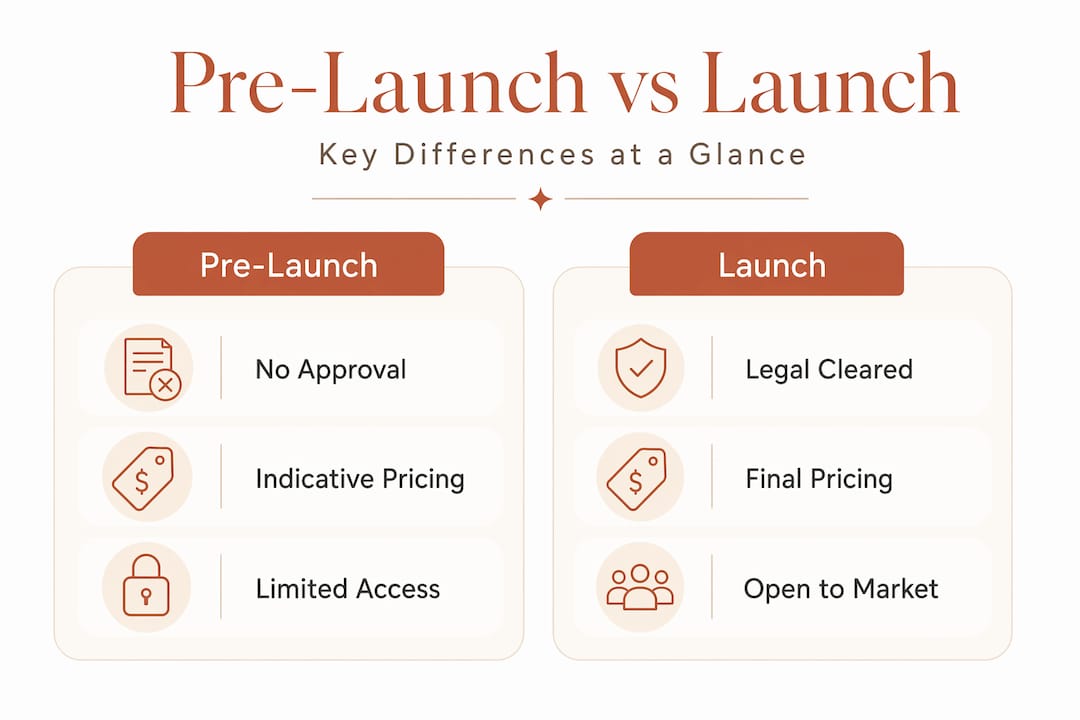
The case for buying at a new property launch is genuinely strong, but only if you go in with clear eyes about what the risks look like.
Benefits worth taking seriously:
- Choice of units. At launch, the full inventory is theoretically available. You can select preferred floors, orientations, and stack positions before the best options disappear.
- Competitive launch pricing. Developers price strategically to drive velocity at launch. Post-launch increases are common as remaining supply shrinks.
- Flexible payment structures. Developers offer payment plans including 1% monthly installments or extended down payment options, with typical initial deposits ranging from 10 to 20% and the residual due at handover. This dramatically reduces upfront financial pressure compared to resale transactions.
- Newer construction quality and specifications. New launches reflect current building standards, energy efficiency requirements, and modern unit layouts.
- Legal protections. Registered launch projects bring statutory protections including escrow arrangements that ring-fence your funds.
Risks you cannot ignore:
- Waiting time. You are buying something that does not exist yet. Completion timelines typically run two to five years, and delays happen.
- Price escalation post-launch. If the project sells well, prices rise before you even receive your keys. Selling during construction can sometimes capture that gain, but it requires understanding the assignment or sub-sale rules in your market.
- Marketing pressure. Promotional offers like limited-time discounts and incentive packages are designed to expire quickly and push buyers toward immediate decisions.
Pro Tip: Before signing anything at a launch event, request the project’s registration documents and confirm the legal status independently. A few hours of verification now is worth far more than months of legal uncertainty later.
What to expect at a property launch event
A property launch event is not a passive open house. It is a strategic marketing performance designed to convert interest into deposits within hours. Knowing what to expect lets you participate on your own terms rather than the developer’s.
Here is what you will typically encounter:
- Fully dressed show galleries. Model units are staged to present the best-case version of the finished product. Check ceiling heights, natural light in actual units (not just the show unit), and storage space carefully.
- Interactive site maps with sold markers. These boards show units marked as taken in real time, or what appears to be real time. This is a deliberate scarcity marketing tactic designed to trigger urgency.
- VIP lists and priority access queues. If you have been added to a VIP list through a realtor or developer contact, you get access before the general public, often at the same price but with a wider selection.
- On-site bank representatives. Loan representatives are frequently present to provide in-principle approvals and discuss financing options immediately.
- Stacked promotional packages. Early purchase incentives such as furniture vouchers, stamp duty rebates, or waived legal fees are bundled to make the decision feel like a time-sensitive win.
How to prepare before you walk in:
Study comparable pricing in the neighborhood before attending. Know your financing ceiling and have a bank pre-approval in hand. Identify the unit types and floors that meet your criteria so you are not making those decisions under sales pressure. And find a trusted property advisor who can flag when a “deal” is actually standard market pricing dressed up as an exclusive offer.

Pro Tip: Attend a few upcoming real estate launches as a non-buyer first. Observe how the event is structured, how sales staff create urgency, and how prices are presented. One dry run will sharpen your instincts considerably before you commit capital.
You can also review how past new launches in Singapore have been structured to understand what event formats and promotional approaches actually look like in practice.
Market trends shaping launches in 2026
The new property launch market in 2026 looks meaningfully different from five years ago. Developers have adapted their strategies to a more digitally connected and financially scrutinizing buyer base.
| Trend | What It Means for Buyers |
|---|---|
| Digital-first marketing | Launches now begin online, with virtual tours and social campaigns running weeks before physical events open |
| Payment flexibility expansion | More developers offer sub-1% monthly installment structures to compete for qualified buyers |
| Scarcity-driven urgency tactics | Real-time sold boards and limited-release unit drops are standard practice across markets |
| Singapore URA Master Plan influence | Urban development catalysts significantly shape which new launch locations attract premium pricing |
| Shift from leads to conversions | Developer marketing now prioritizes conversion-focused campaigns over broad awareness during the launch window |
Singapore’s market offers a useful reference point. Regulatory oversight is tight, buyer protections are strong, and the mass-market condo segment remains supported by firm fundamentals even as interest rates shift. Buyers tracking upcoming real estate launches in Singapore benefit from a transparent pricing environment compared to many regional markets.
My perspective on what buyers consistently get wrong
I’ve spent years advising buyers at new property launches, and the same pattern repeats itself. Buyers walk into launch events having researched the developer’s brochure but not the legal status of the project. They know which unit faces the pool but not whether the project is registered and whether their funds are protected.
The second thing I’ve seen trip buyers up is the psychological weight of launch events themselves. The sold boards, the queue energy, the time-limited offers. These are not accidental. They are engineered to make you feel like hesitation is costly. In my experience, the buyers who walk out without signing and return the next day with a clear head rarely find the unit they wanted is gone. The urgency is frequently manufactured.
What actually works is counterintuitive. Buyers who do less at the event and more preparation beforehand consistently make better decisions. They arrive knowing their ceiling, their preferred units, and their financing status. They treat the launch as confirmation rather than discovery.
If I had one thing to tell every first-time launch buyer, it would be this: understand the legal protections that attach to a registered project before you let the event atmosphere drive your decision. That knowledge is the only real defense against pressure tactics.
— Aman
Ready to attend your next property launch?
Knowing what a new property launch involves is the first step. Getting the right guidance before you commit is what separates a solid investment from an expensive lesson.

At Aesthetic Havens, we work with buyers and investors across Singapore’s new launch market, helping you cut through developer marketing to assess real value. Whether you are tracking upcoming launches or want a thorough breakdown of payment structures and legal protections before signing, our advisory process is built around your interests, not the developer’s sales targets. If you want to understand what real estate advisory can do for your property decisions in Singapore, start there.
FAQ
What is a new property launch vs. a resale?
A new property launch is the official sale of units directly from a developer in a newly approved project. A resale is a purchase from a previous buyer in the secondary market. New launches often offer flexible payment structures and newer specifications, while resales involve immediate occupation and no construction wait time.
What legal protections apply at a property launch?
Once a project is officially registered and launched, buyers benefit from statutory protections such as escrow arrangements that safeguard their deposit funds. Pre-launch projects lack these protections, which is a key reason the regulatory clearance status of any project matters before you commit.
How do I get on a VIP list for upcoming real estate launches?
Work with a licensed realtor who has direct relationships with developers. VIP list access typically means early viewing of units before the public launch event, often at the same published pricing but with a fuller selection of available units.
Are payment plans at new launches actually flexible?
Yes, and increasingly so. Developers now offer installment structures as low as 0.5% to 1% monthly, with initial deposits ranging from 10 to 20% and the balance due at handover. This makes launch-phase entry accessible to buyers who cannot front the full purchase price immediately.
Is it better to buy during the launch or wait?
Buying at launch typically secures better pricing and maximum unit choice. Waiting means narrower selection and post-launch price increases as inventory contracts. The trade-off is a longer wait until completion versus the security of knowing exactly what you are buying in a resale.


