


Knowing how to value corporate real estate accurately is one of the highest-stakes skills in commercial investment. Get it wrong and you overpay for an asset, leave money on the table in a negotiation, or trigger a tax liability you never saw coming. The challenge is that corporate properties are rarely simple. They carry operational complexity, varying lease structures, and site-specific risks that standard residential frameworks simply cannot capture. This guide walks you through the three core valuation methods, the prerequisites professionals use before starting, and how to reconcile results into a defensible, market-supported conclusion.
Table of Contents
- Key takeaways
- How to value corporate real estate: foundational concepts first
- The income capitalization approach
- The sales comparison approach
- The cost approach for specialized properties
- Reconciling approaches and verifying your conclusion
- My take on valuing corporate real estate
- Get expert corporate real estate advisory
- FAQ
Key takeaways
| Point | Details |
|---|---|
| Three core methods exist | Income, Sales Comparison, and Cost Approaches each serve different property types and data scenarios. |
| Cap rate selection is critical | A one-point cap rate difference on a $200K NOI can swing value by over $476,000. |
| Assessed value is not market value | Tax assessments frequently lag market conditions and should never substitute a proper appraisal. |
| Reconcile, don’t just pick one | Professionals weight multiple methods based on data quality and property type to reach a credible conclusion. |
| Professional oversight matters | For financing, tax appeals, or litigation, only a full-scope appraisal meeting regulatory standards holds up. |
How to value corporate real estate: foundational concepts first
Before running a single calculation, you need to establish the analytical foundation. Skipping this step is where most errors begin.
Key terms to know before you start:
- Net Operating Income (NOI): Gross rental income minus operating expenses. This excludes mortgage payments, depreciation, capital expenditures, and income taxes to reflect pure operating income, per NOI inputs.
- Capitalization rate (cap rate): The ratio of NOI to property value, expressed as a percentage. It reflects risk and return expectations for a specific market and asset type.
- Replacement cost: The cost to build an equivalent structure at today’s prices, used in the Cost Approach.
- Assessed value vs. fair market value: These are not interchangeable. Assessed values tend to be lower due to statutory caps and infrequent reassessments, making them unreliable proxies for investment decisions.
The method you choose depends heavily on property type and available data. Income-producing assets like office towers or retail centers favor the Income Approach. Properties with limited lease history but abundant comparable sales lean toward the Sales Comparison Approach. New construction or specialized facilities where neither income nor comps exist call for the Cost Approach.
Regulatory context matters too. The IVS 2025 updates now require major portfolios to apply standardized methods like discounted cash flow (DCF) for transparency, and REITs must use registered valuers with rental reversion models embedded in their analyses. If you are managing cross-border assets or reporting to institutional investors, compliance with IVS 103 is no longer optional.
Pro Tip: Always confirm whether the property is owner-occupied or leased to a third party before selecting your method. Owner-occupied assets require you to impute a market-based rent to separate real estate returns from operating business performance.
The income capitalization approach
The income approach is the most trusted method for valuing income-producing corporate real estate. The formula is straightforward: Property Value = NOI ÷ Cap Rate. The execution, however, requires discipline.
Calculating NOI correctly
Start with effective gross income: base rent plus any additional income streams such as parking fees or signage revenue, minus vacancy and collection losses. Then subtract all operating expenses: property taxes, insurance, management fees, maintenance, and utilities. Do not subtract mortgage interest, depreciation, or capital reserves. Those belong to a different analysis. What remains is your NOI.
A common mistake is using projected or “pro-forma” income rather than stabilized income. Using best-case income instead of actual stabilized figures is a documented valuation pitfall. If the property has near-term lease expirations or below-market rents rolling to market, you need to account for that transition period explicitly, not assume it away.
Selecting a market-supported cap rate
This is where most of the analytical risk lives. Cap rate sensitivity is significant: the difference between a 6% and 7% cap rate on an NOI of $200,000 produces a valuation swing of over $476,000. That is not a rounding error. That is a financing decision.
Cap rates must be derived from recent comparable sales in the same submarket and asset class. Surveys and broker reports can inform your starting point, but you should always anchor the rate to actual transaction evidence.
Step-by-step income approach process:
- Collect 12 months of audited rent rolls and operating statements.
- Adjust for any non-recurring income or expenses.
- Calculate stabilized NOI using realistic vacancy assumptions.
- Extract cap rates from three to five recent comparable sales.
- Apply the formula: Property Value = NOI ÷ Cap Rate.
- Run a sensitivity table showing value at cap rates 50 basis points above and below your selected rate.
For properties with variable income, uneven lease maturities, or significant capital expenditure cycles, the DCF model adds precision. It discounts projected cash flows over a hold period, typically five to ten years, and adds a terminal value based on the projected exit cap rate.
Pro Tip: When running a DCF, stress-test your exit cap rate assumption. Most valuation errors in DCF models come from underestimating the exit cap rate, not from the income projections themselves.
The sales comparison approach
The Sales Comparison Approach grounds your valuation in what buyers have actually paid. For corporate real estate appraisal, this method works best when a sufficient volume of arms-length transactions exists within a reasonable geographic and time window.

What makes a good comparable
A useful comparable, or “comp,” shares the same asset class, general location, building age range, and quality tier as your subject property. Transactions should ideally be within the past six to twelve months and within the same submarket. Distressed sales, related-party transactions, and portfolio deals that bundled multiple assets are generally excluded unless no other evidence exists.
Once you have identified three to five comps, the adjustment process begins. You cannot simply average their prices per square foot and call it done.
| Adjustment factor | How it affects value |
|---|---|
| Location quality | Prime CBD versus suburban fringe may warrant a 10 to 20% adjustment |
| Building condition | Deferred maintenance discounts value; recent renovations support premiums |
| Lease terms | Long-term leases with creditworthy tenants add a pricing premium |
| Tenant quality | Investment-grade tenants reduce risk, supporting lower cap rates and higher prices |
| Size differential | Larger buildings typically trade at a lower price per square foot |
The adjusted figures from each comp produce a value range. You then select a point within that range based on how closely your subject aligns with the best comparables.
The limitation to understand: Unique or specialized properties, such as data centers, cold storage facilities, or owner-occupied industrial plants, often lack meaningful comps. In those cases, the Sales Comparison Approach provides a rough sanity check at best, and you rely more heavily on the Cost or Income Approach. Understanding market factors affecting value such as vacancy rates, zoning, and location is critical when assessing the relevance of each comparable.
The cost approach for specialized properties
When a property is newly built, highly specialized, or sits in a market with no comparable sales, the Cost Approach delivers a floor value that the other methods cannot provide.
The formula is: Property Value = Land Value + (Replacement Cost of Improvements − Accumulated Depreciation).
Here is how to apply it step by step:
- Determine land value independently. Use recent vacant land sales or the allocation method from comparable improved sales. Land value is not depreciated.
- Estimate replacement cost new. This is the cost to build an equivalent structure at current material and labor costs. Use cost manuals, local contractor estimates, or a cost estimator’s report.
- Calculate accumulated depreciation. This includes physical deterioration from age and wear, functional obsolescence from outdated layout or systems, and external obsolescence from market conditions that reduce value regardless of the building’s condition.
- Apply the formula. Add land value to the depreciated replacement cost.
The Cost Approach is particularly relevant for insurance valuations, property tax appeals on special-use assets, and corporate balance sheet reporting. It does not reflect what a market participant would pay for an income stream, so three valuation methods are typically reconciled together for a complete picture.
Pro Tip: Never estimate depreciation from a desk. A physical inspection of the building’s systems, roof condition, and structural integrity is required to quantify deferred maintenance accurately. This is especially true for older industrial or manufacturing facilities where deferred capital expenditure can represent millions in value adjustment.
Reconciling approaches and verifying your conclusion
No single approach tells the complete story. Professionals weight multiple valuation approaches based on data reliability and property type. For a stabilized multifamily asset, the Income Approach might receive 60 to 70% weight. For a newly built special-purpose facility, the Cost Approach dominates. The Sales Comparison Approach provides market calibration across nearly all property types.
When your three approaches produce significantly different values, that divergence is a signal, not an anomaly. It means one or more inputs need scrutiny. Common culprits include:
- A cap rate that is out of step with recent market transactions
- Comp adjustments that are too large or inadequately supported
- Depreciation estimates in the Cost Approach that have not been verified by inspection
- Income data that reflects leases expiring within 12 months without adjustment
“A defensible valuation of corporate real estate must consider both asset-specific and business-specific risks, especially when properties are owner-occupied or integral to operations.” — Integrated valuation perspective
For any valuation supporting a financing application, tax appeal, or legal proceeding, a full-scope physical inspection is non-negotiable. Drive-by or desktop appraisals lack the interior inspection needed to identify costly deficiencies, and they do not meet the ASTM E2018 standard for property condition assessments. Professional appraisal reports that comply with FIRREA, SBA, and Title XI standards are the only ones that hold up under regulatory or legal scrutiny.
Strategic uses of a well-supported valuation extend beyond the transaction itself. Investors use them to challenge inflated tax assessments, negotiate lease renewals with landlords from a position of evidence, and benchmark portfolio performance against market values annually.
My take on valuing corporate real estate
Over the years, I have seen the same mistakes repeat across sophisticated investors and corporate clients alike. The most costly one is treating assessed values as a proxy for market value. I have reviewed properties where the assessed value was 30 to 40% below actual market value, leading buyers to anchor their offers too low and ultimately lose deals they should have won. I have also seen the reverse: assessed values that lagged a market downturn, leaving owners paying excess property tax for years because they never commissioned an independent appraisal.
The second mistake is underestimating how much cap rate selection matters. Most clients focus on the income number. I focus on the cap rate. A single percentage point change in a cap rate on a medium-sized commercial asset does not just nudge the valuation. It changes the investment thesis entirely.
What I genuinely believe is that automated valuation tools have their place in early screening, but they are no substitute for judgment on complex assets. Algorithms cannot observe deferred maintenance, assess the creditworthiness of a tenant’s actual balance sheet, or account for a zoning change under review. Those variables live in conversations and site visits, not spreadsheets. When I work with clients on commercial property decisions, I always recommend pairing a thorough quantitative analysis with direct market intelligence from professionals who know the submarket.
The IVS 2025 standards are pushing the industry toward greater transparency and consistency, which is good. But compliance with a standard is a floor, not a ceiling. The best valuations I have seen go beyond the standard requirements to provide scenario analysis, risk flags, and clear documentation of every assumption. That is the kind of work that actually informs decisions.
— Aman
Get expert corporate real estate advisory

Accurate valuations do not happen in a vacuum. They require current market data, direct knowledge of local transaction activity, and the judgment to weigh conflicting evidence from multiple approaches. At Aesthetic Havens, we work directly with corporate clients and investors across Singapore and international markets to deliver real estate advisory grounded in market reality, not estimates pulled from automated tools.
Whether you are preparing for a major acquisition, appealing a tax assessment, or repositioning a corporate portfolio, our advisory process gives you analysis that is transparent, standards-compliant, and built to hold up under scrutiny. Explore our Singapore market guide to understand current market dynamics, or contact Aman directly to discuss your specific valuation or investment challenge.
FAQ
What are the three methods for valuing corporate real estate?
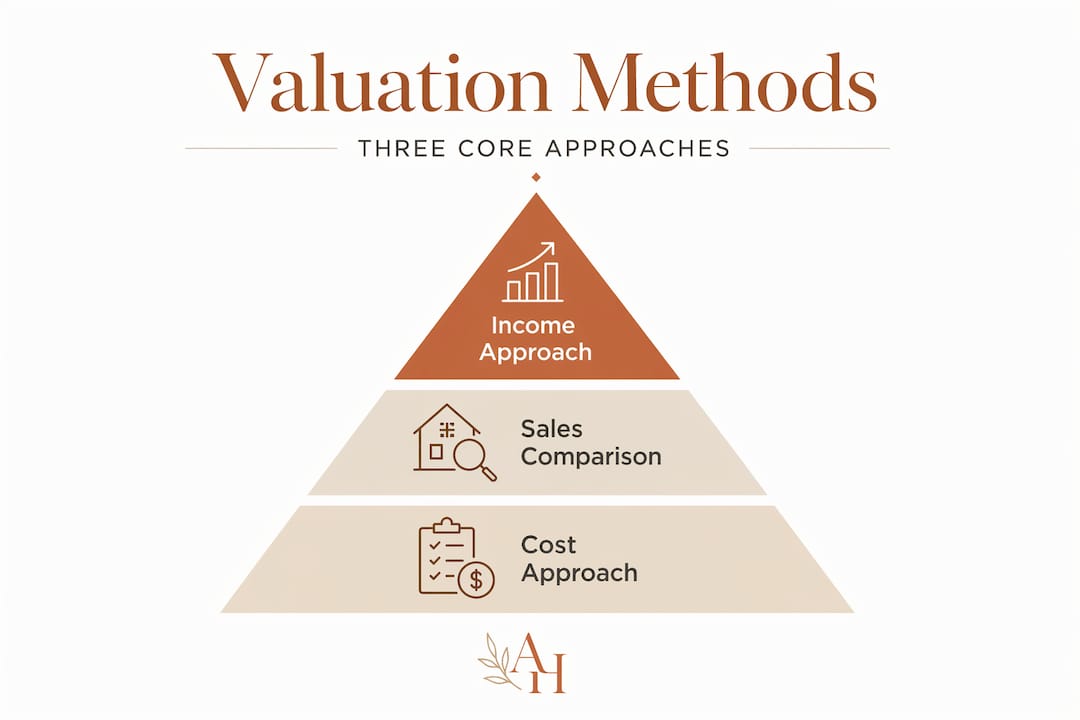
The three primary methods are the Income Capitalization Approach, the Sales Comparison Approach, and the Cost Approach. Most professional appraisers use all three and reconcile the results to reach a final defensible value.
How do you calculate NOI for a commercial property?
NOI is calculated by subtracting all operating expenses from effective gross income. It excludes mortgage payments, depreciation, capital expenditures, and income taxes, reflecting only the property’s pure operating performance.
Why does cap rate selection matter so much?
Cap rate directly determines value in the Income Approach. A difference of just one percentage point on an NOI of $200,000 can shift the valuation by over $476,000, making market-supported cap rate selection one of the most consequential decisions in the entire process.
When should you use the Cost Approach?
The Cost Approach is most appropriate for new construction, special-use properties with no comparable sales, or properties where neither income nor transaction data is available. It is also widely used for insurance valuations and property tax reporting.
Is assessed value the same as market value?
No. Assessed values for tax purposes frequently differ from fair market value due to statutory caps and infrequent reassessments. Relying on assessed value as a valuation proxy can lead to significant pricing errors in investment or financing decisions.


