


Singapore’s property market threw investors a curveball in early 2026. Private home prices rose 0.9% in Q1, yet transaction volumes and developer sales fell sharply versus the prior quarter, exposing a dangerous gap between what headline numbers suggest and what the market is actually doing. If you made a buying or selling decision based on that price figure alone, you likely walked into the deal with an incomplete and potentially costly picture. The smartest property decisions in Singapore come from reading multiple signals together, and this guide shows you exactly how.
Table of Contents
- What are property market trends—and why data beyond price matters
- How to decode Singapore property data: Flash vs. final figures
- Segmenting trends: Why one-size-fits-all metrics mislead
- Operating signals: Volume, liquidity, and what comes next
- Applying trends: For upgraders, investors, and savvy buyers
- Why market trend monitoring is undervalued—Our take
- Get expert guidance on market trends and Singapore real estate
- Frequently asked questions
Key Takeaways
| Point | Details |
|---|---|
| Look beyond prices | Headline property prices alone can mislead, so tracking volume, supply, and segment trends is essential. |
| Segment matters | Differing outcomes between locations and property types require more granular analysis for smart decisions. |
| Validate data sources | Flash estimates are provisional; rely on final released figures before making big moves. |
| Volume signals risk | A drop in transaction volume, even during price gains, may point to hidden market risks. |
| Tailor monitoring to your goal | Strategies differ for upgraders, investors, and homebuyers, so personalize your market analysis. |
What are property market trends—and why data beyond price matters
A property market trend is not just a price direction. It is the combined movement of several measurable forces: transaction volume, new supply entering the pipeline, rental rates, vacancy levels, and buyer sentiment. Each of these tells a different part of the story, and missing even one can distort your read on the market.
Most buyers and investors focus almost entirely on price because it is the most visible number. Property portals, financial news, and dinner conversations all revolve around it. But price is a lagging indicator. It reflects decisions made weeks or months ago. By the time prices officially rise or fall, the underlying forces that drove that change have often already shifted.
The Q1 2026 data illustrates this perfectly. Prices nudged upward, yet sales volumes dropped. That combination signals reduced market urgency, possible bid-ask friction, and a more selective buyer pool. Monitoring Singapore property market trends helps investors and homebuyers convert macro headlines into decision-ready signals rather than noise.
Here is what a proper multi-signal read includes:
- Price movement: The headline figure, but never the only one you track
- Transaction volume: How many deals are actually closing, not just how many are listed
- Rental rates and yields: Useful for investors comparing rental return versus capital appreciation
- Supply pipeline: Upcoming completions and launches that could soften or tighten the market
- Policy environment: Stamp duty changes, loan-to-value limits, and government land sales that shift demand
If you are watching commercial property trends alongside residential, you will quickly notice how supply and demand dynamics differ dramatically between sectors, making multi-signal monitoring even more essential. The fundamental reasons to build this habit are also well-documented among seasoned investors who understand the Singapore property investment benefits that come from staying ahead of the data.
“Price is what you pay. Value is what you get.” The same logic applies to market data: the number you see in the headline is what is reported, but the full picture is what actually drives your outcome.
How to decode Singapore property data: Flash vs. final figures
One of the least discussed but most consequential aspects of Singapore property monitoring is the difference between flash and final data releases. The Urban Redevelopment Authority (URA) publishes flash estimates early each quarter, giving buyers, sellers, and investors an early read on price movements. But these figures are preliminary.

Flash estimates are calculated using transactions captured up to a certain cutoff date. They exclude deals that were signed but not yet lodged with the authorities, which can be significant. URA flash estimates can diverge from final figures, and for Q1 2026, the gap was notably wider than usual, particularly in the Outside Central Region (OCR) segment where late-lodged transactions shifted the final reading meaningfully.
Here is a simplified comparison of how flash and final figures can look:
| Metric | Flash estimate | Final figure | Implication |
|---|---|---|---|
| Overall private residential price change | +0.6% | +0.9% | Final often revised upward |
| OCR non-landed price change | Flat | +1.2% | Segment-level gaps are larger |
| Transaction volume | Partial count | Full count | Underestimates activity at flash stage |
| Release timing | Early in following quarter | Four weeks after quarter end | Flash used for early planning only |
Why does this matter for you? If you act on flash estimates as if they are final confirmed data, you may misjudge urgency or price positioning in a specific segment. A buyer who saw OCR prices as flat in Q1 2026 flash figures might have negotiated harder than necessary, only to find the final data showed meaningful appreciation. Sellers in the same window might have underpriced.
Pro Tip: Treat flash estimates as a directional signal, not a confirmed result. Cross-reference flash figures against final releases before making any major financial commitment. Use the market analysis guide to build a structured approach to reading and timing data releases.
Segmenting trends: Why one-size-fits-all metrics mislead
Singapore’s property market is not one market. It is several markets operating simultaneously, sometimes moving in opposite directions. National averages can paper over this completely.
In Q1 2026, non-landed private residential prices rose 1.3% overall even as the national figure came in at 0.9%. That 0.4 percentage point gap does not sound huge until you consider that landed properties fell or flattened in the same period, which dragged the blended number down. If you are buying a non-landed condominium in the OCR, the national headline figure is almost irrelevant to your decision.
Here is a breakdown of how different segments can behave at the same time:
| Segment | Q1 2026 price trend | Key driver | Investor implication |
|---|---|---|---|
| Non-landed private (overall) | +1.3% | Demand from upgraders and foreigners | Watch volume alongside price |
| Core Central Region (CCR) | Moderate | Luxury demand, foreign buyer activity | Sensitive to ABSD policy changes |
| Rest of Central Region (RCR) | Stable | Mid-market owner-occupiers | Volume signals more reliable than price alone |
| Outside Central Region (OCR) | +1.2% (final) | HDB upgraders, affordability migration | Supply pipeline critically important |
| Landed residential | Flat to negative | Limited new supply, affordability ceiling | Long hold horizon suits this segment |
| HDB resale | Softening | MOP flats entering market | Affects upgrader timing significantly |
Monitoring by segment gives you an entirely different kind of intelligence. You stop asking “is the market up or down?” and start asking “is this segment, in this location, showing the right combination of price strength, volume depth, and supply restraint for my specific goal?”
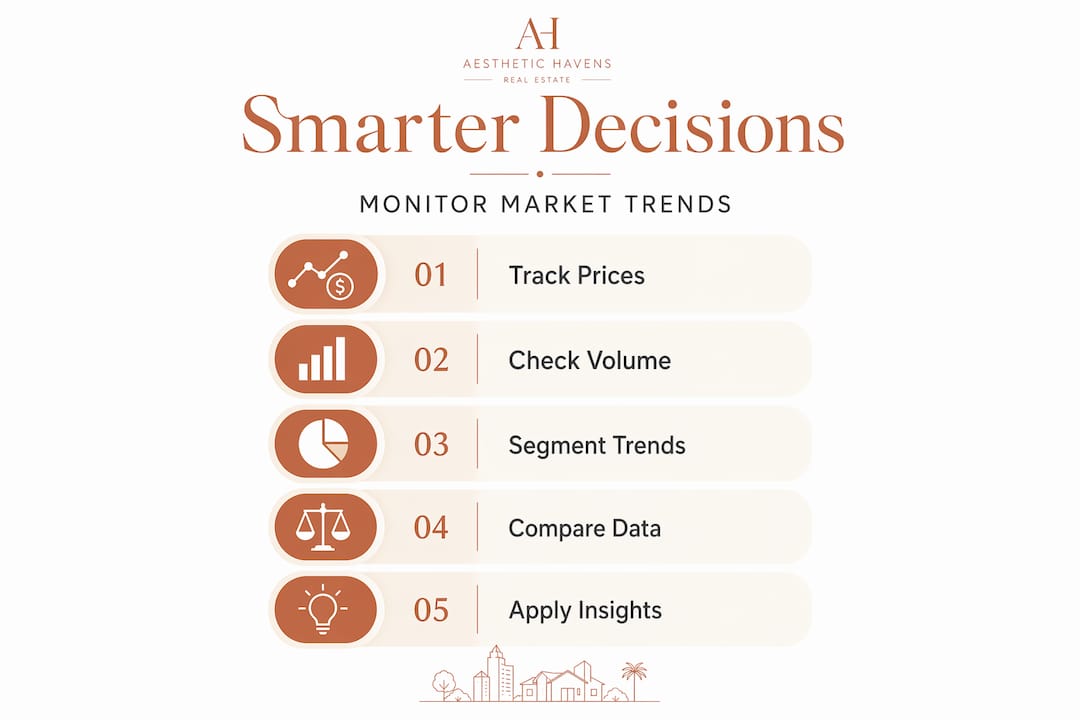
Investors who want to spot undervalued Singapore neighborhoods before prices catch up absolutely must segment their monitoring. National averages will never surface those opportunities.
Key signals to track by segment:
- Price trend per district: Not just the region, but individual project and street-level data
- Volume by segment: How many OCR non-landed units actually transacted this quarter?
- New launch absorption rate: What percentage of new units released are sold within the first month?
- Resale to new launch ratio: Shifts here indicate where buyers are gravitating and why
Operating signals: Volume, liquidity, and what comes next
Price tells you what happened. Volume and liquidity tell you what is about to happen. This is the single most underused insight among Singapore property buyers.
When transaction volumes drop while prices hold steady, the market is typically in a standoff. Sellers are not willing to cut. Buyers are not willing to stretch. This creates a situation where price data looks calm on the surface while actual market activity is quietly contracting. Transaction volume and liquidity indicators can be a leading nuance versus price, since prices may be rising even while activity is weakening underneath.
“Resilient prices but declining volumes” is not a sign of a healthy bull market. It is a sign of a market holding its breath, and that warrants caution, not confidence.
Here are the top liquidity and supply metrics every serious buyer or investor should track:
- Total private residential transactions per quarter: Cross-reference with the five-year average to identify whether volume is above or below historical norms
- New launch units sold vs. units released: A falling absorption rate signals weakening demand even before prices soften
- Upcoming completions in your target district: A wave of new supply absorbing renter demand can compress yields before you expect it
- Vacancy rates by region: Rising vacancies are an early warning for rental investors that their exit or holding yield assumptions need revisiting
- Bid-ask spread in resale listings: If properties are sitting longer and sellers are accepting more discounts, this shows up in volume before it shows in price
Pro Tip: Set a quarterly alert to compare transaction volume against price movement in your target segment. A widening gap between price growth and volume contraction is one of the clearest signals that a market is losing momentum. Pair this with rental market insights to assess whether holding a property still makes sense during a volume dip. And if you are reviewing your financing position during uncertain volume periods, the mortgage affordability guide offers a solid framework for stress-testing your numbers.
Applying trends: For upgraders, investors, and savvy buyers
Market data only creates value when it changes your behavior. Here is how three distinct groups can apply trend monitoring to real decisions.
For HDB upgraders
Upgraders need to watch two markets simultaneously: the HDB resale market they are exiting and the private market they are entering. Tracking both HDB and private market trends is essential because conditions in one segment directly affect the economics of upgrading. When the HDB resale index softened 0.1% in Q1 2026, partly due to more flats reaching their Minimum Occupation Period (MOP) and entering resale supply, upgraders faced a tighter negotiation position on their exit price. Knowing this in advance helps you time your sale more strategically.
- Monitor the volume of MOP flats entering your estate to gauge competition when selling
- Track private OCR volume to identify whether upgrader demand is being met with sufficient new launch supply
- Assess your CPF usage and remaining loan tenure before moving, as private market stress testing differs from HDB financing
For property investors
Investors benefit from trend monitoring because it guides when to pivot between asset types and strategies. Falling resale volumes in a rising price environment often mean rental yields look more attractive than capital gains in the short term. Cross-referencing price growth with rental growth tells you whether the market is becoming more or less favorable for a buy-and-hold strategy.
- Use segment trends to identify whether CCR luxury or OCR mass market offers better risk-adjusted returns in the current cycle
- Watch new launch absorption rates to judge developer pricing confidence and future resale potential
- Track vacancy trends by subzone to protect rental income assumptions
For first-time homebuyers
Buyers who are purchasing for owner-occupation tend to over-focus on price. What matters equally is whether you can sustain the mortgage across a range of interest rate and income scenarios. Go beyond price direction and include stress-tested affordability in your analysis. The smarter property investment guide offers practical frameworks for buyers at any experience level.
- Compare your target property’s price per square foot against segment averages to judge relative value
- Look at resale volume in your shortlisted projects to understand exit liquidity before you buy
- Factor in upcoming supply completions nearby, which can affect both rental demand and resale competition
Why market trend monitoring is undervalued—Our take
After reviewing countless buying decisions across Singapore’s property cycles, one pattern stands out clearly: the buyers who struggled most were not the ones who made wrong decisions. They were the ones who made incomplete ones.
Headline price statistics feel satisfying because they are simple, specific, and easy to discuss. But simplicity is not the same as accuracy. The investor who saw prices up 0.9% in Q1 2026 and felt reassured may have missed that volume was falling, flash data was shifting, and certain segments were decoupling from the national trend entirely.
Affordability and stress testing need to sit alongside price direction in any serious buyer’s monitoring framework. A property can look cheap on a price-per-square-foot basis and still be unaffordable under realistic financing scenarios. That is not a fringe case. That is a very common outcome for buyers who skip the volume and policy data.
Treating flash estimates as gospel and acting before final data is confirmed is one of the most avoidable mistakes in Singapore real estate decision-making.
Pro Tip: Build a personal market dashboard that tracks at least five data points each quarter: price change in your target segment, transaction volume, flash vs. final variance, upcoming supply completions, and rental yield trends. Add policy updates as a sixth layer whenever stamp duty or loan limits change. This takes about 30 minutes per quarter and is among the highest-value activities you can do as a property buyer or investor.
The commercial real estate guide also illustrates how segment-specific monitoring catches opportunities and risks that broad-market reading completely misses, reinforcing that this approach applies far beyond residential property alone.
Most buyers do not do this because it feels like extra work. But in a market as nuanced and policy-sensitive as Singapore’s, that extra work is precisely where your edge lives.
Get expert guidance on market trends and Singapore real estate
Knowing what to monitor is only half the equation. Interpreting it correctly in the context of your specific financial position, goals, and timing is where professional guidance adds real, measurable value.

At Aesthetic Havens, we help buyers, upgraders, and investors build a clear, data-driven view of the Singapore property market before they commit to any decision. Whether you need help decoding real estate advisory options, understanding how the commercial real estate market fits alongside your residential strategy, or simply getting an honest read on whether now is the right time for your specific profile, our team is ready to guide you with unbiased, transaction-backed market intelligence. Reach out today and turn market data into your next smart move.
Frequently asked questions
How often should I monitor property market trends in Singapore?
Monthly or quarterly checks are best practice, since transaction volumes and supply conditions can shift quickly between reporting periods. URA flash estimates can change materially once all transactions are tallied, so quarterly monitoring aligned with official release cycles improves your timing considerably.
Why do transaction volumes matter if prices are still rising?
Low volume signals reduced urgency and potential market friction even when price movement looks positive. In Q1 2026, prices rose 0.9% while volumes dropped, a clear demonstration that relying on price alone produces an incomplete and potentially misleading picture.
Should I trust flash property data releases or wait for final numbers?
Flash estimates are useful for early directional signals but should never drive a final decision on their own. For Q1 2026, flash and final figures diverged more than usual due to late-lodged transactions, so treat all flash data as provisional until confirmed.
How do market trends affect HDB upgraders?
Upgraders need visibility across both the HDB resale index and private market conditions to time their move and negotiate effectively. The HDB resale index fell 0.1% in Q1 2026, partly driven by more MOP flats entering the market, which directly compressed seller negotiation power for upgraders exiting the HDB segment.
Why is segment-specific tracking necessary for investors?
Different segments can move in opposite directions simultaneously, meaning a national average masks where the real opportunities and risks sit. Non-landed prices rose 1.3% against an overall 0.9% figure in Q1 2026, showing how blended statistics can obscure meaningfully different outcomes across property types.


