


Singapore’s commercial property market has rarely rewarded passive investors. Prices shift, tenant demand rotates, and regulatory changes catch underprepared buyers off guard. If you’ve been struggling to generate consistent returns while managing exposure in this environment, you’re not alone. The good news is that 2025 saw S$17 billion flow into commercial real estate as part of a broader S$40 billion total, which signals real opportunity for investors who know where to look and how to position themselves for 2026 and beyond.
Table of Contents
- Understand Singapore’s commercial property landscape
- Key principles for risk minimization
- Choosing your investment strategy: Core, value-add, industrial
- Implementing and monitoring your strategy
- What experienced investors realize about Singapore commercial property
- Unlock tailored support for commercial investments in Singapore
- Frequently asked questions
Key Takeaways
| Point | Details |
|---|---|
| Prioritize risk minimization | Opt for longer leaseholds, prime locations, and green-certified buildings to protect your investment. |
| Choose the right strategy | Select between core, value-add, or industrial approaches based on your risk tolerance and goals. |
| Monitor market shifts | Stay alert to selective activity and value-add cycles for best timing and returns. |
| Diversify asset types | Balance your portfolio with office, retail, and industrial sectors for resilience. |
| Leverage professional guidance | Utilize advisory services and agent expertise to improve deal negotiations and success rates. |
Understand Singapore’s commercial property landscape
Before you allocate a single dollar, you need a clear picture of what the market actually looks like today. Singapore’s commercial sector covers three broad asset classes: office, retail, and industrial. Each behaves differently under economic pressure and offers a distinct risk and return profile.
Office properties, especially Grade A buildings in the CBD, continue to attract institutional capital and anchor tenants. Retail is more complicated. High-street retail in prime locations like Orchard Road and Marina Bay holds firm, while secondary suburban malls face mounting pressure from e-commerce. Industrial properties, covering logistics hubs, data centers, and high-specification facilities, have become a favorite among investors looking for yield stability.
| Asset class | Typical gross yield | Key risk factor | Best suited for |
|---|---|---|---|
| Prime office (CBD) | 3.0% to 4.5% | Vacancy during downturns | Long-term income seekers |
| Retail (prime) | 4.5% to 6.0% | E-commerce disruption | Selective, high-footfall picks |
| Industrial/logistics | 5.0% to 7.5% | Tech and supply chain cycles | Yield-focused investors |
The 2025 investment volumes were largely driven by prime office and retail acquisitions, with foreign and domestic capital competing for a limited pool of quality assets. Going into 2026, expect the activity to shift toward selective deals, partial stake acquisitions, and value-add plays rather than trophy asset bidding wars.
Here’s what’s shaping the current landscape:
- Partial stake deals are gaining traction as buyers spread risk across multiple assets rather than concentrating exposure in one building.
- Value-add investments in secondary locations are drawing interest from investors willing to renovate and reposition properties for better tenants.
- Prime office and logistics remain the top targets for core investors with longer holding horizons.
- Sustainability is no longer optional. Tenants and regulators are actively pushing for green-certified assets.
To track how these dynamics are evolving month to month, reviewing the market trends for 2026 gives you the specific sector data you need. And if you want a broader strategic overview, the market guide for smart investors consolidates the key numbers and frameworks in one place.
Key principles for risk minimization
Market awareness alone doesn’t protect your portfolio. You need deliberate strategies that reduce downside before conditions turn unfavorable.
1. Prioritize longer leaseholds
In Singapore’s leasehold property environment, tenure is everything. Freehold commercial properties are rare and command significant premiums. For leasehold assets, target those with 60 years or more remaining. Properties with shorter tenures can depreciate faster, attract financing restrictions, and become harder to sell. Always factor residual lease tenure into your acquisition price.
2. Choose prime locations first
Location risk is often underestimated in commercial property. The CBD, one-north, and Jurong Lake District (JLD) continue to command premium rents and lower vacancy rates. Properties in these zones offer a buffer when the broader market softens. Secondary locations can still work, but they require a clear repositioning strategy and a more hands-on approach.
3. Target green-certified buildings
This one surprises many investors when they first see the numbers. Green-certified buildings command rental premiums of up to 11% and deliver energy savings of 20% to 60%. With major multinational tenants now committing to sustainability in their lease decisions, non-green buildings face a growing risk of obsolescence. Singapore’s Building and Construction Authority (BCA) Green Mark scheme is the local benchmark to watch.

4. Diversify across sectors and geographies
Concentrating everything in one sector or one precinct is a classic mistake. Spreading across office, industrial, and retail gives your portfolio natural hedging. Consider adding international exposure through Singapore-listed REITs (Real Estate Investment Trusts) with assets in markets like Australia, Japan, or the UK for additional diversification.
| Risk factor | Lower risk approach | Higher risk approach |
|---|---|---|
| Lease tenure | 60+ years remaining | Under 30 years |
| Location | CBD or established business parks | Secondary suburban areas |
| Green certification | BCA Green Mark certified | Non-certified older stock |
| Sector exposure | Multi-sector portfolio | Single sector concentration |
Pro Tip: Before signing any lease or purchase agreement, run a tenant credit check. A financially weak anchor tenant is more dangerous than a slightly lower yield. One vacancy event can wipe out two years of rental income.
To make sure your leasing decisions align with risk minimization, reviewing how to secure the best office deal before entering negotiations gives you a practical edge.
Choosing your investment strategy: Core, value-add, industrial
Not every investor has the same objectives. A retiree building passive income needs a different approach than a family office looking to grow capital over ten years. Understanding the three primary strategies gives you the clarity to commit.
Core strategy: Stability over everything
Core investors focus on prime, well-leased assets in established locations. Think Grade A office buildings in Raffles Place, or fully tenanted logistics facilities near Changi. The returns are more modest, typically in the 3% to 5% gross yield range, but the income is predictable and the tenant quality is high. This is the right strategy if you want capital preservation with steady distributions.
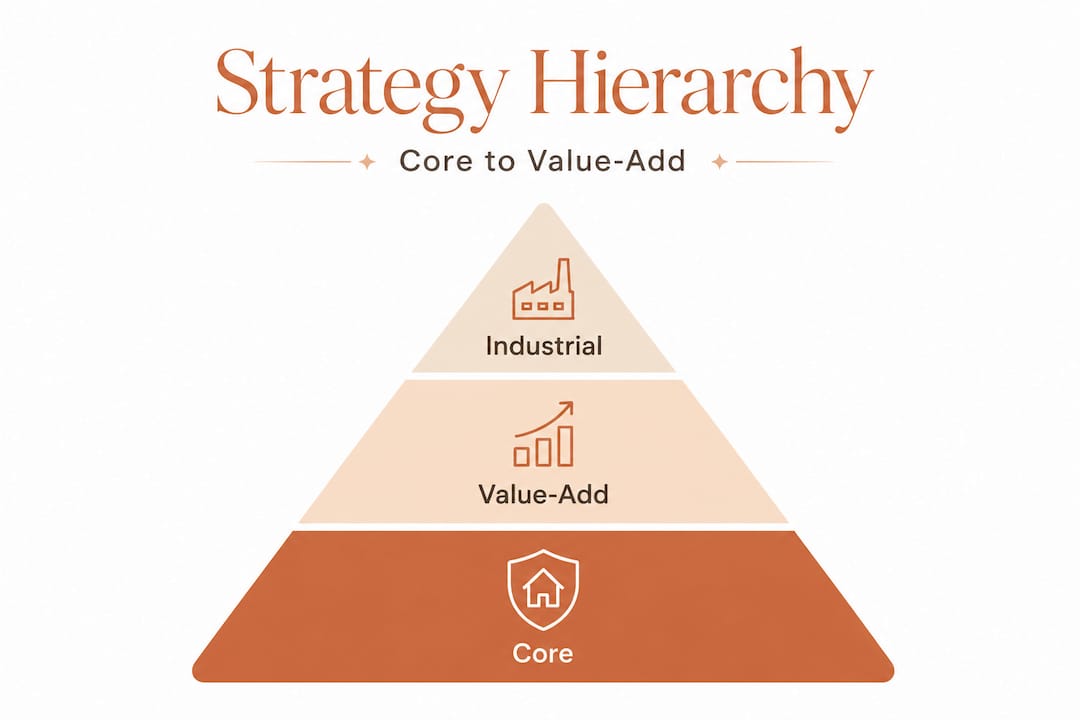
Value-add strategy: Growth through repositioning
Value-add investing involves buying assets that are underperforming because of management issues, outdated specifications, or poor tenant mix, then improving them to unlock higher rents and asset values. This could mean refurbishing common areas in a strata office building, upgrading a logistics facility to attract e-commerce tenants, or repositioning a secondary mall around food and experiential retail.
The risk is higher. Renovation costs can blow out. Repositioning takes time. But the upside, an improvement in both rental income and capital value, can significantly outperform a pure core approach. As market analysis from PLB Insights confirms, value-add plays on secondary assets are expected to be a defining feature of the 2026 commercial market.
Industrial sector: Resilient but not risk-free
Industrial properties have consistently outperformed office and retail in resilience across economic cycles. Logistics demand tied to e-commerce, data center expansion driven by AI infrastructure, and high-spec manufacturing linked to semiconductor supply chains have all supported industrial values and rents.
But here’s what many guides don’t say clearly: industrial performance is tied to technology investment cycles. When tech spending contracts, data center take-up slows. When global trade volumes drop, logistics occupancy comes under pressure. Industrial is not a set-and-forget asset class.
“The commercial investors who outperform over the long run are those who choose the right strategy for their capital position and time horizon, not those who simply chase the hottest sector at any given moment.”
Here’s how to weigh the trade-offs:
- If you want low maintenance income and long-term stability, core prime office or industrial logistics is your answer.
- If you have renovation capital and asset management capacity, value-add in secondary locations can generate outsized returns.
- If you want yield with some growth upside, well-located industrial properties in Jurong, Tuas, or Changi Logistics Corridor offer a compelling balance.
For a detailed sector-by-sector breakdown, the analysis of office, retail, and industrial sectors in Singapore’s 2025 outlook lays out exactly what each segment demands from investors.
Pro Tip: When evaluating value-add deals, always get an independent quantity surveyor’s report before you commit. Renovation budgets quoted by sellers are almost always optimistic. Budget for at least 15% to 20% cost overrun as a baseline.
Implementing and monitoring your strategy
Strategy without execution is just theory. Here’s how to move from planning to performance, and how to track whether your investments are actually delivering.
Step-by-step implementation
- Define your capital budget and risk tolerance. Know how much you’re putting in, whether you’re using leverage (a loan to boost purchasing power), and at what loan-to-value ratio you’re comfortable operating.
- Shortlist assets by strategy type. Core investors should focus on new listings in prime zones. Value-add investors should actively search for distressed or undertenanted properties in B-grade buildings.
- Conduct thorough due diligence. Review tenant lease terms, check remaining lease tenure, assess building condition, and verify that the property has or is eligible for BCA Green Mark certification.
- Negotiate and structure the deal. For partial stake deals or joint ventures, ensure the shareholder agreement clearly defines decision-making rights, exit provisions, and dividend policy.
- Implement any value-add improvements. Work with a licensed contractor and have a project timeline tied to a target retenanting or reletting date.
- Lease up vacant space aggressively. Every month of vacancy has a direct cost. Work with a commercial leasing specialist from day one.
Monitoring metrics that matter
Once you own the asset, track these numbers every quarter:
- Gross rental yield: Total annual rent divided by purchase price. Below 3.5% in non-prime locations is a warning sign.
- Occupancy rate: Anything below 85% for three consecutive quarters should trigger an active review.
- Energy performance: If you’ve invested in green-certified assets, track actual energy savings against the projected 20% to 60% benchmark. Underperformance can hurt your green premium at the next lease renewal.
- Weighted average lease expiry (WALE): Measures how long, on average, your tenants are contracted to stay. A WALE below two years creates near-term income risk and needs to be addressed proactively.
The broader S$40 billion investment volume recorded in 2025 signals that institutional capital is actively pricing in recovery, which means retail and mid-market investors who move with discipline in 2026 can benefit from the same tailwinds before full repricing occurs. For a consolidated view of monitoring frameworks and market-adapted tactics, the resource on smarter Singapore property investments covers the practical mechanics in detail.
What experienced investors realize about Singapore commercial property
Most articles on this topic stop at strategy selection. Here’s what actually separates investors who build lasting portfolios from those who chase short-term headlines.
Conventional wisdom tells you to follow the big deals, buy what institutional investors buy, and ride the macro trends. That logic works until it doesn’t. The problem is that by the time a trend is headline news, the best entry points are already gone. Institutional investors moved six to twelve months earlier.
What genuinely outperforms is the combination of micro-location intelligence and tenant quality. A B-grade building in a micro-location with limited supply, strong footfall from a nearby MRT exit, and a long-tenanted government or MNC anchor tenant will consistently beat a A-grade building in an oversupplied submarket. The headline address doesn’t protect you. The tenant covenant does.
Green certification is another area where investors routinely undervalue the compounding effect. The rental premium isn’t just about today’s rent. A BCA Green Mark certified building is increasingly becoming a prerequisite for large tenants under their own ESG (Environmental, Social, and Governance) commitments. In five to ten years, non-certified buildings may face structural vacancy issues that no repositioning budget can fix. Investing in certification today is buying insurance against obsolescence tomorrow.
Perhaps most importantly, the investors who build real resilience don’t treat Singapore commercial property as a single market. They treat it as a portfolio of micro-markets, each with its own supply constraints, tenant demand drivers, and regulatory dynamics. Raffles Place office, Jurong industrial, and Orchard retail are three completely different investment theses requiring separate due diligence frameworks.
Keep tracking the opportunities for 2026 as they develop, because the investors who read the selective activity signals early will have the strongest negotiating position when deal flow picks up in the second half of the year.
Unlock tailored support for commercial investments in Singapore
Putting these strategies into action is significantly more effective when you have expert guidance aligned with your specific investment objectives.

At Aesthetic Havens, we work with commercial property investors across Singapore to navigate acquisition decisions, leasing strategies, and portfolio planning. Whether you’re assessing your first commercial asset or expanding an existing portfolio, understanding real estate advisory for Singapore investors is a practical first step toward structuring your approach correctly. Discover how the roles and benefits of agents translate into better deal outcomes and fewer costly missteps. For ongoing market intelligence, the market guide for smart investors is available to help you make well-informed decisions with current data.
Frequently asked questions
What is the most resilient commercial property sector in Singapore?
Industrial properties have shown greater resilience compared to office and retail, particularly during economic shifts, though investors should still monitor tech and supply chain cycles that can affect logistics and data center demand.
Do green-certified commercial buildings offer higher rental income?
Yes, green-certified buildings can command rental premiums of up to 11% and deliver energy savings between 20% and 60%, making them increasingly attractive to corporate tenants with ESG commitments.
How can I minimize my risks in commercial property investments?
Prioritize longer leaseholds with significant remaining tenure, invest in prime locations such as the CBD and established business parks, and diversify your exposure across sectors and geographic areas to reduce concentration risk.
What are the main market trends affecting commercial property in Singapore for 2026?
Selective deal activity, partial stake acquisitions, and value-add repositioning strategies are expected to dominate the 2026 market as investors adopt a more cautious but opportunity-focused approach compared to the broad recovery seen in 2025.
Recommended
- Top benefits of investing in commercial property in Singapore
- Singapore commercial real estate: Market guide for smart investors
- How to Buy Commercial Property in Singapore: A Step-by-Step Guide | Aesthetic Havens
- Singapore Commercial Property Trends: Opportunities for 2026
- Real Estate Auction Blog | Tips, Strategies & Insights
- Investitionsstrategien für Immobilien im Südosten Mallorcas


