


Buying property in Singapore is not a casual financial decision. With regulations like the Additional Buyer’s Stamp Duty (ABSD), Seller’s Stamp Duty (SSD), and strict HDB eligibility rules, one misstep can cost you tens of thousands of dollars. Many buyers assume agents are simply middlemen who show you homes and collect a check. In reality, a licensed real estate agent in Singapore is your compliance shield, negotiation expert, and market analyst rolled into one. Agents provide essential navigation in Singapore’s regulated market, reducing risks like overpaying or making costly legal errors. This article breaks down exactly what agents do, why it matters, and how to get the most from that relationship.
Table of Contents
- Why you need a real estate agent in Singapore
- Key responsibilities of property agents during transactions
- Regulatory boundaries and ethical obligations
- How agents create value for homebuyers and investors
- Our take: Rethinking the real estate agent’s role in Singapore
- Connect with trusted Singapore property agents
- Frequently asked questions
Key Takeaways
| Point | Details |
|---|---|
| CEA regulation matters | All agents in Singapore must be registered and comply with strict government rules. |
| Agents protect your interests | Professionals manage risk, handle compliance, and maximize property value for buyers and investors. |
| Dual representation prohibited | Agents cannot represent both sides in a transaction, ensuring fairness and transparency. |
| Negotiable commissions | Agent fees are not fixed, allowing buyers and investors to negotiate a fair rate. |
| Data-driven outcomes | Expert agents leverage market insights for tangible gains and safer transactions. |
Why you need a real estate agent in Singapore
Singapore’s property market is one of the most tightly regulated in Asia. That is not a complaint. It is actually what makes it one of the most stable. But stability comes with complexity, and that complexity is exactly where a good agent earns their keep.
All licensed agents in Singapore must be registered with the Council for Estate Agencies (CEA), the government body that sets conduct standards and handles disciplinary action. This is not optional. Practicing without a valid CEA license is a criminal offense. So when you engage a registered agent, you are working with someone who has passed required exams, completed continuing education, and is accountable to a regulatory body.
Here is where agents make a real, measurable difference:
- HDB eligibility checks: Rules around who can buy what type of flat, at what income ceiling, with what family nucleus, are genuinely complex.
- ABSD calculations: Foreign buyers pay up to 60% ABSD in 2026. Getting this wrong is not a paperwork issue. It is a financial disaster.
- SSD implications: Selling too early can trigger stamp duties that wipe out your profit.
- Due diligence: Agents verify property history, outstanding loans, and encumbrances before you commit.
- Negotiation: Experienced agents know when a seller is motivated and how to structure an offer that wins.
“A professional agent handles eligibility, due diligence, paperwork, and negotiations on your behalf, ensuring every step meets legal and procedural requirements.”
For investors especially, choosing your agent carefully is one of the highest-leverage decisions you can make. The right agent does not just find listings. They filter out bad deals before you ever see them, saving you time, money, and stress.
Data-driven agents also bring something most buyers underestimate: market timing intelligence. They track transaction volumes, price per square foot trends, and upcoming supply pipelines. That knowledge, applied correctly, can mean the difference between buying at a peak and buying at a discount.
Key responsibilities of property agents during transactions
Once you engage an agent, their responsibilities are clearly defined by CEA guidelines. Understanding these helps you know what to expect and what to demand.
Here is a step-by-step look at what a professional agent should do during a transaction:
- Verify your identity and eligibility: Agents must collect your particulars through a Customer’s Particulars Form for Anti-Money Laundering and Counter-Financing of Terrorism (AML/CFT) checks. This is mandatory.
- Present a Prescribed Estate Agency Agreement: Before any work begins, agents must provide a formal written agreement outlining services, fees, and obligations.
- Conduct property due diligence: This includes checking title ownership, outstanding mortgages, and any legal caveats on the property.
- Negotiate on your behalf: Agents submit and convey offers promptly and must keep you updated at every stage.
- Explain all documents: Every form you sign should be explained clearly. You should never feel pressured to sign something you do not understand.
- Seek consent before advertising: If your property is listed, agents must get your permission before publishing any marketing material.
Agents must advise clients, update on offers, explain documents, seek consent for ads, and declare any conflicts of interest. This is not courtesy. It is a legal obligation.

| Agent responsibility | Why it matters |
|---|---|
| AML/CFT checks | Prevents illegal transactions |
| Prescribed agreement | Protects both parties legally |
| Due diligence | Avoids hidden liabilities |
| Offer updates | Keeps you informed and in control |
| Conflict declaration | Ensures unbiased representation |
Pro Tip: Always ask your agent to walk you through the Prescribed Estate Agency Agreement line by line before signing. If they rush you past it, that is a red flag worth taking seriously.
For transactions involving commercial spaces, the commercial leasing agent roles carry additional layers of complexity around zoning, permitted use, and lease structures. And if you are buying as a foreigner, reviewing the foreign buyer guidelines before engaging an agent will help you ask the right questions from day one.
Regulatory boundaries and ethical obligations
Understanding what agents can do is important. But knowing what they cannot do is equally critical for protecting yourself.
The most important prohibition: dual representation. An agent cannot represent both the buyer and the seller in the same transaction. This is not a gray area. Dual representation is an offense under Singapore law. The only narrow exception is administrative paperwork assistance, and only if both parties give written consent and no fee is collected from the other side.
Here is a clear breakdown of what agents are and are not allowed to do:
| Permitted | Prohibited |
|---|---|
| Co-broking with full disclosure | Dual representation without consent |
| Negotiating on client’s behalf | Handling transaction monies |
| Advertising with client consent | Recommending moneylenders |
| Declaring conflicts of interest | Misleading clients about property value |
On the topic of money: agents are prohibited from handling transaction funds or recommending moneylenders. If an agent asks to hold your option fee or deposit, or suggests a specific loan shark or unlicensed lender, walk away immediately.
Co-broking, where two agents from different agencies represent buyer and seller respectively, is perfectly legal and actually common in Singapore. The key requirement is full disclosure to both clients. Transparency is not optional in this market.
“Ethical conduct is not just about following rules. It is about building a relationship where clients can make informed decisions without fear of being misled.”
These boundaries also extend to staging ethics in transactions. Agents who recommend staging services must disclose any referral arrangements to avoid conflicts of interest.
- Agents must declare any personal interest in the property being transacted.
- They cannot exaggerate property values to close a deal faster.
- All marketing must be accurate and not misleading.
- Confidential client information must be protected throughout the process.
How agents create value for homebuyers and investors
Beyond rules and compliance, agents’ real value shows up in concrete results. Let’s talk numbers and outcomes.
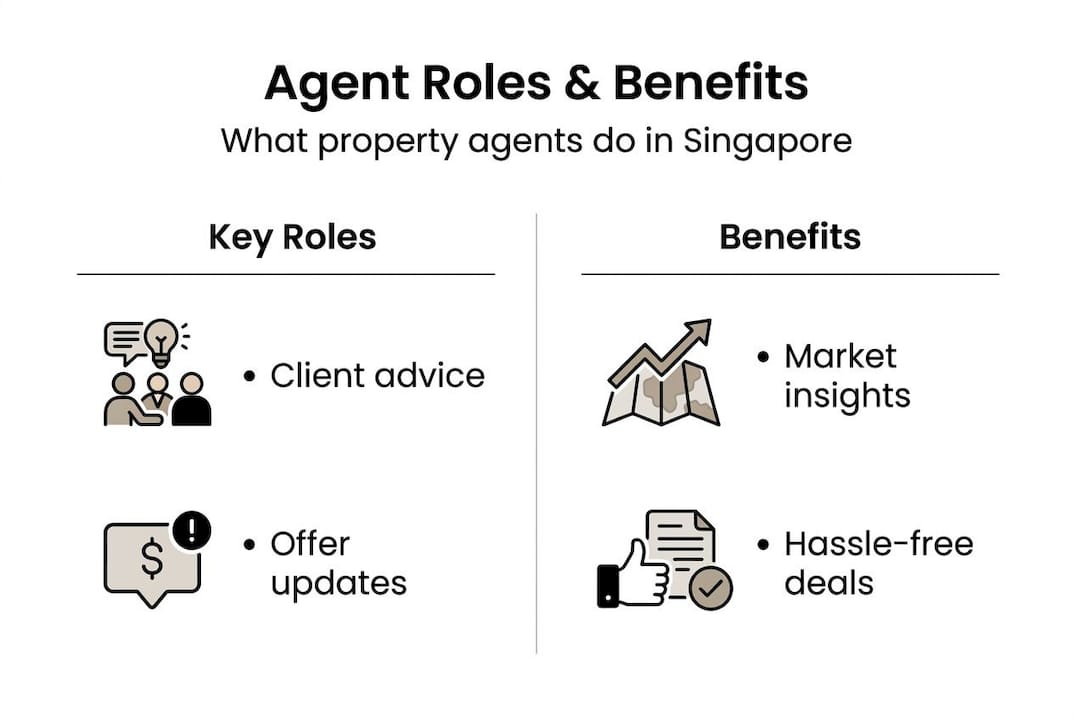
One of the most compelling examples: data-driven agent insights have helped clients generate profits like $270,000 on a $960,000 condo purchase. That is not luck. That is market timing, neighborhood analysis, and negotiation skill working together.
For homebuyers, the value is different but equally real:
- Avoiding overpayment: Agents pull recent transaction data to benchmark the asking price against actual market values.
- Flagging legal issues: Outstanding mortgages, disputed ownership, or illegal renovations can all be caught before you commit.
- Streamlining the process: From option to purchase to completion, agents coordinate lawyers, bankers, and sellers so nothing falls through the cracks.
- Protecting your timeline: Delays cost money. Agents who know the system keep transactions on schedule.
For investors, the calculus is even more significant. An agent who understands rental yield trends, en bloc potential, and upcoming MRT lines can guide you toward assets that appreciate faster than the market average. The impact of proptech is also reshaping how agents deliver this intelligence, with AI-powered tools now giving top agents real-time data that was previously only available to institutional buyers.
Pro Tip: Ask your agent for a Comparative Market Analysis (CMA) before making any offer. A good agent will produce one without hesitation. It shows you exactly what similar properties sold for and gives you a factual anchor for negotiations.
Commissions are also negotiable. Rates are not fixed by law, and in some cases, proptech-enabled agents offer services at 1% commission. That said, the cheapest agent is rarely the best agent. Focus on track record, market knowledge, and communication style over fee alone.
Our take: Rethinking the real estate agent’s role in Singapore
Here is something most articles will not tell you: the conventional view of agents as optional extras is not just wrong, it is expensive. We have seen transactions where buyers skipped professional representation to save on commission, only to miss ABSD exemptions they qualified for or purchase properties with undisclosed encumbrances. The savings evaporated fast.
At the same time, the agent landscape is genuinely changing. Digital platforms and proptech tools are automating parts of the job that used to require hours of manual research. The agents who thrive in this environment are not the ones who resist technology. They are the ones who use it to deliver faster, sharper, more personalized advice.
The strongest agents today blend three things: deep regulatory knowledge, data fluency, and genuine client focus. They are not order takers. They are strategic advisors. When finding the right agent, prioritize transparency and ethics over flashy marketing. The agent who tells you a deal is bad is worth far more than the one who just wants to close.
Connect with trusted Singapore property agents
Applying everything in this article starts with working alongside the right professional. At Aesthetic Havens, we connect buyers and investors with agents who are vetted for compliance, ethical conduct, and deep market knowledge across residential and commercial property.

Whether you are a first-time buyer navigating HDB rules, an investor building a portfolio, or a business owner exploring agent roles for commercial leasing, we have the expertise to guide you. Visit Aesthetic Havens to connect with a trusted Singapore realtor and take the next step toward a smarter, safer property transaction.
Frequently asked questions
How can I verify if my real estate agent in Singapore is legitimate?
You can check the CEA Public Register to confirm your agent’s registration status and legitimacy before signing any agreement.
Can my agent represent both buyer and seller in the same transaction?
No, dual representation is prohibited by law. Agents may only assist the other party with paperwork if both sides consent in writing and no fee is collected.
What documents should I expect my property agent to provide?
Your agent must present a Prescribed Estate Agency Agreement and a Customer’s Particulars Form for AML/CFT compliance checks before any transaction begins.
Are agent commissions fixed in Singapore?
No, commission rates are negotiable and vary by property type and agent, with some proptech-enabled agents offering rates as low as 1%.
Can agents handle transaction monies or recommend moneylenders?
No, agents are legally prohibited from handling transaction funds or recommending moneylenders under Singapore law.
Recommended
- Agent roles in Singapore commercial leasing: unlock value
- Best Property Agent in Singapore: How to Choose the Right One for You | Aesthetic Havens
- Top benefits of investing in commercial property in Singapore
- How AI and PropTech are Engineering Singapore’s Real Estate Future in 2025 | Aesthetic Havens
- Why Work with a Buyer Agent? Explained Simply – Living on the Côte d’Azur


