

Introduction
Ground-floor F&B rents in Singapore’s conservation shophouses range from S$9 psf to S$22 psf per month in 2026, depending on district, frontage quality, and exhaust infrastructure. Shophouse rental yield for investors sits between 2.5% and 4.0% gross, with net yields typically 0.5 to 1.0 percentage points lower after property tax, maintenance, vacancy allowance, and fit-out incentives are deducted.
This article covers F&B tenant demand, rent benchmarks by district and floor level, and yield expectations for conservation and commercial shophouses across Districts 1, 2, 7, 8, 14, and 15. It excludes HDB shop units, strata mall spaces, and government land sales sites. The target audience is Singapore-based and overseas investors, family offices, and owner-occupier F&B brands evaluating shophouse leasing or acquisition through 2026 and beyond.
F&B operators dominate ground floor occupancy in shophouses, and resilient tenant demand in prime precincts has kept overall vacancy rates in core areas below 5% for ground floors. But shophouse leasing volumes hit their lowest since early 2020, with only 779 rental contracts signed in Q1 2026. The Singapore shophouse rental market is selective and competitive; rental stability holds across prime locations, while softer conditions prevail in secondary areas.
After reading this article, you will understand:
-
How F&B demand for shophouses is shifting by concept type, location, and consumer behaviour in 2026.
-
Typical rent benchmarks for F&B shophouse space by district, floor level, and trade category.
-
What gross and net yields investors can reasonably underwrite for 2026 to 2028.
-
Key risks (licensing, manpower, fit-out costs, tenant turnover) that affect F&B tenant stability and landlord cash flow.
-
How AESTHETIC HAVENS helps investors stress-test rental assumptions and match trades to specific streets.
Understanding the 2026 Shophouse F&B Rental and Leasing Activity Landscape
Shophouse rental yield in 2026 measures the annual net rental income a landlord collects from a shophouse, divided by the property’s purchase price. For F&B-led shophouses, gross yields of 2.5% to 3.5% are common in prime districts; the rental growth an investor captures depends on the strength of the F&B trade, the lease structure, and the tenant’s operating resilience.
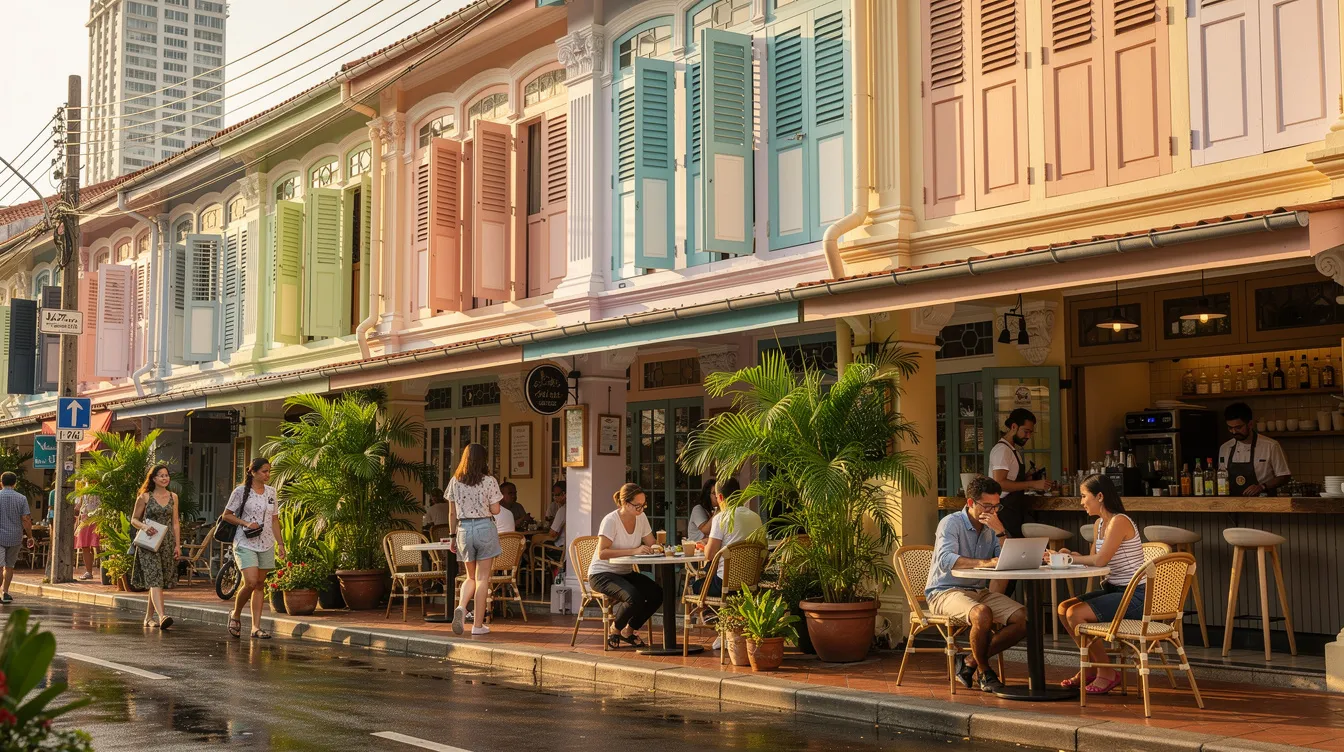
F&B tenants dominate prime ground-floor shophouse use because conservation shophouses offer high ceilings, street-level frontage, and heritage character that restaurants, cafes, and bars can convert into a dining atmosphere. This concentration of food and beverage properties on ground floors means that F&B licensing approvals, exhaust infrastructure, and foot traffic patterns directly shape achievable rents and capital values for the entire asset, and some buyers assess ground-floor units alongside other retail assets when judging tenant durability and rent resilience.
Core Drivers of F&B Demand in Conservation Districts
Tourism recovery toward pre-2019 levels continues to support precincts that depend on visitor spending, particularly the central business district fringe and cultural quarters. Office worker footfall in the CBD fringe remains a weekday anchor for lunch and after-work dining, while local demand for experiential dining (chef-led concepts, omakase counters, cocktail bars) sustains weekend and evening trade in heritage streets.
New restaurant openings are driving demand in the shophouse rental market despite economic pressure. Specific hotspots in 2026 include Keong Saik Road (where ground floor rents reach S$15 to S$22 psf), Telok Ayer and Amoy Street (S$12 to S$16 psf for F&B-approved ground floors), Club Street and Ann Siang (S$10 to S$14 psf), Kampong Glam (regional cuisines and lifestyle cafes), and Joo Chiat (family dining and brunch concepts). High-demand lifestyle districts command premium rental rates for shophouses. Tight supply supports rents in these locations; the limited supply of conservation shophouses supports long-term rental appeal because URA gazetted only about 6,500 shophouses for conservation, and no new conservation stock enters the pipeline.
Competition from wellness and lifestyle concepts impacts the demand for F&B shophouse spaces. Wellness clinics are the fastest-growing shophouse tenant category, with upper floor rents for wellness tenants averaging S$10 to S$14 psf. This competition is redirecting some upper-floor space away from F&B and toward medical aesthetics, physiotherapy, and boutique fitness, which can pay comparable or higher rents without the exhaust and grease-trap requirements that F&B tenants face.
Regulatory and Planning Context for F&B in Shophouses
URA zoning determines whether a shophouse is classified as Commercial or Commercial & Residential, and this classification controls whether F&B use is permitted at all. Owners and tenants must check the allowable use via URA SPACE, which maps each shophouse’s permitted trade categories. Change of use applications (for example, converting a retail space to an eating house) require URA approval and may trigger conservation, BCA, and land-agency reviews.
Operating an F&B business in shophouses requires compliance with strict regulatory requirements. The Singapore Food Agency mandates that food shop licence applicants present proper layout plans (kitchen infrastructure, exhaust ducts, grease traps, hand-wash sinks), a certificate of use or change of use approval from URA or BCA, and a signed tenancy agreement. URA and LTA’s October 2023 circular (DCG Circular PB_23-08) restricts new eating house approvals in specific shophouse areas where traffic congestion and parking disamenity are concerns. Existing restaurants in those areas may renew licences, but new F&B entrants face additional scrutiny or outright refusal.
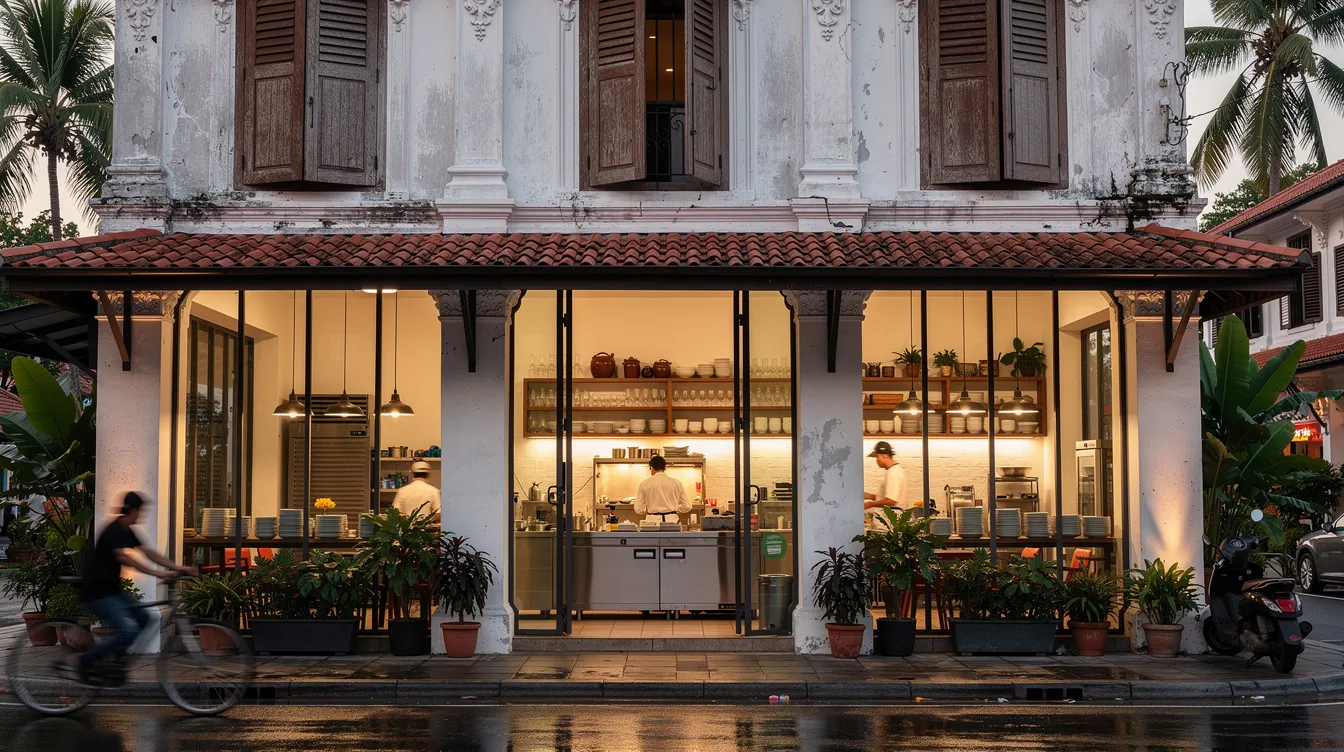
These constraints directly affect achievable rent and yield. Units without approved kitchen exhaust infrastructure cannot support full-service restaurants; they are limited to lighter trades like cafes or wine bars, which typically pay S$3 to S$5 psf less than full-kitchen F&B tenants on comparable ground floors. Prospective F&B tenants should scrutinize existing infrastructure and regulatory approvals before leasing. With this regulatory context established, the next section provides 2026 rent benchmarks by F&B concept and district.
2026 Rent Levels by F&B Concept, District and Floor
F&B rental markets are influenced by location quality and customer footfall. Shophouse rental performance varies based on the tenant’s ability to generate sustainable revenue from their specific trade. The benchmarks below reflect asking rents observed in agency listings and market reports through Q1–Q3 2026; achieved rents after negotiation and incentives are typically 5% to 10% below asking levels.
Prime CBD Fringe: Keong Saik, Duxton, Amoy, Club Street (D1/D2)
The highest-rent F&B shophouse precincts in Singapore are concentrated in Districts 1 and 2. In 2026, the dominant concepts here are cocktail bars, chef-led restaurants, omakase counters, and upscale bistros that benefit from CBD office worker traffic during lunch and evening crowds on weekends.
Ground floor rents in Keong Saik Road range from S$15 to S$22 psf, reflecting the street’s status as one of Singapore’s most photographed dining rows. Telok Ayer and Amoy Street ground floors command S$12 to S$16 psf for units with approved exhaust and wide frontage. Ann Siang Hill and Club Street sit at S$10 to S$14 psf. A corner ground-floor F&B-approved unit in a conservation shophouse in Kreta Ayer was listed at approximately S$15.14 psf per month.
Shophouse rents in District 2 rose 5.4% quarter-on-quarter to $7.00 psf in the broader median, though prime ground-floor F&B rents sit well above this median because the aggregate figure includes upper floors and non-F&B uses. Upper floors in D1/D2 typically rent at a 30% to 50% discount versus ground floors, ranging from S$8 to S$10 psf for private dining rooms, speakeasies, and boutique bars. Professional services typically occupy upper floors of shophouses when F&B is not the intended trade.
Landlords in this district usually structure leases at 3+3 years with stepped rent escalation. Some prime corner units include a turnover rent component above a base rent threshold. Rent-free fit-out periods of one to two months are standard for heavy kitchen installations.
City Fringe and Cultural Quarters: Kampong Glam, Bugis, Little India (D7/D8)
District 7 (Beach Road, Bugis, Rochor) shows a different tenant mix: mid-price restaurants, dessert concepts, cafes, and regional cuisines including Middle Eastern, North Indian, and Southeast Asian kitchens. Median asking rent for F&B premises in D7 runs around S$14,000 per month per unit; on a per-square-foot basis, ground floor F&B typically falls between S$10 and S$17 psf depending on frontage and unit size. District 7 saw the sharpest rent decline of 8.6% quarter-on-quarter during 2026, reflecting softening demand in some secondary stretches.
In District 8 (Farrer Park, Serangoon Road), median asking rent drops to approximately S$9,900 per month per unit. Upper floors attract S$6 to S$10 psf for lighter F&B and lifestyle concepts.
Tourist traffic and event-based footfall (Ramadan bazaars in Kampong Glam, Deepavali celebrations in Little India) create seasonal peaks that some landlords capture through turnover rent arrangements, though this structure remains uncommon outside the most prominent units.
East Coast and Suburban Lifestyle Strips: Joo Chiat, Katong, East Coast Road (D14/D15)
Joo Chiat and East Coast Road have evolved into family-oriented dining destinations. The tenant mix in 2026 centres on brunch cafes, craft beer bars, artisanal bakeries, and neighbourhood restaurants serving repeat local customers rather than tourists.
Ground floor F&B rents range from S$9 to S$15 psf, with strong-frontage units at the upper end. Upper floors attract S$5 to S$8 psf for lighter F&B or multi-use spaces. Concepts with lower fixed costs (lighter kitchens, smaller seating footprints) perform better here because evening footfall is softer than in the CBD fringe and manpower costs consume a larger share of revenue.
F&B operators face shorter lease terms of 2+2 years in these suburban strips. Shorter lease commitments in F&B sectors are common due to volatile operating costs, including fluctuating ingredient prices and the persistent difficulty of hiring trained kitchen and service staff. These shorter terms increase tenant turnover risk for landlords but also allow faster rent resets in favourable supply demand conditions.
Across all districts, ground floor F&B rents range from S$10 to S$22 psf. The next section translates these rent levels into yield calculations.
Shophouse Rental Yield 2026: How F&B Tenants Shape Returns for Prime Commercial Assets
Gross yield measures total annual rental income divided by purchase price. Net yield subtracts property tax, maintenance, vacancy allowance, agency fees, and amortised fit-out incentives. F&B-led shophouses can show attractive gross rents on ground floors, but the operating costs and vacancy risk associated with food and beverage properties reduce net returns. The shophouse rental market supports a 2.5% to 3.5% gross yield in well-let conservation stock. These figures are based on 2025 to Q1 2026 transaction evidence and rental benchmarks tracked by AESTHETIC HAVENS and market data providers.
Calculating Yield for an F&B Shophouse
Below is a worked example for a D2 conservation shophouse.
-
Purchase assumptions. A freehold 3-storey conservation shophouse in Keong Saik with 2,500 sq ft of lettable area, purchased at S$12 million. Average transacted price in Districts 1 and 2 dropped to $9,272 psf (on land area), so a buyer paying S$12 million is pricing at a level consistent with a small-footprint, well-restored unit.
-
Achievable 2026 rent. Ground floor (1,000 sq ft) at S$20 psf per month = S$20,000 monthly. Upper floors (1,500 sq ft combined) at S$11 psf per month = S$16,500 monthly. Total monthly gross: S$36,500; annual gross income: S$438,000.
-
Landlord cost deductions. Property tax, minor capex reserves, insurance, cleaning, and agency fees consume approximately 15% to 20% of gross income. A 1.5-month rent-free period amortised over a 3-year lease term adds another cost layer. After deductions, net operating income is approximately S$330,000 to S$350,000 per year.
-
Gross and net yield. Gross yield: S$438,000 / S$12,000,000 = 3.65%. Net yield: approximately S$340,000 / S$12,000,000 = 2.83%. These figures assume 5% vacancy allowance; at 10% vacancy, net yield drops to roughly 2.5%.
-
Sensitivity. A 10% rent reduction (for example, from tenant renegotiation at renewal) lowers annual gross income by S$43,800, pushing net yield below 2.4%. A six-month vacancy on one floor similarly compresses returns. Changes in interest rates can also tighten underwriting for leveraged buyers even if in-place rent stays unchanged. Investors should model these scenarios before committing capital.
Yield Comparison: Prime vs Growth Districts for F&B
|
District Profile |
Capital Cost (indicative) |
Gross Yield Range (2026) |
Vacancy and Demand Risk |
Typical Investor Profile |
|---|---|---|---|---|
|
Prime CBD fringe (D1/D2): Keong Saik, Telok Ayer, Club Street |
S$12m–S$18m for whole building; land psf S$9,000–S$17,000 |
2.5%–3.0% gross |
Low vacancy (< 5%), but high tenant failure risk for concepts reliant on star chefs or nightlife |
Capital preservation; family offices and UHNW investors seeking income from prime commercial assets with potential capital appreciation |
|
City fringe cultural quarters (D7/D8): Bugis, Little India, Kampong Glam |
S$6m–S$12m; lower entry cost, some leasehold |
3.0%–3.8% gross |
Moderate vacancy; seasonal demand swings from tourism and events |
Income focused deployment concentrated in mid-tier assets; investors seeking investment opportunities with a balance of yield and growth |
|
Suburban lifestyle strips (D14/D15): Joo Chiat, Katong, East Coast Road |
S$4m–S$8m; constrained supply pipeline keeps pricing firm |
3.5%–4.0% gross |
Lower tenant failure rate; stable local patronage but softer evening trade |
Investors seeking income from relatively attractive retail yields with lower entry cost; owner-occupier F&B brands |
For yield-focused investors, D14/D15 offers wider retail yield spreads over financing costs because entry prices are lower and local demand is more stable, and lower borrowing costs would further improve that appeal for leveraged buyers. For investors prioritising capital values remaining stable and long-term brand equity, D1/D2 conservation shophouses, as market-facing research views from an executive director would also suggest, function as prime assets with constrained supply that supports pricing even when rental growth is flat. D7/D8 suits buyers comfortable with higher tenant turnover who can actively manage lease renewals and concept curation.
Capital values in D1/D2 are under pressure on a quarter-on-quarter basis; average transacted price decreased by 12.6% q-o-q to $4,963 psf across all districts in early 2026. This capital price correction could improve yield entry points for buyers willing to transact during a soft market, though current borrowing costs and higher borrowing costs compared to 2021–2022 levels continue to affect asset pricing for leveraged buyers.
Tenant Demand by F&B Trade: Stability, Turnover and Landlord Strategy
Beyond headline rents, landlord returns depend on how long each tenant survives, what fit-out investment they make, and how quickly a unit can be re-let after a closure. Competition among F&B operators is intensifying, and tenants are seeking locations with existing F&B infrastructure to minimize renovation costs.
High-Concept Dining and Bars
Chef-driven restaurants, omakase counters, cocktail bars, and speakeasies cluster in D1/D2 conservation streets. Fit-out budgets for these concepts range from S$800,000 to S$2 million, covering custom interiors, specialised kitchen equipment, and bar infrastructure. The branding power of a successful high-concept venue can lift rental demand across an entire row of shophouses, attracting local and regional capital to adjacent units.
The risk for landlords: these businesses rely on a small number of key personnel (head chef, lead bartender) and trend-driven consumer interest. When a star chef exits or a concept loses novelty, the tenant may close within 24 to 36 months. Landlords typically require personal or corporate guarantees and higher security deposits (three to six months’ rent) for these tenancies. Lease terms are usually 2+2 or 3+3 years.
Everyday Dining, Fast-Casual and Cafes
Brunch cafes, fast-casual Asian concepts, pizza and pasta restaurants, and specialty coffee shops with light food make up the bulk of stable F&B tenancies across D7/D8 and D14/D15. Fit-out costs are more moderate (S$300,000 to S$800,000), and these businesses depend on repeat local customers rather than social media-driven discovery.
While headline rent per square foot is lower (S$9 to S$15 psf vs S$15 to S$22 psf for high-concept), these tenants tend to survive longer, offer strong income visibility, and reduce the periods of vacancy between tenancies. For income producing properties, this trade type delivers more predictable net yields over a 5-year hold.
Franchised and Chain F&B Brands
Regional bubble tea chains, QSR brands, and bakery franchises have selectively entered shophouse streets with high footfall since 2024. Their rents tend to be slightly below independent operator levels, but they bring stronger tenant covenants: group-level guarantees, corporate lease structures, and established operating systems that reduce failure risk.
Institutional owners and family offices are increasingly anchoring shophouse portfolios with one or two chain tenants on ground floors, then placing higher-rent independent concepts on remaining space. This approach balances income preservation with upside from strong tenant demand in prime locations. Retail and F&B tenants face persistent manpower shortages across all trade types, but franchised operators with central kitchens and standardised menus are better positioned to manage this constraint.
Challenges in 2026 and How Investors Can De-Risk
The F&B-led shophouse market in 2026 offers steady income for well-positioned assets, but three operational and regulatory risks require active management.
Rising Fit-Out and Compliance Costs
Construction costs, M&E installation, and grease trap compliance have increased since 2022. A full commercial kitchen exhaust system for a conservation shophouse now runs S$80,000 to S$150,000 depending on duct routing and heritage facade constraints. Fire-rated works and BCA approvals add further cost and delay, sometimes pushing opening timelines back by three to six months.
Landlord response: some owners now pre-install grease traps and exhaust ducting before marketing a unit for F&B lease, then amortise the cost into a higher base rent. This approach reduces tenant fit-out risk and shortens the period between lease signing and rent commencement.
Manpower Shortages and Operating Hours
Retail and F&B tenants face persistent manpower shortages that limit operating hours and table turns. A restaurant that cannot staff a full dinner service six days a week generates less revenue to cover rent. This constraint is particularly acute in D1/D2, where late-night dining and bar concepts depend on extended hours.
Investors can de-risk by preferring tenants with lean operating models: central kitchen production, counter-service formats, or concepts that achieve high revenue per labour hour. Stress-testing rent coverage ratios (monthly rent as a percentage of monthly revenue; above 15% is a warning sign for F&B) helps identify tenants likely to sustain their lease.
Volatile Sales and Concept Turnover
Demand for conservation shophouses is shaped by macroeconomic pressures and consumer trends. New-to-market dining concepts face high closure rates within 24 to 36 months, particularly in over-saturated bar and dining clusters. Median rents in central districts increased by 8.9% quarter-on-quarter in September 2026, which benefits landlords on renewal but also pressures marginal tenants who cannot absorb rent escalation.
Landlord strategies to manage turnover risk: stagger lease expiry dates across a multi-unit portfolio so that no more than 30% of rental income resets in a single year; include reinstatement clauses requiring tenants to return units to base condition; and negotiate early termination penalties that cover at least the cost of re-letting. Overall shophouse rents softened to a median of $6.39 psf, reminding investors that whilst stronger owners continue to achieve premium rents in prime blocks, the broader market is not uniformly strong.
Conclusion and Next Steps for Shophouse F&B Investors
In 2026, F&B shophouse assets in Singapore remain yield-compressive in prime locations. Gross yields of 2.5% to 3.5% are the realistic range for well-let conservation stock; net yields sit lower after operating costs, vacancies, and incentives. The constrained supply of gazetted conservation shophouses underpins long-term pricing, and strong tenant demand from F&B operators keeps ground-floor vacancy below 5% in core areas. But growing investor confidence must be tempered by the reality that leasing volumes hit their lowest level since early 2020, with monthly median rental across Singapore softening to $6.39 psf.
Actionable next steps:
-
Match target districts with your preferred F&B trade profiles and risk appetite. D1/D2 suits capital preservation; D14/D15 suits yield-focused strategies.
-
Run conservative 3-year cash flow and yield scenarios incorporating 10% rent reduction, 5% to 10% vacancy, fit-out capex contributions, and realistic rent-free periods.
-
Walk competing shophouse stretches to benchmark rent productivity differences street by street; asking rents and achieved rents diverge by 5% to 10%.
-
Verify that target units have current URA use-class approval, approved exhaust infrastructure, and no restrictions under the October 2023 eating house circular before committing to a tenancy or acquisition.
-
Engage AESTHETIC HAVENS to validate rental assumptions, identify under-rented or mis-positioned assets, and stress-test tenant covenant quality for F&B-focused shophouse portfolios.
For investors exploring related topics, AESTHETIC HAVENS also covers shophouse financing structures, strata versus whole-building acquisition strategies, and the emerging role of dark kitchens and cloud kitchen models in private commercial real estate.
Additional Resources, URA Realis Data, and How AESTHETIC HAVENS Can Help
AESTHETIC HAVENS provides district-level shophouse rent maps and recent transaction commentary to help investors benchmark asking rents against achieved prices in Singapore’s investment market.
Resources for F&B shophouse investors:
-
District rent maps: Street-by-street rental benchmarks updated quarterly, covering D1/D2 conservation precincts, D7/D8 cultural quarters, and D14/D15 lifestyle strips.
-
URA zoning and conservation guidelines: Summaries of allowable use categories, exhaust and disamenity restrictions, and change-of-use application processes relevant to F&B shophouses.
-
F&B tenant due diligence checklists: Covering financial review criteria, concept viability scoring, licensing track record verification, and SFA food shop licence requirements.
-
Yield sensitivity models: Customisable cash flow templates that adjust for vacancy, capex, rent escalation, and borrowing costs to produce gross and net yield projections for individual assets.
Contact AESTHETIC HAVENS for bespoke yield analysis, tenant mix reviews, and acquisition screening for F&B-focused shophouse portfolios. Whether you are attracting local or regional capital to a conservation shophouse portfolio, or evaluating a single unit for owner-occupation, AESTHETIC HAVENS delivers the street-level data and regulatory insight that commercial property investment in this asset class requires.


