

Introduction
Yes, Ai Tong School is within 1km of Thomson Reserve. Based on current straight-line distance measurements, Thomson Reserve sits approximately 520 metres from Ai Tong School – both developments share the same Bright Hill Drive stretch in District 20. However, parents should always verify this status using MOE’s SchoolFinder or OneMap SchoolQuery for their specific registration year, as boundary definitions can be updated.
This guide explains the practical implications of that proximity for families considering Thomson Reserve as a home base to secure P1 priority at one of Singapore’s most sought after primary schools. The focus here is on P1 registration priority mechanics, Ai Tong’s recent balloting data, the 1km and 2km distance rings, and how all of this connects to your property and education planning – not a general overview of MOE policy history.
Whether you’re a parent eyeing Thomson Reserve at launch or comparing it to similar developments in upper Thomson, this article maps out exactly what the 1km status means for your child’s chances at Ai Tong.
Key takeaways you’ll gain from this guide:
-
Confirmation that Thomson Reserve is within 1km of Ai Tong School, with data sources and verification steps
-
How the 1km band affects Phase 2C balloting at Ai Tong – including real 2025 numbers
-
Which families benefit most by child birth year and citizenship status
-
A step-by-step planning checklist from property purchase to P1 registration
-
How school proximity influences launch pricing and long-term property value at Thomson Reserve
Understanding P1 Priority and Home–School Distance
Singapore’s P1 registration system assigns children to primary schools through a series of phases, each with its own eligibility criteria. When demand exceeds supply at any phase, MOE uses two tiebreakers in strict priority order: citizenship status (Singapore Citizens before Permanent Residents) and home–school distance bands (within 1km, 1–2km, beyond 2km). For consistently oversubscribed schools like Ai Tong, understanding these mechanics is not optional – it is essential.
What “Within 1km” Actually Means for P1
The Ministry of Education measures distance from the school’s boundary to the residential address – specifically, from the school’s land boundary to the building outline of the home. This is not a walking or driving route; it is a straight line distance calculated using official geospatial data.
Being within 1km places your child in the highest-priority distance band during balloting for oversubscribed phases such as Phase 2B and Phase 2C. In practical terms, children living within 1km are considered before those in the 1–2km band, and well before those beyond 2km. This creates a significant advantage at popular schools where every seat matters.
Critically, the 1km band does not override earlier phases. Siblings (Phase 1) and alumni or affiliated connections (Phase 2A) are processed first. Distance priority only activates when there are more applicants than remaining vacancies within a given phase. MOE can also adjust school boundary outlines or distance calculations over time, so parents should always reconfirm using OneMap SchoolQuery for the exact year of their child’s registration.
How Phases and Balloting Work at Popular Schools
For most Thomson Reserve family buyers without existing school affiliations, the relevant phases are Phase 2A (alumni connections and church/clan affiliations), Phase 2B (parent volunteers and community links), Phase 2C (open to all Singapore Citizens and Permanent Residents), and Phase 2C Supplementary for any remaining vacancies.
Balloting is triggered when applicants in any single phase exceed the available places. When this happens, MOE applies citizenship first – Singapore Citizens receive priority over Permanent Residents – then sorts by distance band. So in an oversubscribed Phase 2C at Ai Tong, all Singapore Citizens within 1km ballot first. Only if seats remain after that group are 1–2km citizens considered, and so on.
P1 registration occurs annually from June to August, and Phase 2C is where most families register for P1. At ultra-popular special assistance plan schools like Ai Tong, the 1km band can effectively decide outcomes before families living further away are even considered. This is precisely why the question of whether Thomson Reserve falls within that ring matters so much.
Ai Tong School Today: Demand, Balloting and SAP Status
With the general rules established, let’s look at what they mean specifically at Ai Tong – a primary school where theory meets intense real-world competition every July.
Ai Tong at a Glance
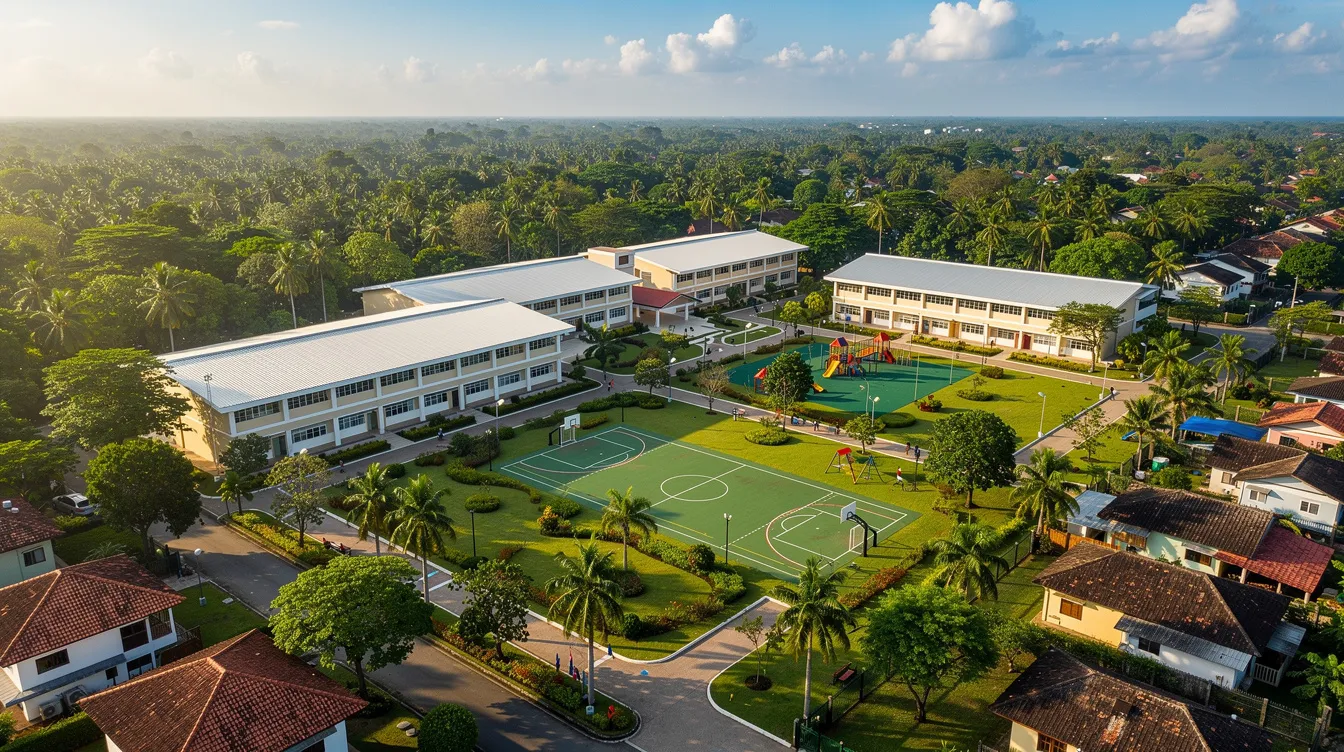
Ai Tong School is a Special Assistance Plan (SAP), government-aided primary school located at 100 Bright Hill Drive, Singapore 579646. Established in 1912 and granted SAP status in 1989, it is one of Singapore’s most respected Chinese-medium bilingual schools, known for its Higher Chinese curriculum, strong academic results, and broad CCA offerings.
Its location on Bright Hill Drive places it squarely within the Bishan–Upper Thomson education cluster, which also includes Catholic High School (Primary) and CHIJ St Nicholas Girls’ – making District 20 one of the densest concentrations of top-tier primary and secondary school options in Singapore. The school’s address is on the same road as Thomson Reserve, a point that becomes significant when we examine distance measurements below.
Recent P1 Registration Data and Oversubscription
Ai Tong School is consistently oversubscribed in P1 registration, particularly in Phase 2C. In 2025, all Phase 2C places at Ai Tong went to 1km applicants – specifically, 76 applicants within 1km balloted for 43 places. That represents roughly 1.8 applicants per available seat, and it meant families living in the 1–2km band had zero chance of entry at that phase.
This pattern has held across recent registration cycles. Ai Tong School is oversubscribed in Phase 2C registration year after year, and the data consistently shows that the 1km band absorbs all or nearly all available seats before the 1–2km group is reached. Even within 1km, parents still faced balloting – reinforcing that living within 1km gives priority in Phase 2C registration, but does not eliminate competition entirely.
This competitive context is exactly why parents eyeing Thomson Reserve need to understand whether the development genuinely falls inside that critical 1km ring.
Is Thomson Reserve Within 1km of Ai Tong School?
The answer is yes. Thomson Reserve’s site on Bright Hill Drive sits comfortably within Ai Tong’s 1km band based on current MOE distance maps and multiple independent data sources, with an estimated distance of approximately 520 metres from the school’s address.
Map View: 1km and 2km Rings Around Thomson Reserve
The maps below illustrate the school landscape around Thomson Reserve. The first shows a 1km radius ring centred on the development, with Ai Tong School clearly inside. The second expands to a 2km ring, revealing the broader education corridor that includes Catholic High (Primary), CHIJ St Nicholas Girls’, and several neighbourhood primary schools.
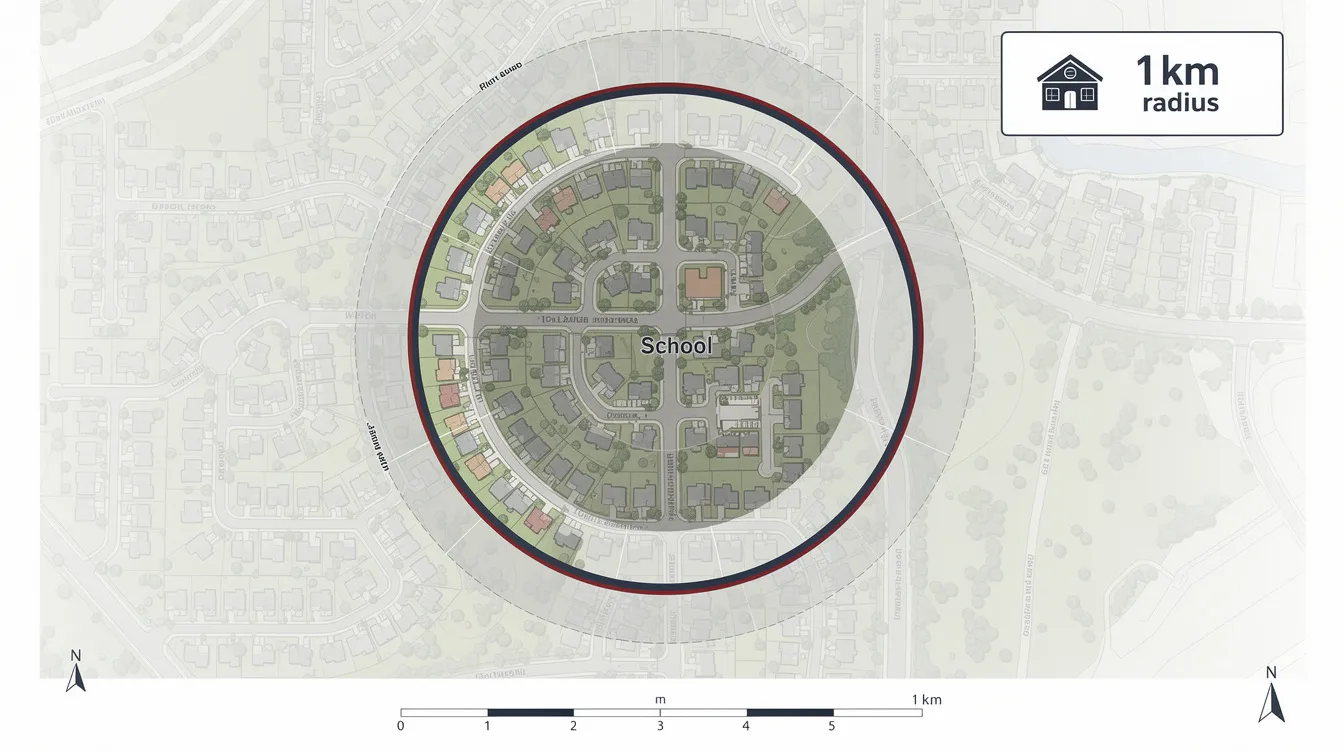
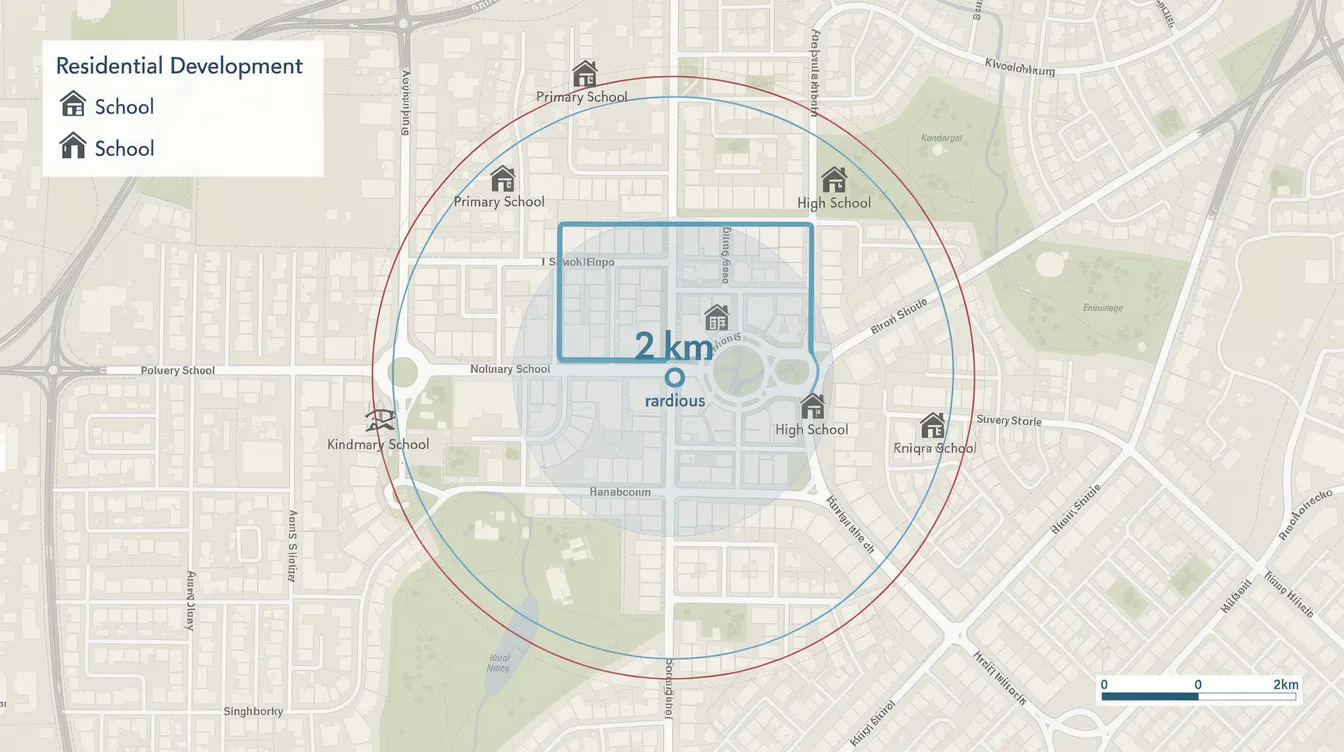
What these maps show is unambiguous: Thomson Reserve and Ai Tong School share the same Bright Hill Drive stretch, placing the development solidly inside the 1km ring. Catholic High and CHIJ St Nicholas Girls’ appear within the 2km ring at approximately 1.4km and 1.5km respectively, offering additional school options in the wider corridor.
Parents should cross-check these visual maps with MOE’s school finder or OneMap SchoolQuery for the specific registration year, as official geospatial data is the only authoritative source.
How MOE Confirms the 1km Status
To verify the 1km status officially, follow these steps:
-
Visit OneMap SchoolQuery at the SLA website and enter your Thomson Reserve postal code or address
-
Select Ai Tong School from the list of nearby schools
-
The tool will return your distance band classification (within 1km, 1–2km, or beyond 2km)
-
Repeat this check in the calendar year of your child’s actual P1 registration, as data is refreshed annually
MOE uses specific geospatial data tied to building outlines, not marketing addresses or unit-level positions. Once Thomson Reserve reaches completion, different blocks (1–11 Bright Hill Drive) will share the same development footprint but parents should use their eventual unit’s block and postal code for the most precise confirmation. Properties used for school admission must meet specific legal and verification criteria – a marketing brochure is helpful but not conclusive.
Thomson Reserve is the only new launch within 1km of Ai Tong for 2026, making it unique among current District 20 options for families prioritising this school.
Beyond 1km: The 2km Band and Other Primary Schools
Beyond Ai Tong, several primary schools fall within the 2km ring of Thomson Reserve based on 2026 data:
-
CHIJ St Nicholas Girls’ School (Primary) – approximately 1.4km, a mission school with strong academic standing
-
Catholic High School (Primary) – approximately 1.5km, another SAP school with a bilingual Chinese focus
-
Neighbourhood primaries in the Ang Mo Kio and Upper Thomson area offering less competitive registration odds
Being within 2km, while less decisive than 1km at Ai Tong, still offers improved odds compared to living farther away at these other schools. For families who want a safety net, the 2km schools form a broader education corridor that reinforces both schooling options and long-term property value. Think of Ai Tong as the flagship benefit, with the 2km cluster adding depth to the District 20 proposition.
What 1km Priority Means in Practice for Thomson Reserve Parents
With the 1km status confirmed, what does it actually change for a family living at Thomson Reserve and targeting Ai Tong for P1 between approximately 2031 and 2035?
Impact on Phase 2C and 2C(S) for Ai Tong
Living within 1km of Ai Tong School gives priority access in P1 registration at the most critical stage. In Phase 2C, your child competes only against other within-1km Singapore Citizens first. Only if seats remain after that group are 1–2km families considered – and at Ai Tong, recent data shows they rarely are.
Using 2025 as a benchmark: 76 applicants within 1km competed for 43 Phase 2C places. All places went to the 1km group. Had your address been at 1.1km, your child would not have been considered at all. Living at Thomson Reserve places you inside that decisive ring.
However, Permanent Residents within 1km may still lose out. Singapore Citizens receive priority over Permanent Residents for school admissions in every distance band – a PR family at Thomson Reserve ranks behind all SC families within 1km during balloting.
Which Families Benefit Most From Buying at Thomson Reserve
The ideal profile: Singapore Citizens with no strong alumni or volunteer affiliation to another school, with children born roughly 2025–2028. These children will reach P1 registration between approximately 2031–2034, aligning with Thomson Reserve’s expected completion (Notice of Vacant Possession in early 2031).
For alumni parents who already have Phase 2A access at Ai Tong or another school, the 1km benefit is less critical – their earlier-phase eligibility already provides priority. Similarly, families with strong ties to mission schools like Catholic High or Raffles Institution affiliates may not need the distance advantage.
Families with multiple young children can reuse the Thomson Reserve address across several P1 cycles, making the 1km priority more valuable over time. If you have two or three children spaced a few years apart, one property purchase covers multiple registration years.
How Long You Need to Live There Before P1 Registration
Residency requirements, typically of 30 months, apply for priority registration. MOE requires that the address used for P1 registration be your genuine, occupied residence for at least 30 months prior to registration. Providing a false address carries serious consequences, including withdrawal of the school place.
This means timing your purchase and move-in date is critical. Thomson Reserve’s expected TOP is early 2031. A child born in 2027 would register for P1 in mid-2033 and begin school in January 2034. Moving in by early 2031 provides approximately 30 months of residence before the 2033 registration window – tight but feasible.
For children born in 2025 or 2026, the timeline is tighter. Parents in this situation should plan to purchase early and move in immediately upon TOP to maximise their buffer. Buying at launch in 2026 and completing the 30-month residency by 2033 is achievable for most families, but leaves little margin for construction delays.
Step-by-Step P1 Planning for Ai Tong if You’re Eyeing Thomson Reserve
Theory is useful; a checklist is better. Here is a concrete planning sequence from property search through to P1 registration day.
From Property Search to Address Registration
-
Confirm your child’s birth year and P1 registration year. A child born in 2027 registers in mid-2033. Work backwards from that date to establish your timeline for purchase, move-in, and the 30-month occupation requirement.
-
Use OneMap SchoolQuery to confirm 1km status for your target stack or unit within Thomson Reserve. While the entire development is expected to fall within 1km, confirming with your specific block and postal code eliminates doubt.
-
Plan your purchase date relative to TOP and the 30-month rule. Purchasing at launch pricing in 2026 and receiving keys in early 2031 gives you roughly 30 months of occupation before a 2033 registration. Build in buffer for potential construction timeline shifts.
-
Register your address and move in with utilities and bills in your name. MOE may verify genuine occupancy. Utility accounts, town council correspondence, and NRIC address updates all serve as evidence.
-
Maintain documentation of genuine residence. Keep records of utility bills, renovation invoices, and any correspondence that proves continuous occupation at the Thomson Reserve address.
-
Consult a property advisor to clarify which stacks are closest to the school boundary and to compare Thomson Reserve against other condos within 1km of Ai Tong. Analyses and market trends are important for real estate decision-making, and an advisor can help you weigh education priority against financial fundamentals.
Choosing Between Ai Tong and Other Primary School Options
|
Factor |
Ai Tong School |
Catholic High (Primary) |
CHIJ St Nicholas Girls’ |
|---|---|---|---|
|
Distance from Thomson Reserve |
~520m (within 1km) |
~1.5km (1–2km band) |
~1.4km (1–2km band) |
|
School type |
SAP, Government-Aided |
SAP, Government-Aided |
Mission, Government-Aided |
|
Language focus |
Higher Chinese / English bilingual |
Higher Chinese / English bilingual |
English-medium with Chinese |
|
Oversubscription level |
Very high (consistently oversubscribed) |
High |
Moderate to high |
|
P1 distance advantage from Thomson Reserve |
Maximum (1km band) |
Moderate (2km band) |
Moderate (2km band) |
For most Mandarin-focused families living at Thomson Reserve, Ai Tong will likely remain the first-choice application. The 1km advantage there is strongest, and the SAP bilingual environment aligns with families who value Chinese-language education. However, parents should maintain a backup list – particularly Catholic High and CHIJ St Nicholas Girls’ – in case Ai Tong’s Phase 2C ballot does not go their way. High-demand primary schools may have oversubscription during registration at any of these schools, so diversifying your planning is prudent.
Common Parent Concerns and How to Address Them
Even with 1km priority and a promising new development like Thomson Reserve, uncertainty lingers. Here are the questions parents most frequently raise.
“Does 1km Guarantee My Child a Place at Ai Tong?”
No. Living within 1km gives priority in registration but does not guarantee admission. Balloting occurs when applicants exceed available school places, and at Ai Tong, even the within-1km group has seen more applicants than seats. In 2025, 76 applicants within 1km balloted for 43 places – meaning roughly 33 families within 1km did not secure a spot in Phase 2C.
The 1km band is a significant advantage, not a certainty. Parents should mentally prepare alternative choices and register for Phase 2C(S) or consider other schools in the 2km corridor if the Phase 2C ballot is unsuccessful.
“What If MOE Changes the Distance Rules or Boundaries?”
MOE has historically evolved its P1 registration framework gradually and with advance notice. Recent changes – such as increasing Phase 2C reserved places and introducing a “two-track” Phase 2C at 12 highly oversubscribed schools – were announced well before implementation. Home-school distance is one of several factors in the admission process for schools, and while the weighting can shift, wholesale removal of distance-based priority would represent a major policy overhaul.
For practical mitigation: check MOE’s announcements annually, verify your distance band using official tools each registration year, and ensure the property also works for your family’s lifestyle and budget beyond school-access reasons. If Ai Tong were ever added to the two-track school list, the difference between 1km and 2km priority could narrow – but as of 2026, Ai Tong is not among those 12 schools.
“Is It Rational to Pay a Premium Just for School Proximity?”
Market data consistently shows that condos within 1km of top schools command 3–8% price premiums compared to otherwise similar developments further away. For a property like Thomson Reserve – which is the only new launch within 1km of Ai Tong for 2026 – this premium is embedded in both launch pricing and expected resale value.
Many family buyers find this worthwhile because the premium serves double duty: it supports education access during the ownership period and is recoverable (often with appreciation) upon resale to the next generation of parents seeking the same school proximity. That said, parents should run straightforward affordability and exit-scenario calculations before committing to a higher PSF purely for school access. An advisor experienced in District 20 can help model these scenarios against your household finances.
Conclusion and Next Steps
Ai Tong School is within 1km of Thomson Reserve – approximately 520 metres by straight line distance on the same Bright Hill Drive corridor. For most families targeting Ai Tong, this address offers a clear, data-backed P1 priority advantage in Phase 2C and 2C(S), where registration phases impact priority for school admission based on distance. It is not a guarantee, but in a school where all Phase 2C places have gone to 1km applicants in recent years, being inside that ring is the single most impactful geographic factor a parent can control.
Your next steps:
-
Verify 1km status via OneMap SchoolQuery using Thomson Reserve’s postal code for your child’s specific registration year
-
Map your child’s birth year against P1 registration timing and Thomson Reserve’s expected TOP in early 2031 to confirm you can meet the 30-month occupation requirement
-
Compare Thomson Reserve to other condos in the Ai Tong 1km zone – noting that Thomson Reserve is the only new launch option in this band for 2026
-
Consult a property advisor to align your property choice with both education goals and investment fundamentals
AESTHETIC HAVENS can help parents evaluate Thomson Reserve versus other District 20 options from both an education-priority and investment-return perspective. If you’re beginning your search, reach out for a personalised comparison across the Ai Tong 1km corridor.
Additional Resources for Parents Planning Around Ai Tong
-
MOE P1 Registration page – official schedule, phases, and rules updated annually
-
OneMap SchoolQuery – the only authoritative tool for confirming your home–school distance band
-
Ai Tong School official website – school information, CCA listings, and contact details
-
MOE SchoolFinder – search and compare primary schools by location and programme
-
Thomson Reserve key facts and site details – development specifications, unit mix, and construction timeline
Parents should always defer to MOE and school websites for the latest registration and distance information. This guide is planning support – not legal or admissions advice. Registration phases, distance bands, and school capacities can change, and only official sources reflect the rules applicable to your child’s specific P1 year.


