


Yes, you can buy a private condominium unit in Singapore as a foreigner, and in most cases you will not need prior government approval to do it. The three things that actually decide whether a purchase goes smoothly are the property’s legal classification under the Residential Property Act, the Additional Buyer’s Stamp Duty you will owe, and whether a lender will approve your financing under MAS rules.
TL;DR:
- Confirm the unit’s legal classification through the approved plan and title documents before signing; a sales label alone cannot establish condominium status.
- Landed homes and most strata landed units outside approved developments require approval; restricted leases, including renewals, are exempt for up to seven years.
- Pay BSD within 14 days of signing, or 30 days if signed overseas; eligible nationals may apply for an ABSD remission, which is not automatic.
- Secure in principle loan approval before signing: TDSR counts existing overseas debt and uses a stressed interest rate, while lenders may require more cash upfront.
- Owners who rent out a unit should check mortgage consent terms and budget for annual property tax plus Singapore income tax on rental earnings.
Table of Contents
- Which property types can foreigners buy without approval?
- When do foreigners need RPA approval, and what happens if you skip it?
- What stamp duties will you pay as a foreign condo buyer?
- How do MAS financing rules affect what you can borrow?
- What’s the realistic buying timeline and total cost?
- How does working with a local consultant change the process?
- What are the rules on leasing out a foreign-owned condo?
- Are there ownership quotas in specific developments?
- Does foreign buyer activity affect valuation and resale?
- What documents does a foreign buyer need at closing?
- What taxes apply after you own the condo?
- Why the paperwork matters more than the purchase price
- Get hands-on help with your condo purchase in Singapore
- FAQ
- Sources
Which property types can foreigners buy without approval?
Private, non-landed condominium units sit in the category the Singapore Land Authority treats as open to foreign buyers without prior approval. This covers standard high-rise condo units and most strata-titled apartments inside developments that carry proper condominium status. Some strata-landed homes inside approved condominium developments also qualify, but this is where buyers get tripped up.
“Condominium” is frequently a marketing label developers attach to a project for appeal, not a legal classification. A building branded as a condominium in its sales materials is not automatically one in the eyes of the law. SLA guidance points buyers toward verifying the development’s approved plan rather than trusting a brochure.
Before you commit to a unit, confirm its status through a few concrete steps:
- Check whether the development appears on an approved plan carrying the title “condominium” with SLA.
- Request the title documents and tenure details from the seller’s agent or developer.
- Ask your conveyancing lawyer to confirm the unit’s classification before you sign an Option to Purchase.
- Review SLA’s FAQ pages for mixed-use Commercial and Residential properties if the project includes retail or office components.
When do foreigners need RPA approval, and what happens if you skip it?
Certain residential property types fall outside the “non-restricted” category and require approval from the Controller of Residential Property before a foreigner can acquire them. These include landed houses (terraces, semi-detached and bungalows), strata-landed homes outside developments approved as condominiums, and properties in Sentosa Cove that carry landed status. The Residential Property Act gives the Controller and the Minister power to demand divestment and to impose fines when a foreign person acquires a restricted property without approval.
Approval applications are realistic mainly for landed homes bought for owner occupation, and they are assessed case by case rather than granted as a matter of course. Buying first and seeking forgiveness later is not a workable strategy here: the law gives the Controller the power to order a sale.
One useful exception exists: the Residential Property Act permits a foreign person to acquire a restricted property under a lease of up to seven years, including renewal options, without needing prior Ministerial approval. This gives some foreign buyers a legal route to occupy a landed property for a defined term without going through the full approval process.
Before assuming a project qualifies for an exception, verify it against:
- The property’s classification on its title deed, not its marketing name.
- Whether any lease structure proposed by the seller actually falls within the seven-year threshold.
- Whether Sentosa Cove or other special zones apply different rules to the specific unit.
What stamp duties will you pay as a foreign condo buyer?
Every property buyer in Singapore pays Buyer’s Stamp Duty, calculated on a tiered scale against the purchase price or market value, whichever is higher. BSD must be stamped and paid within 14 days of signing the contract (or within 30 days if the document was signed overseas), and missing this window brings penalties.
On top of BSD, foreigners face the Additional Buyer’s Stamp Duty, and this is where costs rise sharply. IRAS) sets ABSD rates by buyer profile, and foreigners are charged at a substantially higher rate than Singapore Citizens or Permanent Residents purchasing their first property. A partner resource lays out current ABSD rates and worked examples if you want to see how the duty applies across different buyer profiles.
Nationals of certain Free Trade Agreement countries may qualify for an ABSD remission, which can bring their rate down to match that of a Singapore Citizen, according to IRAS guidance on FTA remissions. This is not automatic.
- Confirm your nationality appears on the IRAS list of FTA-eligible countries.
- Apply for the remission through the myTax portal with the required supporting documents.
- Submit the application within the timeframe IRAS specifies, since late applications risk losing the remission.
How do MAS financing rules affect what you can borrow?
The Monetary Authority of Singapore requires banks to apply a Total Debt Servicing Ratio framework when assessing property loans, a guardrail against borrowers taking on more debt than they can service. Lenders calculate your monthly debt obligations, including the new mortgage, against your gross income and apply a stress-test interest rate rather than the quoted rate, which lowers the loan amount many buyers qualify for.
For foreign buyers specifically, banks tend to apply these checks more conservatively, and they typically ask for:
- Proof of income that satisfies Singapore tax residency or foreign income verification standards.
- A larger cash buffer or higher down payment than a local buyer might need.
- Documentation addressing currency risk if your income is earned outside Singapore dollars.
- Evidence of any existing loans, including overseas mortgages, that count toward your TDSR.
Pro Tip: Get an in-principle loan approval before you sign an Option to Purchase, and flag any existing loan commitments early so your TDSR calculation reflects reality rather than a surprise during underwriting.
What’s the realistic buying timeline and total cost?
A foreign buyer’s purchase typically moves through a set sequence, and skipping a step tends to cost money later.
- Verify the unit’s title and classification with your lawyer before making an offer.
- Secure in-principle loan approval so your budget reflects actual lending capacity.
- Sign the Option to Purchase and pay the option fee.
- Exercise the option within the agreed period and pay the deposit balance.
- Stamp the document and pay BSD and ABSD within the statutory deadline.
- Engage a conveyancing lawyer to lodge a caveat and manage the transfer.
- Complete the purchase, settle outstanding balances, and take possession.
Budget for more than just the purchase price:
- Down payment, shaped by your loan-to-value limit and whether ABSD financing is bundled in.
- Legal and conveyancing fees for title searches, contract review, and caveat lodgment.
- BSD and ABSD, due within strict deadlines after signing.
- Valuation gaps, where the bank’s valuation comes in below the agreed price, requiring extra cash.
A practitioner guide on avoiding stamp duty penalties walks through the deadlines that trip up buyers most often, particularly around Option to Purchase versus Sale and Purchase Agreement stamping. For a broader review of what to check before any offer, our due diligence checklist for Singapore buyers is worth reading alongside this section.
How does working with a local consultant change the process?
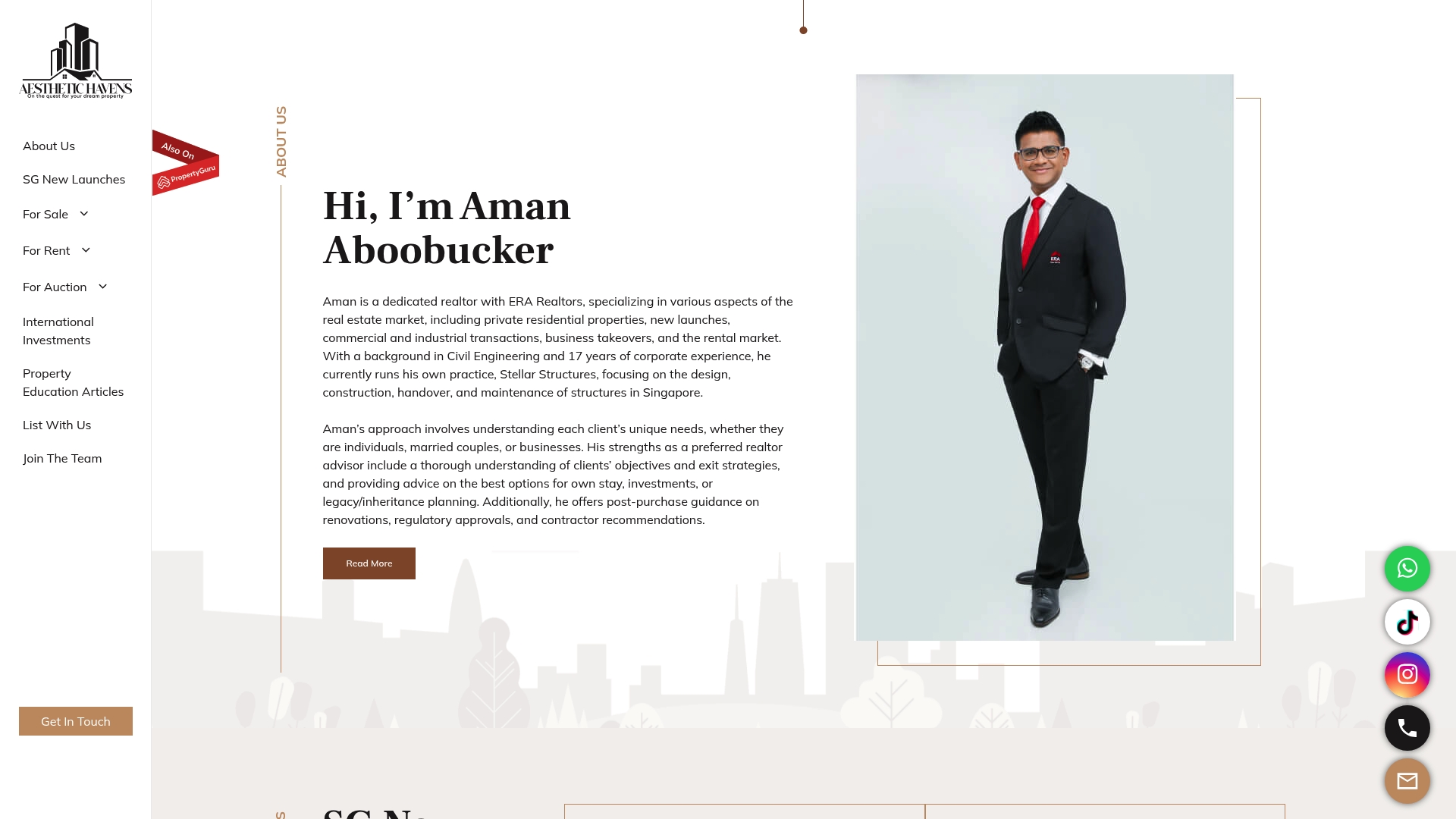
Aman Aboobucker, operating under ERA Realtors through Aesthetic Havens, works across engineering and real estate backgrounds to guide foreign buyers through title verification, ABSD and BSD calculations, and financing coordination. We support this process with a few services aimed squarely at the friction points foreign buyers run into:
- Title and approved-plan verification before an offer is made.
- Coordination with conveyancing lawyers on stamping deadlines and caveat lodgment.
- Guidance on ABSD exposure and whether an FTA remission applies.
- Liaison with lenders to clarify TDSR impact before a loan application is submitted.
Two patterns show up often: buyers who assume a “condominium” label settles the legal question, and buyers who underestimate how an existing overseas loan affects their TDSR once a Singapore bank runs the numbers.
What are the rules on leasing out a foreign-owned condo?
Foreign owners of private condominium units can lease them out, and the rules here are more relaxed than the restrictions on purchase itself. Most private residential leases run for terms agreed between landlord and tenant, commonly one or two years, though the market and individual landlords set these terms rather than a fixed statutory minimum for private condos.
Landlords, foreign or local, carry standard obligations: registering the tenancy where required, maintaining the unit to a habitable standard, and ensuring the lease agreement complies with general contract law. Where a condo sits within a development that has specific house rules (short-term rental bans, for instance), those rules bind the owner regardless of nationality.
A foreign owner renting out a unit should also account for the income tax treatment of rental earnings, covered further below, and should check whether their mortgage terms impose any restriction on subletting. Some loan agreements require the bank’s consent before a unit is leased out, so this is worth confirming with your lender rather than assuming it is unrestricted.
For a fuller breakdown of lease structures, notice periods, and landlord duties across the private market, our guide to property leasing in Singapore covers the mechanics in more depth.

Are there ownership quotas in specific developments?
Unlike some markets that cap the share of units a foreign-owned company or group can hold in a single building, Singapore’s private condominium market does not impose a blanket foreign ownership quota on individual developments. A foreigner buying a non-landed unit in an approved condominium project faces the same purchase process regardless of how many other units in that building are foreign-owned.
The quota-style restriction that does exist applies at the category level rather than the building level: landed housing, Sentosa Cove properties, and strata-landed developments outside approved condominium status are restricted categories requiring Controller approval, as covered earlier. Within the non-restricted condominium category, there is no per-project cap on foreign buyers.
Some executive condominiums (ECs) carry their own eligibility rules tied to citizenship and income during the initial minimum occupation period, which function differently from a quota but achieve a similar restriction in practice during that window. Once an EC passes its tenth year, it is treated as a private condominium and these citizenship-linked restrictions fall away, opening resale units to foreign buyers on the same basis as any other private condo.

Does foreign buyer activity affect valuation and resale?
Foreign demand plays a role in pricing dynamics in certain segments, particularly in districts popular with expatriates and international investors, such as the prime central region. A development with strong foreign buyer interest can see valuations hold up differently during a cooling measure cycle compared with one dependent mostly on local demand.
For resale, a foreign-owned unit sells through the same process as any other private condo. There is no additional approval step for a foreign owner to sell, and the buyer’s own nationality and ABSD exposure, not the seller’s, determine the stamp duty on the next transaction. What does matter at resale is pricing realistically against bank valuations, since a foreign buyer’s financing is also subject to TDSR limits and LTV caps that can narrow the pool of qualified buyers at a given price point.
Owners planning an eventual exit should also factor in Seller’s Stamp Duty if they sell within the holding period that applies at the time, since this duty applies regardless of the seller’s nationality and can meaningfully affect net proceeds on a short holding period.
What documents does a foreign buyer need at closing?
Closing a condo purchase as a foreigner follows the same legal process as any private transaction, but with a few extra verification steps layered in. Expect to provide:
- A valid passport and, where relevant, employment pass or long-term visit pass details for identity verification.
- Proof of funds for the down payment, often including bank statements showing the source of funds.
- Loan approval documents from your financing bank, including the letter of offer.
- The signed Option to Purchase and, once exercised, the Sale and Purchase Agreement.
- Stamp duty payment confirmation for both BSD and ABSD, lodged through the stamping system.
Your conveyancing lawyer typically handles title searches, caveat lodgment, and the final completion statement that reconciles the purchase price against deposits, loan proceeds, and stamp duties paid. Foreign buyers sometimes need additional time here if supporting documents (income proof, overseas bank statements) require translation or certification, so building in extra lead time before your completion date is worth doing rather than assuming a standard local timeline will fit.
What taxes apply after you own the condo?
Once you own a condo in Singapore, two recurring tax obligations apply regardless of your nationality: property tax and income tax on any rental income. Property tax is charged annually on the Annual Value of the unit, with owner-occupied and non-owner-occupied rates differing, and non-owner-occupied rates (which apply to most foreign-owned investment units) sit higher than owner-occupied rates.
If you rent the unit out, the rental income is taxable in Singapore under income tax rules, with allowable deductions for expenses like mortgage interest, property tax paid, and maintenance costs. Foreign owners who are not tax resident in Singapore are taxed on Singapore-sourced rental income at the prevailing non-resident rate, and the obligation to declare this income exists whether or not you live in Singapore yourself.
These ongoing obligations sit on top of the one-time BSD and ABSD paid at purchase, so a full cost picture for a foreign buyer includes acquisition duties, recurring property tax, and income tax on any rental yield, not just the headline purchase price.
Why the paperwork matters more than the purchase price
Most foreign buyers fixate on the purchase price and the ABSD line item, and both matter, but the research behind this guide points to a different conclusion: the biggest risk sits in classification and timing, not in the headline numbers. A buyer who confirms title status, FTA eligibility, and TDSR impact before signing an Option to Purchase avoids nearly every costly mistake this guide covers. A buyer who skips that sequence and trusts a sales brochure’s description of “condominium” status is the one who ends up facing a divestment notice or a financing shortfall discovered too late to fix cheaply.
Conventional advice tends to treat ABSD as the main obstacle for foreign buyers, when in practice it is a known, calculable cost you can plan around months in advance. The harder problem is verification: confirming a unit’s legal classification, checking FTA remission eligibility against the exact rules in force at the time of purchase, and getting a real loan pre-approval rather than an informal estimate. Prioritize those three checks before you fall in love with a unit, and the rest of the process becomes administrative rather than risky.
— Aman
Get hands-on help with your condo purchase in Singapore
Working through title verification, ABSD exposure, and financing liaison on your own is doable, but it takes time most foreign buyers evaluating a Singapore purchase from overseas simply do not have. We offer support services built around exactly these steps, assisting with coordination between conveyancing, lenders, and the paperwork that closes a deal.
An initial consultation typically covers your target property type, budget, and financing position, then provides guidance on approvals or remissions that might apply to your case. Start by reviewing our residential listings or reach out through our main site to set up a conversation.
This article is general information, not a substitute for advice from a qualified financial advisor. Consult a qualified financial professional about your own circumstances before acting on anything here.
FAQ
Can foreigners buy property in Singapore?
Foreigners can buy private, non-landed condominium units in Singapore without prior approval, but landed houses, most strata-landed homes outside approved condominium developments, and Sentosa Cove properties require approval under the Residential Property Act. Foreign buyers also pay a higher Additional Buyer’s Stamp Duty rate than citizens or permanent residents under IRAS rules.
What salary is needed to live comfortably in Singapore?
There is no official published salary threshold for comfortable living in Singapore, since it depends heavily on housing choice, lifestyle, and whether you are supporting a family. For a property purchase specifically, your effective income needs to support a mortgage within the TDSR limits your bank applies, which an in-principle loan assessment can clarify for your situation.
What are the new EC rules?
Executive condominiums carry citizenship and income eligibility rules tied to citizenship status during their initial minimum occupation period, which restricts purchase mostly to Singapore Citizens and Permanent Residents in that window. After ten years, an EC converts to full private condominium status, and foreign buyers can purchase resale units on the same basis as any other private condo.
Can a married couple own 1 HDB and 1 condo?
A married couple can own one HDB flat and one private condo unit at the same time, subject to HDB’s own ownership rules on the flat and standard ABSD treatment on the condo purchase depending on the buyers’ profiles. Foreign spouses in a mixed-nationality couple should check their specific ABSD liability with IRAS guidance before finalizing the purchase structure.
Sources
- Foreign ownership of property | Singapore Land Authority
- Residential Property Act – Singapore Statutes Online


