


Additional Conveyance Duties apply when you buy or sell equity in a Singapore property-holding entity that mainly owns residential property, and you cross the 50%/basics-of-stamp-duty-for-property-holding-entities/determining-the-additional-conveyance-duties-payable) significant-owner threshold. If you are the buyer, you likely face ACDB, which stacks Buyer’s Stamp Duty and an ABSD component on top of the normal share price. If you are the seller, ACDS can apply at rates that shrink the longer you have held the equity, unless the transfer was made under a will.
TL;DR:
- Additional conveyance duties are triggered when buying or selling more than 50% of a property-holding entity that mainly owns residential property in Singapore, based on property value and ownership thresholds.
- Duties are calculated on the market value of the underlying residential property at the time of transfer, proportional to the equity transferred, not on the negotiated share price.
- Transfers under a will or by declaration of trust generally avoid ACD, but trust or entity structures, including JV deals or electronic share transfers, can still trigger duties if thresholds are met.
- Failing to file on time or misjudging the property’s residential value can lead to penalties, back duties, and penalties, especially if IRAS revisits the significant-owner or property-holdings tests.
- Buyers should verify property and ownership thresholds beforehand with professional valuation and document everything properly to avoid costly assessments and penalties later.
Table of Contents
- What Additional Conveyance Duties Are and How to Tell If Your Deal Qualifies
- How Additional Conveyance Duties Are Calculated and What Rates Apply
- Trusts, Scripless Shares, and JV Deals: Where People Get Caught Out
- Which Documents Attract Duty and How to File or Seek Remission
- A Pre-Closing Checklist for Buyers, Sellers, and Trustees
- How Aesthetic Havens Helps Clients Navigate ACD Exposure
- How ACD Interacts With Other Stamp Duties You Already Owe
- Why the Rules Have Kept Shifting Since 2017
- Transfers That Fall Outside the ACD Net
- Two Worked Examples That Show How the Numbers Actually Move
- What Happens If You File Late or Get the Calculation Wrong
- How Payment and Remission Applications Actually Work
- Why ACD Changed How Serious Investors Structure Deals
- Where to Verify the Rules Yourself
- Sources
- FAQ
What Additional Conveyance Duties Are and How to Tell If Your Deal Qualifies
ACD exists to close a gap that used to let people dodge residential stamp duty simply by trading company shares instead of the property title itself. IRAS defines it as duty on qualifying acquisitions or disposals of equity interests in property-holding entities that own mostly residential property in Singapore, whether you are buying in or selling out.
Two tests decide whether your transaction is caught:
- Property-holding entity (PHE) test: the entity’s residential property makes up at least 50% of its total tangible assets, based on the last accounts before the transaction.
- Significant owner test: you (alone or together with associates such as spouses, related companies, or family trusts) hold or will hold at least 50% of the equity interest or voting power.
An SPV holding one Sentosa Cove bungalow is a PHE. A property fund holding a mixed portfolio of an office tower and two condo units generally is not, unless the residential slice tips past half its asset base. The associate rules are broader than most people expect. Splitting shares across a spouse, a sibling, and a private company you control does not defeat the 50% test if IRAS treats those parties as associates.
Timing matters too. The regime only bites transactions on or after March 11, 2017, and separate holding-period rules determine whether seller duty applies at all.
How Additional Conveyance Duties Are Calculated and What Rates Apply
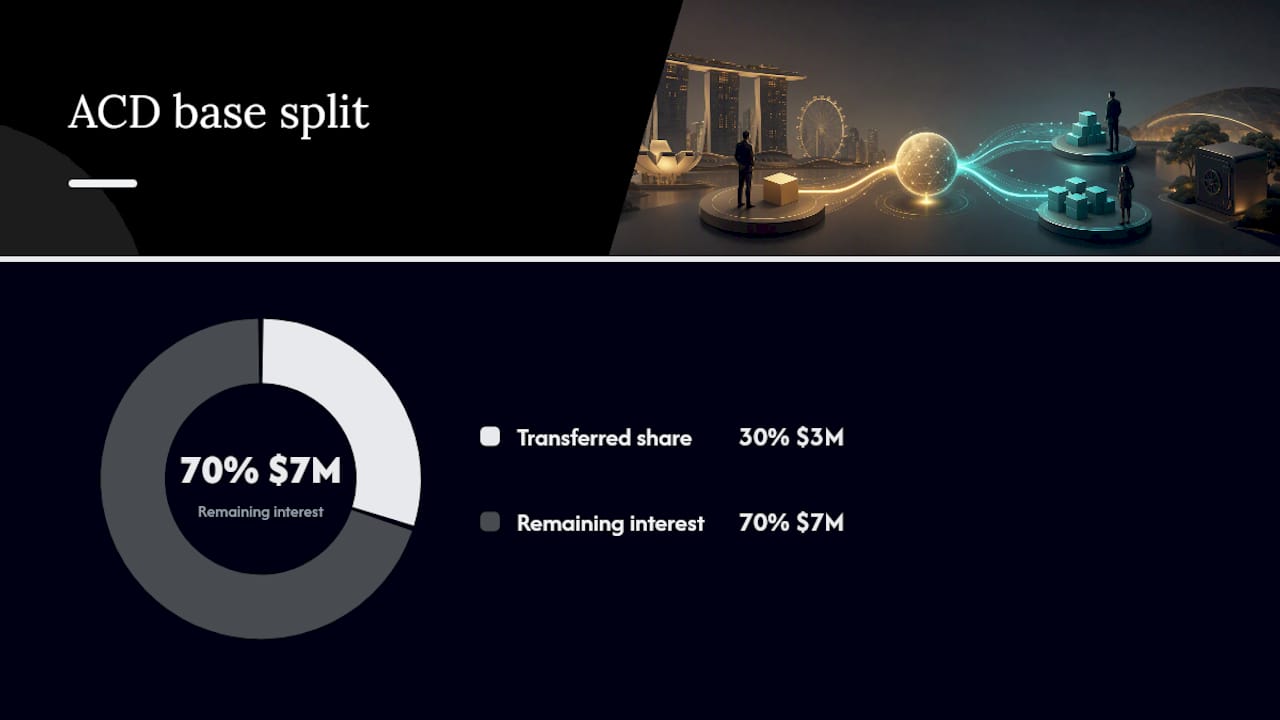
ACD is never charged on the share price you negotiate. IRAS calculates it on the market value of the PHE’s underlying residential property at the time of the deal, then prorates that figure by the percentage of beneficial interest actually changing hands. Buy 30% of the shares in an entity holding a $10 million bungalow, and your ACD base is $3 million, not the price you paid for your stake.
Mixed-use buildings need an extra step: apportioning the residential floor area against the total, usually through a professional valuation, before applying the rate.
The duty itself has two faces:
- ACDB (buyer’s side): Buyer’s Stamp Duty plus an ABSD component, with the ABSD portion often the larger chunk of the bill.
- ACDS (seller’s side): rates that track the top Seller’s Stamp Duty band for the applicable holding period.
Pro Tip: Run the numbers on the residential value, not the share price, before you sign anything. Buyers routinely underestimate ACDB because they anchor on what they’re paying for the shares rather than what the underlying property is worth.
Transfers executed under a will, or by way of assent to a beneficiary, are not chargeable with ACD at all, which matters enormously for estate planning.
Trusts, Scripless Shares, and JV Deals: Where People Get Caught Out
1. Living trusts and ACD(Trust). The Stamp Duties (Amendment) Bill introduced ACD(Trust) so that moving PHE equity into a living trust can trigger buyer-side ACD when the trustee ends up as a significant owner. Trustees, and in some scenarios beneficiaries, can be held liable. Anyone buying property under a trust structure in Singapore needs this checked before, not after, settlement.
2. Scripless shares. Electronic transfers through CDP still count as dutiable instruments. The duty exposure is identical to paper share certificates; only the filing mechanics differ.
3. JV and SPV transfers. Bringing in a joint-venture partner who acquires 50% or more of an SPV’s equity typically crosses the significant-owner line and triggers ACDB on the residential value, even though no property title moves. Some developer arrangements qualify for remission, but that has to be applied for, not assumed.
4. Mortgagee sales. If a bank forces a sale of PHE shares pledged as security, the original mortgagor can still owe ACDS if they were a significant owner within the relevant holding period. Losing control in a forced sale does not erase the duty clock.
Which Documents Attract Duty and How to File or Seek Remission
Duty attaches to the instrument, not the handshake. Chargeable documents include the sale and purchase agreement, share transfer instrument, deed of gift, deed of settlement, and any declaration of trust, whether signed on paper or executed electronically through CDP.
Duty becomes chargeable on the earlier of the date the contract is signed or the date the transfer instrument is executed, so waiting for completion to start paperwork is a common mistake. Keep dated copies of every agreement; IRAS assesses against the document date, not the closing date.
- Contracts and options to purchase
- Share transfer forms and CDP instructions
- Deeds of gift or settlement
- Declarations of trust
For rescinded agreements, a refund window of up to six months from the date of stamping typically applies, provided you can show the deal genuinely fell through with supporting termination documentation.
Pro Tip: Hold on to valuation reports, board resolutions, and shareholder registers going into the deal. When IRAS queries a residential-component calculation or an associate test months later, those documents are what save you from a reassessment.
Buyers dealing with the ABSD layer inside ACDB should also review how ABSD rates, rules, and exemptions apply to their specific entity structure.
A Pre-Closing Checklist for Buyers, Sellers, and Trustees
- Confirm PHE status first. Pull the entity’s last set of accounts and check whether residential property exceeds 50% of tangible assets.
- Run the significant-owner math, including associates. Map out spouses, related companies, and family members before assuming a split structure avoids the threshold.
- Commission a valuation for mixed-use assets. Get the residential component apportioned by a professional valuer, not estimated internally.
- Prepare and date every dutiable document properly, and file within the standard stamping window to avoid late penalties.
- Request a Commissioner’s opinion for genuinely ambiguous SPV or JV structures before you close, rather than after IRAS raises questions.
Pro Tip: If you’re a trustee handling a family transfer, treat the significant-owner test as a moving target. A later distribution or share reallocation inside the trust can flip an entity’s PHE status without anyone signing a new sale agreement.
Legal fees and conveyancing timelines for these transactions differ from a standard resale purchase; see this breakdown of legal fees and conveyancing costs for private property in Singapore.
How Aesthetic Havens Helps Clients Navigate ACD Exposure
Aman Aboobucker at Aesthetic Havens works with clients across trust transfers, SPV equity deals, and estate structuring where ACD exposure is easy to miss until the stamp bill arrives. The firm’s property valuation and asset progression advisory services help clients model residential-component values and significant-owner scenarios before signing. Complex trust or JV structures still call for a conveyancing lawyer or tax adviser alongside your property consultant.
How ACD Interacts With Other Stamp Duties You Already Owe
ACD rarely arrives alone. When you buy PHE equity as a significant owner, ACDB adds Buyer’s Stamp Duty and an ABSD component to whatever duty the underlying transaction structure already generates, meaning the effective rate stacks rather than substitutes. This differs sharply from jurisdictions like the United Kingdom, where Stamp Duty Land Tax applies directly to property transfers and share-based structures face separate, generally lighter Stamp Duty Reserve Tax treatment. Singapore closed that structural gap deliberately: ACD was built to match the duty burden of a share deal to what a direct property purchase would have cost.
Singapore also has no capital gains tax, so sellers of PHE equity are not weighing ACDS against a CGT bill the way a UK or Australian seller might weigh SDLT against capital gains. That makes ACDS the primary tax lever on the seller’s side of these deals, rather than one of several competing charges. Income tax exposure is a separate question entirely; if IRAS deems your property trading activity to be a business rather than a passive investment, gains can be taxed as income regardless of what ACD already collected. Buyers and sellers structuring an equity deal should treat ACD, income tax characterization, and existing entity-level property tax as three separate checks, not one combined calculation.
Why the Rules Have Kept Shifting Since 2017
The regime has not stood still since its March 2017 introduction. The original framework targeted direct qualifying acquisitions and disposals of PHE equity, but lawmakers identified a further gap: equity moved into living trusts as an estate-planning device could sidestep the significant-owner test entirely, because a trustee’s holding was not automatically treated as ownership. The Stamp Duties (Amendment) Bill closed that gap with ACD(Trust), extending duty to equity transfers held by trustees under specified conditions.
Holding-period rules feeding into ACDS have also moved. The Ministry of Finance extended the Seller’s Stamp Duty holding period-and-higher-ssd-rates-for-residential-properties) and raised SSD rates for residential properties, and because ACDS is pegged to the prevailing top SSD rate within the holding period, that change flowed straight through to sellers of PHE equity too. Anyone relying on an older holding-period figure from a pre-2025 article is likely working from outdated numbers; check the SSD holding-period rules for the current 3-year versus 4-year regime before estimating exposure. The pattern is consistent: each amendment has narrowed avoidance routes rather than widened relief, so treat any online estimate older than the latest legislative round with caution.
Transfers That Fall Outside the ACD Net
Not every PHE equity movement gets taxed. Transfers executed under a will or by way of assent to a beneficiary are not chargeable with ACD, a carve-out that matters enormously for families passing shares down after a death rather than during lifetime planning.
Entities that fail the PHE test outright also sit outside the regime. If residential property makes up less than half the tangible assets on the books, the acquisition or disposal of its equity never triggers ACD, regardless of how large the transaction is. This is why commercial-heavy or industrial-heavy holding companies with a small residential sideline rarely need to worry about this duty at all.
Transactions that never cross the significant-owner threshold are similarly exempt. Buying 20% of the shares in a PHE, with no associate relationships pushing your effective stake past 50%, keeps you outside ACDB entirely, even though the entity itself clearly qualifies as a PHE.
Genuine intra-family gifting still generally attracts ACD if it moves a significant-owner stake outside the will/assent exception, so a lifetime gift of shares is not automatically safe just because no money changes hands.
Two Worked Examples That Show How the Numbers Actually Move
No ACDB applies, even though the entity is unmistakably a PHE holding residential property.
Neither spouse crossed 50% individually, but the aggregated test caught them anyway.
Example 3: Trust transfer. A property-holding entity’s shares are settled into a living trust for the benefit of adult children, with a corporate trustee taking legal title. If the trustee’s resulting holding meets the significant-owner threshold, ACD(Trust) can apply to that settlement even though no money changed hands and no third-party buyer exists. This is the scenario families most often get wrong, because they treat it as pure estate planning rather than a dutiable conveyance event.
What Happens If You File Late or Get the Calculation Wrong
Late stamping carries financial penalties that scale with how long the duty goes unpaid, on top of the duty itself. Filing after the deadline is treated the same as underpaying: IRAS charges the outstanding amount plus a penalty, and the penalty grows the longer the account stays open.
Getting the significant-owner calculation wrong, whether by missing an associate relationship or misjudging the PHE test, creates a different kind of risk. If IRAS later determines that ACD should have applied and did not, the assessment can be reopened with back duty plus penalties, sometimes years after the transaction closed. This is precisely why the associate rules deserve real diligence before signing rather than a quick mental check.
Understating the residential component in a mixed-use valuation carries the same exposure. If a later review finds the true residential share of the asset base was higher than what was declared, the shortfall in duty becomes payable retroactively, with penalties attached. Trustees face a particular version of this risk under ACD(Trust): because liability can extend to the trustee personally in specified circumstances, an incorrect filing is not just a company problem, it can become the trustee’s problem directly.
Deliberate underdeclaration, as opposed to a genuine error, exposes the filer to more serious consequences under the Stamp Duties Act, including the possibility of prosecution in egregious cases. The safer path in any ambiguous structure is requesting a Commissioner’s opinion before filing, not defending a position after an audit begins.
How Payment and Remission Applications Actually Work
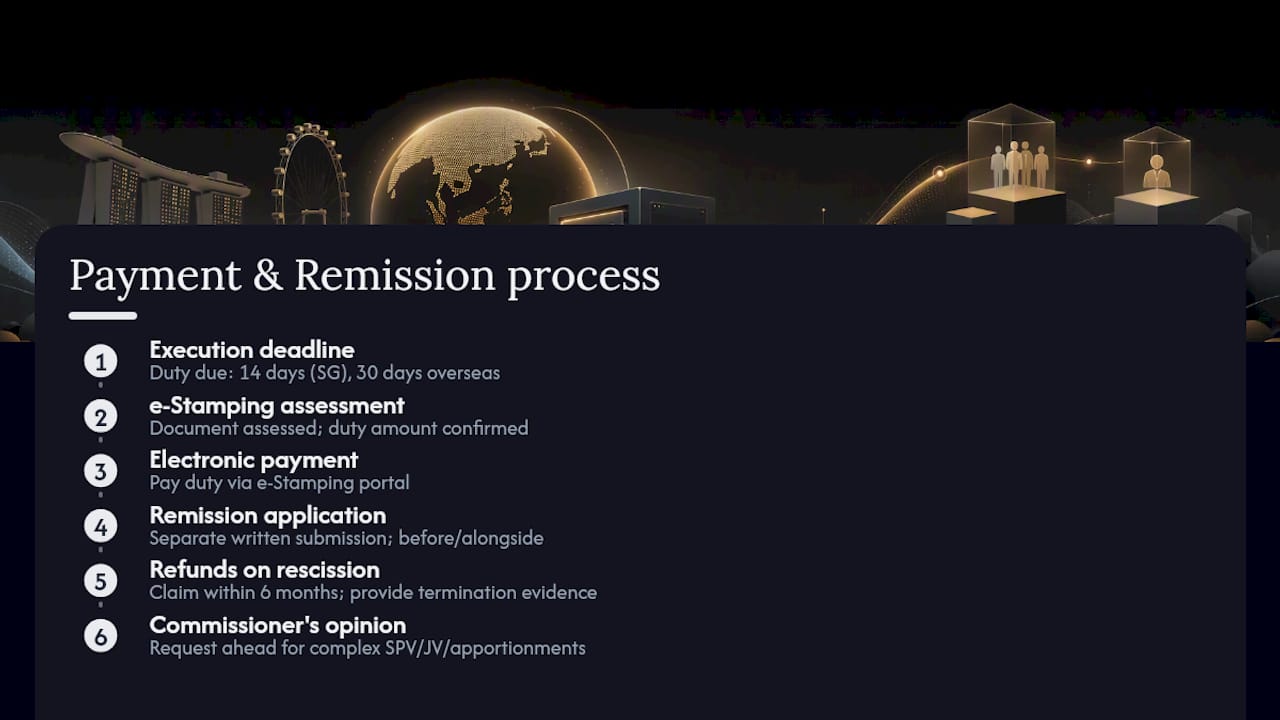
Duty is due within 14 days of the dutiable document being executed if signed in Singapore, or 30 days if signed overseas. Payment runs through IRAS’s e-Stamping portal, where the document is first assessed and the duty amount confirmed before payment is submitted electronically.
Remission applications, where a concession or reduced rate might apply (such as certain developer JV structures or specific family arrangements), require a formal written application to IRAS setting out the facts, the relevant provision being relied on, and supporting documentation. This is not a box you tick during e-Stamping; it is a separate submission that should ideally happen before or alongside the stamping process, not as an afterthought once duty has already been paid in full.
Refunds follow a stricter timeline. Where a sale and purchase agreement is rescinded, the standard refund window runs up to six months from the date of stamping, and the application needs clear evidence the transaction genuinely fell through, such as a termination deed or mutual release. Missing that window generally forfeits the refund entirely, regardless of how legitimate the underlying rescission was.
For genuinely complex SPV, JV, or mixed-use apportionment cases, requesting a Commissioner’s opinion ahead of filing gives you a documented position to rely on if the assessment is ever questioned later, and it is the step practitioners lean on most when the significant-owner or PHE tests are not clear-cut.
Why ACD Changed How Serious Investors Structure Deals
ACD did what it was designed to do: it made indirect ownership through shares carry roughly the same duty consequence as owning the property directly. That closes an avoidance route that used to look almost too easy. The real shift is that planning now has to start with the associate and trustee tests, not the purchase price, because those are the two places deals quietly fail.
— Aman
Where to Verify the Rules Yourself
For primary confirmation, consult IRAS’s ACD overview, the IRAS e-tax guide with worked examples, MOF’s holding-period press release, and Allen & Gledhill’s trust analysis.
Sources
FAQ
How Do I Avoid Triggering Additional Buyer Stamp Duty on a PHE Deal?
The only real lever is structuring the acquisition to stay genuinely below that threshold, since IRAS treats spouses, related companies, and connected family members as one combined owner for this test.
How Is Additional Conveyance Duty Actually Calculated?
ACD is calculated on the market value of the PHE’s underlying residential property, prorated by the percentage of equity actually transferred, not on the price paid for the shares. Mixed-use properties need the residential portion apportioned separately, typically through a professional valuation.
Do I Need to Pay Duty on a Gifted PHE Property Transfer?
Yes, in most cases, unless the transfer happens under a will or by way of assent to a beneficiary. IRAS explicitly excludes will and assent transfers from ACD, but a lifetime gift of shares to a family member while you are alive generally does not qualify for that exemption.
What Rate Applies If I Sell PHE Equity I’ve Held for Two Years?
ACDS rates track the top Seller’s Stamp Duty band for your holding period, and shorter holding periods carry higher rates. Check the current 3-year versus 4-year holding period rules before assuming an older rate schedule still applies, since MOF has extended these periods in recent years.


