


Conveyancing in Singapore is the legal process that moves property title from seller to buyer, running through the Option to Purchase, the Sale and Purchase Agreement, completion, and registration. Start by appointing a conveyancing lawyer and confirming your financing with your bank and the CPF Board before you sign anything. That single move prevents the most common failure in Singapore property deals: a completion date arriving before the money is actually ready to move.
TL;DR:
- Coordinating CPF withdrawal and bank disbursement is crucial, as delays in either can postpone the transaction or cause completion to stall.
- A thorough due diligence checklist before exercising the option helps identify title issues or encumbrances that could prevent or delay closing.
- Both HDB resale and private property transactions require legal work, but HDB deals follow a fixed process, while private deals involve more negotiated contract terms.
- Lawyers must file the IRAS Notice of Transfer within one month after completion to ensure property tax records are updated and bills are sent correctly.
Table of Contents
- The Conveyancing Process in Singapore: Buyer’s Step-by-Step Guide
- Selling Property in Singapore: What Your Lawyer Handles
- HDB Resale vs. Private Property: Where the Rules Diverge
- Coordinating CPF and Bank Financing Without Missing a Beat
- Stamp Duty and the IRAS Notice of Transfer: Don’t Skip This Step
- How Long Does Conveyancing Take in Singapore?
- What Legal Fees and Disbursements to Expect
- Lawyer Task Checklist: What Should Be Happening and When
- Practitioner Notes: Small Checks That Prevent Big Delays
- Why Appointing Legal Help Early Actually Changes the Outcome
- How Aesthetic Havens Supports You Through the Transaction
- Sources
- FAQ
The Conveyancing Process in Singapore: Buyer’s Step-by-Step Guide
Buying a home follows a fixed legal sequence, whether it’s an HDB flat or private property. Missing a step, or doing steps out of order, usually costs money or time.
- Pre-option due diligence. Your lawyer runs title searches to confirm the seller actually owns the property free of undisclosed mortgages, caveats, or court orders. Skipping this is how buyers end up in disputes over encumbrances the seller never mentioned.
- Exercise the Option to Purchase. The OTP fixes the price and gives you an exclusive window, typically two to three weeks, to decide. You pay an option fee upfront, then exercise it with a further deposit before the deadline. Our practical guide to the OTP covers the negotiation details worth knowing before you sign.
- Pre-completion legal work. Between exercising the option and completion, your lawyer sends requisitions to government agencies, rechecks for new caveats, and prepares completion accounts showing exactly what’s owed and by whom.
- Completion day. Funds move from your bank and CPF account to the seller’s lawyer, keys change hands, and your lawyer lodges the transfer with the Singapore Land Authority or HDB, depending on the property type.
A thorough due diligence checklist before you exercise the option catches problems while you still have room to walk away.
Selling Property in Singapore: What Your Lawyer Handles
Sellers carry a different set of obligations, most of them tied to clearing debts and refunding CPF before the sale can close cleanly.
- Preparing title documents and disclosing any mortgages, liens, or caveats registered against the property.
- Redeeming the outstanding home loan, which means requesting a redemption statement from your bank early so the payoff figure is accurate on completion day.
- Calculating the CPF amount used for the original purchase, plus accrued interest owed back to your CPF account, a figure our CPF accrued interest breakdown explains in more detail.
- Settling agent commission and any outstanding property tax before the remaining sale proceeds reach you.
Sellers who request these figures only after exercising the option often discover the payout is smaller, or slower, than expected.
HDB Resale vs. Private Property: Where the Rules Diverge
HDB resale transactions run on a standardized track. You file an Intent to Sell, list on the HDB Resale Portal, and both parties pass HDB’s eligibility checks before the resale can proceed, a process our HDB resale checklist walks through step by step. That structure is deliberate: HDB’s resale procedures exist to enforce quotas and grant conditions that don’t apply to private deals.
Private property conveyancing is more negotiated. The OTP and Sale and Purchase Agreement terms are drafted case by case, and lawyers lodge the transfer electronically through SLA’s STARS system rather than routing it through HDB.
- HDB transactions move at HDB’s pace; private deals move at the pace both parties and their lawyers agree to.
- HDB requires eligibility approval before resale can complete; private property does not.
- Private conveyancing gives lawyers more room to negotiate contract terms that protect their client, which is why contract drafting matters more here.
Coordinating CPF and Bank Financing Without Missing a Beat
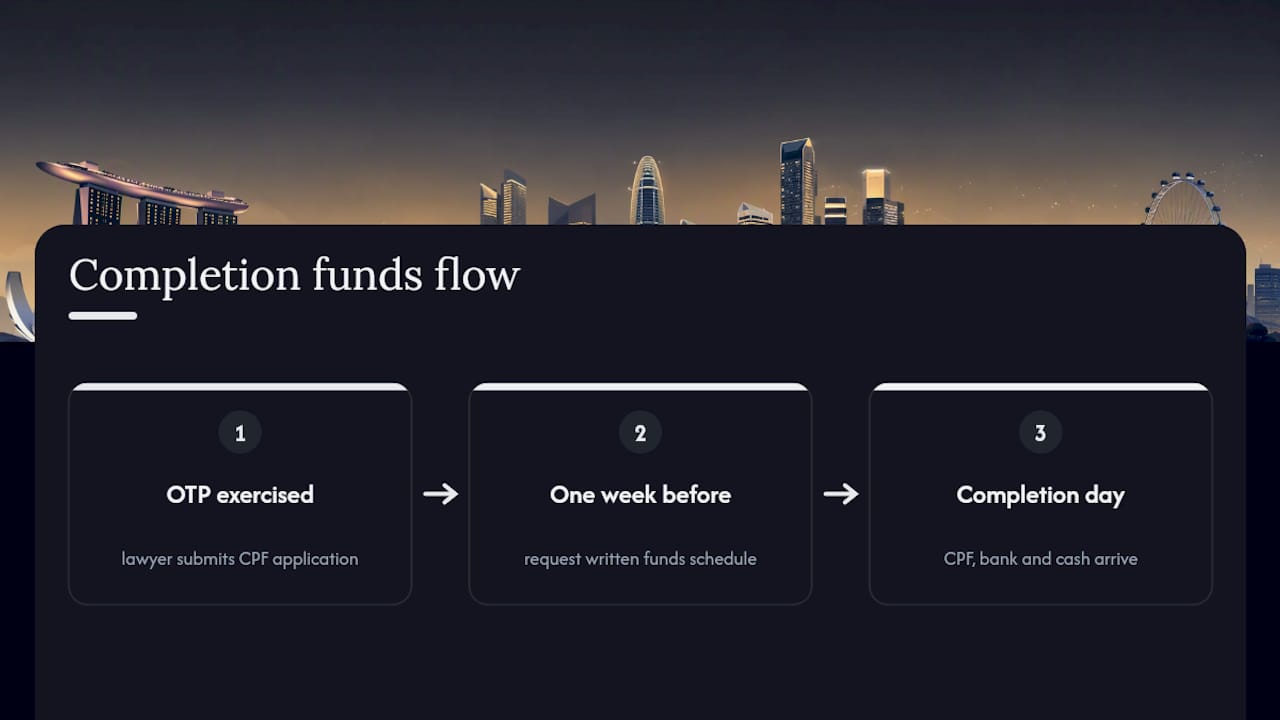
Your lawyer sits in the middle of two separate money flows: your CPF withdrawal and your bank’s mortgage disbursement, both of which need to land on completion day, not before or after.
For CPF, your lawyer submits the withdrawal application to the CPF Board once the OTP is exercised, timed to release funds exactly when completion requires them. For the bank, your lawyer reviews the letter of offer, confirms conditions precedent are met, and coordinates disbursement so the mortgage funds arrive alongside your CPF withdrawal and cash portion.
The most common failure point isn’t fraud or bad faith. It’s timing. A CPF refund calculation that arrives late on the seller’s side, or a bank disbursement that lags a day behind the CPF withdrawal, can stall completion entirely.
Pro Tip: Ask your lawyer for a written funds flow schedule at least a week before completion, showing exactly when CPF, bank, and cash portions are expected to land. If any party can’t confirm their piece by that date, you’ll know before completion day, not on it.
Stamp Duty and the IRAS Notice of Transfer: Don’t Skip This Step
Buyer’s Stamp Duty is due within 14 days of exercising the OTP if signed in Singapore, and most law firms arrange payment as part of the completion process so it’s never missed. Sellers face Seller’s Stamp Duty only if the property falls within the applicable holding period.
The step buyers most often overlook happens after completion, not during it: the seller’s lawyer must file a Notice of Transfer with IRAS within one month of the transfer, using the online Update Property Ownership service. That one-month deadline is a legal requirement, not a courtesy.
- This filing updates IRAS records so property tax bills go to the correct owner going forward.
- Property tax is apportioned between buyer and seller based on the completion date.
- The buyer named in the filing is who receives the acknowledgement notice and, later, the property tax bill.
Confirm with your lawyer that this filing actually happened. Keys in hand doesn’t mean the paperwork caught up.
How Long Does Conveyancing Take in Singapore?
HDB resale conveyancing typically runs eight to ten weeks from the exercised option to completion, largely because of HDB’s fixed approval and eligibility checkpoints. Private property conveyancing usually completes in eight to twelve weeks, though it can move faster or slower depending on the agreed completion date in the Sale and Purchase Agreement.
- Financing delays, especially a slow bank valuation or loan approval, are the single biggest cause of pushed completion dates.
- Title issues uncovered during pre-completion searches can add weeks if they require resolving before registration.
- CPF refund calculations that arrive late from the seller’s side ripple straight into your own completion timing.
Build a buffer of at least one to two weeks past your target date, particularly if you’re selling one property to fund the purchase of another.
What Legal Fees and Disbursements to Expect
Conveyancing fees in Singapore vary by transaction complexity, but DBS publishes reference fee bands that give a useful starting point: HDB resale conveyancing tends to sit at the lower end of the range, while private property, especially with mortgage work on both sides, runs higher.
- Legal fees generally scale with property value and whether a mortgage is involved on the buyer’s side.
- Disbursements cover title searches, requisition fees, and lodgement charges, and these are billed separately from the core legal fee.
- GST applies to the legal fee component, so ask whether a quote is stated before or after GST.
When comparing quotes, ask each firm to itemize disbursements separately and confirm whether the quote covers both the bank’s mortgage documents and the conveyancing work, or just one.
Lawyer Task Checklist: What Should Be Happening and When
A conveyancing lawyer’s work follows a predictable rhythm, and knowing it lets you spot a stalled file before it becomes a crisis.
- Pre-exercise: title searches and preliminary checks on encumbrances, confirming the property is clear to transact.
- Pre-completion: drafting or reviewing the Sale and Purchase Agreement, preparing transfer and mortgage documents, and coordinating CPF and bank funds timing.
- Completion: lodging the transfer through SLA’s STARS eLodgement system or with HDB, releasing funds to the seller’s side, and handing over keys.
- Post-completion: filing the IRAS Notice of Transfer, and confirming the registration has gone through cleanly.
If your lawyer can’t tell you which stage your file is at when you ask, that’s worth following up on directly.
Practitioner Notes: Small Checks That Prevent Big Delays
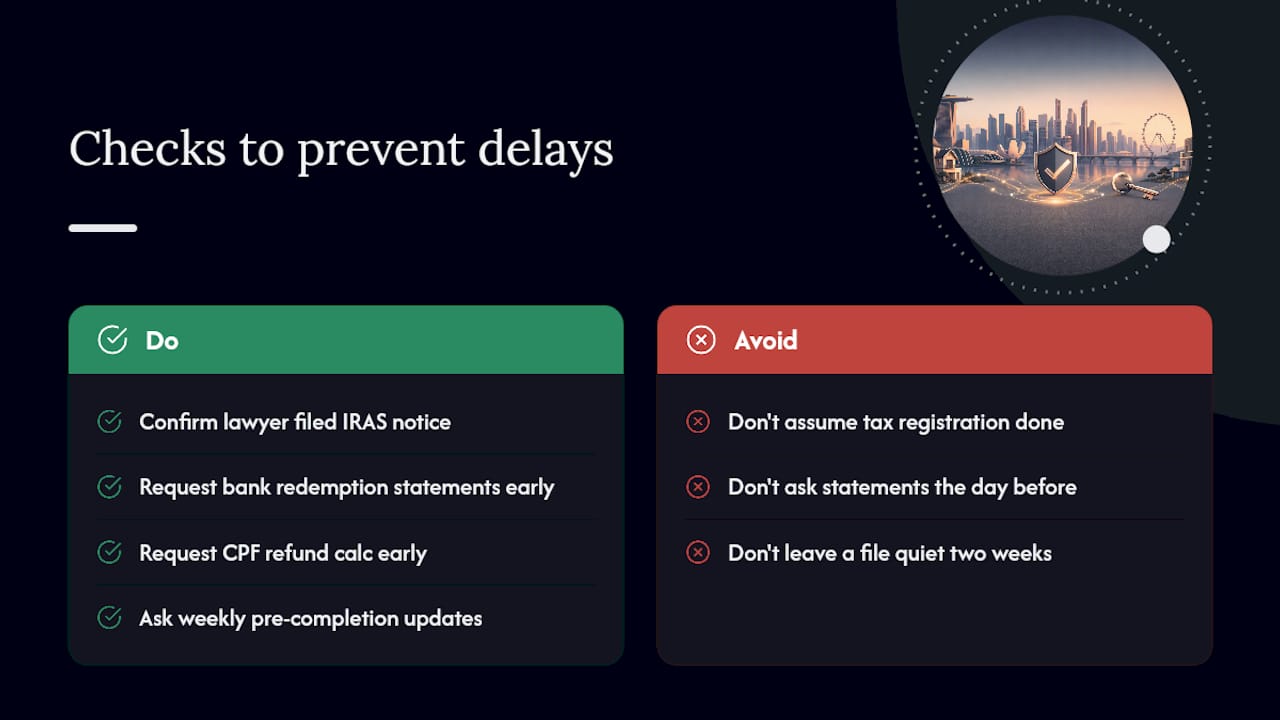
Years of watching Singapore transactions close, or stall, point to a few checks that catch problems before they’re expensive. Keys changing hands is not the same as tax registration: confirm your lawyer actually filed the IRAS Notice of Transfer after completion, because until that happens the seller may still be billed for property tax.
Ask for bank redemption statements and CPF refund calculations well before completion week, not the day before, so you can test whether the numbers actually work. And request short weekly updates from your lawyer once you’re in the pre-completion window. A file that’s quiet for two weeks straight is usually a file with a problem nobody’s flagged yet.
Why Appointing Legal Help Early Actually Changes the Outcome
Most failed completions in Singapore trace back to timing, not bad intentions: a CPF refund that lands late, a bank disbursement that misses the window, a title issue found too close to the deadline. Engaging a conveyancing lawyer before you exercise the option, not after, gives everyone enough runway to catch those problems while they’re still fixable.
That’s the coordination role a real estate consultancy can play alongside legal counsel: helping with valuation, connecting clients to solicitors, and staying involved through the post-purchase steps that often get overlooked once the deal closes.
— Aman
How Aesthetic Havens Supports You Through the Transaction
A property purchase or sale in Singapore involves more moving parts than most people expect, and coordinating a lawyer, a bank, and CPF timing on your own is where deals go sideways. A real estate consultancy can work alongside your legal team, offering property valuation, transaction coordination, and guidance on financing sequencing so nothing falls through the cracks between exercising your option and completion day.
An initial consult typically covers where you are in the process, what documents and figures you’ll need from your bank or CPF account, and whether your target timeline is realistic given current market conditions. Whether you’re buying your first HDB flat or managing a private property sale alongside a new purchase, that kind of coordination catches the timing gaps before they become missed completion dates. Browse current listings and get in touch through the Aesthetic Havens consultancy page to start the conversation before you exercise your next option.
This article is general information, not a substitute for advice from a qualified lawyer. Consult a qualified legal professional about your own circumstances before acting on anything here.
Sources
- IRAS | File a Notice of Transfer
- CPF Board | CPF refund when selling or transferring property
- Estimated Legal Fees | DBS Singapore
- SLA | Land Titles Registry
FAQ
What Are the Stages of the Conveyancing Process in Singapore?
Conveyancing runs through four stages: pre-option due diligence, exercising the Option to Purchase, pre-completion legal work including title searches and fund coordination, and completion with registration through SLA or HDB. Each stage has its own documents and deadlines, which is why appointing a lawyer before you exercise the option matters.
How Much Does Conveyancing Cost in Singapore?
Legal fees vary by property type and complexity, and DBS publishes reference fee bands for HDB and private transactions that are a useful starting point for budgeting. Disbursements for title searches and lodgement are billed on top of the core legal fee, and GST applies separately.
How Long Does Conveyancing Usually Take?
HDB resale conveyancing typically takes eight to ten weeks from exercising the option to completion, while private property conveyancing usually runs eight to twelve weeks. Financing delays and CPF refund timing are the most common reasons a completion date gets pushed back.
Do You Need a Conveyancing Lawyer for HDB?
Yes, HDB resale transactions require a lawyer to handle the legal documentation, coordinate CPF and bank funds, and manage the resale portal requirements alongside HDB’s eligibility checks. HDB conveyancing is more standardized than private property, but the legal steps, title checks, and fund coordination, are just as necessary.
What Happens if the IRAS Notice of Transfer Isn’t Filed?
The seller’s lawyer is required to file the Notice of Transfer within one month of completion, and until that filing goes through, property tax records may still show the seller as the owner. Buyers should confirm with their lawyer that this filing was completed shortly after keys are handed over.


