


Sellers in Singapore typically pay a commission on private and HDB resale deals commonly acknowledged to be around the market benchmark, while buyers generally pay a lower commission when they engage their own agent. Rental commissions usually total about one month’s rent in total, often split between landlord and tenant for HDB flats. None of these numbers are fixed by law. The Council for Estate Agencies (CEA) confirms commissions are negotiable and must be written into the Prescribed Estate Agency Agreement (EAA) before an agent starts work.
- Seller commission in resale for private and HDB
- Buyer commission where a buyer’s agent is used
- Rental commissions total about one month’s rent, often split ½ landlord / ½ tenant for HDB
- New launches: developer pays, buyer usually pays nothing
GST may apply on top of these figures if the agent or agency is GST-registered, so always ask before signing anything.
Key Takeaways
Commission rates in Singapore are negotiable by regulation, but they only hold up when documented in the Prescribed EAA with GST treatment stated clearly.
| Point | Details |
|---|---|
| Standard benchmarks | Sellers typically pay ~2%, buyers ~1% where used, and rentals about one month’s rent total. |
| Everything is negotiable | CEA confirms rates aren’t fixed by law, but must be recorded in the Prescribed EAA before work starts. |
| GST depends on registration | Confirm whether your agent’s agency is GST-registered before assuming a quoted rate includes or excludes it. |
| Verify before you sign | Check the CEA Public Register for registration status and transaction history before engaging any agent. |
| Aesthetic Havens’ approach | Com structures commission, exclusivity, and EAA documentation around net outcome, not just the lowest percentage. |
Table of Contents
- What Are Typical Property Agent Commission Rates in Singapore?
- Who Pays the Agent, and How Do Co-Broking Splits Work?
- When Does GST Apply to Agent Commissions?
- How Do You Negotiate a Lower or Higher Commission?
- What Should Be in the Prescribed Estate Agency Agreement?
- How Do You Verify and Choose the Right Agent?
- What Are the Red Flags in Commission Disputes?
- How Aesthetic Havens Approaches Commission and Client Outcomes
- How Aesthetic Havens Can Help With Commission Negotiations
- Where to Verify Rules and Registrations
- Why Value Should Beat the Lowest Commission Every Time
- Sources
What Are Typical Property Agent Commission Rates in Singapore?
Commission conventions differ by transaction type, and the differences aren’t arbitrary. They reflect who’s doing the marketing work, who has leverage, and who’s footing the bill for advertising and viewings.
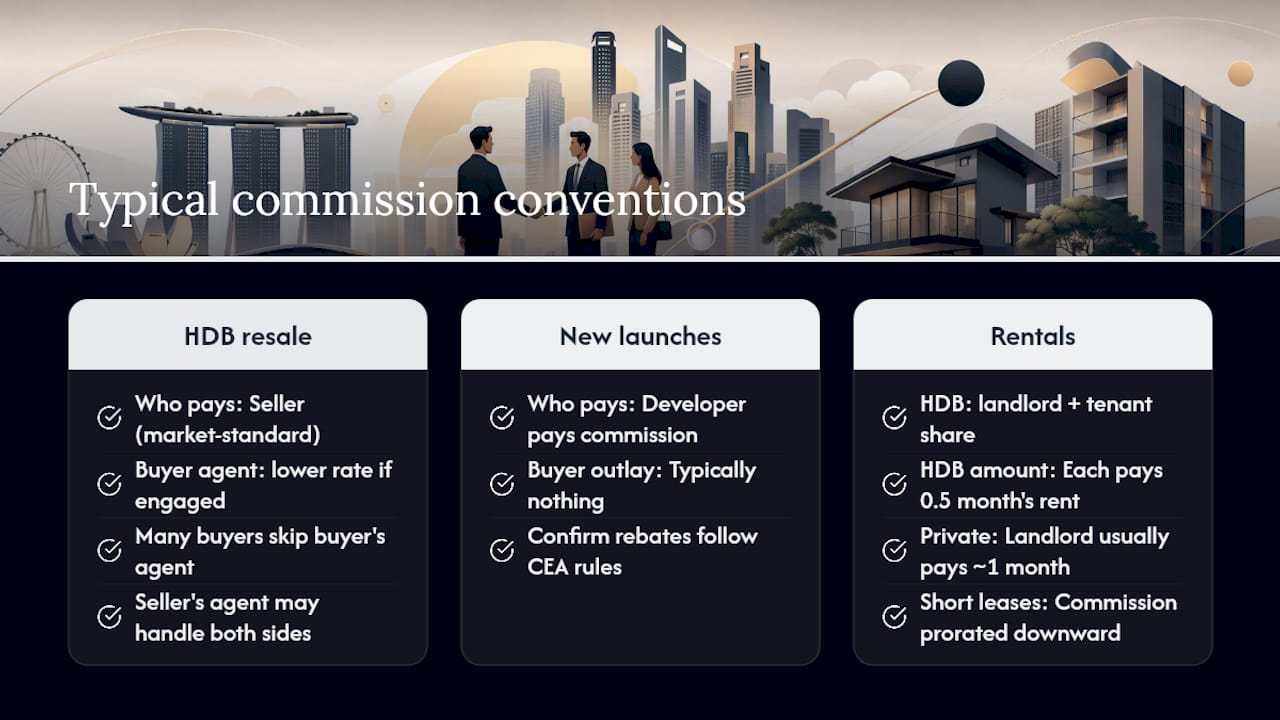
HDB resale follows the most predictable pattern. Sellers commonly pay their agent a market-standard commission rate, while buyers who choose to engage their own agent pay a lower typical rate. Many HDB buyers skip a buyer’s agent altogether and rely on the seller’s agent to handle both sides, which changes how the fee gets split later.
For very expensive properties, sellers and agents may negotiate the rate based on the property’s marketing needs and transaction size.
New launches work differently. Developers pay the agent’s commission directly, which means buyers typically pay nothing out of pocket. Buyers should still confirm any rebates or incentives comply with CEA rules rather than assume every “cashback” offer is straightforward.
Rentals carry their own convention. For HDB whole-unit rentals, the common structure is half a month’s rent from the landlord and half a month’s rent from the tenant, totaling roughly one month combined. Private rentals often shift more of that cost to the landlord, with one month’s rent as the standard for a typical one or two-year tenancy, though shorter leases sometimes see commissions prorated downward.

Commercial and industrial deals are the outlier. Rates get negotiated case by case, shaped by lease length, tenant covenant strength, and how competitive the leasing market is at the time.
Who Pays the Agent, and How Do Co-Broking Splits Work?
- The seller agrees to pay their agent 2% of the sale price, documented in the EAA.
- If a separate agent brings the buyer, the seller’s agent typically shares that 2%, commonly splitting it into roughly 1% for each side.
- The buyer, in this scenario, pays nothing directly. Their agent’s share comes out of the seller’s commission pool.
- In cases where a buyer specifically hires and pays their own agent for a search or negotiation mandate, that buyer pays an additional fee on top, often around 1%.
Here’s where the math matters. That difference sounds small until you’re reconciling final settlement figures at completion, and buyers who assume “no GST” without checking sometimes get an unpleasant surprise on the invoice.
When Does GST Apply to Agent Commissions?
GST isn’t automatic. It applies only when the property agent or their agency is GST-registered with IRAS), which typically happens once an agency’s annual taxable turnover crosses the registration threshold. A smaller independent agent might not be GST-registered at all, while most established agencies are.
Before agreeing to any commission figure, ask directly whether the quoted rate is inclusive or exclusive of GST.
- Always pay the property agency, never the individual agent’s personal account.
- Request a proper tax invoice showing the agency’s GST registration number if GST is charged.
- Keep the receipt and invoice with your transaction file, not just a text message confirmation.
Pro Tip: Search the agency’s name on IRAS’s GST-registered business search before signing the EAA. It takes two minutes and confirms whether that “plus GST” clause is even legitimate.
How Do You Negotiate a Lower or Higher Commission?
Negotiating commission is normal and expected in Singapore, but the direction you push should match the actual work involved, not just what feels fair.
Reasons that justify asking for a lower rate:
- You’re a repeat client using the same agent for a second or third transaction.
- The property is likely to sell fast with minimal marketing (hot location, below-market asking price).
- You’re bundling multiple mandates with one agency, such as selling and then renting through the same office.
Reasons an agent might reasonably ask for a higher rate:
- The unit needs premium marketing: professional photography, staging, or paid listing boosts for a luxury property.
- The sale is urgent and requires the agent to prioritize aggressive outreach over other clients.
- The property has struggled to sell previously and needs a harder push to attract buyers.
One thing worth knowing before you negotiate hard: listing well below the market benchmark can cool other agents’ enthusiasm for showing your property, since co-broking partners weigh their own time against the expected split. The right moment to negotiate is before you sign the EAA, not after. Once it’s signed, the commission clause is binding.
Pro Tip: Ask the agent to justify their proposed rate with a marketing plan in writing. An agent who can’t explain where the fee goes probably hasn’t thought it through either.
What Should Be in the Prescribed Estate Agency Agreement?
The Prescribed EAA exists precisely because commission disputes used to be common before it became standard practice. CEA requires agents to use this prescribed format for a reason: it protects both the client and the agent by putting every term in writing before work begins.
Confirm these clauses before signing:
- Commission percentage or fixed sum, stated clearly, not left as “to be discussed.”
- GST treatment, specifying whether the quoted figure includes or excludes GST.
- Exclusivity term, usually 3 to 6 months for a sale mandate, defining how long you’re locked to one agent.
- Marketing cost allocation, clarifying who pays for photography, staging, or paid ads if the agent doesn’t absorb them.
- Termination and tail clause, covering what happens if you switch agents mid-mandate, including whether commission is still owed if a buyer introduced during the mandate later completes a purchase after termination.
| Clause | What to Check |
|---|---|
| Commission rate | Written as a specific percentage or dollar figure, not vague |
| GST | Explicitly inclusive or exclusive |
| Exclusivity period | Defined start and end date |
| Tail clause | Covers post-termination sales to introduced buyers |
If an agent resists using CEA’s prescribed forms or offers a homemade contract instead, treat that as a serious warning sign. Ask why, and if the answer isn’t satisfactory, find a different agent.
How Do You Verify and Choose the Right Agent?
The commission figure matters less than what you get for it.
Start with verification, not price:
- Check the agent’s registration number on the CEA Public Register to confirm they’re licensed and see their transaction history.
- Ask for two or three recent, comparable transactions, not just a generic portfolio.
- Request contactable references from recent clients, ideally ones who sold or rented a similar unit type.
- Compare their proposed marketing plan against competitors before comparing fees.
At your first meeting, bring or request these documents:
- A copy of their CEA registration and agency license.
- A written marketing proposal specific to your property.
- A draft of the Prescribed EAA for review before any verbal commitment.
Choosing an agent by assessing track record over lowest fee tends to produce better net outcomes, especially in a market where negotiation skill and buyer network matter more than the sticker price of the commission.
What Are the Red Flags in Commission Disputes?
Most commission disputes trace back to skipped verification steps, not genuinely bad-faith agents. Watch for these warning signs:
- An agent who can’t produce a CEA registration number when asked.
- Refusal to sign a Prescribed EAA, or pressure to sign a modified version.
- Requests to pay commission in cash to a personal account rather than the agency.
- An agent attempting to represent both buyer and seller without disclosing it, which gov.sg explicitly flags as a consumer protection issue.
If something feels wrong, stop payment immediately, verify the agent’s status on the CEA register, and gather every email, invoice, and text message tied to the transaction. For suspected fraud, file a report with CEA directly, and involve the police if money has already changed hands under false pretenses. Good record-keeping from day one is what makes any later complaint resolvable.
How Aesthetic Havens Approaches Commission and Client Outcomes
Aman structures commission conversations around outcome, not just percentage. Before recommending a rate, the checklist typically covers:
- Expected buyer pool size and how much marketing spend that realistically requires.
- Whether exclusivity is warranted, tied to a defined, written marketing commitment from the agent.
- A minimum acceptable net price, so any commission discount doesn’t quietly erode the seller’s actual proceeds.
Exclusive mandates get recommended when a property needs coordinated marketing over several months, such as a private resale unit competing against many similar listings. Non-exclusive arrangements suit faster-moving HDB resale flats where multiple agents casting a wider net can work faster than one committed agency.
Commission discussions go sideways when clients focus only on the percentage and skip the paperwork that protects them. Every agreement should be invoiced properly, documented in the Prescribed EAA, and kept on file long after the deal closes.
How Aesthetic Havens Can Help With Commission Negotiations
Com works through commission structuring, EAA documentation, and marketing coordination as part of every sale or lease mandate, rather than leaving clients to figure out the fine print alone.

If you’re preparing to sell, lease, or manage a property transaction in Singapore and want commission terms handled properly from the first conversation, review how Com structures the property sales workflow for clients, then reach out to discuss your specific transaction and get a written commission proposal before you sign anything.
Where to Verify Rules and Registrations
For the official word on any commission question, go directly to the source rather than relying on secondhand summaries.
- CEA consumer guidance on engaging a property agent
- CEA Public Register to verify agent registration and credentials
- Gov on the four things to check before engaging an agent
Why Value Should Beat the Lowest Commission Every Time
Chasing the lowest commission percentage is the most common mistake I see, and it rarely pays off. An agent willing to cut their fee to nearly nothing often has little incentive to fight for your price during negotiation. What actually protects you is transparency: a written EAA, a clear GST answer, and an agent whose track record you’ve actually checked. Get the paperwork right first. The percentage matters far less than who’s on the other side of it.
— Aman
Sources
- What to take note of when engaging a property agent | Council for Estate Agencies
- Gov
- Property Agent Commission Singapore 2026: CEA & COA Rates and Who Really Pays the Agent
- Council for Estate Agencies (CEA)


