


En bloc is defined as the collective sale of an entire strata development to a single buyer, typically a developer, at a price that reflects the site’s redevelopment potential rather than individual unit values. The role of en bloc in investment is to give property owners a structured path to earn premiums of 30% to 80% above current market value, far beyond what any single-unit resale could achieve. Singapore’s Urban Redevelopment Authority (URA) and the Strata Titles Board (STB) govern this process, with IRAS overseeing the tax implications. For investors who understand the legal thresholds, financial realities, and market cycles, en bloc property investment can be one of the most rewarding exits in Singapore real estate.
How does the en bloc process work in Singapore?
The en bloc process is a legally defined procedure that begins with owners forming a Collective Sale Committee (CSC) at an Extraordinary General Meeting (EGM). The CSC appoints lawyers, marketing agents, and valuers, then works to gather the required owner consent before launching a public tender.
Consent thresholds are non-negotiable. For developments over 10 years old, 80% owner consent by share value and strata area is required. Buildings 10 years old or newer require 90%. That higher bar for newer buildings reflects the policy intent to protect owners who have not yet fully benefited from their purchase.

Once consent is secured, the CSC submits the collective sale agreement to the STB for approval. Dissenting owners can object on grounds of financial loss or procedural irregularity. The STB weighs these objections before granting or denying the order. The full en bloc timeline from the first EGM to receipt of sale proceeds typically spans 12 to 24 months, and that estimate assumes no major legal challenges.
Proceeds are split among owners using an apportionment formula. The most common methods blend share value, strata area, and independent valuation to account for unit size differences. Disputes over apportionment are a leading cause of delays, even after the consent threshold is met.
Common reasons en bloc deals fail or stall:
- Insufficient owner consent despite months of negotiation
- STB objections from dissenting minority owners citing financial loss
- Developer bids falling below the reserve price set by the CSC
- Apportionment disputes that fracture owner alignment
- Market downturns reducing developer appetite mid-process
What are the financial benefits and risks of en bloc property investment?
The headline appeal of en bloc is the premium. A successful collective sale can deliver 30% to 80% above market value, depending on the site’s plot ratio, location, and redevelopment potential. A unit worth $1.5 million on the open market could fetch $1.95 million to $2.7 million through a collective sale. That gap is the core enbloc investment benefit.
The premium size depends on several factors:
- Plot ratio uplift: Sites where the URA Master Plan allows denser redevelopment attract higher bids.
- Land scarcity: Freehold or 999-year leasehold sites in prime districts command stronger developer interest.
- Site size and shape: Regular, large footprints are easier to develop and attract more competitive bids.
- Market timing: Developer land bank levels and interest rate conditions directly affect bid prices.
The gross figure, however, is not what lands in your bank account. Net proceeds are reduced by CPF refunds with accrued interest, outstanding mortgage settlements, Buyer’s Stamp Duty (BSD), Additional Buyer’s Stamp Duty (ABSD) on the replacement property, legal fees, and interim rental costs while you wait for a new home. These deductions can collectively consume a significant portion of the gross payout. The gap between headline price and actual cash in hand surprises many first-time en bloc recipients.
Pro Tip: Before calculating your en bloc windfall, subtract CPF refunds, ABSD on your next purchase, and at least 12 months of interim rent. The real number is often 20% to 30% lower than the gross figure.
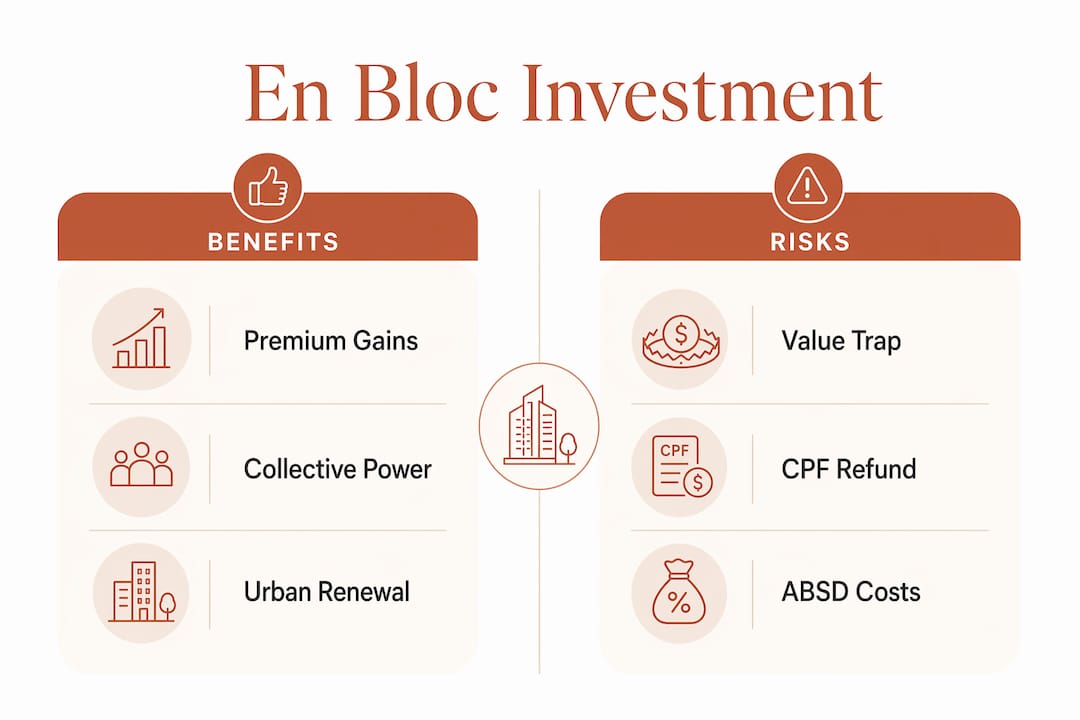
The most dangerous financial trap in en bloc property investment is what analysts call the “en bloc value trap.” Investors who overpay for aging properties based on speculative collective sale hopes, rather than fundamental market value, risk holding a depreciating asset that never gets sold collectively. If the en bloc fails, they are left with an old unit in a development with deferred maintenance and declining rental appeal.
| Financial factor | Impact on net proceeds |
|---|---|
| CPF refund with accrued interest | Reduces cash payout directly |
| ABSD on replacement property | Significant cost for second-property buyers |
| Interim rental (12–24 months) | Ongoing expense during transition |
| Legal and agent fees | Deducted from gross sale price |
| Mortgage settlement | Clears debt but reduces net cash |
How has the 2026 developer ABSD reshaped the en bloc market?
Developer ABSD is the single biggest structural force shaping the current en bloc market. Developers must pay 40% ABSD on en bloc land purchases. Of that, 35% is remittable, but only if the developer completes the project and sells all units within five years. That deadline creates enormous pressure.
The five-year sell-all rule has a predictable effect. Developers now strongly favor smaller, boutique sites over mega-sites because a 50-unit project is far easier to sell out within five years than a 500-unit one. The boutique site preference has effectively ended the era of large-scale collective sales that defined Singapore’s en bloc cycles in 2007 and 2017.
For investors, this shift has direct implications. Large aging estates with hundreds of units face a much harder path to a successful collective sale today. Developers face higher financial risk managing mega-sites because any unsold inventory at the five-year mark triggers ABSD clawback. That risk gets priced into lower bids or outright disinterest.
The government has introduced extensions and clawback adjustments for genuinely complex or large projects, but these are not guaranteed. Investors evaluating en bloc strategy for investors should factor in site size as a primary filter. A 30-unit freehold development in a prime district is a far more credible en bloc candidate in 2026 than a 300-unit leasehold estate in a suburban location. Understanding Singapore’s commercial property cycles helps investors time their entry into en bloc-eligible properties more precisely.
What strategic considerations matter when evaluating en bloc investments?
The most important rule in understanding enbloc deals as an investment is this: the property must make financial sense without the en bloc upside. En bloc potential should be a bonus, not the core reason to buy. Investors who ignore this principle consistently overpay and underperform.
A sound evaluation framework covers these areas:
- Standalone value: Would you buy this unit at this price if en bloc were impossible? If not, the premium you are paying is pure speculation.
- Rental viability: Older developments often have lower rental yields due to dated fittings and facilities. Calculate actual rental income, not optimistic projections.
- Holding costs: Maintenance fees in aging estates can be high. Factor in sinking fund contributions and potential special levies.
- Owner alignment: Speak to neighbors and understand the sentiment. A development where owners are divided on en bloc is a development where the process will stall.
- Replacement housing cost: After the sale, you need somewhere to live. In a rising market, the replacement cost can erode much of the en bloc premium.
- Market timing: En bloc cycles follow developer land demand. Buying into a potential en bloc candidate at the wrong point in the cycle means years of waiting with no guarantee of success.
Pro Tip: Check the URA Master Plan for the site’s gross plot ratio before buying. A site with significant plot ratio uplift is the most reliable predictor of developer interest. Without that uplift, the en bloc premium shrinks considerably.
The new launch versus resale decision also matters here. Buying a resale unit in an en bloc-eligible development is a different risk profile from buying a new launch. Resale buyers inherit the development’s age, condition, and owner dynamics. New launch buyers have none of those variables but also have no en bloc upside for at least a decade.
En bloc sales are a structural pressure valve for urban renewal in Singapore, governed by the URA Master Plan. They are not a guaranteed wealth mechanism. The market is selective and cyclical, and most aging developments never achieve a successful collective sale.
Key Takeaways
En bloc investment delivers its strongest returns when investors buy for fundamental property value first and treat collective sale upside as a secondary benefit, not the primary thesis.
| Point | Details |
|---|---|
| Premium potential | Successful en bloc sales yield 30%–80% above market value, depending on plot ratio and location. |
| Consent thresholds | Developments over 10 years old need 80% owner consent; newer buildings require 90%. |
| Net proceeds reality | CPF refunds, ABSD, interim rent, and legal fees reduce actual cash received well below the gross figure. |
| ABSD impact on developers | The 35% remittable ABSD and five-year sell-all rule push developers toward boutique sites over mega-estates. |
| Investment discipline | Buy for standalone value first. En bloc upside is a bonus, not a purchase justification. |
What I have learned about en bloc after years in Singapore property
The en bloc cycle is one of the most misunderstood dynamics in Singapore real estate. I have watched investors buy into aging developments at inflated prices, convinced that a collective sale was imminent, only to hold for five or six years with no deal materializing. The property deteriorated, the rental yield dropped, and the exit was painful.
The market is far more selective than most buyers realize. Developers today are not chasing every aging estate. They want specific sites: freehold or long-tenure leasehold, manageable unit counts, strong plot ratio uplift, and locations where new launches will sell quickly. If a development does not tick most of those boxes, the en bloc dream stays a dream.
My honest advice is to treat en bloc the way you treat a bonus at work. Plan your finances without it. If it comes, it is a windfall. If it does not, you still own a property that earns rental income, holds its value, and gives you a clean exit on the open market. That discipline separates investors who build wealth from those who chase speculation.
Regulatory complexity is real, and the cost of getting it wrong is significant. I always recommend working with an advisor who understands both the legal process and the financial modeling before committing to any en bloc-oriented purchase.
— Aman
How Aesthetic Havens can support your property investment decisions
Property investors weighing en bloc opportunities need more than market optimism. They need a clear picture of costs, timelines, and realistic outcomes before committing capital.

Aesthetic Havens, operated under ERA Realtors, provides data-informed guidance on property sales and investment selection across Singapore’s residential and commercial sectors. Whether you are assessing a potential en bloc candidate or planning your next move after a collective sale, the property sales workflow guide walks you through the process step by step. For investors building long-term wealth, the real estate wealth creation strategies resource covers portfolio planning beyond any single transaction. Reach out to Aman directly for a personalized consultation grounded in current market data.
FAQ
What is an en bloc sale in Singapore?
An en bloc sale is the collective sale of an entire strata development to a single buyer, usually a developer, at a price reflecting the site’s redevelopment value. It is governed by the Land Titles (Strata) Act and overseen by the Strata Titles Board.
How much premium can owners expect from an en bloc sale?
Owners can expect a premium of 30% to 80% above individual market value, depending on the site’s plot ratio, tenure, and location. The actual cash received is lower after CPF refunds, stamp duties, and replacement housing costs.
Why do en bloc deals fail even after reaching the consent threshold?
Deals fail due to STB objections from dissenting owners, developer bids below the reserve price, or apportionment disputes that break owner alignment. Market downturns can also cause developers to withdraw interest mid-process.
How does the 40% developer ABSD affect en bloc activity?
Developers pay 40% ABSD on en bloc purchases, with 35% remittable only if all units are sold within five years. This deadline makes large mega-site developments financially risky, pushing developer demand toward smaller boutique sites.
Should I buy a property specifically for en bloc potential?
No. En bloc potential should be a secondary consideration, not the primary reason to buy. A property must justify its purchase price based on rental yield, resale value, and livability without any collective sale upside factored in.


