


Real estate portfolio expansion is defined as the deliberate acquisition and management of additional income-producing properties to build long-term wealth through cash flow and equity growth. Knowing how to expand a real estate portfolio separates investors who own a few properties from those who operate a genuine property business. The core methods include the BRRRR strategy, DSCR loan financing, capital recycling, and intentional diversification across markets and asset classes. Sustainable growth depends on maintaining positive cash flow, keeping leverage disciplined, and building operational systems that scale with your holdings. This guide covers each method in practical depth so you can grow your portfolio without burning out or overextending.
What are the primary methods to expand a real estate portfolio?
The most effective ways to grow property holdings fall into two categories: active acquisition strategies and passive investment vehicles. Each suits a different risk tolerance, capital base, and time commitment.
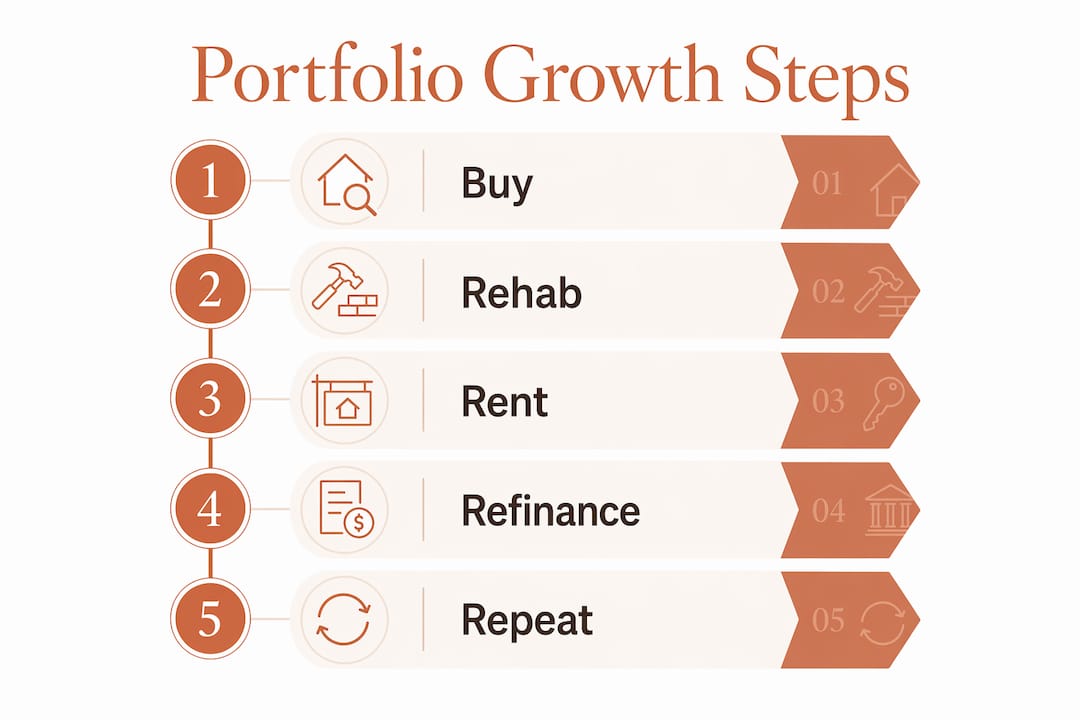
The BRRRR method (Buy, Rehab, Rent, Refinance, Repeat) is the most capital-efficient active strategy. You purchase an undervalued property, renovate it to force appreciation, rent it to generate income, then refinance to pull out equity and fund the next acquisition. Building a 10-property portfolio typically takes 5–8 years with standard reinvestment, but aggressive BRRRR execution can compress that to 3–5 years. That time difference represents years of compounding rental income.

House hacking works well for investors just starting to increase property holdings. You purchase a multi-unit property, live in one unit, and rent the others to offset your mortgage. The rental income reduces your personal housing cost while you build equity, freeing up capital for the next purchase.
REITs (Real Estate Investment Trusts) offer a passive route to expand your exposure without direct property management. REITs must distribute at least 90% of their taxable income as dividends. That mandatory payout makes them a reliable income vehicle, though they offer less control than direct ownership. For a deeper look at how REITs fit a broader investment plan, the role of REITs in property investment is worth understanding before you commit capital.
| Method | Key Benefit | Typical Timeline |
|---|---|---|
| BRRRR | Recycles capital across acquisitions | 3–5 years to 10 properties |
| House hacking | Reduces personal housing costs | 1–2 years to first expansion |
| Direct buy-and-hold | Stable long-term cash flow | 5–8 years to 10 properties |
| REITs | Passive income, no management | Immediate, liquid |
Pro Tip: Start with one BRRRR deal before scaling the method. The learning curve on renovation budgeting is steep, and a single controlled project teaches you more than any course.
How can financing and capital recycling accelerate portfolio growth?
Financing is the engine of portfolio expansion. Without the right loan structures, most investors hit a wall long before they reach their target property count.
Conventional loans cap most investors at 10 financed properties. Beyond that limit, DSCR loans enable scaling without the conventional ceiling because they qualify on property cash flow rather than personal income. That decoupling is critical. It means a property that generates strong rental income qualifies for financing regardless of how many loans you already carry.
The key risk metric to track is your Debt Service Coverage Ratio. Maintain a portfolio DSCR of at least 1.20 and a minimum of 20% equity per property when using leverage. A DSCR of 1.20 means the property generates $1.20 in income for every $1.00 of debt payment. Dropping below that threshold leaves you exposed to vacancy or rate changes.
Capital recycling is the behavioral shift that separates casual landlords from serious portfolio builders. Treating equity as fuel to be recycled through cash-out refinances or 1031 exchanges is what drives exponential growth. A 1031 exchange lets you sell one property and defer capital gains tax by rolling proceeds into a new acquisition. A cash-out refinance pulls equity from an appreciated property without triggering a taxable event.
- Assess your current equity. Identify properties with 30%+ equity as refinance candidates.
- Run a cash-out refinance. Pull equity at current rates and use it as a down payment on the next property.
- Execute a 1031 exchange. Sell a lower-performing asset and roll the full proceeds into a higher-yield property.
- Structure acquisitions in an LLC. Portfolio lenders often require or prefer LLC ownership, and it separates personal liability from investment risk.
- Stagger your fixed-rate end dates. Staggering mortgage maturities prevents a refinance crunch where multiple loans reset simultaneously during unfavorable market conditions.
Pro Tip: Before executing a 1031 exchange, identify your replacement property before closing the sale. The IRS gives you 45 days to identify and 180 days to close. Missing either deadline eliminates the tax deferral.
Why is diversification critical when expanding your portfolio?
Concentration is the hidden risk in most growing portfolios. Investors who own ten properties in one neighborhood or one asset class are not diversified. They are simply running a larger version of the same bet.
Intentional diversification across geographic locations, property types, and tenant demographics reduces vulnerability to market or sector downturns. The word “intentional” matters here. Diversification is a deliberate strategy, not a byproduct of buying whatever is available.
The three dimensions of real estate diversification are:
- Geographic markets. Owning properties across multiple cities or regions means a local economic shock, a new employer leaving town, or a zoning change does not threaten your entire portfolio at once.
- Property types. Mixing residential, commercial, and industrial assets creates different income cycles. Residential rents tend to be stable; commercial leases often run longer with built-in escalations.
- Tenant profiles. A portfolio with individual residential tenants, small business tenants, and corporate tenants spreads default risk across income brackets and sectors.
International property investment adds another layer of geographic diversification and can expose you to markets with stronger growth trajectories than your home market. Understanding signs of profitable real estate markets before entering a new geography is the difference between a calculated expansion and a speculative one.
Lender diversification also matters. Relying on a single bank for all your financing creates a single point of failure. If that lender tightens its criteria or exits the market, your acquisition pipeline stalls.
How should you manage and operate a growing real estate portfolio?
Management complexity grows faster than property count. At three properties, you can handle most issues yourself. At ten, self-management becomes a liability.
Scaling beyond three properties requires shifting from hands-on tenant management to systems-based operations. That shift is not optional. Investors who skip it burn out, miss maintenance issues, and lose track of cash flow across their holdings.
- Automate rent collection. Use a property management platform that collects rent, sends reminders, and logs payments automatically. Manual collection at scale creates gaps and disputes.
- Centralize accounting. Track income and expenses per property in dedicated accounting software. Blending portfolio finances with personal accounts makes tax preparation expensive and error-prone.
- Hire a property manager. A professional property manager typically charges 8%–12% of monthly rent. That cost is offset by reduced vacancy, faster maintenance resolution, and your time freed for acquisitions.
- Schedule quarterly portfolio reviews. Review cash flow, DSCR, equity position, and insurance coverage for every property. Problems caught early cost far less than problems discovered at tax time.
- Plan refinance dates deliberately. Stagger fixed-rate expirations so you never face multiple refinances in the same quarter. This preserves liquidity when rates are unfavorable.
Pro Tip: Treat your property manager as a business partner, not a vendor. Share your acquisition criteria with them. The best managers flag off-market deals before they hit listings.
The role of property management in maximizing returns is often underestimated by investors who focus only on acquisition. A well-managed property retains tenants longer, commands higher rents, and requires less emergency spending.
What are common mistakes to avoid in portfolio expansion?
Most portfolio failures trace back to three errors: over-leveraging, poor tracking, and premature cash withdrawal.
Critical warning: A portfolio DSCR below 1.20 means your properties do not generate enough income to cover debt payments with any safety margin. One vacancy or one rate reset can trigger a cash flow crisis across your entire portfolio. Discipline on leverage is not conservative thinking. It is the foundation of long-term growth.
The most common pitfalls investors face when growing their property holdings include:
- Over-leveraging. Thin DSCR ratios leave no buffer for vacancy, repairs, or rate increases. Always model your portfolio at 80% occupancy before adding debt.
- Not tracking property performance. Investors who manage by gut feeling rather than data miss underperforming assets until losses are significant. Track net operating income per property monthly.
- Withdrawing cash flow too early. Consistent positive cash flow funds future acquisitions without requiring new personal capital. Spending it on lifestyle expenses breaks the compounding cycle.
- Ignoring operational burnout. Adding properties without adding systems creates a workload that degrades every part of the portfolio. Burnout leads to deferred maintenance, poor tenant selection, and missed refinance windows.
- Under-diversifying. Concentrating in one market or one asset class amplifies risk. A single policy change, employer departure, or zoning shift can impair the entire portfolio simultaneously.
What I’ve learned about building a portfolio that actually lasts
The investors I see struggle most are not the ones who move too slowly. They are the ones who confuse activity with progress. Buying more properties without fixing the systems on the ones you already own is how portfolios collapse under their own weight.
The single biggest mindset shift I advocate is treating equity as working capital, not as a score. Equity sitting idle in a property is capital that could be funding your next acquisition. Cash-out refinancing and 1031 exchanges are not aggressive moves. They are the standard operating procedure of anyone running a real estate business at scale.
I also push investors hard on building their professional team early. A CPA who specializes in real estate, a real estate attorney who understands LLC structuring, and a property manager who knows your target market are not luxuries. They are infrastructure. Trying to manage tax strategy, legal exposure, and tenant relations yourself while also sourcing deals is a recipe for expensive mistakes.
Patience is the most underrated skill in this business. The investors who reach 10+ properties sustainably are the ones who spent years refining their acquisition criteria, not chasing every deal that crossed their desk. Deliberate scaling with strong systems beats fast scaling with weak foundations every time.
— Aman
Working with a property consultant to grow your portfolio
Expanding a real estate portfolio across multiple markets and asset classes is complex. The financing structures, tax implications, and acquisition criteria all interact in ways that are difficult to manage without expert guidance.

Aesthetic Havens provides property consulting services built specifically for investors looking to grow efficiently. From identifying high-return investment properties to structuring financing across multiple acquisitions, the advisory team brings market intelligence and transaction experience to every engagement. Understanding the benefits of a property consultant is the first step toward building a portfolio with a clear plan behind it. Contact Aesthetic Havens to discuss your portfolio goals and get a personalized acquisition strategy.
FAQ
How long does it take to build a 10-property portfolio?
Building a 10-property portfolio takes 5–8 years with standard reinvestment strategies and 3–5 years with aggressive BRRRR execution. The timeline depends heavily on cash flow reinvestment discipline and financing access.
What is a DSCR loan and why does it matter for scaling?
A DSCR loan qualifies based on the property’s rental income rather than the borrower’s personal income. This makes it the primary tool for investors who have hit the conventional loan limit of 10 financed properties.
What DSCR should I maintain across my portfolio?
Maintain a portfolio DSCR of at least 1.20 and a minimum of 20% equity per property. These thresholds provide a safety buffer against vacancy and interest rate changes.
When is the right time to expand my property portfolio?
Positive cash flow exceeding all expenses is the clearest signal that you are ready to expand. If your current properties generate surplus income after all costs, that surplus can fund the next down payment without requiring new personal capital.
How does diversification reduce risk in a real estate portfolio?
Diversification across geographic markets, property types, and tenant profiles means no single economic event can impair your entire portfolio. A downturn in one city or one sector affects only a portion of your holdings rather than all of them.
Key takeaways
Expanding a real estate portfolio sustainably requires disciplined capital recycling, diversified acquisition, and operational systems that scale with your property count.
| Point | Details |
|---|---|
| Use BRRRR to recycle capital | Buy, rehab, rent, refinance, and repeat to fund each acquisition from the last. |
| Maintain DSCR above 1.20 | Keep a 1.20+ DSCR and 20% equity per property to stay solvent through downturns. |
| Diversify across markets and types | Spread holdings by geography, asset class, and tenant profile to reduce concentration risk. |
| Build systems before scaling | Automate rent collection and hire property management before your portfolio exceeds five properties. |
| Recycle equity, don’t spend it | Use cash-out refinances and 1031 exchanges to fund acquisitions rather than withdrawing cash flow for personal use. |


