


Luxury real estate is defined as residential property that ranks in the top 10% of home prices within a given market, combining exceptional location, architectural quality, and lifestyle value that standard homes cannot match. The national entry point for luxury in the U.S. sits at approximately $1,283,432 as of may 2026, down from a peak near $1.4 million in may 2023. That figure alone tells you something critical: luxury is not a fixed dollar amount. It is a moving target shaped by local market conditions, buyer priorities, and the quality of what a property actually delivers. Understanding the luxury real estate definition means looking beyond price tags and into the specific tiers, features, and forces that give high-end property its lasting value.
What is luxury real estate, and how is it classified?
Luxury real estate classification follows price percentile benchmarks rather than a single national threshold. The industry recognizes three primary tiers: the top 10% of home prices as entry-level luxury, the top 5% as high-end luxury, and the top 1% as ultraluxury. Each tier carries distinct expectations around space, exclusivity, and amenity quality.
The top 5% nationally begins near $2 million, while the top 1% starts around $5.5 million. Those numbers shift significantly by metro area. A home priced at $1.3 million qualifies as luxury in Pittsburgh but sits well below the luxury threshold in San Jose, where median home prices push the entry point far higher. This is why local percentiles matter more than national averages when evaluating any specific property.

Seven distinct levels of luxury exist within these broad tiers, each defined by a combination of geographic rarity, exclusivity, and amenity depth. The lower levels include well-appointed homes in desirable neighborhoods. The upper levels include estates with private acreage, waterfront access, or positions within protected or geographically constrained zones such as islands, mountain enclaves, or conservation-bordered land.
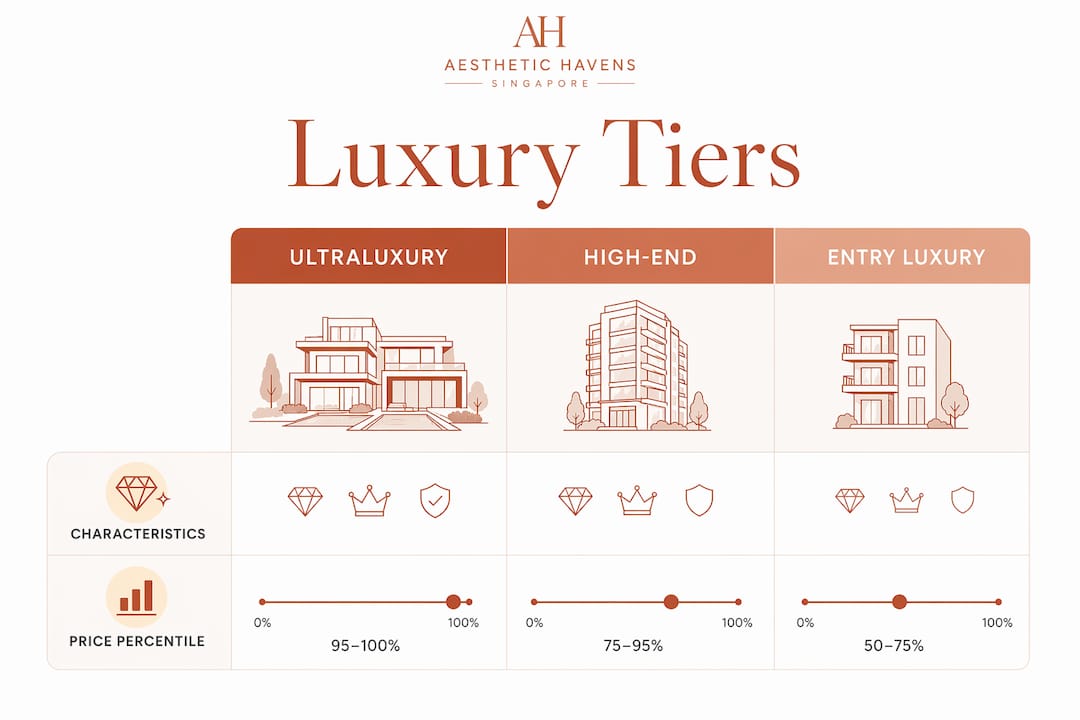
| Luxury level | Key characteristics | Price percentile |
|---|---|---|
| Entry luxury | Quality finishes, desirable zip code | Top 10% |
| Mid luxury | Custom design, premium location | Top 7–8% |
| High-end luxury | Architectural distinction, rare amenities | Top 5% |
| Upper luxury | Gated communities, concierge services | Top 3% |
| Ultraluxury | Private estates, trophy locations | Top 1% |
Pro Tip: Always ask a local agent for the 90th, 95th, and 99th percentile price thresholds in your specific target market before setting a budget. National figures will mislead you in high-cost metros like San Francisco or New York.
What features and qualities define luxury homes beyond price?
Price gets a property into the conversation. Design and exclusivity close the deal. Luxury homes are distinguished by architectural integrity, meaning the structure was conceived with intention rather than assembled from builder-grade templates. Custom millwork, natural stone, and materials sourced for longevity signal genuine luxury. A high price tag on a generic floor plan does not.
Exclusivity is a structural feature in the truest luxury properties. Ultraluxury markets are often physically constrained by mountains, coastlines, or protected zoning, which limits supply and preserves value. Tax and estate planning considerations also concentrate ownership in these zones, creating a private network of buyers who transact with discretion and control over timing.
Lifestyle compatibility defines what luxury means to each buyer. A ski-in property in Montana and a penthouse above Central Park both qualify as luxury, but they serve entirely different lives. The best luxury real estate supports specific lifestyles through proximity to trail systems, private social venues, outdoor living infrastructure, and curated views. Buyers who ignore lifestyle fit and focus only on price tend to resell within five years.
Common features found across luxury properties include:
- Private outdoor spaces: Infinity pools, landscaped gardens, rooftop terraces, and direct beach or trail access
- High-specification kitchens: Professional-grade appliances, custom cabinetry, and butler’s pantries
- Smart home integration: Automated climate, lighting, and security systems built into the architecture
- Primary suite quality: Spa-caliber bathrooms, walk-in wardrobes with custom storage, and private sitting areas
- Privacy infrastructure: Gated entries, mature screening hedges, and soundproofed construction
- Dedicated wellness spaces: Home gyms, saunas, wine cellars, and home theaters
- Architectural provenance: Named architects, heritage listings, or award-winning design credentials
The shift away from pure scale is real. Buyers now prioritize craftsmanship and intentional design over raw square footage. A 4,000-square-foot home with exceptional materials and a considered floor plan consistently outperforms a 7,000-square-foot McMansion in both buyer satisfaction and resale trajectory. Size is no longer the proxy for quality it once was.
How have market dynamics reshaped luxury real estate in 2026?
The luxury property market has corrected meaningfully since its 2023 peak. The national luxury threshold fell for 26 consecutive months year over year before the pace of decline slowed to 1.4% in may 2026, down from declines exceeding 5% in early 2025. That deceleration signals stabilization rather than continued freefall.
Luxury real estate has largely decoupled from the broader housing market. While entry-level and mid-market homes remain constrained by mortgage rate sensitivity, luxury buyers transact with cash or large down payments, insulating the segment from rate-driven demand swings. This structural difference makes the luxury segment behave more like a private asset class than a consumer housing market.
Intergenerational wealth transfers are reshaping who buys luxury property and why. Younger buyers entering the luxury tier often arrive with inherited capital rather than earned income, which changes their priorities. They favor properties with design integrity, sustainability credentials, and locations that reflect personal identity rather than inherited status markers.
The Bay Area illustrates how localized economic forces create their own luxury micro-markets. AI company liquidity events from firms such as OpenAI and Stripe have kept down payments for homes near $3 million approximately 6.6 percentage points above pre-pandemic levels in that region. That premium does not exist in other tech-adjacent metros, which shows how a single industry cluster can sustain a luxury tier that broader market corrections cannot touch.
“Luxury real estate is no longer defined by size but by three pillars: policy, architectural design integrity, and changing buyer behavior favoring craftsmanship over scale. The McMansion era is over. Buyers now seek intention and integrity in every square foot.”
Source: In Real Estate, What Is ‘Luxury’?
The Singapore luxury real estate market reflects similar dynamics internationally, where policy-driven supply constraints and high-net-worth demand combine to create a segment that operates by its own rules. Understanding these forces is what separates informed buyers from those who overpay for the wrong reasons.
How can buyers and investors identify true luxury real estate?
Identifying genuine luxury requires evaluating price within its local percentile context first. A property priced at $900,000 in a market where the 90th percentile sits at $850,000 qualifies as luxury by market standards. The same property in a market where the 90th percentile is $2.5 million does not. Local percentile thresholds provide the most objective starting point.
Architectural and design quality assessment comes next. Buyers should look for materials that age well, floor plans that serve daily life without wasted space, and construction details that reflect skilled labor rather than speed-to-market building. A free home valuation from a specialist familiar with luxury benchmarks can confirm whether a property’s price reflects genuine quality or simply a premium zip code.
Lifestyle fit is the factor most buyers underweight. Proximity to the amenities that matter to you specifically, whether that is a private marina, a world-class school district, or a protected natural reserve, determines long-term satisfaction more reliably than any specification sheet. Buyers who work with luxury-focused advisors report higher satisfaction because those advisors filter for lifestyle alignment, not just price range.
Use these criteria to evaluate any property claiming luxury status:
- Percentile position: Does the price rank in the top 10% of the local market?
- Design provenance: Was the home designed by a recognized architect or built to a documented standard?
- Material quality: Are finishes natural, durable, and sourced from reputable suppliers?
- Location scarcity: Is the site geographically constrained or protected from overdevelopment?
- Privacy standard: Does the property offer genuine separation from neighboring structures?
- Lifestyle alignment: Does the location support your specific daily and recreational priorities?
- Resale trajectory: Has the property or comparable properties in the area held value through market corrections?
Pro Tip: Ask for the price history of comparable sales in the top 10% of the local market over the past five years. Properties that held value through the 2023–2025 correction period demonstrate the kind of resilience that defines true luxury, not just high price.
The shift toward design integrity and craftsmanship has also made smaller, well-executed properties competitive with larger estates. Buyers who focus on quality per square foot rather than total square footage consistently make stronger long-term investments.
Key Takeaways
Luxury real estate is defined by price percentile position, architectural quality, exclusivity, and lifestyle value, not by any single price point or square footage threshold.
| Point | Details |
|---|---|
| Price percentile defines entry | The top 10% of local home prices sets the entry-level luxury threshold, not a fixed national number. |
| Three core tiers structure the market | Top 10% is entry luxury, top 5% is high-end, and top 1% is ultraluxury, each with distinct quality standards. |
| Design beats size in 2026 | Buyers now prioritize craftsmanship and intentional floor plans over raw square footage. |
| Local context is everything | A $1.3M home qualifies as luxury in some metros and falls short in others based on local percentiles. |
| Lifestyle fit drives long-term value | Properties aligned with buyer lifestyle priorities outperform in both satisfaction and resale trajectory. |
Why the luxury definition matters more than the price tag
I have watched buyers fixate on a price number and miss the actual point of luxury entirely. The clients who come to me asking “what is the most expensive property available” are asking the wrong question. The right question is: “Which property in this market represents the top tier of quality, exclusivity, and lifestyle alignment for my specific situation?”
The shift I have seen most clearly over the past few years is the rejection of scale as a status signal. Buyers who once wanted the largest home on the street now want the most considered one. They ask about the architect. They ask about the materials. They ask whether the floor plan actually serves how they live. That is a meaningful change, and it reflects a more sophisticated understanding of what luxury real estate actually delivers.
The AI-driven wealth concentration in markets like the Bay Area is a real phenomenon, but it is also a reminder that luxury markets are always local. What drives value in San Francisco has no bearing on what drives value in Singapore or Miami. Buyers who treat luxury as a universal category make expensive mistakes. Those who understand the local percentile structure, the design standards, and the lifestyle infrastructure of a specific market make decisions that hold up over time.
My advice: focus on lasting value over transient trends. A well-built home in a geographically constrained location with genuine design integrity will outperform a flashy property in an oversupplied market every single time.
— Aman
How Aesthetic Havens guides luxury property buyers
Navigating the luxury property market requires more than a price filter and a wish list. Aesthetic Havens works with buyers and investors who want to understand what genuinely qualifies as luxury in their target market, whether that is Singapore, international destinations, or emerging high-value corridors.

The team at Aesthetic Havens brings market-specific knowledge of percentile thresholds, design standards, and lifestyle factors that determine real value in the high-end segment. For business owners and investors who need a structured approach to property transactions, the property sales workflow resource outlines the full process from evaluation to completion. Buyers who want to select investment property with confidence will find practical frameworks built on current market data. Reach out to Aesthetic Havens to discuss your specific criteria and get guidance grounded in real market intelligence.
FAQ
What is the minimum price for luxury real estate in the U.S.?
The national entry point for luxury real estate in the U.S. is approximately $1,283,432 as of may 2026, representing the 90th percentile of home prices. This threshold varies significantly by metro area.
How is luxury real estate different from regular high-priced homes?
Luxury real estate combines price percentile position with architectural quality, exclusivity, and lifestyle value. A high price alone does not qualify a property as luxury if it lacks design integrity or location scarcity.
What are the three main tiers of luxury real estate?
The three tiers are entry-level luxury (top 10% of local prices), high-end luxury (top 5%), and ultraluxury (top 1%). Nationally, these correspond roughly to $1.3 million, $2 million, and $5.5 million price points.
Why does luxury real estate vary so much by location?
Local income levels, geographic constraints, and demand from specific buyer pools all shift what qualifies as luxury in a given market. A property priced as luxury in one city may fall below the threshold in a higher-cost metro.
Is investing in luxury real estate a good strategy in 2026?
Luxury real estate has shown resilience through recent corrections, with price declines slowing to 1.4% year over year by may 2026. Properties in geographically constrained markets with strong design credentials have held value better than oversupplied suburban estates.
Recommended
- Singapore Luxury Real Estate 2025: The Ultimate HNWI Guide to Market Trends, Desired Features & Premier Developments | Aesthetic Havens
- Downsizing with Style: Why Luxury Boutique Launches are Attracting Empty Nesters | Aesthetic Havens
- New Launch vs Resale 2026: Singapore Property Market Guide | Aesthetic Havens
- The Upperhouse Singapore | Aesthetic Havens


