


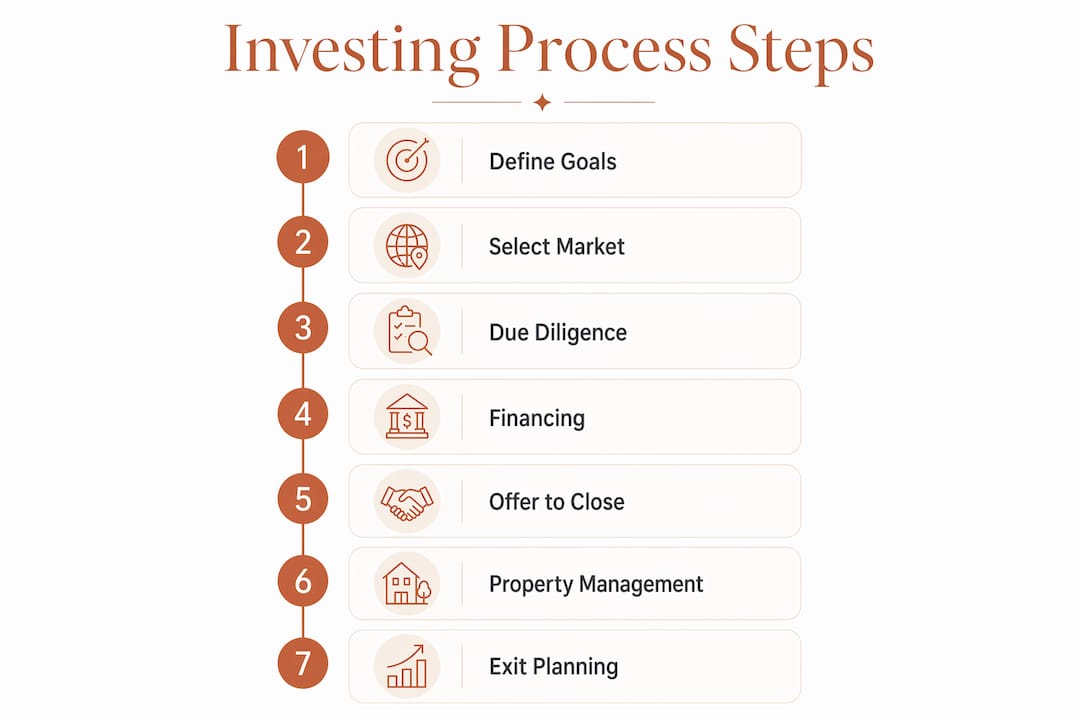
The international real estate investing process is the step-by-step approach investors use to purchase and manage property abroad while controlling risk and building returns. Cross-border property investment, known formally as foreign direct real estate investment, demands more than capital. It requires market research, legal due diligence, currency risk management, and a clear exit plan. Investors who master each stage enter foreign markets with confidence rather than guesswork. This guide walks you through every critical phase, from setting your goals to closing the deal and managing the asset long term.
What does the international real estate investing process involve?
The international property investment process begins with one question: what do you want this investment to do for you? Capital growth, rental income, portfolio diversification, and lifestyle use are four distinct goals, and each one points you toward a different market and property type. Mixing up these goals at the start is the single most common reason investors end up with the wrong asset in the wrong country.
Once you define your objective, market selection follows a structured analysis. A thorough market health check analyzes economic indicators and local dynamics rather than just price charts, using data from central banks and national statistics offices. GDP growth, urbanization rates, and population trends tell you whether demand for property is structural or speculative. Speculative demand fades. Structural demand does not.

Foreign ownership rules add another filter. Some countries restrict non-resident ownership to condominiums or specific zones. Others require joint ventures with local partners. Understanding how countries structure ownership rights for foreign investors is fundamental to protecting your asset and keeping the investment viable.
| Evaluation factor | Why it matters |
|---|---|
| GDP growth rate | Signals economic health and long-term demand |
| Urbanization trend | Drives rental demand in city centers |
| Foreign ownership rules | Determines what you can legally buy and hold |
| Political and legal stability | Protects title security and contract enforcement |
| Currency convertibility | Affects repatriation of rental income and sale proceeds |
Pro Tip: Prioritize countries with stable legal systems and transparent land registries. Markets where title disputes are common can tie up your capital for years in local courts.
What legal and financial due diligence steps are required?
Legal due diligence for overseas property goes well beyond a physical inspection. Title deed verification, lien checks, and local planning permissions are the three non-negotiable starting points. A property can look perfect and still carry an undisclosed mortgage, a disputed boundary, or a zoning restriction that prevents rental use.
The most critical rule in this phase: never use the seller’s solicitor or the developer’s recommended lawyer. That arrangement creates a direct conflict of interest. You need independent legal representation whose only obligation is to you. The additional cost is minor compared to the risk of missing a fatal title defect.
Anti-money laundering compliance adds another layer of friction. Many jurisdictions now require 6-month bank statements to prove the origin of funds at the point of registration. Prepare this documentation early. Delays at the compliance stage can stall a deal after contracts are signed, which puts your deposit at risk.
Currency risk is the most underestimated cost in cross-border deals. Exchange rates can shift significantly between the day you agree on a price and the day you transfer funds. Engaging an FX specialist early lets you lock in a forward contract, protecting your real purchase price from adverse moves.
Financing options for international buyers fall into three main categories: specialist international lenders, local banks in the target country, and equity release against existing property. The right choice depends on the currency of the rental income, the currency of the loan, and your intended holding period. A mismatch between loan currency and income currency creates ongoing FX exposure that compounds over time.
| Financing route | Best suited for | Key risk |
|---|---|---|
| Specialist international lender | Investors with no local credit history | Higher interest rates |
| Local bank in target country | Long-term holders with local income | Requires local documentation |
| Equity release on existing property | Investors with significant home equity | Increases exposure on primary asset |
Pro Tip: Coordinate your legal due diligence timeline with your financing approval timeline. Losing a deposit because financing fell through after the due diligence window closed is an avoidable and expensive mistake.
What are the key steps from offer to closing?
The transactional sequence in an international property purchase follows a predictable structure, though the terminology and legal formalities vary by country. Knowing the sequence prevents you from being rushed through stages you do not fully understand.
The process typically moves through these milestones:
- Formal offer submission. Submit a written offer with your proposed price, conditions, and timeline. In many markets, verbal offers carry no legal weight.
- Preliminary contract (reservation or pre-contract agreement). This locks in the price and removes the property from the market. A deposit, typically 5%–10%, is paid at this stage.
- Due diligence period. Your independent solicitor completes title checks, lien searches, and planning permission reviews. This is your window to withdraw without full penalty if a defect is found.
- Final purchase contract. Signed before a notary or equivalent authority in the target country. This is the legally binding transfer of ownership.
- International funds transfer. Coordinate the transfer to arrive on the exact date specified in the contract. Late transfers can trigger penalty clauses or void the agreement.
- Title registration. Your solicitor registers the transfer with the local land registry. Until this step is complete, the ownership change is not legally recognized.
Timing is the most common failure point in this sequence. Investors underestimate how long international wire transfers take, especially when compliance checks are involved. Build a buffer of at least two to three business days into every payment deadline. Use the investment checklist framework to track each milestone and its associated document requirements.
How do you manage property, taxes, and exit strategies abroad?
Owning property abroad does not end at closing. The ongoing management phase determines whether the investment actually performs. Remote property management requires a trusted local manager who handles rent collection, maintenance coordination, and tenant relations. Without reliable local oversight, property upkeep deteriorates and rental income becomes inconsistent.
Tax obligations in foreign markets are multi-layered. Rental income tax, capital gains tax, and local compliance requirements each affect your net return. Many countries also require non-resident landlords to file annual tax returns locally, separate from any obligations in their home country. Ignoring these requirements creates penalties that erode returns over time.
Key management and tax action items for international investors:
- Appoint a licensed local property manager before the first tenant moves in.
- Confirm whether your home country has a double taxation agreement with the target country to avoid being taxed twice on rental income.
- Track all capital improvements, as these typically reduce your taxable capital gain on exit.
- Set aside a maintenance reserve of at least 1% of the property value annually.
- Review your exit timeline annually against local market conditions and tax thresholds.
Exit planning starts at acquisition, not when you decide to sell. The role of property management in preserving asset value directly affects your resale price. Markets with strong institutional interest, such as Poland’s private rented sector where NOI yields reached 6.3% in 2026, attract professional buyers who pay a premium for well-managed assets. A poorly maintained property in the same market sells at a discount regardless of location.
For investors who want to mitigate investment risks across their portfolio, documenting every management decision and expense creates a clean record that supports both tax filings and future sale negotiations.
Key Takeaways
The international real estate investing process succeeds when investors combine clear goals, independent legal advice, disciplined currency management, and reliable local property oversight from the start.
| Point | Details |
|---|---|
| Define goals first | Capital growth, rental income, and lifestyle use each require a different market and asset type. |
| Use independent legal counsel | Never rely on the seller’s solicitor. Independent advisers catch title defects and protect your deposit. |
| Manage currency risk early | Engage an FX specialist before signing contracts to lock in your purchase price against exchange rate moves. |
| Coordinate timing precisely | Align legal due diligence, financing approval, and fund transfers to avoid deposit loss or contract penalties. |
| Plan tax and exit from day one | Track rental income tax, capital gains obligations, and local compliance requirements throughout the holding period. |
What I’ve learned from watching investors get this wrong
The most expensive mistakes I see in cross-border deals share one root cause: investors treat the international property buying process like a domestic purchase with extra paperwork. It is not. The legal frameworks, tax structures, and banking systems in foreign markets operate on entirely different assumptions.
The investors who do well are the ones who slow down at the due diligence stage. I have seen deals where a title search revealed an undisclosed mortgage that the seller “forgot” to mention. I have seen investors lose deposits because their bank transfer arrived two days late due to compliance holds they did not anticipate. These are not rare edge cases. They are predictable outcomes when the process is rushed.
Currency management is where I see the most consistent underestimation. An investor agrees on a price in euros, then watches the exchange rate move 4% against them before closing. That is a significant loss on a property that has not even generated a day of rental income yet. Working with an FX specialist who understands property transaction timelines is not optional. It is a basic cost of doing this properly.
My honest advice: budget 10%–15% above the purchase price for transaction costs, legal fees, taxes, and contingencies. Investors who budget tight get surprised. Investors who budget with a buffer close deals cleanly and start earning returns faster.
— Aman
Working with a property consultant on your international investment
Navigating a foreign real estate transaction alone is possible. Doing it well, consistently, is much harder without professional support.

At Aesthetic Havens, we work with investors at every stage of the overseas property investment process, from initial market selection through legal coordination, financing guidance, and post-purchase management planning. Our role is to represent your interests, not the seller’s. That distinction matters enormously in cross-border deals where conflicts of interest are common and the stakes are high. If you want to understand exactly what a property consultant does for international investors and how that translates into protected capital and better returns, start there. The right guidance does not add cost to your investment. It removes the costs that come from getting the process wrong.
FAQ
What is the first step in the international property investment process?
The first step is defining your investment objective clearly, whether that is capital growth, rental income, diversification, or lifestyle use. Your goal determines which markets and property types are worth analyzing.
How do I protect myself legally when buying property abroad?
Hire an independent solicitor who has no connection to the seller or developer. Independent legal advisers verify title deeds, check for liens, and confirm planning permissions without any conflict of interest.
What is the biggest financial risk in overseas property investment?
Currency volatility is consistently underestimated. Exchange rate moves between contract signing and fund transfer can significantly increase your effective purchase price. Engaging an FX specialist early mitigates this risk.
Do I need to pay taxes in both my home country and the target country?
Potentially yes, unless a double taxation agreement exists between the two countries. Confirm this with a tax adviser before committing to a market, as the combined tax burden affects your net return.
How do I manage a rental property in another country?
Appoint a licensed local property manager before your first tenant moves in. Reliable local managers handle rent collection, maintenance, and tenant relations, which preserves asset value and keeps income consistent.


