


A new launch in Singapore is defined as a private residential development or executive condo sold directly by the developer before or shortly after receiving its sales permit. This guide to Singapore new launches covers everything buyers and investors need to make a confident decision in 2026. The market this year presents a tighter supply picture: approximately 17 projects totaling 8,100 units are expected, a 30% drop from the 11,000-plus units launched in 2025. That reduction matters because it concentrates demand around fewer projects, pushing take-up rates higher and leaving less room for hesitation. Key developments like Springleaf Residence in District 26, Vela Bay in the emerging Bayshore precinct, and UPPERHOUSE in the central region are already drawing strong interest from buyers and investors alike.
What are the key factors to consider before buying a new launch?
Buying a new launch property is not the same as buying a resale unit. The process starts earlier, moves faster, and carries financial commitments that extend years into the future.
Financial readiness comes first. Before you attend any showflat, calculate your Total Debt Servicing Ratio (TDSR), which caps your total monthly debt repayments at 55% of gross monthly income. Your Central Provident Fund (CPF) Ordinary Account savings can fund part of the down payment and monthly installments, but you need to know exactly how much is available. Securing an In-Principle Approval (IPA) from a bank before launch day is non-negotiable. Without an IPA, you risk booking a unit and then discovering you cannot secure the loan amount you need.

Eligibility rules differ by property type. Singapore citizens and permanent residents can buy private condos with fewer restrictions. Executive Condos (ECs) are only available to Singapore citizens who meet HDB income and household eligibility requirements. ECs typically cost 20%–30% less than comparable private condos at launch, making them a strong option for HDB upgraders. That price gap closes over time as ECs privatize after 10 years.
Developer credibility is a real risk factor. Research the developer’s track record on past project timelines, construction quality, and defect rectification. Delays in Temporary Occupation Permit (TOP) dates directly affect your progressive payment schedule and your plans for moving in or renting out the unit.
- Obtain your IPA before attending any launch event
- Confirm CPF usage limits for your chosen property type
- Check the developer’s past project delivery record on the Urban Redevelopment Authority (URA) website
- Understand the Additional Buyer’s Stamp Duty (ABSD) applicable to your citizenship status and property count
- Review the Singapore mortgage affordability guide before committing to any price range
Pro Tip: Request the developer’s breakeven price estimate from your agent before the launch. If the launch price sits far above breakeven, your upside is limited from day one.
How do you identify the best Singapore new launch condos in 2026?
Shortlisting the right project requires more than liking the showflat. Location, pricing, developer quality, and future area plans all determine whether a project delivers value.
Comparing projects by region
Singapore’s private residential market divides into three regions: the Outside Central Region (OCR), the Rest of Central Region (RCR), and the Core Central Region (CCR). Each serves a different buyer profile.
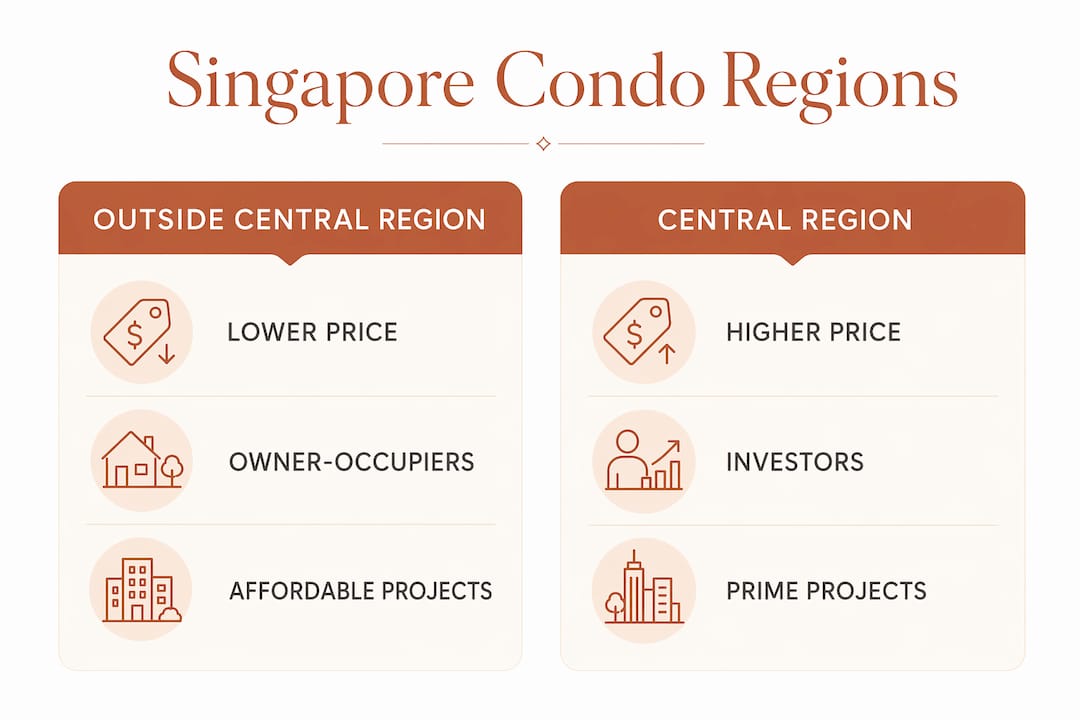
| Region | Typical Price PSF | Buyer Profile | Key 2026 Projects |
|---|---|---|---|
| OCR | Lower | Owner-occupiers, HDB upgraders | Springleaf Residence (District 26) |
| RCR | Mid-range | Investors, upgraders | UPPERHOUSE |
| CCR | Highest | High-net-worth, investors | Selected boutique launches |
OCR projects like Springleaf Residence offer more affordable entry points. Springleaf Residence is a 473-unit, 99-year leasehold development with an estimated TOP in 2028. Its location near the upcoming Springleaf MRT station on the Thomson-East Coast Line gives it strong connectivity credentials. RCR and CCR projects command higher prices per square foot but tend to attract stronger rental demand from expatriates and corporate tenants.
Evaluating Vela Bay and the Bayshore precinct
Vela Bay is the first private residential development in the Bayshore precinct, offering 515 units with direct access to Bayshore MRT and sea-facing views toward East Coast Park. The URA Master Plan designates Bayshore as a new waterfront residential district, which means infrastructure and amenity investment will continue for years. Buyers who enter early capture the benefit of area transformation before prices adjust upward.
Several 2026 new launch projects recorded take-up rates above 90% on their opening weekends. That pace of absorption signals that well-priced projects in good locations do not stay available for long.
Pro Tip: Cross-reference a project’s launch price against the developer’s estimated breakeven cost. Projects priced significantly above breakeven carry higher risk of limited capital appreciation in the short term.
What is the step-by-step process to buy a new launch in Singapore?
The purchase process for a new launch follows a defined sequence. Missing any step can cost you a unit or create financial complications later.
-
Complete your financial assessment. Calculate your TDSR, confirm CPF savings available, and obtain your IPA from a bank. This sets your firm budget ceiling before you look at any project.
-
Register for showflat visits. Developers release appointment slots before launch day. Register early because popular projects fill slots within hours. Bring your IPA letter and identification documents.
-
Attend the launch and select your unit. On launch day, you choose your preferred unit from the available stack. Decisions happen quickly. Know your preferred floor, facing, and layout before you arrive.
-
Pay the booking fee. The standard booking fee is 5% of the purchase price, paid by cashier’s order or bank transfer. This secures your unit and triggers the issuance of the Option to Purchase (OTP).
-
Sign the Sales and Purchase Agreement (S&P). You have 21 days from the OTP date to exercise it by signing the S&P and paying an additional 15% of the purchase price (minus the booking fee already paid). Engage a conveyancing lawyer immediately after booking.
-
Manage progressive payments. New launches use a Progressive Payment Scheme (PPS), where loan drawdowns align with construction milestones. This means you pay interest only on the amount drawn down, not the full loan. Progressive payment schemes save buyers approximately S$30,000–S$60,000 in interest compared to full loan drawdowns on resale purchases.
-
Prepare for TOP and legal completion. When the project receives its TOP, you conduct a defect inspection and take possession. Final legal completion follows shortly after.
- Keep a copy of every payment receipt and correspondence with the developer
- Appoint your lawyer before signing anything, not after
- Understand the differences between new launches and resale before committing to either path
What are the common mistakes to avoid when buying new launch condos?
Buyers who rush into new launches without preparation tend to repeat the same errors. Recognizing these patterns protects both your money and your peace of mind.
-
Ignoring developer breakeven pricing. Developer pricing reflects land and construction costs, and projects launched at a steep premium above breakeven leave little room for early capital gains. Always ask your agent for a breakeven analysis before committing.
-
Underestimating total financial obligations. The purchase price is only part of the cost. Stamp duties, legal fees, renovation costs, and monthly loan repayments during construction all add up. Build a full cost model before booking.
-
Buying based on showflat emotion. Showflats are designed to impress. The actual unit will differ in furnishing, finishes, and sometimes layout. Always request the actual floor plan and visit the site location separately.
-
Overlooking leasehold term implications. A 99-year leasehold property loses financing eligibility as the lease shortens. Banks typically reduce loan-to-value ratios for properties with fewer than 60 years remaining. Factor this into your long-term exit strategy from day one.
-
Skipping URA Master Plan research. The URA Master Plan reveals planned infrastructure, zoning changes, and new amenities for every district. A project near a future MRT station or commercial hub carries different appreciation potential than one in a static area.
Pro Tip: Check the Singapore property market forecast before finalizing your purchase. Buying into a market cycle peak without understanding the broader trend is the single most avoidable mistake.
What investment considerations matter most for Singapore new launches?
New launches attract investors because they combine progressive payment benefits with the potential for capital appreciation before TOP. But not every project delivers equal returns.
-
Location transformation is the primary driver of appreciation. Projects in precincts undergoing URA-planned development, like Bayshore or Marina South, benefit from a rising tide of infrastructure investment. The first-mover advantage in emerging precincts is real, but it requires patience. Area transformation under URA master plans takes years, not months.
-
Rental demand varies sharply by location and unit type. CCR and RCR projects near business districts, international schools, and MRT lines command stronger rental yields. Smaller units (one-bedroom and two-bedroom) in these zones attract expatriate tenants and generate more consistent rental income than larger suburban units.
-
Developer reputation affects resale value. Buyers in the secondary market pay a premium for projects built by established developers with strong delivery records. A well-regarded developer name on the title deed is a tangible asset at resale.
-
Lease tenure shapes long-term returns. Freehold properties carry a pricing premium at launch but retain financing eligibility longer. Leasehold projects offer lower entry prices but require a more disciplined exit timeline to avoid the depreciation curve in later decades.
“The best new launch investment is not the one with the most impressive showflat. It’s the one where the location story, the developer’s track record, and the entry price all align in your favor.”
Investors should also review the upcoming new launches pipeline to understand how supply in specific districts affects both launch pricing and future resale competition.
Key Takeaways
Buying a new launch in Singapore in 2026 requires financial preparation, project analysis, and a clear understanding of the purchase process before you step into any showflat.
| Point | Details |
|---|---|
| Supply is tighter in 2026 | Only 8,100 units across 17 projects means strong competition for well-priced units. |
| IPA is non-negotiable | Secure your In-Principle Approval before attending any launch event or showflat. |
| Progressive payments save money | Buyers save S$30,000–S$60,000 in interest compared to full loan drawdowns on resale. |
| Location transformation drives returns | Projects in URA-designated growth precincts like Bayshore offer first-mover upside. |
| Breakeven pricing reveals true value | Always compare launch price to developer breakeven before committing to a purchase. |
My honest take on Singapore’s 2026 new launch market
I have watched buyers make the same mistake repeatedly: they fall in love with a showflat and skip the analysis. The 2026 market is unforgiving of that approach. With supply down 30% and take-up rates above 90% at several launches, the window to make a considered decision is shorter than ever.
What I tell every client is this: the progressive payment scheme is one of the most underappreciated financial tools in Singapore real estate. Saving S$30,000–S$60,000 in interest during construction is not a minor footnote. It is a real financial advantage that resale buyers simply do not get.
The Bayshore precinct genuinely excites me as a long-term play. Vela Bay’s position as the first mover in a URA-designated waterfront district mirrors what we saw in Punggol and Tengah in their early phases. Patience is required, but the structural case is strong.
My honest advice: balance your lifestyle goals with your investment thesis. A unit you can live in comfortably and rent out easily is almost always a better choice than a pure speculative bet on an unproven location. Use the URA Master Plan as your map, not the developer’s marketing brochure.
— Aman
Ready to find your ideal new launch in Singapore?
Navigating Singapore’s new launch market alone is possible, but it costs time and often money. A trusted property consultant gives you access to launch allocations, breakeven pricing data, and developer track records that are not publicly available. At Aesthetic Havens, Aman Aboobucker and the ERA Realtors team specialize in matching buyers and investors with the right new launch projects based on budget, eligibility, and investment goals.

Whether you are a first-time buyer looking at ECs or an investor targeting the Bayshore precinct, the team provides end-to-end support from IPA guidance to unit selection and S&P review. Understanding why a property consultant adds value at every stage of the purchase process is the first step toward a smarter decision.
FAQ
What is a new launch condo in Singapore?
A new launch condo is a private residential development sold directly by the developer, typically before or shortly after construction begins. Buyers purchase units off-plan and follow a progressive payment schedule tied to construction milestones.
How many new launch projects are available in Singapore in 2026?
The 2026 pipeline includes approximately 17 private residential projects totaling around 8,100 units, a 30% reduction compared to the 11,000-plus units launched in 2025.
What is the advantage of the progressive payment scheme?
The progressive payment scheme ties loan drawdowns to construction stages, meaning buyers pay interest only on amounts drawn. This saves buyers approximately S$30,000–S$60,000 in interest compared to full loan drawdowns on resale purchases.
Are executive condos a good alternative to private new launches?
ECs cost 20%–30% less than comparable private condos at launch and offer CPF and financing benefits for eligible Singapore citizens. They privatize after 10 years, after which they can be sold on the open market like any private property.
What do agent commissions look like for new launch purchases?
New launch commissions have normalized to around 2%, paid by the developer, not the buyer. This means buyers who use an agent for a new launch purchase pay no direct commission.
Recommended
- New Launch vs Resale 2026: Singapore Property Market Guide | Aesthetic Havens
- Singapore New Launch Review: Is Springleaf Residence (District 26) the Best Buy of 2025? | Aesthetic Havens
- Singapore Luxury Real Estate 2025: The Ultimate HNWI Guide to Market Trends, Desired Features & Premier Developments | Aesthetic Havens
- Upcoming New Launches In Singapore for Q1 2025 | Aesthetic Havens


