

Introduction
The Singapore asset progression roadmap is a structured wealth-building strategy that moves homeowners through successive property upgrades-from HDB flat to private condo to landed house-and then, when timing is right, into strategic right-sizing. If you’re searching for “the Singapore asset progression roadmap HDB condo landed right sizing explained,” you’re looking for a practical, stage-by-stage plan that accounts for regulations, realistic budgets, and life-stage triggers under current market conditions.
Here is the core answer: a typical roadmap begins with a public housing flat (usually a Build-To-Order flat) in your late 20s, transitions to a mass-market or city-fringe private condo in your 30s to early 40s after clearing MOP, and then-for households with sufficient income and equity-moves to landed property in the 40s to 50s. At each stage, asset progression leverages capital appreciation from the previous property to fund the next upgrade. Eventually, many homeowners right-size in their 50s to 60s to convert property equity into liquidity for retirement, passive income, and a simpler lifestyle.
Why does this matter now? Between 2024 and 2026, elevated ABSD rates, longer MOP for Plus/PLH HDB flats (now 10 years), Total Debt Servicing Ratio caps, and higher interest rates all make sequencing and financial planning more consequential than ever. A mistimed upgrade or overlooked CPF accrued interest obligation can turn a wealth-building move into a costly setback.
Key takeaways you’ll gain from this guide:
-
Typical budgets at each step-HDB, condo, landed-based on 2024–2026 property prices and transaction costs
-
The main regulatory triggers every upgrader must know: MOP, ABSD tiers, TDSR, and LTV limits
-
Realistic timelines for each transition, from early stage planning to execution
-
How right-sizing fits into retirement and legacy planning to help you retire comfortably
-
A step-by-step process to design your personal roadmap, whether you stop at condo, go landed, or diversify into industrial property
Understanding Asset Progression in Singapore
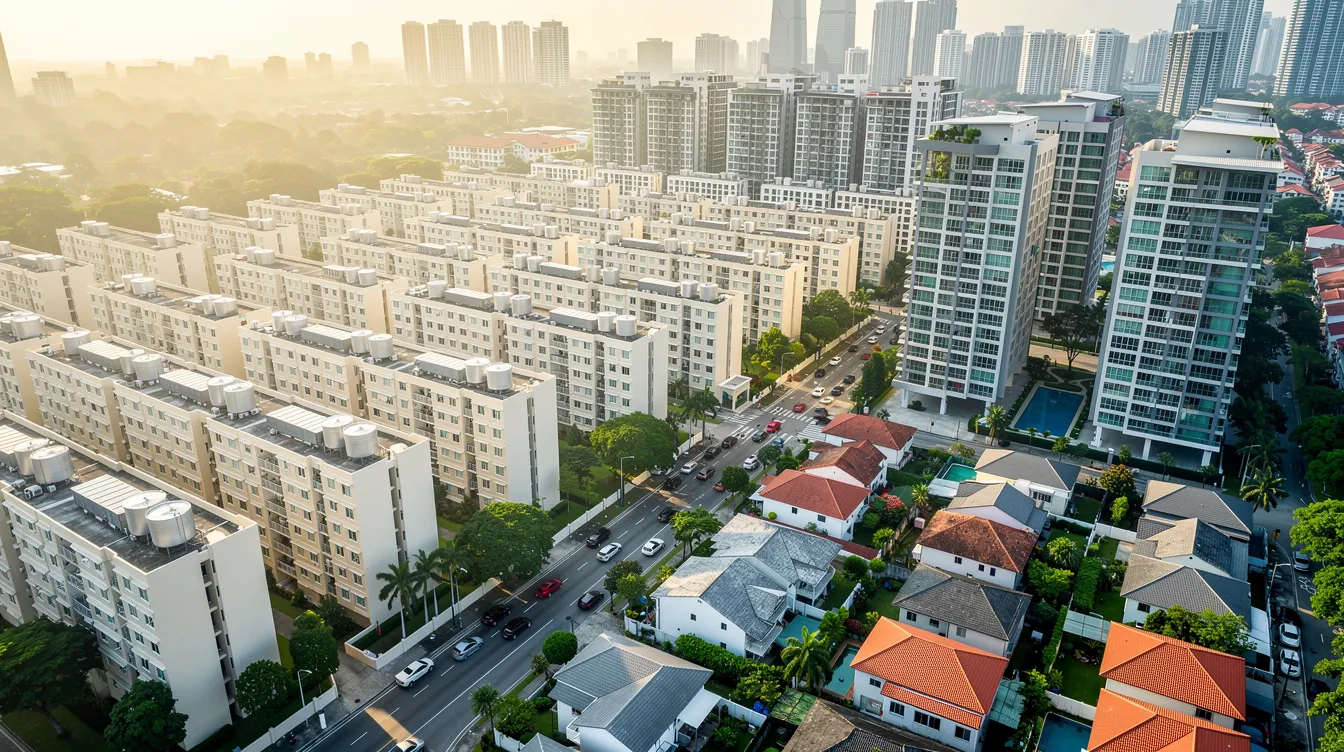
Asset progression means systematically upgrading or restructuring your property portfolio across your lifetime to grow net worth, improve your living situation, and manage cashflow risk. In Singapore’s context-where public housing accounts for about 84% of residents and only 15.9% of property owners hold private property-moving from HDB to condo to landed is a deliberate, multi-decade plan rather than a lucky windfall.
This differs sharply from speculative flipping. Asset progression involves longer holding periods (typically 5–15 years per stage), careful CPF usage, disciplined cash savings, and alignment with life-stage needs like family size, children’s schooling, and retirement. Property prices and transaction costs can impact the roadmap’s effectiveness at every stage, so each move must be stress-tested against income stability, interest rate changes, and regulatory shifts.
From AESTHETIC HAVENS’ perspective, homes are both shelter and balance-sheet assets. For business owners, residential property sits alongside industrial, commercial, or warehouse assets that serve operational purposes. A complete wealth accumulation strategy coordinates all these pieces-not just the house you sleep in.
Core Pillars of a Singapore Asset Progression Plan
Before any upgrade from HDB to condo or from condo to landed, four core pillars must be in place:
-
Regulations & Eligibility – MOP durations (5 years standard; 10 years for PLH/Plus/Prime flats), ABSD rates, TDSR at 55% of gross income, and LTV caps (75% for first property with no existing mortgage) define when and how you can move. HDB upgraders must clear a 5-year MOP. ABSD for a second property is 20% for citizens-a cost that can easily exceed six figures.
-
Affordability & Financial Buffers – Downpayments (cash plus CPF), stamp duties, legal fees, renovation, and moving costs must be covered without draining your reserves. Maintaining an emergency fund for rainy days and keeping 6–12 months of mortgage payments in accessible savings is non-negotiable.
-
Time Horizon & Exit Strategy – Understanding when MOP completes, when leasehold age starts eroding valuation, and when children start school shapes your decision window. Each property should have a clear exit plan before you buy it.
-
Risk Diversification – Concentrating all wealth in a single property is dangerous. For some households-especially SME owners-diversifying into industrial or commercial property alongside a modest residential home can generate more stable returns.
A critical but often overlooked factor across all four pillars is CPF accrued interest. When you withdraw CPF OA savings for a property purchase, you must repay CPF accrued interest upon sale-at 2.5% per annum. Over long holding periods, this compounds significantly. For $200,000 in CPF used, it grows to $256,017 in 10 years. Accrued interest increases even after your mortgage is fully paid off, steadily reducing your eventual cash proceeds.
Life Stages and Property Decisions
The typical Singapore household lifecycle maps neatly to property decision points:
-
Mid-20s to early 30s (First HDB): Combined income typically S$6,000–S$10,000 per month. Family size 1–3 (newly married, possibly one young child). Long loan tenures available (25–30 years). Priority is securing affordable entry and building equity through mortgage payments and potential price appreciation.
-
Early 30s to early 40s (First Private Condo): Combined income S$9,000–S$18,000+. Children entering school, space needs growing, MOP completed or approaching. Equity accumulated in the existing HDB flat provides the springboard for upgrading to private property.
-
40s to 50s (Larger Condo or Landed): Household income S$15,000–S$30,000+. Substantial CPF OA balances and condo equity. Children may be in secondary school or JC. Business income stabilising for SME owners. The window for landed entry opens-or for strategic dual-property plays.
-
50s to 60s (Right-Sizing for Retirement): Properties often fully paid or nearly so. Peak CPF balances. Goal shifts from growth to stability, liquidity, and passive income. Downsizing becomes a powerful tool for retirement fund building.
With these life-stage anchors in mind, the next section walks through the actual roadmap-stage by stage, with budgets, regulatory checkpoints, and timelines.
The Singapore Asset Progression Roadmap: HDB → Condo → Landed
This section details the typical sequence of property moves, with indicative budgets and timelines calibrated to 2024–2035 under current rules. Figures are market-based estimates; readers should run personalised scenarios or consult a real estate professional for tailored advice.
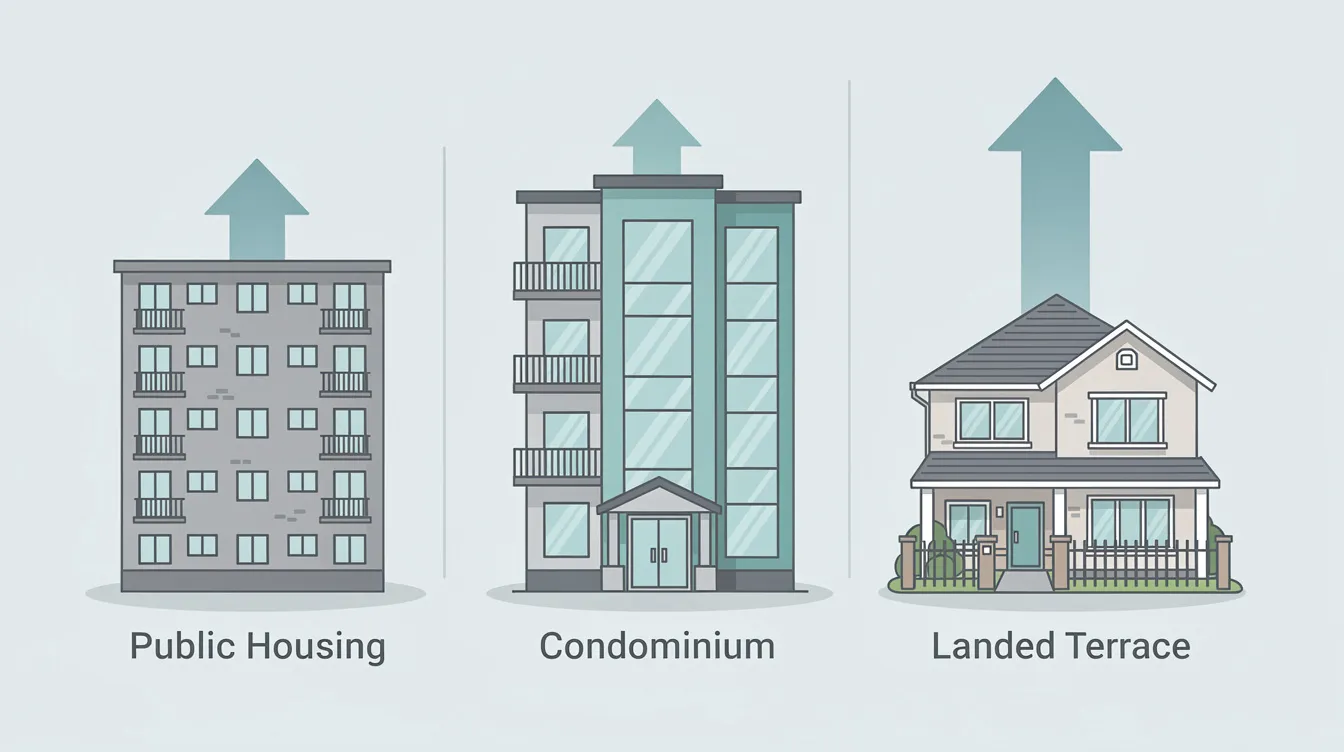
Stage 1: Starting with HDB (Age 25–35, Years 0–10)
Homeowners typically start with a public housing flat, such as a Build-To-Order flat in a non-mature estate. This is the foundation of asset progression-the early stage where equity accumulation builds initial capital through regular mortgage payments and housing value increase.
Typical prices and numbers (2024–2026):
-
4-room BTO in non-mature estates (Tengah, Punggol, Woodlands): approximately S$380,000–S$550,000
-
4-room resale HDB in non-mature estates (Sengkang, Bedok): approximately S$535,000–S$630,000
-
Typical resale flat prices range from $700,000 to $900,000 in mature estates like Queenstown or Bukit Merah
-
Median 4-room resale price across Singapore as of Q3 2026: approximately S$628,000
-
CPF Housing Grants of up to S$80,000 for 4-room or smaller flats can significantly reduce the effective purchase price
Regulatory checkpoints:
-
HDB upgraders need to clear a 5-year MOP before selling. PLH flats require a 10-year MOP before resale-a critical factor for long term planning
-
HDB loan vs bank financing: HDB loan offers up to 80% LTV with more stable interest but slightly higher rates; bank loans offer up to 75% LTV with potentially lower initial rates but more volatility
-
Income ceilings apply for BTO eligibility (approximately S$14,000 for most categories in 2024)
-
HDB owners must repay CPF accrued interest upon sale. CPF accrued interest compounds at 2.5% per annum, and selling your HDB reduces cash proceeds due to this obligation
Strategic goals at this stage:
-
Build equity safely while keeping flexibility to upgrade
-
Manage CPF usage carefully-every single cent withdrawn starts accruing interest immediately, reducing future cash proceeds
-
Monitor HDB prices and new policy announcements annually
-
Begin cash savings for the next property purchase downpayment
-
Avoid over-committing CPF OA savings so that upgrading options remain open
Stage 2: Upgrading from HDB to Private Condo (Age 30–45, Years 8–20)
For most households, moving to a mass-market or city-fringe private condo is the key wealth-building step. Upgrading to private properties allows homeowners to leverage capital appreciation from public housing into a faster-appreciating asset class. Private property prices grew 157% in the past decade-far outpacing HDB resale prices, which have declined by 2.1% annually since 2013.
Typical prices and numbers:
-
OCR mass-market condos (3-bedroom): S$1.2M–S$1.8M
-
RCR city-fringe condominiums (3-bedroom): S$1.8M–S$2.5M
-
Average non-landed private property transaction: approximately S$2.01 million since 2024
-
New launch projects in prime areas command S$5,000–S$6,100 per square foot
-
BSD on a S$1.8M condo: approximately S$49,600; ABSD of 20% (S$360,000) if buying as a second property without selling HDB first
Regulatory checkpoints:
-
To avoid ABSD on a second property, sell your existing HDB flat before or within 6 months of acquiring the private condo to qualify for ABSD remission
-
ABSD for a second property is 20% for citizens-an enormous cost that proper planning can eliminate
-
LTV up to 75% for borrowers with no existing property loan; TDSR capped at 55% of gross household income
-
Existing car loans, business loans, and outstanding loan obligations reduce borrowing capacity under TDSR
-
Total Debt Servicing Ratio caps loan repayments based on income in Singapore’s property market
Strategic goals:
-
Gain exposure to faster-appreciating private market
-
Potential rental income from future investment if retaining a unit
-
En bloc upside over 10–20 years for older developments
-
Asset progression can generate significant profits through property sales when timed to favourable market conditions
Narrative example: A 35-year-old couple in Sengkang sells a 4-room existing HDB flat purchased around 2016 for S$420,000 at a resale price of approximately S$600,000. After refunding CPF funds including accrued interest and paying agent fees, they net roughly S$450,000–S$500,000 in cash proceeds. They target a new launch condo in Tampines at S$1.8M-covering the downpayment with their sale proceeds and CPF OA savings, taking a bank loan for the remainder. Because they sell the HDB within six months, they avoid ABSD entirely and keep their upgrade on track.
Stage 3: Moving from Condo to Landed or Larger Private Home (Age 40–55, Years 15–30)
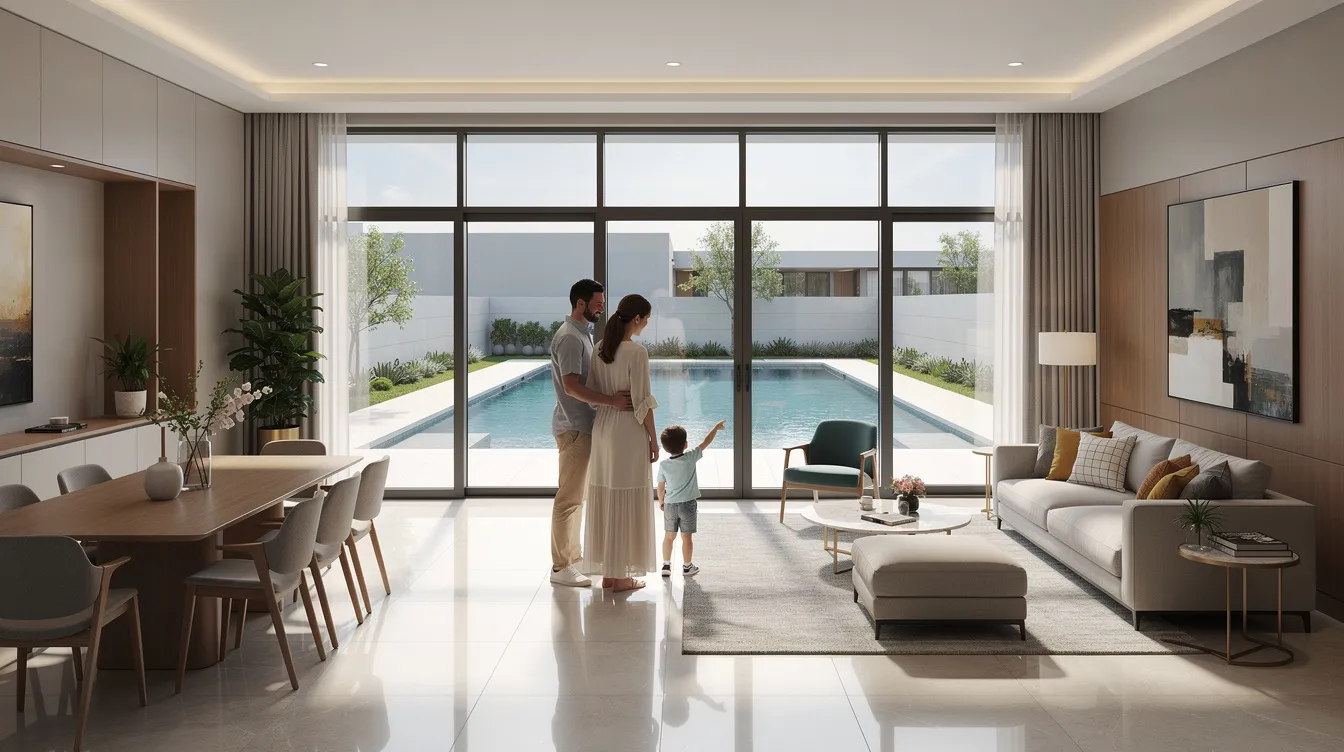
Landed properties in Singapore are regarded as resilient wealth storehouses due to land scarcity-only 72,000 landed homes exist in Singapore. Only Singapore Citizens can buy landed properties under the Residential Property Act (RPA); PRs require LDAU approval. Entry-level terrace houses start at $2 million in Singapore, but median prices have risen sharply.
Typical prices and numbers (2024–2026):
-
Terrace houses: median approximately S$4.53 million, with land PSF of approximately S$2,400 in Q3 2026
-
Semi-detached: median approximately S$6.36 million
-
Detached/bungalows: median approximately S$11.50 million
-
In 2024, 942 landed homes sold within the S$2.5–5.0M bracket-strong upgrader demand expected to continue
-
Landed properties typically require a higher capital outlay compared to other property types. HDB upgraders need $1.2 million to $2.5 million cash for landed homes.
Equity example: If a household bought a condo for S$1.2M in the mid-2010s and sells it at a current market value of S$2.0M–S$2.4M, net cash proceeds after CPF refunds, accrued interest, selling costs, and outstanding loan repayment could be S$800,000–S$1.2M. This funds 30–50% of a S$3.5M–S$4.5M terrace purchase. The financing gap requires bank financing and additional cash savings. Mr Lee’s condo appreciated to $1.55 million in 6 years, illustrating how private condo equity builds the bridge to landed.
Regulatory nuances:
-
Only Singapore Citizens can purchase landed on mainland Singapore
-
ABSD applies if retaining any existing property when buying landed
-
TDSR scrutiny intensifies at higher loan sizes; banks may require additional income documentation
-
Planning and execution typically require 18–24 months: align sale completion of your condo, loan approval, landed property identification, and move-in to avoid bridging loans or fire-sale discounts
Alternative Branches: Dual-Property Strategy & Diversifying into Industrial
Not every household needs-or wants-to upgrade to landed. Some clients choose a more diversified approach: owning a modest own-stay condo alongside an investment unit or a small industrial property.
For SME owners, this can be particularly powerful. Rather than stretching into an expensive house, they acquire business-use premises (factory, warehouse, or light industrial space) that serve operational needs while also building as an asset. AESTHETIC HAVENS advises many clients on exactly this trade-off: when does a S$2M warehouse outperform a S$4M terrace in total returns and cashflow?
This is an optional branch in the roadmap-not mandatory-but it suits business owners focused on cashflow, investments, and risk diversification rather than maximum residential size. The next section ties all these stages together into a full life-stage framework with concrete budgets and triggers.
Full Life-Stage Framework: Budgets, Triggers and Timelines
This framework synthesises the roadmap into a holistic plan from age 25 to 65, calibrated to 2024–2026 policies and interest rates. Each stage below includes a budget snapshot, trigger events, and a decision window.
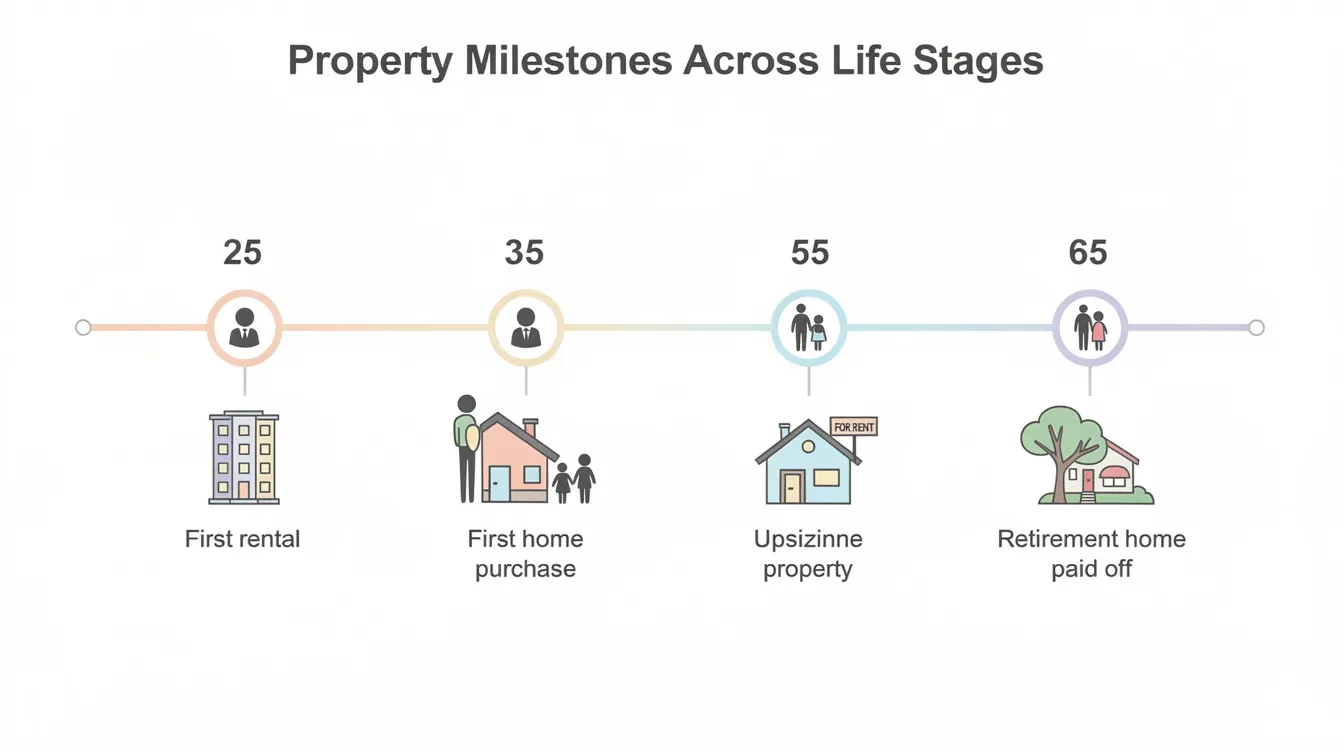
Stage A (25–35): Entry HDB and First Planning Milestones
Budget snapshot:
-
Typical combined income: S$6,000–S$10,000 per month
-
Purchase price for BTO in estates like Punggol, Sengkang, or Tengah: S$380,000–S$550,000
-
Downpayment (HDB loan at 80% LTV): S$76,000–S$110,000 from CPF and cash
-
Monthly mortgage: approximately S$1,200–S$1,800 over 25 years
Trigger events:
-
MOP countdown begins on key collection-5 years for standard flats, 10 years for PLH
-
Career promotions or significant income increases
-
Wedding, first child, or change in workplace location
-
Lease age approaching the 60–70-year mark (for older resale HDB) when valuation drops
Decision window:
-
1–2 years before MOP expiry, start modelling three options: (1) right-size within HDB resale market, (2) upgrade directly to private condo, or (3) wait if Plus/PLH implications extend your timeline
-
Emphasise building an emergency fund and avoiding over-use of CPF OA so that upgrading options remain financially viable
Stage B (33–45): HDB to Condo Transition
Budget snapshot:
-
Combined income: S$9,000–S$18,000+ for typical upgrader couples
-
Estimated sale proceeds from a 4-room HDB bought around 2014–2018, sold around 2024–2028: S$550,000–S$750,000 gross; after CPF refunds and accrued interest, net cash proceeds approximately S$350,000–S$500,000
-
Target condo purchase price: S$1.3M–S$2.5M depending on region
Trigger events:
-
MOP cleared-the single most important regulatory trigger
-
Children starting primary school (desire to be near preferred schools)
-
Pay increments or business income growth
-
HDB’s lease age reaching a point where banks become less generous with financing for potential buyers
Decision window:
-
12–18 months to line up valuation, CPF refunds, loan approvals, and condo launch cycles
-
Trade-off between buying a new launch (longer completion, potential appreciation during construction) versus resale (immediate move-in, known condition)
-
Many homeowners underestimate the time needed for proper sequencing-begin planning well before MOP clears
Narrative example: Mr Lee upgraded to a $1.2 million condo with $0 cash by carefully structuring his HDB sale proceeds and CPF to cover the entire downpayment. His condo subsequently appreciated to $1.55 million in 6 years-a decent profit that positions his family for the next stage of asset progression.
Stage C (40–55): Condo to Landed or Dual-Property Play
Budget snapshot:
-
Combined income: S$15,000–S$30,000+
-
Substantial CPF OA balances (potentially S$300,000–S$600,000 combined) and existing condo equity
-
Landed targets: S$3M–S$8M for terrace or semi-D; higher for prime areas
Trigger events:
-
Children entering secondary school or JC-need for more space
-
Business income stabilising after years of growth
-
En bloc opportunity on current condo (windfall that accelerates the upgrade)
-
Lease decay reducing the condo’s long-term value
Options:
-
Sell condo and upgrade fully to landed (own-stay)
-
Right-size to a more efficient condo and add an investment property or industrial asset
-
Retain current condo and add industrial/commercial property if TDSR permits
Decision window:
-
Interest-rate cycles matter enormously at this price level-a 1% rate difference on a S$3M loan changes monthly payments by S$2,500
-
Policy updates (ABSD adjustments, LTV changes) should shape timing within any 3–5 year period
-
Terrace houses appreciated approximately 47% over the last six years, rewarding those who entered early in the cycle
Stage D (50–65): Right-Sizing, De-Leverage and Retirement Income
Budget snapshot:
-
Properties often fully paid or with small remaining mortgages
-
Peak CPF balances across OA, SA, and MA
-
Reduced loan tenures available (15–20 years maximum at this age) if new borrowing is needed
-
Emphasis on liquidity, passive income, and reducing obligations
Trigger events:
-
Approaching retirement age (55–65)
-
Children moving out (empty nest)
-
Health considerations-desire for single-storey living, proximity to healthcare
-
High property tax and maintenance costs on large landed homes
-
Opportunity cost: capital tied up in a large house could yield better returns in diversified investments
Right-sizing options:
-
Sell landed or large condo, move into a smaller freehold condo near amenities and MRT
-
Homeowners may downsize to optimise cash flow as they approach retirement
-
The Silver Housing Bonus provides financial assistance for eligible seniors downsizing to smaller properties
-
Convert freed equity into a retirement fund, investments generating passive income, or business succession funding
The aim at this stage is stability, liquidity, and passive income-not maximising property count for its own sake. The next section zooms into right-sizing specifically.
Right-Sizing Explained: When Bigger Isn’t Better
Right-sizing is a deliberate step within the asset progression roadmap-not a “downgrade failure.” Many homeowners treat property as something you only ever upgrade, but the most financially sophisticated households know that the right-sizing process aims to convert property equity into liquidity for retirement, healthcare, and legacy goals.
Why is right-sizing powerful? You unlock what are effectively tax-free capital gains (Singapore has no capital gains tax on residential property), cut recurring maintenance and property tax, and improve cashflow for investments, business needs, or simply enjoying financial freedom in your later years.
What Right-Sizing Looks Like in Practice
Example 1: Landed to mid-size condo
-
Sell a terrace house valued at S$4.5M
-
Purchase a freehold condominium in a central estate at S$2.5M–S$3.0M
-
After CPF refunds, fees, and renovation of the new unit, net cash freed: approximately S$1.0M–S$1.5M
-
Lifestyle improvement: no more garden maintenance, pool and gym included, closer to MRT and healthcare
Example 2: Large condo to smaller freehold near MRT
-
Sell a 5-bedroom RCR condo at S$2.8M
-
Purchase a 3-bedroom new freehold condo near MRT at S$1.8M
-
Net cash freed after all costs: approximately S$700,000–S$900,000
-
Deploy proceeds into dividend-yielding investments generating rental income-equivalent returns
Example 3: Older executive HDB to newer smaller flat or private apartment
-
Sell an older executive flat for S$800,000–S$900,000
-
Move into a newer 3-room HDB (if eligible) or small private apartment at S$500,000–S$650,000
-
Net savings reinvested for retirement, creating a sustainable income stream alongside CPF savings
Financial and Emotional Triggers for Right-Sizing
Financial triggers:
-
Rising interest burden in the post-2022 rate environment
-
High property tax on large landed properties (tax rate increases with annual value)
-
Low utilisation of space-paying mortgage and maintenance on rooms nobody uses
-
Approaching retirement age 55–65 with insufficient liquid retirement fund
Emotional and lifestyle triggers:
-
Empty nest after children become independent
-
Caregiving needs-desire to be nearer to elderly parents or hospitals
-
Desire to simplify, travel, or focus on personal interests rather than home upkeep
-
Business succession: winding down active involvement, reducing financial complexity
Families should weigh these against legacy goals (passing property to children) and business needs. Not every household should right-size at the same age-but every household should plan for when it might make sense.
Sequencing a Right-Sizing Move Safely
-
Get accurate valuation and financial check – Engage a real estate professional for a current market valuation. Note your property’s lease age, outstanding loan balance, and CPF usage to date. Calculate CPF accrued interest that must be refunded upon sale.
-
Assess loan eligibility for replacement property – Check TDSR and LTV given your age, income, and any existing obligations. At 55+, shorter maximum tenures reduce the loan quantum banks will approve.
-
Plan sale timeline and marketing – List the property with realistic pricing. Budget 3–6 months for marketing and completion. Avoid rushing into a sale that produces a negative sale outcome or fire-sale discount.
-
Identify and secure replacement property – Inspect condition, factor renovation and maintenance costs. For right-sizers, prioritise accessibility, proximity to transport and healthcare, and low ongoing maintenance.
-
Manage ABSD and transition logistics – If buying before selling, you’ll face ABSD on what is technically a second property. ABSD remission applies if you sell the existing property within 6 months. Build in a transition buffer-temporary rental or extended completion period-to avoid paying ABSD unnecessarily or being forced to accept poor terms.
Designing Your Personal Roadmap (HDB → Condo → Landed / Right-Size)
There is no one-size-fits-all progression. Some households will stop at condo and invest the difference. Others will push to landed and then right-size. Business owners may diversify into industrial property alongside a modest home. The right knowledge and proper planning determine which path creates the most wealth and stability for your specific situation.
Step-by-Step Planning Process
-
Audit your current position – Document your property’s current market value, remaining loan balance, CPF usage (and accrued interest), combined income, monthly expenses, and cash savings. This baseline determines what’s actually possible.
-
Define your next 10-year goals – Space needs (children, ageing parents), school proximity, business plans, and desired lifestyle. Be specific: “We need a 4-bedroom home near an MRT in District 15 by 2030” is more useful than “we want to upgrade.”
-
Model 2–3 upgrade scenarios with conservative assumptions – Use today’s property prices, current interest rates (not the 1.5% rates of 2020), and realistic income growth. Factor in CPF accrued interest, BSD, ABSD, and renovation costs for each scenario.
-
Stress-test against adverse changes – What happens if interest rates rise another 1.5%? What if one spouse loses income for 12 months? What if property prices drop 10%? Only proceed with a plan that survives the stress test.
-
Set a target timeline and savings plan – Determine the specific year for each move and the monthly savings required to fund downpayments, stamp duties, and buffers.
-
Engage professional guidance – Firms like AESTHETIC HAVENS can provide data-driven valuations, model industrial vs residential trade-offs, and help sequence buy/sell transactions to minimise ABSD exposure and financing stress.
For households running businesses, integrate operational property (industrial, warehouse, office) into the same roadmap. Your factory may be a more productive asset than a bigger house.
Comparison: Staying Put vs Upgrading vs Right-Sizing
|
Factor |
Stay in Current Home |
Upgrade to Larger / More Prime |
Right-Size / Unlock Equity |
|---|---|---|---|
|
Monthly instalment |
Stays the same or decreases as loan amortises |
Increases significantly (larger loan, higher price) |
Decreases or eliminated (smaller loan or fully paid) |
|
Upfront cash/CPF needed |
None |
High: 25–30% downpayment + BSD + possible ABSD |
Moderate: downpayment on smaller property, offset by sale proceeds |
|
Liquidity impact |
Capital remains locked in property |
Further capital locked up; reduced liquid assets |
Capital freed; improved cashflow and investments options |
|
Lifestyle impact |
Stable but potentially outgrown space |
More space, better amenities, possible better location |
Less space but potentially better location, lower upkeep |
|
Risk level |
Low (status quo) |
Higher (larger debt, market exposure, ABSD risk) |
Moderate (execution risk in sale/purchase, but reduces financial exposure) |
How to interpret this: If you’re in your 30s–40s with growing income and family, upgrading often makes sense-the higher risk is offset by longer time horizon and appreciation potential. If you’re approaching 50s–60s with income plateauing, right-sizing delivers financial freedom and stability. Staying put works if your current home suits your needs and you’re building wealth through other assets and investments.
Working with Advisors and Marketplaces
A qualified advisor can add substantial value beyond what self-research delivers. AESTHETIC HAVENS, for example, works with many clients navigating exactly these transitions-balancing residential upgrades with industrial or commercial property considerations.
Key questions to ask an advisor:
-
“What happens if interest rates rise 1.5% from today-can I still afford this upgrade?”
-
“How will CPF accrued interest affect my net proceeds if I sell in 5 vs 10 years?”
-
“Should I buy a new launch or resale condo given current market conditions and my timeline?”
-
“Is an industrial property a better use of my next S$1M than upgrading from condo to landed?”
These are the questions that separate a plan from a gamble.
Common Challenges and How to Avoid Costly Mistakes
Mis-timed upgrades or over-leveraging can set households back a decade. Many homeowners learn these lessons the hard way. This section covers the most common pitfalls and their solutions.
Over-Leveraging and Ignoring TDSR
Problem: Taking the maximum loan based on current income without buffers for job change, business downturn, or interest rate increases. TDSR caps at 55%, but being at 55% leaves zero margin.
Solution: Cap commitments below the TDSR limit in practice-target 40–45% to maintain breathing room. Maintain 6–12 months of mortgage instalments in accessible cash or CPF. Model worst-case scenarios using today’s elevated rates (3.5–4% for home loans). If a short span of unemployment would force a fire sale, you’re over-leveraged.
Underestimating CPF Accrued Interest and Net Proceeds
Problem: CPF accrued interest is 2.5% per annum, and it compounds relentlessly. Large CPF OA withdrawals for HDB or condo can dramatically reduce cash proceeds upon sale-especially after 10–15 years. Selling your HDB reduces cash proceeds due to accrued interest, and accrued interest increases even after mortgage is paid off. Many homeowners don’t realise this until they receive their sale settlement and find far less cash than expected.
Solution: Track CPF usage annually. Run scenarios where you sell after 5, 10, and 15 years-the difference in net proceeds can be staggering. Balance CPF vs cash usage at each property purchase so you don’t end up “asset rich, cash poor.” For context, $200,000 in CPF used grows to $256,017 in accrued interest obligations after just 10 years.
Mishandling ABSD, MOP and Other Regulatory Rules
Problem: Committing to a second property before understanding ABSD rates, or forgetting that PLH flats require a 10-year MOP before resale.
Solution:
-
ABSD for citizens: 20% on second residential property, 30% on third and subsequent
-
ABSD for PRs: 5% on first, 30% on second, 35% on third+
-
Foreigners: 60% on any residential purchase
-
PLH/Plus/Prime HDB flats: 10-year MOP, not 5
-
Always verify current rates on the IRAS ABSD page before signing any Option to Purchase
Poor Sequencing of Sale and Purchase
Problem: Buying first, then being forced to sell the existing property at a discount due to tight deadlines-or facing ABSD bridge exposure that costs hundreds of thousands.
Solution: For HDB → condo moves, ideally sell HDB first or negotiate a longer completion period on the condo purchase. For condo → landed moves, plan 18–24 months ahead. Use longer completion periods, request extension of stay on your sold property, or budget for 2–3 months of temporary rental. The cost of a short-term rental is trivial compared to a negative sale outcome from rushed pricing or a 20% ABSD penalty.
Conclusion and Next Steps
A disciplined asset progression roadmap-from HDB to condo to landed and then right-sizing-can generate significant wealth and improve lifestyle across your lifetime. But it only works when grounded in regulation awareness, realistic budgets, proper planning, and life-stage alignment. The Singapore property market incorporates various stages including HDB, private condominiums, and landed properties, and each stage rewards patience and penalises impulsiveness.
The households that create lasting financial freedom through property are not the ones who stretch furthest or buy the most-they’re the ones who sequence each move carefully, maintain buffers, and know when right-sizing delivers more value than upgrading.
Your next steps:
-
Do a simple net-worth and property equity audit – What is your current home worth? What’s your outstanding loan? How much CPF accrued interest do you owe?
-
Check your MOP status and loan details – When exactly can you sell? What does your TDSR look like today?
-
Sketch your desired position 10 years from now – Where do you want to live? What income will you have? What does your family need?
-
Shortlist 2–3 plausible paths – Model them with conservative assumptions and stress-test against rate rises and income disruption
-
Speak with an advisor – Whether it’s about residential progression, industrial property for your business, or integrating both into one cohesive plan, professional guidance pays for itself many times over
If you’re a business owner considering using operational premises (factory, warehouse, office) as part of your overall asset mix, explore AESTHETIC HAVENS’ guides on industrial and commercial property alongside this residential roadmap.
Frequently Asked Questions on Singapore’s Asset Progression Roadmap
These FAQs consolidate common questions into quick answers, reflecting 2024–2026 regulations as at publication.
Is it still realistic to go from HDB to condo to landed in Singapore today?
-
Yes, but it requires early planning, disciplined savings, and strong income growth over 15–25 years. It is achievable for a subset of households-not an automatic entitlement
-
Private property prices increased by 157% over the past decade, meaning those who entered earlier benefited significantly. Entering at today’s property prices demands higher incomes and larger cash reserves
-
Right-sizing in later stages helps many households complete the full cycle-even if they can’t hold a landed home permanently, the profit from buying and selling at the right time funds a comfortable retirement
What minimum income do I need to upgrade from a 4-room HDB to a mass-market condo?
-
For a S$1.5M OCR condo with 75% LTV (loan of S$1.125M over 30 years at 3.5%), monthly instalments are approximately S$5,050. Under TDSR at 55%, minimum gross household income required is approximately S$9,200 per month-assuming no other debt obligations
-
If you have car loans, existing outstanding loan payments, or business debt, the required income rises accordingly
-
Individual situations vary with age (shorter maximum tenure = higher monthly payment), total debts, and remaining CPF OA savings available for downpayment
Should I always sell my HDB before buying a condo to avoid ABSD?
-
Pros of selling first: Avoid 20% ABSD entirely (potentially saving S$300,000+ on a S$1.5M condo), clarity on actual cash proceeds from HDB sale, simpler financing
-
Cons of selling first: Need temporary housing (rental), timing risk if condo purchase takes longer than expected, emotional stress of being without a home
-
Alternative: Buy first, pay ABSD upfront, then sell HDB within 6 months to claim ABSD remission. This requires significant upfront cash and confidence in selling the HDB quickly. Many clients prefer this route when market conditions favour fast HDB resales
How does right-sizing fit into retirement and legacy planning?
-
Right-sizing converts illiquid property equity into accessible capital for retirement-deployable into income-generating investments, CPF top-ups, or simply cash reserves for healthcare
-
Moving to a smaller, well-located home improves proximity to healthcare and transport while reducing maintenance burden
-
A simpler property portfolio is easier for children to manage or inherit, avoiding the complications of maintaining a large landed house as part of an estate
Can I integrate industrial or commercial property into this roadmap?
-
Many SME owners do exactly this-using an own-use factory, warehouse, or office space to complement their home progression
-
Industrial property can provide stable rental income (if leased out) or operational savings (if owner-occupied), and is not subject to ABSD
-
AESTHETIC HAVENS specialises in helping business owners evaluate industrial assets alongside their residential plans, creating a holistic wealth accumulation strategy that balances shelter, business needs, and long-term returns

