

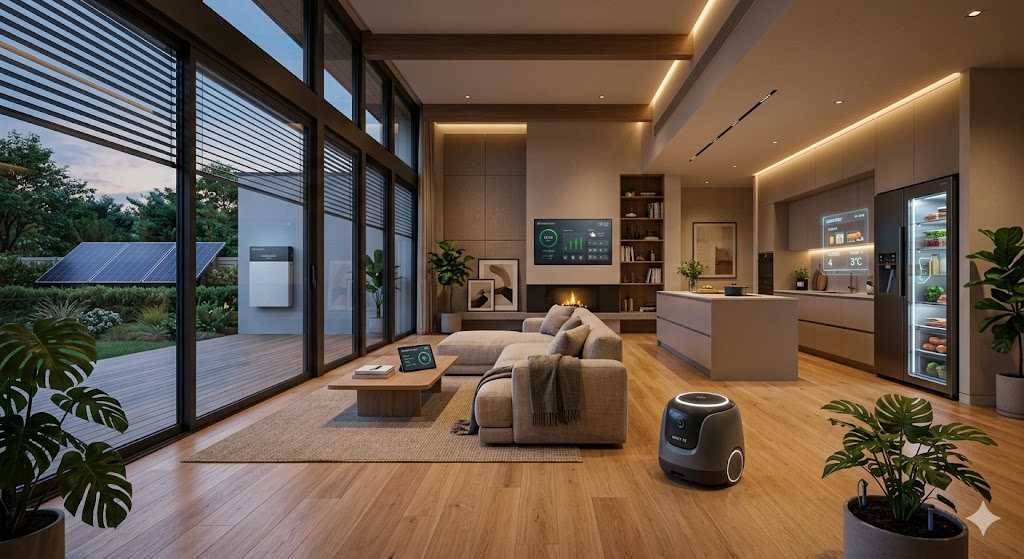
Smart Home Trends 2026: What New Launches Offer in Tech & Sustainability
SEO Title: Smart Home Trends 2026: What New Launches Offer in Tech & Sustainability
Meta Description: Explore smart home trends 2026. Discover what new launches offer in tech and sustainability. Learn about AI, Matter 1.5, and sustainable smart home technology.
Focus Keyphrase: smart home trends 2026
Tags: Smart Home Trends 2026 , Sustainable Smart Home Technology ,Tech And
Sustainability , Smart Home 2026 ,HomeAutomation
Introduction to the Connected Landscape
The smart home market transformed radically throughout the year 2026.1 Consequently, smart home trends 2026 prioritize tech and sustainability.2 Consumers demand much more than basic, everyday convenience now.3 Furthermore, buyers seek robust, whole-home energy management software solutions.3 Interoperability completely defines the modern connected device ecosystem today.5 Flashy technological gadgets yielded to invisible, background ambient intelligence.7 Therefore, AI seamlessly powers safety, efficiency, and everyday convenience.7 Consequently, the global smart home market demonstrates massive financial growth.5 Sustainable smart home technology is driving this unprecedented expansion.5
Projections indicate a staggering $450.20 billion valuation by 2032.8 This represents a massive increase from $230.76 billion in 2026.8 Furthermore, the market expands at an 11.8% annual growth rate.8 Wireless technologies completely dominate this rapidly expanding tech sector.9 They currently hold over 55% of the total market share.9 Growth is heavily driven by rising global internet penetration rates.8 Additionally, the proliferation of connected smart devices accelerates consumer adoption.8 Expanding middle-class populations in emerging economies contribute significantly here.8 Consumers demonstrate increasing demand for remote home monitoring solutions.8
Moreover, energy-efficient and low-carbon tech solutions are highly sought.8 The Asia Pacific region projects the highest global regional growth.8 It expects a massive 17.0% compound annual growth rate.8 Retrofit installations show particularly fast growth across all demographics.8 Smart home trends 2026 clearly highlight these expansive market dynamics.8 Tech and sustainability are no longer just optional luxury features. They are fundamental expectations for modern residential property buyers globally. Thus, sustainable smart home technology shapes the entire industry future.
| Market Metric | 2026 Status | Projected Future Value |
| Global Valuation | $230.76 Billion | $450.20 Billion (by 2032) |
| Growth Rate (CAGR) | 11.8% | 11.8% consistently |
| Wireless Tech Share | 55.65% | Expected to dominate further |
| Asia Pacific CAGR | 17.0% | Highest regional growth globally |
The Core Shift Toward Intelligent Sustainability
Modern luxury definitions changed fundamentally in the residential sector.3 Affluent buyers now prioritize environmental tech and sustainability heavily.3 They expect properties to combine automated comfort with eco-friendliness.3 Consequently, energy efficiency ceased to be a mere regulatory afterthought.3 It is now central to high-end residential smart home design.3 Rising global energy costs place immense pressure on property developers.3 Therefore, sustainable smart home technology mitigates these severe economic challenges.3 Smart home trends 2026 reflect this massive consumer paradigm shift.
Clients no longer desire isolated, standalone environmental sustainability features.3 Instead, they demand intelligent homes capable of dynamic energy adaptation.3 Systems must seamlessly adjust usage based on real-time room occupancy.3 Environmental conditions and user behavior dictate energy flow autonomously.3 Furthermore, residential automation focuses deeply on structural energy resilience now.3 An accelerating convergence exists between smart building technologies today.3 Energy infrastructure and residential automation merge into unified digital platforms.3 This represents a pinnacle achievement in tech and sustainability.
Standard automation features serve entirely new tech and sustainability objectives.3 Smart lighting control provides crucial daily environmental energy optimization.3 Moreover, HVAC automation actively drives long-term carbon footprint reduction.3 Smart shading systems influence overall building thermal performance significantly.3 Energy monitoring transitioned into a highly prominent residential lifestyle feature.3 Industry leaders focus heavily on integrated energy management systems.3 Brands like Schneider Electric and ABB lead this specific charge.3 Occupancy-based automation reduces operational energy consumption drastically every day.3 It maintains luxury without compromising sustainable smart home technology.3
Ambient Artificial Intelligence and Proactive Automation
Artificial intelligence transformed smart home capabilities entirely in 2026.5 It is arguably the most transformative trend across all categories.5 AI powers automation, comfort, daily cleaning, and ambient lighting.5 Homes are no longer just connected; they are highly interactive.5 AI shifts automation from reactive commands to proactive predictive actions.10 Advanced systems adapt and learn based on daily user habits.10 This makes home automation feel completely natural and highly intuitive.10 Smart home trends 2026 showcase this incredible ambient intelligence evolution.
For example, systems analyze evening temperature reduction behavioral patterns.10 They preemptively adjust climates ten minutes before typical user action.10 Morning lighting slowly raises brightness before alarms sound daily.10 This simulates sunrise, helping users wake up naturally and refreshed.10 Furthermore, predictive maintenance utilizes AI to save homeowners money.10 Smart appliances utilize high-tech sensors for continuous operational monitoring.10 They track machine vibration patterns and internal temperature fluctuations.10 This embodies the perfect marriage of tech and sustainability.
The system identifies potential mechanical problems weeks in advance.10 This early warning system prevents catastrophic household appliance failures.10 It saves families approximately $200 annually on routine maintenance costs.10 AI also powers sophisticated new robotic home assistants today.7 The LG AI Home Robot handles various mundane household chores.7 It connects seamlessly to the ThinQ smart home software platform.7 Equipped with sensors and cameras, it navigates homes completely autonomously.7
The robot assists with laundry and complex refrigerator organization.7 Furthermore, it loads the dishwasher to reduce daily household labor.7 It is highly proactive and emotionally responsive to human users.7 This drastically improves overall life quality for busy modern families.7 Sustainable smart home technology creates unprecedented levels of domestic comfort.
| AI Application Area | Core Functionality | Primary Consumer Benefit |
| Climate Control | Learns temperature preferences over time. | Maximizes comfort while reducing energy waste. |
| Appliance Maintenance | Monitors vibrations and component health. | Saves an average of $200 annually. |
| Robotic Assistants | Navigates homes to perform physical chores. | Reduces manual labor and reclaims free time. |
| Ambient Lighting | Simulates natural sunlight cycles daily. | Improves sleep hygiene and circadian rhythms. |
Technological Breakthroughs at CES 2026
The CES 2026 launches showcased incredible tech and sustainability.7 The tech industry’s annual mega event highlighted dozens of breakthroughs.7 AI moved beyond simple novelty to quietly power everyday convenience.7 Samsung introduced the EdgeAware AI Home environmental monitoring system.7 This tech pulls data from cameras and connected smart devices.7 Importantly, it does not send private data to external clouds.7 This eases massive concerns regarding domestic privacy and constant surveillance.7
The system detects twelve distinct critical audio events locally.7 This includes breaking glass, running water, and prolonged human coughing.7 Consequently, it sends immediate alerts and helpful user wellness insights.7 It automatically initiates emergency response services when deemed absolutely necessary.7 Mammotion Technology debuted the SPINO S1 Pro robotic pool cleaner.7 This represents a massive leap in sustainable smart home technology.7 It is a fully robotic residential pool cleaning aquatic device.7
The unit features automated shore landing and self-charging capabilities.7 It utilizes AI-powered mapping and debris detection visual sensors.7 Furthermore, it employs underwater communication for complex pool layouts.7 The battery-powered device produces absolutely zero local carbon emissions.7 Therefore, it supports efficient, hands-free sustainable outdoor pool maintenance routines.7 Roborock introduced the Saros Rover robotic vacuum cleaner device.12 This device actually climbs household stairs using articulated mechanical legs.12
It cleans stairs multiple times without any operational problems.12 The vacuum makes sudden stops, turns, and deliberate physical hops.12 Additionally, Lockin unveiled revolutionary new wireless smart door locks.12 The V7 Max and Veno Pro require absolutely no recharging.12 They utilize AuraCharge optical wireless charging technology continuously indoors.12 This completely eliminates the need for frustrating manual battery replacements.12 Smart home trends 2026 are defined by these spectacular innovations.
| CES 2026 Innovation | Manufacturer | Key Technological Breakthrough |
| EdgeAware AI Home | Samsung | Local audio detection without cloud data transfer. |
| SPINO S1 Pro | Mammotion | Automated shore landing and zero-emission pool cleaning. |
| Saros Rover | Roborock | Articulated legs for autonomous stair climbing and cleaning. |
| V7 Max Smart Lock | Lockin | AuraCharge optical wireless charging eliminating battery changes. |
| AI Home Robot | LG | Autonomous physical household chore completion and emotional response. |
Next-Generation Home Energy Management Systems
Comprehensive energy management forms the foundation of modern homes.13 It effectively facilitates sustainable, low-carbon residential smart home living.13 Systems regulate energy flow throughout the entire home automatically.13 They recognize usage trends and identify wasteful electrical consumption patterns.13 Smart thermostats adapt to outside atmospheric temperatures dynamically.13 They predict user arrivals to heat or cool highly efficiently.13 This is the absolute core of tech and sustainability.
EcoFlow’s Home Energy Management System exemplifies this critical trend.14 The system offers a comprehensive, automated digital home energy network.14 It monitors residential electricity usage continuously in real time.14 Furthermore, it analyzes historical data to uncover hidden electrical patterns.14 Homeowners easily control smart devices and home batteries remotely.14 The software maximizes solar utilization to prevent ecological resource waste.14 It automatically improves overall home efficiency without any manual effort.14
The centralized EcoFlow App acts as the digital system brain.14 It seamlessly connects grid inputs and solar panels to appliances.14 Consequently, the system automatically navigates complex time-of-use utility rates.14 It intelligently shifts heavy energy loads to cheaper off-peak hours.14 The system relies heavily on stored solar energy during peaks.14 Furthermore, it provides proactive emergency backup electrical power capabilities.14 By integrating weather forecasts, it detects severe storms quite early.14
The system charges batteries to 100% before massive storms arrive.14 This guarantees continuous power for essential household electrical circuits.14 Smart home trends 2026 heavily prioritize this uninterrupted energy security.14 Advanced smart panels replace outdated main breaker boxes entirely.16 They actively manage electricity distribution and provide visual power monitoring.16 Users see exactly how much power heavy appliances consume daily.16 Specific circuits can be disabled remotely during grid power blackouts.16 This easily preserves crucial battery life for essential family needs.16
Advanced Battery Storage and Grid Independence
Home battery systems paired with solar panels revolutionized global energy.10 They achieve up to 90% grid independence for many homeowners.10 This represents a massive step toward true global energy freedom.10 Tesla Powerwall technology remains a dominant market force in 2026.17 Powerwall provides critical energy security and immense financial savings benefits.17 These systems feature advanced energy monitoring and intelligent smart controls.17 They learn and adapt to family energy use over time.17
Over-the-air updates continuously add new, highly functional software features.17 Tesla expanded its residential battery storage lineup significantly this year.17 The Powerwall 3 targets new residential solar and storage installations.17 Solar panels integrate directly into the new Powerwall 3 unit.17 This design ensures higher efficiency and compact physical installation footprints.17 Conversely, Powerwall 2 adds onto existing residential solar panel systems.17 It remains highly compatible with all major global inverter brands.17 Sustainable smart home technology demands this high level of integration.17
| Tesla Specification | Powerwall 2 | Powerwall+ | Powerwall 3 |
| Energy Capacity | 13.5 kWh | 13.5 kWh | 13.5 kWh |
| Continuous Power | 5 kW | 7.6 kW / 5 kW | 11.5 kW |
| Scalability | Up to 10 units | Up to 4 units | System expansion anytime |
| Solar Inputs | None (AC coupled) | 4 inputs with MPPT | 6 inputs with MPPT |
| Integrated Inverter | No | Yes | Yes |
Other major global innovations debuted at recent technology exhibitions.18 HYXI unveiled a revolutionary AI-native smart energy ecosystem recently.18 The HYXI Aura streamlines whole-home backup and residential energy management.18 It utilizes an all-in-one design eliminating bulky extra network gateways.18 It enables smooth on-grid and off-grid electrical power switching.18 The HYXI Halo provides versatile plug-in micro energy storage units.18
It brings smart energy to residential balcony solar panels.18 Hoymiles introduced the HoyPrime AC utility-scale battery storage system.19 It integrates massive battery systems and energy management into platforms.19 These systems transform ordinary homes into dynamic micro power plants.10 Smart home trends 2026 clearly highlight these massive storage innovations.18 Tech and sustainability merge perfectly within these high-capacity batteries.
The Matter 1.5 Protocol and True Interoperability
The Matter standard eliminated smart home ecosystem fragmentation entirely today.5 It is a unifying, IP-based connectivity protocol for modern homes.21 Matter is backed by over 500 major global technology companies.20 It utilizes IPv6 across Wi-Fi, Thread, and Ethernet network connections.20 This provides a common application layer and universal data model.20 It ensures real interoperability between fiercely competing smart device brands.20 Developers no longer build separate software implementations for different platforms.20 Smart home trends 2026 heavily feature this crucial universal interoperability.20
Updates to the standard occur biannually without any delay fail.22 Version 1.5 arrived precisely in November of the year 2025.22 This release marked a critical operational milestone for connected homes.23 It introduced highly anticipated standard software support for security cameras.23 Cameras now stream and record securely using unified digital standards.23 Capabilities include live streaming, two-way talk, and local network recording.23 Furthermore, Matter 1.5 revolutionized energy management data sharing capabilities globally.23
| Matter Standard Version | Official Release Date | Key Features and Device Support Added |
| Version 1.2 | October 2023 | Refrigerators, Room Air Conditioners, Dishwashers, Robot Vacuums. |
| Version 1.3 | May 2024 | Microwave Ovens, Water Management, EV Charging Management. |
| Version 1.4 | November 2024 | Enhanced energy focus: solar systems, home routers, heat pumps. |
| Version 1.5 | November 2025 | Security cameras, sophisticated energy management, TCP transport, soil sensors. |
The update integrates local energy pricing and grid carbon intensity.23 Devices exchange standardized energy data for intelligent, green home automation.23 Consequently, electric vehicles charge automatically when utility pricing drops low.23 Soil sensors debuted to facilitate much smarter outdoor water management.25 They measure ground moisture levels to automate irrigation systems intelligently.25 This conserves water resources and drastically improves overall plant health.25 Moreover, Matter 1.5 adds full TCP digital data transport support.23 Sustainable smart home technology relies on this robust communication speed.
This allows faster data transmission for large digital software payloads.23 It efficiently handles high-resolution images and massive firmware updates quickly.23 The Thread wireless protocol also saw massive operational network improvements.24 The range of Thread-compatible products grew exponentially in early 2026.24 Major brands expanded their installed base with new Thread devices.24 This ensures highly stable, low-latency local mesh network environments continuously.6 Tech and sustainability require these highly efficient communication protocols.
Ecosystem Wars: Apple, Google, Amazon, and SmartThings
The competition between ecosystems shifted away from basic voice control.6 It now focuses on AI execution and strict privacy balance.6 Matter allows users to mix hardware seamlessly across different platforms.6 Consequently, platforms differentiate themselves through highly unique software intelligence capabilities.6 Smart home trends 2026 reveal distinct strategic approaches among tech giants.6 Apple HomeKit remains the ultimate privacy-focused connected home software ecosystem.6 It emphasizes strict end-to-end encryption and localized data processing deeply.6
HomeKit creates adaptive scenes using localized artificial intelligence networks securely.6 Deeply integrated Siri provides context-rich cross-device voice coordination effortlessly.6 Furthermore, HomeKit Secure Video utilizes Apple hardware for visual analysis.6 Apple routes Matter commands through local Home Hubs highly securely.6 This strictly prevents third parties from accessing behavioral user data.6 Google Home leads in contextually intelligent, highly proactive home automation.6 It is deeply powered by the highly sophisticated Gemini AI.6
Gemini utilizes environmental data to predict specific future user needs.6 Routines evolve automatically based on habits and daily family schedules.6 Google Home features multi-user personalized voice profile recognition software capabilities.6 It alters responses intelligently based on whichever family member speaks.6 Google utilizes localized processing for critical Matter communication command execution.6 Amazon Alexa evolved into a massive, global ambient intelligence platform.6 It blends voice, vision, and advanced physical human gesture recognition.6
Alexa responds to physical presence without explicit vocal command triggers.6 It boasts the absolute widest third-party device compatibility available globally.6 However, Alexa still relies heavily on cloud-based AI computational processing.6 This dependency may deter highly privacy-conscious sustainable tech consumers.6 Samsung SmartThings operates as the ultimate universal home network translator.6 It coordinates hybrid homes utilizing completely diverse hardware manufacturer brands.6 SmartThings unifies Matter, Thread, Zigbee, and Z-Wave connected smart devices.6
It uses advanced AI to analyze complex usage behavior patterns.6 Moreover, SmartThings Energy monitors real-time power consumption across connected devices.6 It automates energy-saving routines to promote environmental sustainability targets actively.6 These platforms define how consumers interact with tech and sustainability.
| Smart Platform | Primary AI Philosophy | Local Execution | Key Ecosystem Strength |
| Apple HomeKit | Privacy-first adaptive scenes. | Very High | Unmatched user data security and privacy. |
| Google Home | Gemini AI predictive routines. | Moderate | Proactive anticipation of user needs. |
| Amazon Alexa | Ambient vision and voice. | Low | Widest global device compatibility and integrations. |
| Samsung SmartThings | Behavior-based energy saving. | High | Universal hardware and protocol translation capabilities. |
Innovations in Next-Generation Smart Appliances
Modern appliances changed significantly to cooperate with broader network systems.13 They are crucial components of eco-conscious residential smart homes today.13 Washing machines automatically adjust water levels perfectly for load sizes.13 Dishwashers schedule runs specifically when local energy demand is lowest.13 Refrigerators manage their chilling cycles highly efficiently using internal AI.13 These adjustments reduce environmental stress and yield massive financial savings.13 Sustainable smart home technology integrates deeply into these daily appliances.
Samsung introduced a highly advanced Bespoke AI household appliance line.26 These appliances offer bold, timeless, professional-inspired modern kitchen design aesthetics.26 SmartThings connectivity enables unparalleled intelligent operational energy efficiency for users.26 The Bespoke AI Laundry Hub centralizes daily clothes washing and drying.27 An intuitive AI Home LCD display provides highly personalized laundry suggestions.27 AI OptiWash and OptiDry automatically detect fabric types and moisture.27
The system automatically dispenses exact required liquid laundry detergent amounts.27 A Less Microfiber cycle actively supports ecological tech and sustainability.27 Auto Connectivity syncs multiple distinct kitchen appliances effortlessly together daily.26 Turning on the cooktop automatically activates the smart microwave’s ventilation vent.26 This greatly enhances air ventilation and simplifies everyday cooking tasks.28 Bespoke refrigerators feature AutoView illuminated exterior glass viewing door panels.28
The glass illuminates brightly when approached to view interior contents.28 Furthermore, Home Appliance Remote Management delivers highly intelligent technical support.26 It autonomously diagnoses and analyzes appliances using AI diagnostic networks.26 This simplifies necessary maintenance and improves long-term product serviceability significantly.26 Smart home trends 2026 highlight appliances as active energy managers. Tech and sustainability merge to create the ultimate modern kitchen.
Advanced Presence Sensing and Security Upgrades
Traditional passive infrared motion sensors became largely obsolete quite recently.29 They are rapidly replaced by mmWave radar presence sensing technology.29 This technology detects micro-movements including human respiratory breathing physical patterns.29 It detects human occupants even when they remain perfectly still.29 This fundamental shift changes automation entirely from reactive to ambiently aware.29 Lights no longer turn off unexpectedly while users quietly read.29 It dramatically enhances both user convenience and overall tech sustainability.29
Smart locks transitioned to true hands-free operational usage access paradigms.29 They utilize highly sophisticated Ultra-Wideband (UWB) wireless communication technology systems.29 The ALIRO standard unifies smart lock communication protocols globally today.1 Users experience true hands-free entry as they physically approach doors.29 This fundamentally alters the physical threshold home entry user experience.29 It eliminates transitional physical friction and greatly improves user accessibility.29
Security systems employ local AI for video footage processing now.29 Local processing eliminates controversial mass cloud video data internet uploads.7 This heavily eases concerns regarding domestic privacy and corporate surveillance.7 Modern security systems detect abnormal atmospheric temperature and humidity fluctuations.13 They react instantly to open windows and HVAC system inefficiencies.13 They alert homeowners and trigger minor automated environmental system adjustments.13 Consequently, cybersecurity and data privacy are now massive purchase drivers.4
Sustainable Design Strategies and Academic Perspectives
Sustainable smart home technology also benefits from major government initiatives.30 The Sustainable Energy Authority of Ireland provides vastly enhanced grants.30 These grants encourage homeowners to upgrade their existing residential properties.30 Upgrades make homes much more comfortable, healthier, and highly efficient.30 Households use these grants to combat significantly higher energy costs.30 Furthermore, early research helps homeowners maximize available government financial supports.30 Smart home trends 2026 show increased reliance on these incentives.
In the first quarter, SEAI supported numerous home energy upgrades.30 They processed a record 25,000 grant applications this calendar year.30 Grant support is fully available for modern windows and doors.30 It also comprehensively covers attic insulation, heat pumps, and solar.30 This vital government support directly fuels smart home trends 2026.30 It drastically accelerates the widespread adoption of sustainable smart home technology.30 Tech and sustainability initiatives thrive with strong governmental financial backing.
Emerging international markets show highly unique sustainable smart home preferences.31 In India, residential homes utilize a distinct health and wellness approach.31 Designs incorporate proper atmospheric ventilation and dedicated daily relaxation spaces.31 Integrated air-purifier systems are becoming absolute standard modern architectural features.31 Architects intentionally leave physical space for natural ambient sunlight exposure.31 Smart home technology rapidly adapts to these specific global regional requirements.31
Water efficiency represents another major sustainable home eco-design pillar.13 Traditional homes frequently overlook massive daily residential clean water waste.13 Smart irrigation technologies monitor local weather rainfall and soil moisture.13 They automatically modify watering schedules to prevent needless water consumption.13 Leak detection devices notify owners instantly when plumbing issues arise.13 This prevents significant fresh water loss and massive property damage.13 These automations encourage water-conscious habits without requiring constant manual supervision.13
Academic research highlights crucial psychological aspects of smart home adoption.32 Researchers identified specific user-centered design strategies promoting general technology adoption.33 Convenience and comfort significantly improve daily human quality of life.32 Health and wellbeing software applications promote healthier daily living routines.32 Safety features drastically enhance the physical security of the property.32 Sustainable development focuses strictly on global environmental resource conservation metrics.32 Privacy considerations remain absolutely paramount for user digital data preservation.32
Six primary design strategies encourage mass global consumer technology adoption.33 First, engineers must create fully automated residential physical living environments.33 Second, platforms must guarantee service scalability and software application diversity.33 Third, manufacturers must actively increase overall user system service accessibility.33 Fourth, systems should greatly improve the lifestyle balance of users.33 Fifth, providers must secure long-term system facility operational physical safety.33 Sixth, devices must actively reduce the environmental global ecological load.33
SEO Strategies for Smart Home Brands in 2026
Search engine optimization strategies evolved dramatically in the year 2026.34 Marketers no longer chase high-volume informational keywords blindly online today.34 AI Overviews answer basic user queries directly on search pages.36 Therefore, traditional informational articles often yield zero-click website traffic results.36 Consequently, massive keyword search volume is practically a useless vanity metric.36 Instead, smart marketers must actively target specific user verification intent.36
Users constantly seek real human sources and highly original data.36 They want to verify AI-generated synthesis information rigorously and accurately.36 Content requires absolute structural superiority and actual first-hand expert knowledge.36 Voice search completely dominates massive SEO trends in 2026 globally.35 It accounts for 27% of all global online internet searches.35 This represents a 340% massive exponential increase since the year 2020.35 Voice queries are conversational, much longer, and distinctly question-based typically.35
Typed text queries differ significantly from spoken voice request structures.35 Brands must actively optimize for featured text snippets to succeed.35 Voice assistants pull answers almost exclusively from these specific snippets.35 Content must directly answer user questions concisely in under 29 words.35 Smart home brands must utilize modern needs-first user framework strategies.34 They must decode exactly what people need when they search.34
Content must incorporate specific psychological decision triggers for potential buyers.34 These triggers include verified social proof, delivery speed, safety, and price.34 Organizing terms by intent perfectly aligns them with sales funnels.37 Evaluating keyword ranking difficulty alongside search volume remains crucially important.37 For instance, localized SEO generates highly qualified local buyer leads.34 Content structured around true human needs generates higher-quality internet traffic.34
To achieve high SEO ranking, robust technical metadata is absolutely required. Integrating a strong focus keyphrase like “smart home trends 2026” works well. High keyword density must remain natural within the written article text. Utilizing tags like tech and sustainability improves overall search visibility. Sustainable smart home technology represents a highly lucrative semantic topic cluster. Marketing efforts must reflect these sophisticated search engine behavioral shifts.
| SEO Strategy Element | 2023 Outdated Approach | 2026 Modern Approach |
| Primary Goal | High-Volume Keywords | User Verification Intent |
| Target Queries | Short-Tail Typed Phrases | Conversational Voice Queries |
| Content Format | Long-Form Generic Text | Concise Featured Snippets |
| Value Proposition | Basic Informational Summaries | Original Data & Deep Expertise |
Professional Integration and Adaptive Automation
As smart homes grow complex, professional system integration becomes essential.2 Consumers increasingly turn to expert custom smart home system integrators.2 Integrators design and deploy highly reliable, whole-home automated network systems.2 They ensure devices from different global manufacturers work together seamlessly.2 Physical installation involves safely replacing standard residential light switch panels.2 Integrators install Brilliant smart home control panels into electrical boxes.2
This requires absolutely no complex custom electrical wiring installation protocols.2 While mobile smartphone apps remain essential for remote network monitoring.2 Homeowners vastly prefer physical, in-home interfaces for daily system interactions.2 Bringing app-like digital capabilities to walls drives higher daily engagement.2 It creates a natural, shared technological experience for the entire household.2 Integrators connect thermostats, security cameras, smart lighting, and audio systems.2
They verify system compatibility and plan optimal device placement strategies.2 They vastly simplify daily routines by setting up complex automated schedules.2 Personalization is a defining core expectation in modern smart homes.2 Satisfaction increases massively when systems support multi-user household profiles effectively.2 Brilliant enables true personalization through highly specific room-based digital controls.2 Users create highly customizable scenes reflecting how they actually live.2
This includes exact temperature preferences and specific lighting moods by room.2 Systems provide beautifully simplified control interfaces for visiting guests and family.2 Professional integrators ensure sustainable smart home technology functions perfectly daily. They bridge the complex gap between advanced tech and sustainability. Smart home trends 2026 prove that DIY setups are fading rapidly. Complete, professionally managed adaptive environments represent the future of living.
Conclusion: The Future of Connected Living
In conclusion, the smart home narrative matured significantly and rapidly.5 The industry moved completely away from isolated, gimmicky novelty gadgets.2 It now focuses exclusively on intelligent, cohesive, adaptive living environments.2 Whole-home automation and energy efficiency are absolute baseline consumer expectations.2 The fusion of artificial intelligence and sustainable energy generation works flawlessly. Smart homes today actively support the exact way people live.2
They constantly learn, rapidly improve, and protect the fragile environment simultaneously.2 The unified tech ecosystems represent the absolute pinnacle of residential technology. Smart home trends 2026 clearly illustrate this magnificent ongoing technological evolution. Sustainable smart home technology is no longer an expensive niche market. Tech and sustainability merge perfectly to create the ultimate living space. Homeowners everywhere now demand these incredible, intelligent, and efficient digital systems.
Works cited
- Smart Home Guide 2026 – What to Buy, Platform Updates, and More!, accessed June 7, 2026, https://www.youtube.com/watch?v=_oXp9sEm_js
- Brilliant’s Smart Home Trends for 2026 – Brilliant Tech, accessed June 7, 2026, https://www.brilliant.tech/blogs/news/brilliant-s-smart-home-trends-for-2026
- Residential clients demand greener smart homes | ISE 2027, accessed June 7, 2026, https://www.iseurope.org/news/residential-clients-demanding-more-sustainable-smart-homes
- Five Smart Home Trends for 2026: How Nice Is Shaping the Future of Smart Living, accessed June 7, 2026, https://www.niceforyou.com/en/magazine/five-smart-home-trends-2026-how-nice-shaping-future-smart-living
- The Smart Home in 2026: What’s Actually Sticking (and What’s Not …, accessed June 7, 2026, https://iotbreakthrough.com/the-smart-home-in-2026-whats-actually-sticking-and-whats-not/
- Apple HomeKit vs Google Home vs Alexa vs SmartThings in 2026, accessed June 7, 2026, https://ththeater.com/apple-homekit-vs-google-home-vs-alexa-vs-smartthings/
- CES 2026: How AI Will Power the Next Wave of Smart Home Tech, accessed June 7, 2026, https://www.nar.realtor/blogs/styled-staged-sold/ces-2026-how-ai-will-power-the-next-wave-of-smart-home-tech
- Smart Home Market Size Report 2026 – 2032 [300 Pages & 156 Tables], accessed June 7, 2026, https://www.marketsandmarkets.com/Market-Reports/smart-homes-and-assisted-living-advanced-technologie-and-global-market-121.html
- Smart Home Market Size, Share & Forecast Report, 2032 – Fortune Business Insights, accessed June 7, 2026, https://www.fortunebusinessinsights.com/industry-reports/smart-home-market-101900
- Top 10 Smart Home Innovations Shaping the Future of Living (2025-2030), accessed June 7, 2026, https://www.hdlautomation.com/Articles_100000182859653.html?utm_source=chatgpt.com
- Smart Home – CES, accessed June 7, 2026, https://www.ces.tech/topics/smart-home/
- The Home Tech Gadgets That Stole the Show at CES 2026 – CNET, accessed June 7, 2026, https://www.cnet.com/home/our-favorite-home-tech-gear-that-everyones-talking-about-at-ces-2026/
- Sustainable Smart Living Trends for 2026 | Glanmire Park, accessed June 7, 2026, https://www.glanmirepark.com.au/smart-homes-take-sustainability-to-the-next-level-in-2026/
- Smart Home Energy Management: Take Control & Save | EcoFlow US, accessed June 7, 2026, https://energy.ecoflow.com/us/blog/smart-home-energy-management
- DIY Solar System Guide (2026): Components, Costs, and Installation Tips for U.S. Homeowners – EcoFlow, accessed June 7, 2026, https://www.ecoflow.com/us/blog/diy-solar-system
- Complete Home Energy Solutions Guide For 2026 | EcoFlow US, accessed June 7, 2026, https://energy.ecoflow.com/us/blog/home-energy-solutions
- How Powerwall Works | Tesla Support, accessed June 7, 2026, https://www.tesla.com/support/energy/powerwall/learn/how-powerwall-works
- HYXI Presents AI-Native Smart Energy Ecosystem at SNEC 2026 | New Products & Partnerships – News and Statistics, accessed June 7, 2026, https://www.indexbox.io/blog/hyxi-unveils-ai-native-smart-energy-ecosystem-at-snec-2026/
- Hoymiles Unveils HoyPrime AC at SNEC 2026, Advancing Its Global Full-Scenario Solar and Storage Strategy, accessed June 7, 2026, https://pressreleasehub.pa.media/article/hoymiles-unveils-hoyprime-ac-at-snec-2026-advancing-its-global-full-scenario-solar-and-storage-strategy-75709.html
- Introduction to Matter: A Technical Overview (2026 Update) – YouTube, accessed June 7, 2026, https://www.youtube.com/watch?v=BV4HppnUsW8
- Build With Matter | Smart Home Device Solution – Connectivity Standards Alliance, accessed June 7, 2026, https://csa-iot.org/all-solutions/matter/
- Matter (standard) – Wikipedia, accessed June 7, 2026, https://en.wikipedia.org/wiki/Matter_(standard)
- Matter 1.5 for Next Generation Smart Homes – Silicon Labs, accessed June 7, 2026, https://www.silabs.com/blog/matter-1-5-for-next-generation-smart-homes
- The Matter Standard in 2026 – A Status Review | Development …, accessed June 7, 2026, https://matter-smarthome.de/en/development/the-matter-standard-in-2026-a-status-review/
- Matter 1.5 Introduces Cameras, Closures, and Enhanced Energy Management Capabilities – CSA-IOT, accessed June 7, 2026, https://csa-iot.org/newsroom/matter-1-5-introduces-cameras-closures-and-enhanced-energy-management-capabilities/
- Samsung Introduces New Line of Bespoke AI Appliances Designed for the Modern Kitchen at KBIS 2026, accessed June 7, 2026, https://news.samsung.com/us/samsung-introduces-new-line-bespoke-appliances-designed-modern-kitchen-kbis-2026
- Samsung Bespoke AI Laundry Hub™ – CES, accessed June 7, 2026, https://www.ces.tech/ces-innovation-awards/2026/samsung-bespoke-ai-laundry-hub/
- 2026 Samsung Bespoke AI Kitchen Appliances are Available Now, accessed June 7, 2026, https://news.samsung.com/us/2026-samsung-bespoke-ai-kitchen-appliances-available-now
- The 5 Smart Home Trends CES 2026 Made Impossible to Ignore – YouTube, accessed June 7, 2026, https://www.youtube.com/watch?v=XsC_NnTBDb0
- SEAI urges homeowners to start their home energy upgrade journey over the summer months, accessed June 7, 2026, https://www.seai.ie/news-and-events/news/home-energy-upgrade-summer-months
- 10 home design trends defining how Indians want to live in 2026, accessed June 7, 2026, https://timesofindia.indiatimes.com/life-style/home-garden/10-home-design-trends-defining-how-indians-want-to-live-in-2026/articleshow/131523146.cms
- Smart Homes as Catalysts for Sustainable Consumption: A Digital Economy Perspective, accessed June 7, 2026, https://www.mdpi.com/2071-1050/16/11/4676
- Exploring the Sustainable Values of Smart Homes to Strengthen Adoption – MDPI, accessed June 7, 2026, https://www.mdpi.com/2075-5309/12/11/1919
- Keyword Research in 2026 for SEO and User Intent – In Front Marketing, accessed June 7, 2026, https://infrontmarketing.ca/blog/search-engine-optimization/keyword-research-in-2026-moving-from-keywords-to-needs-and-decision-triggers/
- 7 SEO Trends 2026 That Will Decide Who Wins Organic Traffic This Year | Strategyc, accessed June 7, 2026, https://www.strategyc.io/blog/seo-trends-2026
- Unpopular opinion: Chasing high keyword volume is completely destroying your SEO strategy in 2026. Here’s why : r/DigitalMarketing – Reddit, accessed June 7, 2026, https://www.reddit.com/r/DigitalMarketing/comments/1tr680t/unpopular_opinion_chasing_high_keyword_volume_is/
Keyword Research: A Step-by-Step Guide for SEO in 2026 | Salesforce ANZ, accessed June 7, 2026, https://www.salesforce.com/au/blog/how-to-do-keyword-research/

