


A renewal is negotiated, not granted. In Singapore, open-market rents are a private arrangement between owner and tenant, so the outcome depends on who arrives with better evidence, a calmer tone and an earlier start. Begin two to three months before expiry, anchor the talk on closed rental data rather than listing prices, make one counter with a real number, and trade lease length for price. If you are a landlord or tenant who wants a second pair of eyes on the numbers, our Real Estate Sales & Leasing and Property Valuation services are built for exactly this moment.
TL;DR
- Start 2 to 3 months before expiry. Check your agreement first: any renewal option has its own written-notice deadline.
- Anchor on closed rental data from URA or HDB statistics, not on asking prices.
- Make one counter with a specific figure, and lead with your track record as a tenant or the vacancy cost to the landlord.
- Trade term for price, and settle the deposit, diplomatic clause and stamp duty in the same conversation.
- Singapore has no statutory cap on renewal rent increases, so the agreement and the evidence are all you have.
Table of Contents
- What a renewal actually is in Singapore
- Is there a limit on how much a landlord can raise the rent?
- The timeline that keeps leverage on your side
- Step 1: Find out what the market actually pays
- Step 2: Decide your walk-away point
- Step 3: Open the conversation and make your case
- Step 4: Trade, do not just haggle
- Step 5: Put it in writing and stamp it
- If you cannot agree
- Where having an agent on your side helps
- Our view on renewals
- FAQ
- Sources
What a renewal actually is in Singapore
Unless your tenancy agreement contains a renewal option, neither side has to renew. Most renewals are simply a new tenancy agreement, or a short extension letter, signed between the same people. That is why the whole thing is negotiable: rent, length, deposit, repairs, even who pays the stamp duty.
The Council for Estate Agencies (CEA) publishes a template tenancy agreement for private residential property and states that you can negotiate the terms and conditions with the other party before signing. The same logic applies at renewal. Nothing about the first deal is binding on the second one.
If the agreement does include a renewal option, read it line by line. Typical wording lets the tenant renew only if there is no existing breach and a written request is made a set number of months before expiry, with the new rent “mutually agreed”. Miss the written notice and the option can lapse, which hands all the leverage to the other side.

Is there a limit on how much a landlord can raise the rent?
Not by law. In a July 2023 written answer, the Ministry of National Development said open-market HDB and private rents are private arrangements between owners and tenants, and that it was not ruling out any option while monitoring the situation. So the answer to “what is the highest a landlord can raise rent?” is: whatever the tenant will accept, which is precisely why preparation matters.
For tenants, that means a proposed increase is an opening position. For landlords, it means an aggressive number is only worth anything if comparable homes are really renting at that level.
The timeline that keeps leverage on your side
The notice period in your agreement is the minimum, not your planning horizon. A sensible sequence looks like this:
| When | What to do |
|---|---|
| 6 months or more before expiry | Read the agreement: renewal option, notice deadline, diplomatic clause, break clauses. |
| 4 to 6 months | Start tracking comparable rents in your building and neighbourhood. |
| 3 to 4 months | Stress-test your budget (tenant) or your yield and vacancy tolerance (landlord). |
| 2 to 3 months | Open the conversation, in writing. |
| Final weeks | Sign, stamp and update any records. |
This follows the planning sequence in Skymedia’s rent-budget guide. Another Singapore guide makes the same point from the tenant side: leaving it until the last weeks, or the landlord springing a number on the expiry day, tells you something about how the next two years may go. Writing early, with a clear deadline for a reply, protects you from a rushed decision.
A tenant-initiated renewal letter usually states the proposed new term, a rent “in line with the current rent, given prevailing market conditions”, that the deposit carries forward, that the diplomatic clause stays, and a target signing date. SG Tenancy’s template page suggests sending it 8 to 10 weeks before the tenancy ends. Landlords can send the mirror image: a proposed term and rent, with a date by which you need an answer.
Step 1: Find out what the market actually pays
The weakest negotiating position is a feeling that rent is “too high”. The strongest is a short table of comparable homes.
Use closed data, not asking prices. Listing portals show what owners hope to get. Agreed rents are lower in a soft market and higher in a tight one. URA’s Property Data portal is the official source for private residential and commercial rental statistics, and it offers the REALIS subscription system for fuller, up-to-date market data. For public housing, HDB publishes rental statistics. Landlords whose agreement has a “prevailing market rate” clause will often point to recent comparable rentals, and the tenant can check the same figures before replying.
Know the HDB reference points. HomeQuant’s analysis of HDB rental approvals found that for June to August 2026 the median approved monthly rent was S$2,900 for 3-room flats, S$3,400 for 4-room, S$3,550 for 5-room and S$3,900 for executive flats. These are medians for a three-month window across the whole island. They move with every release, so use them to sense the range and then pull your own town and flat type for the actual conversation. A Clementi 4-room and a Sengkang 4-room are not the same comparison.

Build a small comparables sheet. Record at least five similar units: size, floor, condition, asking or approved rent, and for listings how long they have been online. Units sitting unrented for weeks are a signal that asking rents are above what people will pay. Keep the sheet to one page. You will be showing it, not defending a thesis.
A worked example
Suppose your 4-room flat rents at S$3,300 and the landlord asks for S$3,600. That is S$300 a month, or S$3,600 over a year. Your comparables show similar units at S$3,300 to S$3,450.
A reasonable counter is S$3,400 on a 24-month term. You are above your current rent, which signals good faith, and the landlord gets two years of certainty. Meanwhile, one empty month at S$3,300 costs the landlord the same S$3,300 that your S$300 increase would earn in 11 months, before agent fees and any repainting. MoneyBees Academy’s lesson uses this kind of vacancy arithmetic as an objective anchor, and it works as well for landlords weighing a firm number against a gap between tenants.
Step 2: Decide your walk-away point
Before speaking to the other side, write down three numbers:
- Your target. The rent and term you would be happy with.
- Your acceptable limit. The highest rent you can pay (tenant), or the lowest you would accept (landlord).
- Your alternative. For tenants: what moving would really cost, including a new deposit, moving fees, a possible overlap, and stamp duty on a new lease. For landlords: realistic vacancy, agent fees and the chance of a worse tenant.
This is the part people skip. If your alternative is poor, you negotiate on terms rather than threatening to leave. If it is strong, you can hold your ground calmly.
Step 3: Open the conversation and make your case
Keep the first message short, polite and in writing, so there is a record. Then, when you talk:
- Lead with reliability (tenants). On-time payments, quick reporting of faults, servicing invoices for the air-conditioning, no neighbour complaints. A tenant who pays and looks after the unit is worth real money to a landlord because the alternative is vacancy and uncertainty.
- Lead with the market (landlords). Show recent comparable rents and what you have spent on the unit. Explain what you are offering in return, such as a fixed term or a repair.
- Counter once, with a number. expat.sg’s guide advises countering once with a real figure rather than going back and forth. A vague “can you lower it a bit?” gives the other side nothing to agree to.
- Separate the person from the number. “The comparable units I found are renting at around S$3,400” is a statement about the market. “You are being greedy” is not.
- Keep your reply date. Say when you need an answer. A deadline is not a threat, it is a plan.
What to say, in practice
Tenant: “We would like to renew for 24 months. We have paid on time throughout and kept the unit in good condition. Recent comparable units in the block are renting at S$3,300 to S$3,450, so we propose S$3,400 a month. Could you confirm by the end of next week?”
Landlord: “We would like you to stay. Recent rentals nearby are at S$3,550, so we propose S$3,500 for 24 months, with the air-conditioning service arranged by us.”
Both give a term, a figure, a reason and a deadline.
Step 4: Trade, do not just haggle
Rent is one lever. The others are often cheaper for the other side to give:
- Term for price. 24 months at a flat rent against 12 months with an increase. Landlords value certainty, tenants value a stable budget.
- Deposit. Confirm it carries forward rather than being refunded and repaid.
- Diplomatic clause. Keep it, or agree its timing, especially for corporate tenants on postings. Check the minimum period before it can be used.
- Maintenance. Who pays for servicing, minor repairs and any planned work.
- Break or renewal options. If you want another renewal later, ask for the option in writing now.
- Stamp duty. A renewal signed as a new tenancy agreement is a dutiable document. IRAS charges 0.4% of the total rent for terms of four years or less, usually paid by the tenant unless the agreement says otherwise, and the stamping window is 14 days. Our guide to rental stamp duty for Singapore landlords covers who pays and the penalty for missing the deadline.
When a landlord will not move on rent, ask for a trade in another category. When a tenant will not move on rent, offer one.
Step 5: Put it in writing and stamp it
A verbal agreement on a new rent is easy to misremember by month three. Once you agree, sign either a new tenancy agreement or a written extension that records the new term, rent, deposit, and any changed clauses. Use the CEA template as a base for private residential property and keep copies of everything, including the inventory list. Landlords should also run through their paperwork using our rental checklist for landlords.
If you are renewing a commercial lease, the dynamics differ: longer terms, rent reviews, fit-out and reinstatement clauses. We cover those separately in how to negotiate commercial rent in Singapore.
If you cannot agree
Start with a structured conversation: restate both sides’ numbers, narrow the gap to a few dollars, and offer a trade such as term or maintenance. Many gaps close there.
If you are still stuck, the usual first formal step in a tenancy dispute is mediation at a Community Mediation Centre, since HDB does not mediate private disputes between landlord and tenant. For a straightforward rent disagreement, though, the practical outcome is often that the tenancy ends on its expiry date and each side looks for a new counterparty. Plan for that timeline: tenants should start viewing alternatives while talking, and landlords should have a listing and valuation ready.
If a tenant stays on after the tenancy ends without a new agreement, a different set of rules applies, covered in our guide to evicting a tenant in Singapore. For personal legal advice on a particular dispute, speak to a lawyer.
Where having an agent on your side helps
Negotiating a renewal is less about persuasion and more about verified data and clean paperwork. Our Real Estate Sales & Leasing and Property Valuation services support landlords and tenants with the market evidence and the terms. For landlords, a valuation gives a defensible rent figure before you send a renewal offer. For tenants and landlords alike, we can help you draft the renewal proposal and check that the final document matches what you agreed.
If you own several units, or want to know whether keeping a tenant is the right call against selling, our consultancy and Asset Progression services look at the renewal as part of the whole portfolio. See what we do on the Aesthetic Havens site.
Our view on renewals
Most renewal conflicts we hear about are not really about the rent. They are about two people who each guessed the other’s number and never checked it.
Our approach starts with objectives and exit strategy. A landlord who wants a long, steady tenancy and a landlord who plans to sell next year should not negotiate the same renewal. A tenant who will relocate in 18 months should not sign for 24 without a diplomatic clause. Put the goal first, then the number.
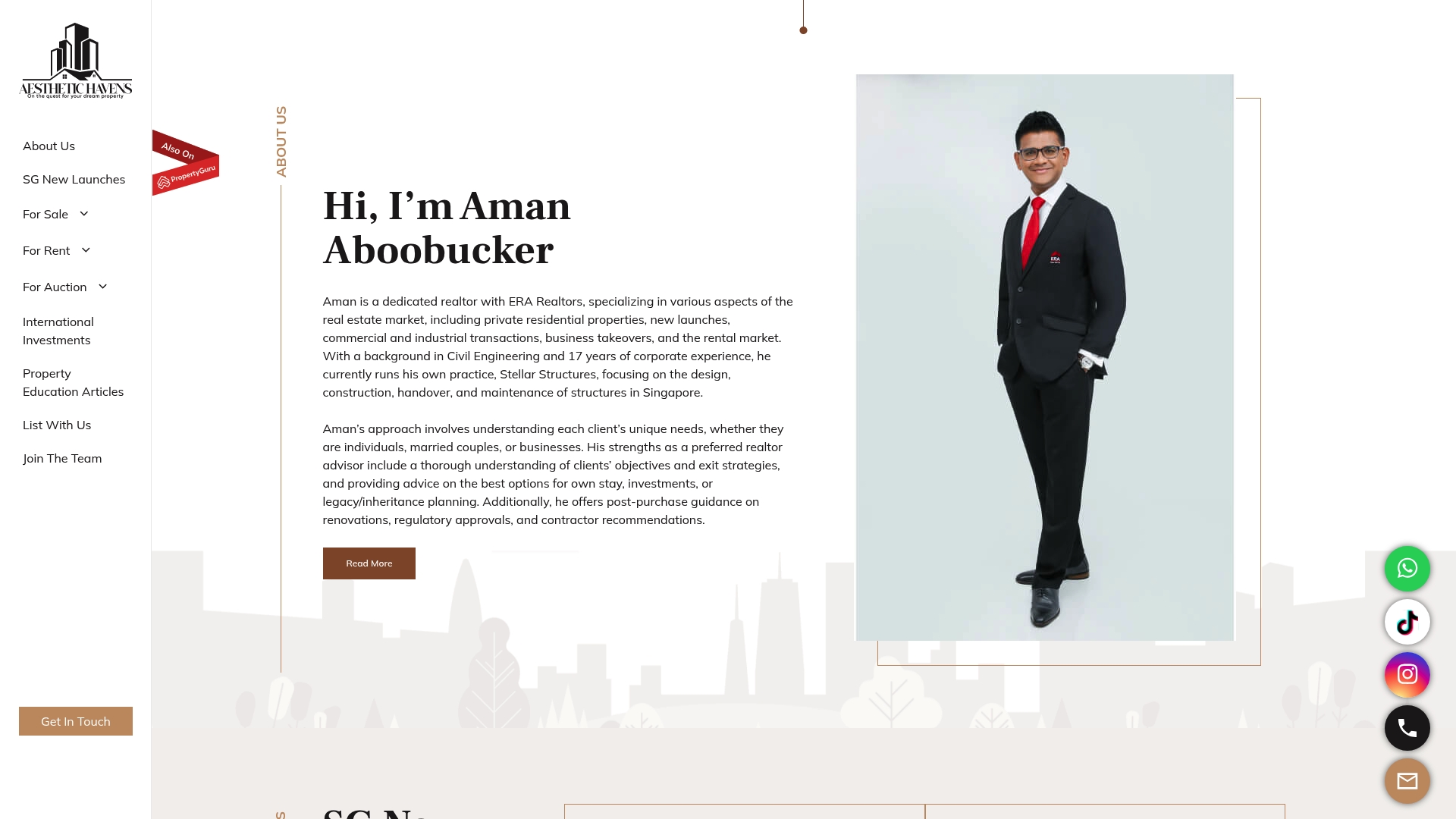
With an engineering background and years in real estate, I like to treat a renewal as a small, measurable decision: comparable rents, vacancy cost, the cost of moving, the term. When those are on one page, the conversation becomes calm. That is what we bring to the table for the owners and tenants who work with us, along with post-purchase and landlord support when the lease question becomes a bigger property question.
Aman
FAQ
When should I start negotiating a tenancy renewal?
Two to three months before the tenancy ends is a safe window, and earlier if your agreement has a written-notice deadline for a renewal option. Read the clause first, since missing it can end the option. Sending a written proposal with a reply date keeps the process moving.
Can my landlord raise the rent as much as they want at renewal?
There is no legal cap on open-market rents in Singapore. The Ministry of National Development describes these as private arrangements between owners and tenants. That makes comparable closed rents from URA or HDB data your best evidence in a negotiation.
What should I say to negotiate a lower rent?
State your track record, cite two or three comparable rents, and propose one specific figure and term. For example, offer a 24-month term at a flat rent in return for a lower monthly figure. Keep the tone factual and ask for a reply by a set date.
Do I pay stamp duty again on a renewal?
If the renewal is signed as a new tenancy agreement or a document that changes the terms, it is generally dutiable and must be stamped within 14 days. Duty is 0.4% of total rent for terms of four years or less, usually borne by the tenant unless the agreement says otherwise.
Sources
- Property Data, Urban Redevelopment Authority
- Renting or renting out, Council for Estate Agencies
- Written answer by the Ministry of National Development on maximum rental fee adjustments
- HDB rents in August 2026, HomeQuant
- Rent Increase Budget Singapore, Skymedia
- Tenancy Renewal Letter Template Singapore, SG Tenancy
- Renewing a Tenancy in Singapore: Key Checks, Reinstate.sg
- Renewing or signing a lease, MoneyBees Academy
- Lease renewal and rent increases in Singapore, expat.sg
- Stamp Duty on a Tenancy Agreement in Singapore, Propace
- What If I Have a Tenancy Dispute or Complaint in Singapore, SingaporeLegalAdvice.com


