


Smart-home features make a Singapore condo more attractive to buyers, and the strongest case is built on appeal, convenience and a well-documented system rather than on a fixed percentage uplift. Buyers respond to security, climate control, access and energy features that work reliably, are easy to hand over and sit inside a well-built development. Below, we cover what the evidence shows, which features matter, what to check on the system, the condo rules that apply, and how a developer’s track record fits in.
TL;DR
- Smart features add appeal and convenience for buyers. Treat them as a way to make your unit stand out, not as a guaranteed price premium.
- Security, access, climate and energy features are the ones buyers and developers in Singapore keep returning to.
- Open, documented systems that the next owner can maintain and expand are easier to present than closed ones tied to one vendor.
- Changes to switches, wiring or anything touching common property follow MCST by-laws and national rules, so check before you install.
- A developer’s quality record and the building’s overall condition shape how much confidence buyers place in everything inside the unit.
Table of Contents
- Do smart-home features raise resale value?
- What buyers say they will pay for
- Which features matter most to condo buyers
- Choose systems the next owner can keep using
- Rules to check before you install anything
- What the money looks like
- Developer reputation and build quality
- How to present smart features when you sell
- Our perspective
- Plan your sale or purchase with us
- FAQ
- Sources
Do smart-home features raise resale value?
They raise appeal first, and appeal is what supports a stronger sale. Smart home adoption in Singapore is already mainstream: Statista reports that smart home market revenue reached about US$227.1 million in 2023 and that smart home management devices had an ownership rate of 46% as of February 2024. When nearly half of households own this kind of device, a buyer walking through your unit is likely to understand what it does and to value it.
Property professionals describe the effect in similar terms. In a Singapore Business Review report on a launch, the head of research at Colliers International said smart homes appeal to all kinds of buyers, from singles to families and from young to old, because the technology improves efficiency, living standards and security. The head of marketing and communications at Huttons Group described smart features as the “icing on the cake” in making a unit attractive. The same piece noted that developers have to account for integration and maintenance, which can contribute to higher prices.
So the practical reading is this. A smart home does not replace location, size, tenure, floor level and condition, which still drive price. What it does is shorten the distance between a viewing and an offer, because the unit feels current and ready to move into. Among comparable units in the same development, that edge matters.

What buyers say they will pay for
The best Singapore-specific evidence is about willingness to pay and uptake, and it points in a consistent direction.
| Evidence | What it found |
|---|---|
| Peer-reviewed study in Buildings, January 2025 | Among 213 young Singaporean respondents, 39.9% were willing to pay for a smart public residential unit in the near future. Close to 45% of those willing to buy would pay a premium of 6% to 10%. |
| Visionaire executive condominium | 80% of clients took up the smart home packages when the concept was introduced in 2016, according to the developer’s deputy general manager, as reported by ULI Singapore. |
| Jadescape, Shunfu Road | 60% of units (300 of 400) sold on launch weekend at an average of S$1,600 psf, with smart features such as facial recognition at the lobby escalator and an integrated sink and dishwasher among the selling points. |
The Buildings study by Gao Shang, Low Sui Pheng and Kock Ho Ying is the most rigorous of the three. It looked at young Singaporeans and public residential units, so read it as a signal of demand among the next generation of buyers rather than a price table for private condos. That is still useful: younger buyers are the ones who will be purchasing resale condos for years to come, and a meaningful share say they would pay more for smart features.
The Visionaire uptake figure shows something different: when smart packages are offered clearly and priced upfront, most buyers choose them. The Jadescape launch, covered in the Singapore Business Review article cited above, shows smart features sitting inside a launch that sold strongly. None of these is a resale transaction study, so use them as evidence of what buyers like, and let comparable sales in your own development set the asking price.
Which features matter most to condo buyers
The features that repeatedly show up in the evidence share three traits: they solve an everyday problem, they work without effort, and the next owner can understand them in a minute.
Security and access
Smart locks, video door viewers, lobby and lift access and camera integration speak to safety, which the Colliers comment above names directly. Buyers with young children or elderly parents tend to notice these first. At the building level, access upgrades such as facial recognition are increasingly common. The Strata Titles Boards found that replacing the old access card and vehicle transponder systems at The Gardens at Bishan with facial and licence plate recognition did not constitute additions to or a change of use of common property and did not need approval by special resolution. For a buyer, that means a development with modern access control is not necessarily stuck waiting for a difficult vote to keep up with technology.
Climate and energy
In Singapore’s climate, air-conditioning and power use drive monthly bills, so smart air-con control, energy monitoring and efficient appliances are easy for buyers to understand. Cooling systems at estate level show how much running costs matter. According to The Straits Times in July 2026, Tengah residents on the Centralised Cooling System managed by SP Group saw monthly utilities bills fall from S$250 to S$270 to under S$200. The chilled water rate has stayed at S$0.10 per kilowatt-hour refrigeration (before GST) since July 2024. That is a Tengah example, not a promise for every condo, but it shows why buyers read a unit’s running costs as part of its value.
Convenience in the kitchen and living areas
Integrated appliances, lighting scenes, voice or app control and smart curtains make a unit feel considered. The Jadescape launch highlighted an integrated sink and dishwasher that could reduce dishwashing time by 50%. Features like this are tangible in a viewing, which is what counts.

EV charging
EV charging is a growing part of the conversation. According to the LTA’s guide for MCSTs, amendments to the BMSMA effective 8 December 2023 lowered the resolution threshold for EV charger installation proposals to an ordinary resolution, a simple majority of votes at a meeting. Developments with chargers in place or a clear route to them can read as future-ready.
Choose systems the next owner can keep using
A smart home is only as valuable as it is usable after you leave. Before you buy a system, or when you evaluate one in a unit you want to purchase, ask who controls it.
A 2026 industry article by Mike Lim of Automate Asia makes a useful distinction: device compatibility is not the same as openness. A system can support many devices and still keep the main app, programming logic, configuration, controller, licence or server inside one vendor’s ecosystem. True openness, in his framing, means the homeowner can maintain, modify or expand the system without going back to the same vendor each time. This is one practitioner’s perspective, but it matches what buyers care about in practice.
A simple handover checklist makes any smart home easier to sell:
- Accounts and admin access. Make sure the main account can be transferred or reset, so the buyer is not locked out on day one.
- Hub or controller details. Note the model, where it sits and how to reset it.
- Device list. Brand, model, installation date and warranty for each device.
- Wiring and installer records. Who did the work, and whether electrical changes were done by a licensed worker (more on this below).
- App and licence terms. Any subscription, cloud service or licence that continues after the sale.
- Manuals and quick-start notes. One page that tells a new owner how to use lights, locks and air-con in five minutes.
A seller who hands over this pack presents the system as an asset. A seller who cannot explain it risks the buyer seeing it as a puzzle.
Rules to check before you install anything
Smart-home work in a condo follows two layers of rules: the development’s by-laws set by the MCST, and national rules on building and electrical work. A Singapore smart home renovation guide published in October 2026 summarises this as the MCST’s by-laws plus requirements from BCA, URA and EMA. It says that switch, lighting and power point changes must be done by an EMA-licensed electrical worker, and that works affecting the building’s appearance or structural integrity need MCST authorisation.
The official rules underline why this matters:
- Under the Building Maintenance (Strata Management) Regulations 2005, a subsidiary proprietor or occupier must not mark, paint, drive nails or screws into, or otherwise damage or deface any structure that forms part of the common property without the prior written approval of the management corporation. Mounting a camera or sensor on a common wall or ceiling element can fall into this.
- BCA explains that as a condo unit owner you are automatically a subsidiary proprietor and part of the MCST. Structural elements such as slabs, beams, columns and walls cannot be altered without assessment by a Professional Engineer and approval from the Commissioner of Building Control. Alterations to features fixed on the external building, such as windows and walls, are not allowed without approval from the MCST and relevant government agencies.
In plain terms: keep installations inside your unit, use licensed electricians for wiring, avoid drilling into common property or the facade, and get written MCST approval whenever there is doubt. Keep the approvals with your handover pack. A buyer’s lawyer and agent will be reassured by seeing that the work was done properly.
What the money looks like
When you decide what to install before selling, think in terms of return on appeal rather than a formula.
- Low-cost, high-visibility items such as a smart lock, smart plugs for lighting and air-con control, and a video doorbell where permitted are easy to demonstrate at a viewing.
- Deeper integrations such as full lighting scenes, motorised curtains and whole-home control cost more and are best justified when you will live with them for years before selling.
- Running costs matter as much as purchase costs. Subscriptions, replacement batteries and device lifespans all affect the financial case, so factor them in.
A 2016 survey of young couples, reported by PropertyReview, found that 79% of 100 respondents aged 20 to 40 would consider an executive condominium set up with smart technologies. It is a small, older sample, so take it as a hint of interest rather than a benchmark.
If you are planning a sale, a professional valuation tells you how the market is pricing your unit against recent comparable transactions. Our guides on what property valuation is and why it matters and on ways to value real estate assets in Singapore explain the methods.
Developer reputation and build quality
Smart systems sit on top of a building. If the building has defects, wiring problems or poor workmanship, the technology on top will not rescue buyer confidence. That is why developer reputation belongs in any smart-home conversation.
BCA’s guide to buying a condo explains the CONQUAS Banding system, which rates developers, builders and projects from Band 1 (very low incidence of major defects) to Band 6 (high incidence of major defects). BCA advises buyers to visit the Quality Housing Portal for information on the past workmanship and quality performance of developers and builders before buying.
For a buyer, this means checking three things:
- The developer’s and builder’s record on the Quality Housing Portal.
- Whether the development’s smart or access systems are building-wide, and who maintains them.
- How the MCST manages upgrades and maintenance, since common-area technology depends on it.
For a seller, a well-regarded developer and a well-run MCST are selling points you can mention alongside your unit’s smart features. Our articles on buying new launch versus resale and the pros and cons of a resale condo cover how age, developer and condition shape the decision.
How to present smart features when you sell
Technology only helps if buyers notice it and trust it. A few habits make the difference.
- Show, do not tell. Before viewings, set the lights, air-con and curtains to a pleasant scene so the first impression includes the technology working.
- List features accurately. State what is included in the sale and what is not. Fixtures usually stay and personal devices may leave, so settle it in writing.
- Photograph and film the features. Short video walkthroughs of the lock, lighting scenes and app control help online viewers. Home presentation also pays off more broadly, as we discuss in our home staging guide.
- Bundle the paperwork. The handover pack above, plus MCST approvals and electrician records.
- Price off comparables. Let recent sales in your development and your agent’s analysis set the price, then use the smart features to support your position in negotiation.
If you are weighing the broader market before listing, our overview of Singapore property trends helps frame timing.
Our perspective
Many owners ask us whether a smart home “adds value”. Our answer is that it adds reasons for a buyer to say yes, and those reasons are worth planning for.
In our work with buyers, sellers and investors, we look at a unit the way the next buyer will: location, layout, condition, running costs and how easily they can live in it on day one. Smart features belong in that last group. They are strongest when they are reliable, documented and permitted, and weakest when nobody can explain how they work.
With a background in both engineering and real estate, we pay attention to the technical details behind the pitch: who installed the wiring, what the system depends on, and what the MCST allows. We guide clients on their objectives and exit strategy from the start, so a decision about a lock or a lighting system is made with the eventual sale in mind. After purchase, we support clients on renovation and regulatory questions so that the work they do protects the value they have built.
Whether you are buying to stay, to invest or to progress a portfolio, our advice is the same: choose a good development, a sound unit and sensible technology, and keep the paperwork tidy.
Aman
Plan your sale or purchase with us
If you are buying a condo with smart features, or preparing to sell one, we can help you judge the unit, the development and the price. Our services cover property valuation, sales and leasing, and advisory on buying, selling and investing across residential, commercial and industrial property. For buyers watching new projects, we also cover SG new launches, and you can browse residential listings at any time.
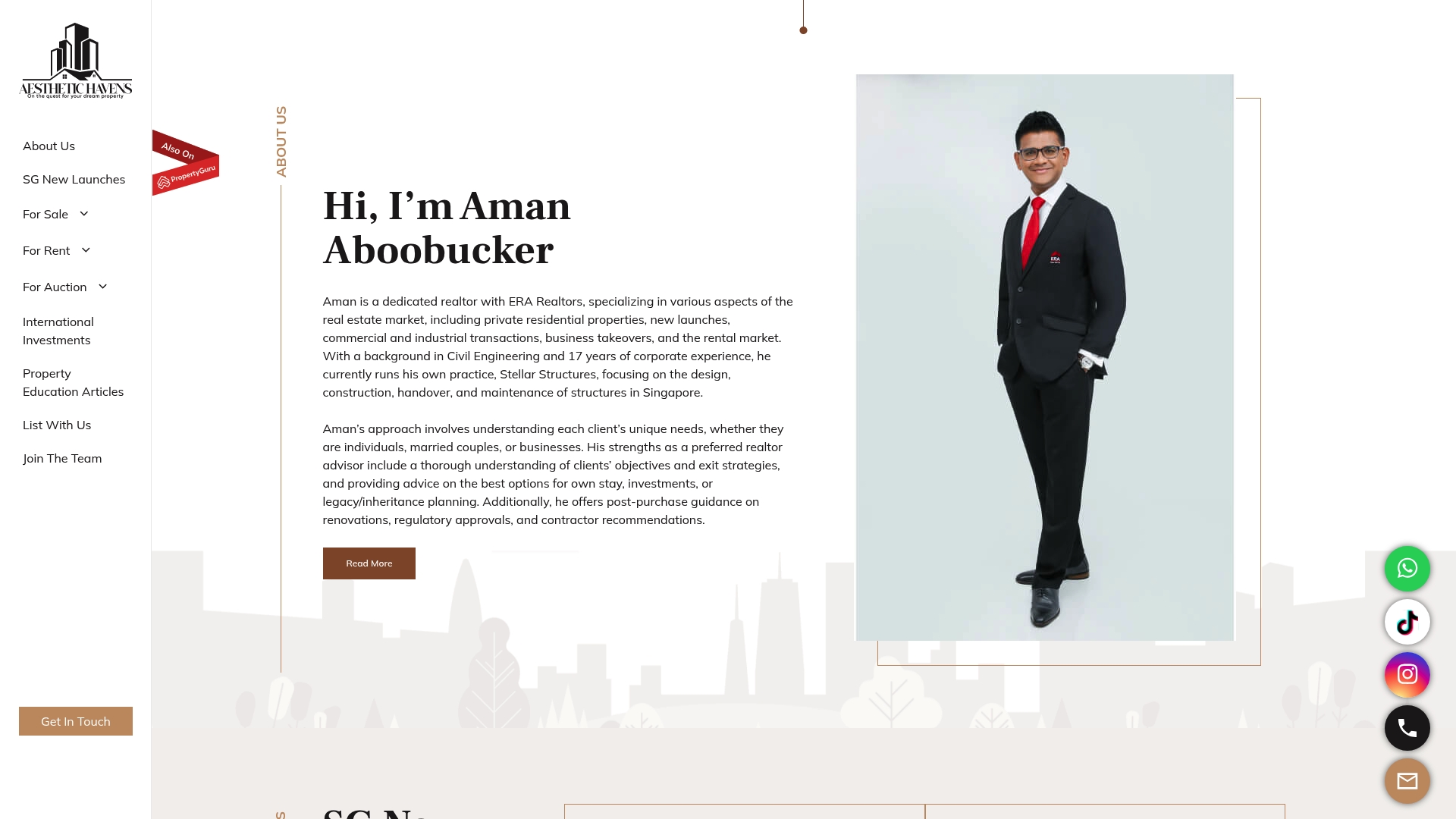
To discuss your unit or your next purchase, start from Aesthetic Havens and tell us what you want to achieve.
FAQ
Will a smart home let me sell my condo for more?
It can help your unit stand out and support your asking price, but location, size, tenure and condition still drive value. A 2025 study of young Singaporeans found close to 45% of willing buyers would pay a 6% to 10% premium for a smart unit. Treat that as a signal of demand, and set your price from recent comparable sales.
Which smart features are worth installing before a sale?
Focus on security and access, air-con and lighting control, and anything that visibly saves effort, such as a smart lock. These are simple to demonstrate in a viewing. Keep to work inside your unit and use a licensed electrician for any wiring changes.
Do I need MCST approval for smart-home devices?
Work inside your unit that does not touch common property generally stays with you, but anything that affects common property, the facade or the building’s appearance needs written MCST approval. Regulations also bar damaging or defacing common property without the management corporation’s prior written approval. Check your development’s by-laws and ask the MCST when unsure.
How does the developer’s reputation affect a condo’s resale appeal?
Buyers rely on workmanship and build quality, and a smart system cannot make up for defects. BCA’s CONQUAS Banding rates developers and builders from Band 1 to Band 6, and BCA advises buyers to check the Quality Housing Portal before purchasing. A strong record supports buyer confidence across the whole unit.
Should I choose an open or a closed smart-home system?
Open systems that the next owner can maintain and expand without returning to one vendor are easier to hand over. Ask who holds the main account, controller and licence, and write it down for the buyer. A documented system is easier to present than one only the seller understands.
Sources
- Smart homes in Singapore: statistics and facts, Statista
- Singapore embraces smart homes in heated Jadescape take-up, Singapore Business Review
- Receptiveness of Young Singaporeans Towards Smart Features, Buildings (MDPI)
- Sensors and Smart Home Technology Drive Results in Singapore, ULI Singapore
- Condo facial recognition upgrade and the Strata Titles Boards, Zaobao
- Centralised Cooling System in Tengah, The Straits Times
- Electric Vehicle Guide for MCSTs, Land Transport Authority
- Smart Home Singapore 2026: choose the right system without getting locked in
- Condo Smart Home Singapore: MCST Rules and Wiring
- Building Maintenance (Strata Management) Regulations 2005, Singapore Statutes Online
- What to know as a condo owner, Building and Construction Authority
- Before owning a condo: what to know, Building and Construction Authority
- Smart Home Features Appeal 79% of Singapore Young Couples, PropertyReview


