

Introduction
Selling a Singapore private condo in the fourth year of ownership now carries a 4% seller’s stamp duty if the property was purchased on or after 4 July 2025. Before that date, the same fourth-year sale would have attracted 0% SSD. This case study walks through a realistic condo investment bought in November 2025 and sold just after the four-year mark in December 2029, showing exactly how the numbers changed under the new 4-year SSD rule.
The scope here is narrow: one private residential property, one investor, one exit. Commercial and industrial SSD rules sit outside this analysis. The target readers are Singapore property investors, upgraders, agents, and small business owners who hold residential units alongside other asset classes, compare different residential projects, and need to understand how the extended ssd holding period reshapes exit planning.
The short answer: the government revised the SSD rules to discourage short-term speculation and promote long-term ownership. Because SSD rates increased by four percentage points for each tier and the holding period stretched from three to four years, an investor who would previously have walked away SSD-free at the 3-year mark now faces an 8% levy at that same point. A planned exit just past Year 4 remains viable, but it demands tighter cash flow management and a longer capital commitment.
Here is what this case study covers:
-
How the SSD regime shifted from a 3-year to a 4-year holding period in July 2025, and the specific rate changes at each tier.
-
Detailed numbers for a condo bought at S$1.6 million in late 2025 and sold at S$1.9 million shortly after Year 4.
-
A side-by-side comparison of net profit under the old versus new SSD structures.
-
Impact on cash flow, leverage, and opportunity cost across the four-year hold.
-
Practical guidance on structuring timelines and exits under the current rules.
Understanding Seller’s Stamp Duty (SSD) After the 2025 Rule Change
Seller’s stamp duty is a tax imposed on residential property owners who sell within a specified period after purchase. On 3 July 2025, the Singapore government announced that the SSD holding period would increase from three to four years, and that SSD rates would rise by four percentage points at every tier. The Ministry of Finance stated that the changes aimed to restore the rate structure that applied between 14 January 2011 and 10 March 2017.
The trigger was a measurable increase in short-term property trading. Short-term speculative behavior in property trading increased five-fold between 2020 and 2025. Subsale volumes averaged 338 units per quarter from Q1 2023 to Q1 2025, and, in view of this rise, the government acted.
The Pre‑July 2025 SSD Regime (3‑Year Period)
For residential properties bought between 11 March 2017 and 3 July 2025, the SSD framework from IRAS applied a three-year clock:
-
Sold within 1 year: 12%
-
Sold after 1 year but within 2 years: 8%
-
Sold after 2 years but within 3 years: 4%
-
Sold after 3 years: 0%
Many investors built exit models around the 3-year mark. In a market where property prices have risen 40% since 2020, selling at the start of Year 4 with zero SSD was a straightforward play. The math was simple: wait three years, sell, keep all the upside.
The Post‑4 July 2025 SSD Regime (4‑Year Period)
Changes take effect for purchases on or after July 4, 2025. The new SSD rate structure includes 16% for up to 1 year, 12% for more than 1 to 2 years, 8% for more than 2 to 3 years, 4% for more than 3 to 4 years, and 0% after 4 years. SSD is charged on the higher of selling price or market value, which means even a below-market sale does not reduce the tax base.
This regime mirrors the earlier 2011–2017 structure. The SSD schedule does not apply retrospectively to earlier purchases; only properties acquired from 4 July 2025 onward fall under the new rates.
The calculation of SSD applies even if you sell the property at a loss. If an investor buys at S$1.6 million, the market drops, and the unit sells for S$1.4 million, SSD is still owed on the higher of S$1.4 million or the assessed market value at disposal.
Why the 4‑Year SSD Matters for Exit Timing
Under a 3-year regime, an investor’s “free exit” opened at Month 37. Under the 4-year regime, that window does not open until Month 49. For a leveraged buyer with, say, 75% loan-to-value financing, the extra 12 months means:
-
Roughly S$38,000–S$42,000 in additional interest payments at a 3.2% annual rate on a S$1.2 million loan.
-
Twelve more months of exposure to rental market softening or vacancy.
-
Capital locked for an additional year that cannot be redeployed into industrial or commercial properties, or into business operations.
The next section sets up the concrete numbers for a condo bought after the rule change.
The Investment Scenario: Buying a Condo After the SSD Rule Change
This section lays out a single realistic example. The figures are rounded but internally consistent, so readers can adapt the model to their own situation by adjusting the inputs.
Profile of the Investor and Property
The buyer is a Singapore citizen in their mid-30s, a salaried professional who also plans to acquire a B1 industrial unit for business use within three to four years. Risk appetite is moderate; the plan from day one is a 4–5 year hold.
The property: a new 2-bedroom private condo in the Rest of Central Region, purchased in November 2025 at S$1.6 million. It is one of the 99-year leasehold residential projects an investor might target in the Rest of Central Region, with an expected Temporary Occupation Permit in early 2027. The unit is an investment; it will be rented out, not owner-occupied.
Financing, Taxes, and Upfront Cash Outlay
Financing assumptions:
-
75% bank loan: S$1,200,000 at an average interest rate of 3.2% per annum over the first four years.
-
25% downpayment: S$400,000 (5% in cash, 20% in CPF or cash).
Buyer’s Stamp Duty on S$1.6 million under current tiered BSD rates comes to approximately S$44,600. This case assumes no Additional Buyer’s Stamp Duty (the investor’s first residential property); buyers purchasing a second or subsequent property would need to layer ABSD on top.
Total upfront capital required: roughly S$450,000, covering the downpayment, BSD, legal fees, and incidental costs.
Operating the Investment During the First Four Years
The project TOPs in early 2027, so rental income begins around March 2027. Key operating assumptions:
-
Average gross monthly rent: S$4,500, with roughly one month of vacancy per year.
-
Annual rental income (net of vacancy): approximately S$49,500 once leasing begins.
-
Annual outgoings (MCST, property tax, insurance, minor maintenance): approximately S$8,400.
-
Monthly loan instalment (interest and principal on S$1.2 million over 25–30 years at 3.2%): approximately S$5,800, or about S$69,600 per year.
For the period before TOP (November 2025 to early 2027), the investor earns no rent but services the progressive payment schedule on the construction loan. Once rental income starts, the unit runs at a modest annual cash flow deficit of roughly S$28,000–S$30,000 (rent minus loan instalments and outgoings). Over the full four-year holding period, total net cash outflow from operations (including the pre-TOP period) is approximately S$90,000–S$100,000.
A business owner evaluating this against a B1 industrial unit for self-use would note that the industrial unit could offset rental expense for business premises while also appreciating. The condo, by contrast, generates rental income but requires cash injections to cover the loan shortfall each year.
Total position heading into exit: the investor has deployed roughly S$450,000 upfront and an additional S$90,000–S$100,000 in net operating cash outflows over four years, for a total capital commitment of around S$540,000–S$550,000.
Case Study: Exiting the Condo at Year 4 Under the 4‑Year SSD Rule
The investor sells the condo in December 2029, just over four years after the November 2025 purchase. Because the ssd holding period exceeds four years, the seller’s stamp duty SSD payable is S$0 under the post-2025 rules.
Year‑4 Exit Assumptions and Market Conditions
Late 2029 market backdrop: after cooling measures dampened speculative activity, price growth has moderated. The SSD increase is expected to have insignificant impact on transaction volumes over the medium term, and subsales as a percentage of total transactions declined to 4.4%, indicating that long term investors rather than flippers dominate the market.
Exit price: S$1.9 million, reflecting about 4.4% compound annual growth from S$1.6 million over four years. This is a reasonable assumption rather than an optimistic one.
Selling costs: agent commission at 2% of sale price (S$38,000), legal fees and incidentals (approximately S$3,000). Total selling costs: roughly S$41,000.
Step‑by‑Step Calculation of Net Profit at Year 4
-
Gross sale proceeds: S$1,900,000.
-
Outstanding loan balance after 4 years: approximately S$1,130,000 (after principal repayments on the S$1.2 million loan over ~48 months of servicing post-drawdown).
-
Seller’s stamp duty: S$0, because the holding period exceeds four years under the new regime.
-
Selling costs (agent fees, legal): S$41,000.
-
Net sale proceeds after loan and costs: S$1,900,000 – S$1,130,000 – S$41,000 = approximately S$729,000.
-
Cumulative net rental income (loss): negative S$95,000 (net cash outflow from operations over 4 years, as estimated above).
-
Total equity returned: S$729,000 – S$95,000 = approximately S$634,000.
-
Original equity invested: approximately S$450,000 (downpayment + BSD + upfront costs).
-
Net profit: S$634,000 – S$450,000 = approximately S$184,000.
-
Annualised return on equity: roughly 9–10% per annum on the S$450,000 over four years.
The SSD must be paid to the Inland Revenue Authority of Singapore within 14 days of signing the sale contract; in this scenario, the investor avoids that obligation entirely by selling after the four-year threshold.
Year‑by‑Year Property Value vs. SSD Exposure
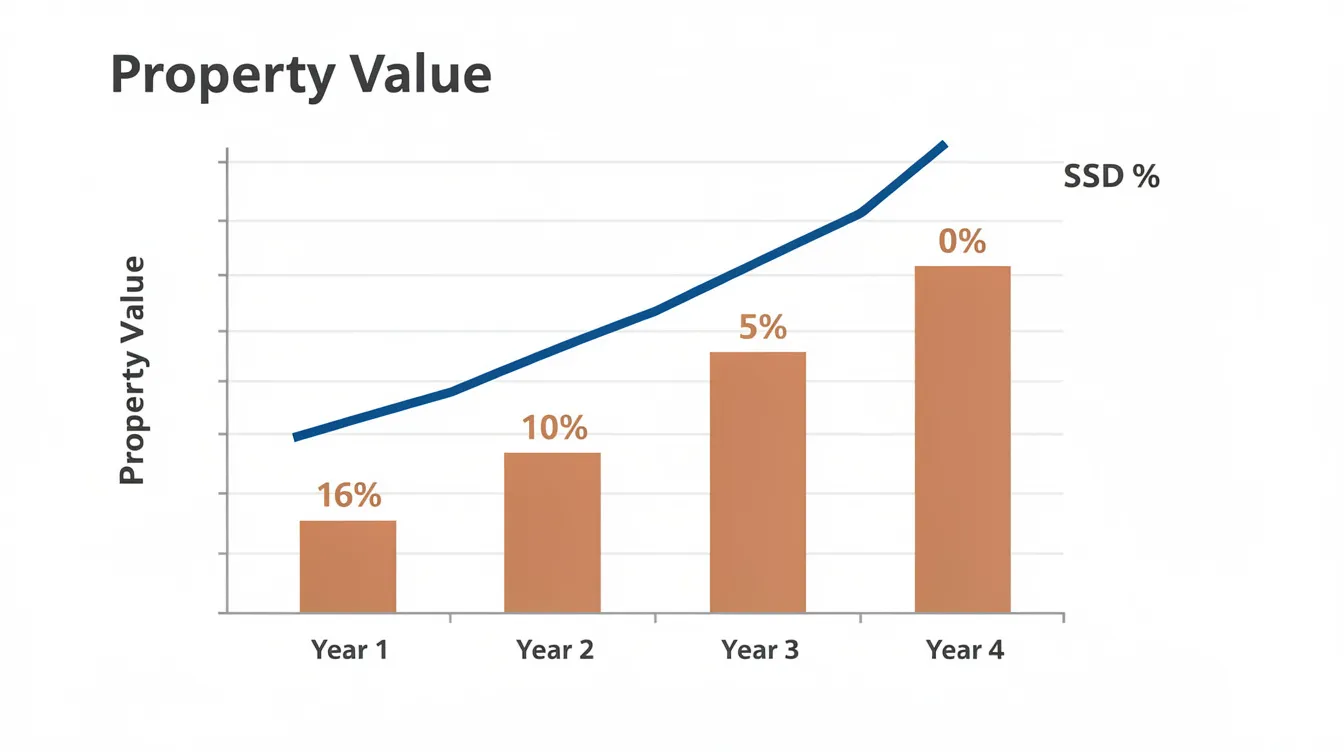
The pattern is a shrinking penalty wall. At Year 1 (late 2026), selling the S$1.6 million purchase would trigger 16% SSD, or S$256,000 or more depending on market value. By Year 2, that drops to 12%, then 8% at Year 3, 4% at Year 4 (if sold just inside the four-year window), and S$0 once the clock passes 48 months. The case study exit sits just beyond that wall.
Decoupling within 4 years of purchase triggers SSD rates of 4% to 16% depending on the tenure since purchase, a point investors with joint ownership structures should note.
What Would Have Happened Under the Old 3‑Year SSD Rule?
This counterfactual is not legally possible for a post-July 2025 purchase, but re-running the numbers under the old regime isolates the policy’s effect.
Same Property, Old Rules: Timing Options and SSD Payable
Under the old 3-year SSD regime, the investor would have had an SSD-free exit available from late 2028 (Year 3) onward. A Year-3 sale at an estimated S$1.8 million would have carried 0% SSD, giving the investor flexibility to recycle capital a full year earlier.
Under the new rules, that same Year-3 sale attracts 8% SSD on S$1.8 million: S$144,000. That single line item transforms a profitable early exit into a marginal one.
Net Profit Comparison: Old vs New SSD Structures
|
Scenario A: Year‑3 Exit (Old 3‑Year SSD) |
Scenario B: Year‑3 Exit (New 4‑Year SSD) |
Scenario C: Year‑4 Exit (New 4‑Year SSD) |
|
|---|---|---|---|
|
Sale price |
S$1,800,000 |
S$1,800,000 |
S$1,900,000 |
|
SSD payable |
S$0 |
S$144,000 (8%) |
S$0 |
|
Net sale proceeds (after loan + costs) |
~S$627,000 |
~S$483,000 |
~S$729,000 |
|
Cumulative net rental (loss) |
–S$60,000 (3 yrs) |
–S$60,000 (3 yrs) |
–S$95,000 (4 yrs) |
|
Total equity returned |
~S$567,000 |
~S$423,000 |
~S$634,000 |
|
Net profit |
~S$117,000 |
–S$27,000 (loss) |
~S$184,000 |
|
Annualised return on equity |
~8% pa |
Negative |
~9–10% pa |
Under the old rules, a Year-3 exit captured strong returns with one fewer year of holding costs. Under the new 4-year SSD regime, that same Year-3 sale produces a net loss because S$144,000 in SSD consumes the entire capital gain and then some. The Year-4 exit under the new regime produces the highest absolute profit, but it requires 12 additional months of loan servicing, vacancy risk, and illiquidity.
The extra year changes more than profit; it changes how capital flows through an investor’s portfolio.
How the 4‑Year SSD Rule Changed Investor Behaviour and Portfolio Strategy
Holding Period, Risk, and Liquidity Effects
The minimum practical hold for an SSD-free exit has extended from three years to four years. For a buyer who financed 75% of a S$1.6 million purchase, that extra year means approximately S$40,000 in additional interest. It also adds 12 months of rental market exposure; if rents soften by 10% in Year 4, net cash outflow widens further.
Liquidity matters especially for investors who buy properties alongside running businesses. Several common questions arise: should an owner delay a condo sell to free up cash for a warehouse purchase? Should an SME owner prioritise an industrial unit for operations instead of committing capital to a residential flip with a four-year lock-in?
Rebalancing Between Residential and Industrial Investments
With a longer SSD horizon on condos, some buyers are redirecting capital. One approach: hold the condo for the full four to five years while acquiring a B1 industrial unit in Year 2 using business cash flow. The industrial asset supports operations and generates revenue, while the condo appreciates in the background without being touched.
Another approach: an investor who had planned to buy a second condo decides against it because the SSD constraints now lock capital for four years instead of three. That capital goes into an industrial asset with a different risk profile and no equivalent SSD restriction on early disposal.
Cash Flow Planning While Waiting Out SSD
Servicing loans across four years requires buffers that many investors underestimate. If rent drops by 15% and interest rates rise by 0.5 percentage points in Year 3, monthly cash outflow could increase by S$800–S$1,000. Over 12 months, that is an unplanned S$10,000–S$12,000 drain.
Steps to manage this:
-
Project worst-case rental and interest rate scenarios across all four years before committing to the purchase.
-
Maintain a reserve fund covering at least 6 months of loan instalments and maintenance (roughly S$45,000 for the scenario above).
-
Coordinate the timing of any planned industrial or commercial acquisitions so that cash demands do not stack in the same quarter.
-
Stress-test a forced Year-3 exit: if SSD of 8% on sale price must be paid, does the investor still retain positive equity? If not, the deal may be too leveraged from the start.
Common Pitfalls When Exiting Near the 4‑Year SSD Threshold
Investors who try to sell close to the boundary of the four-year mark expose themselves to timing errors and assumption failures.
Miscounting the SSD Holding Period
The ssd holding period runs from the date the Option to Purchase was accepted (or the Sale & Purchase Agreement was signed, if no OTP exists) to the date of disposal, which is typically when the seller grants the buyer’s OTP or signs the S&P. Investors sometimes use the TOP date or the date they moved in; neither is correct.
If a seller issues an OTP three weeks too early, thinking the four-year mark has passed, the sale falls inside the SSD window. A 4% SSD on S$1.9 million is S$76,000; a three-week miscalculation is expensive.
Solution: confirm exact SSD computation dates with the conveyancing lawyer before issuing an OTP. Cross-reference with IRAS SSD guidance but verify manually for borderline cases.
Forced Early Exit Due to Life or Business Events
Job loss, business expansion requiring capital, divorce, or emigration can force a sale before the four-year mark. In these situations, SSD is not waived (outside a narrow set of exemptions such as HDB Minimum Occupation Period scenarios, which do not apply to private condos).
Mitigation: maintain some liquid, non-SSD-constrained assets in the portfolio. If a short-term cash gap can be bridged through a credit line or temporary rental of other assets, renting out the condo rather than selling it avoids triggering SSD altogether.
Overestimating Price Growth to Justify Waiting
Not every market rewards patience. If annual price growth runs at 1–2% CAGR instead of 4.4%, the Year-4 exit on a S$1.6 million purchase yields a sale price closer to S$1.66–S$1.73 million. After four years of interest, outgoings, and selling costs, net profit could be near zero or negative, even without SSD.
Before committing, run a conservative scenario: 1.5% annual growth, one quarter of vacancy per year, and a 0.5 percentage point rate increase in Year 3. If the deal still works, it is resilient. If it breaks, the margin of safety is too thin. Research from 99.co’s analysis of sub-sale patterns showed that 173 transactions (34.5% of surveyed subsales) fell in the 3–4 year window; under the new regime, every one of those sellers would have paid 4% SSD.
Conclusion and Next Steps
The 2025 shift from a 3-year to a 4-year SSD period, with rates rising by four percentage points at each tier, made early condo exits measurably more costly. In this case study, a Year-3 exit under the new rules would have produced a net loss of roughly S$27,000 after SSD of S$144,000. A Year-4 exit, timed just past the SSD window, returned approximately S$184,000 in net profit on S$450,000 of equity, translating to about 9–10% annualised return.
Compared to the old regime, the new rules require investors to finance, manage, and endure one additional year before reaching an SSD-free exit. For buyers who also operate businesses or hold industrial properties, that extra year of locked capital has direct implications for how and when they deploy funds elsewhere.
Next steps for readers:
-
Map out the actual SSD timeline for each residential property you own or plan to buy, using the contract date (OTP acceptance or S&P signing), not the TOP or move-in date.
-
Build a spreadsheet projecting purchase costs, SSD at each yearly exit point, rental income, loan servicing, and sale proceeds under at least two growth scenarios (base case and conservative).
-
Review how your residential plans interact with any industrial or commercial property goals, especially if you run a business that could benefit from owned premises.
-
Consult professional advisers to stress-test scenarios before committing to a purchase with a potential 4-year lock-in.
Related topics worth exploring next: how ABSD, BSD, and SSD interact in multi-property portfolios; comparing residential versus industrial property strategies under current cooling measures; and structuring property ownership for SMEs weighing own-use industrial space against investment condos.
Additional Resources
-
IRAS SSD rates and holding period definitions for the official rate tables and computation rules.
-
MOF announcement on SSD extension (3 July 2025) for the ministry’s stated rationale and effective date details.
-
99.co analysis of SSD rate hike effects on sub-sales for market data on subsale clustering in the 3–4 year window.
-
A simple checklist for planning exits around SSD milestones: verify OTP/S&P date, confirm holding period with lawyer, compute SSD at Years 1–4, and compare net proceeds at each hypothetical exit point before listing.

