

Introduction
CPF accrued interest is the single largest line item most HDB upgraders forget to subtract from their expected sale proceeds. If you have used your CPF Ordinary Account to pay for your HDB flat, every dollar withdrawn has been silently compounding at 2.5% per annum since the day it left your CPF account. When you sell, that CPF principal plus total accrued interest must be refunded to your own CPF account before you see a single dollar of cash. For upgraders planning the jump from HDB flat to condo or landed property, this hidden cost can erase S$40,000 to over S$100,000 from the cash you expected to hold in your bank account.
This article focuses on Singapore CPF OA accrued interest as it applies to HDB owners upgrading to private residential property between 2024 and 2030. It is not a guide for overseas property, commercial assets, or non-residential purchases. The target reader is an HDB owner planning to upgrade to a condo or landed property, including business owners who hold residential property and want to make informed asset progression decisions.
The core answer, stated plainly: CPF accrued interest is charged at 2.5% per annum, compounded monthly at 0.2083%, on every dollar of CPF OA savings withdrawn for housing. Sellers must refund both principal and accrued interest upon sale. Accrued interest reduces actual cash proceeds from property sales; a S$100,000 CPF withdrawal held for 25 years accrues approximately S$83,000 in interest. A S$200,000 total CPF usage over 8 to 10 years can generate S$40,000 or more in accrued interest alone, money that returns to CPF rather than to your bank account.
By the end of this article, you will:
-
Understand what CPF accrued interest is and how the accrued interest mechanism works at a formula level.
-
See exactly how it changes your net cash when selling an HDB and upgrading in 2026 and beyond.
-
Learn how to estimate your own exact accrued interest using CPF tools and a simple compounding formula.
-
Discover specific strategies (voluntary refunds, cash vs CPF structuring, timing) to reduce its impact and plan realistic upgrade budgets.
-
Get a framework for safe asset progression (HDB to condo to landed) without running into cash-flow traps.
The article includes suggested charts, tables, and waterfall diagrams to help you visualize how compounding and upgrade scenarios work in practice.
Understanding CPF Accrued Interest for HDB Upgraders
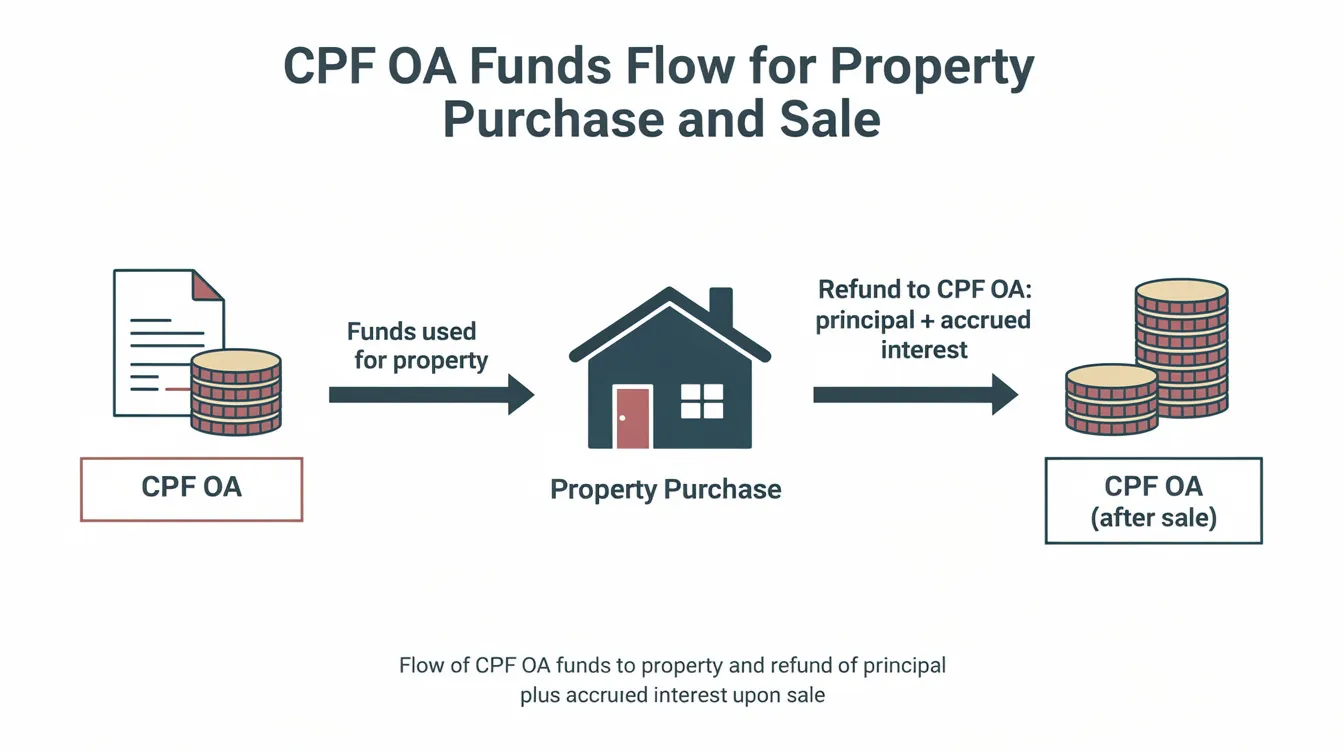
CPF accrued interest exists because your CPF Ordinary Account is a retirement savings vehicle, not a housing piggy bank. When you withdraw CPF funds to buy a property, those funds stop earning the 2.5% annual CPF OA interest they would have generated inside your account. The CPF Board tracks this “missed” interest as a refund obligation tied to your property. Upon sale, you repay the CPF principal used plus all accumulated interest back to your own CPF account. This is not a penalty or a fee paid to the government; it is a retirement protection mechanism that ensures your CPF savings are eventually restored.
For a typical HDB upgrader, understanding CPF accrued interest is non-negotiable. Consider a couple who bought a BTO in 2016 and plan to sell after their Minimum Occupation Period in 2026. Over those 10 years, every CPF dollar they used for the down payment, monthly instalments, stamp duties, and legal fees has been compounding. By 2026, the gap between their “paper profit” on the HDB resale and their actual cash in hand could be S$50,000 or more, depending on total CPF usage.
What Counts as CPF Usage for Housing (and Attracts Accrued Interest)
Every CPF OA withdrawal for housing costs accrues interest from the month it leaves your account. The items that count include:
-
Down payment for HDB, EC, or condo paid from CPF OA.
-
Monthly instalments serviced via CPF OA (this is typically the largest ongoing source of accrued interest).
-
Buyer’s Stamp Duty (BSD) and Additional Buyer’s Stamp Duty (ABSD) paid using CPF money.
-
Legal and conveyancing fees paid from CPF OA.
Housing grants also attract accrued interest. The Enhanced CPF Housing Grant, Family Grant, and other CPF housing grants are treated as CPF monies used for the flat. On sale, you must refund the grant principal plus accrued interest since disbursement. For grants exceeding S$30,000, portions of the refund may be credited to your Special Account, MediSave, or Retirement Account rather than OA, depending on CPF Board policy at the time.
Every CPF dollar used for the first flat is compounding against your future cash proceeds. Even “small” items like S$5,000 in legal fees or S$15,000 in stamp duties paid via CPF OA will generate several thousand dollars of accrued interest over a decade.
How CPF Accrued Interest Works Behind the Scenes
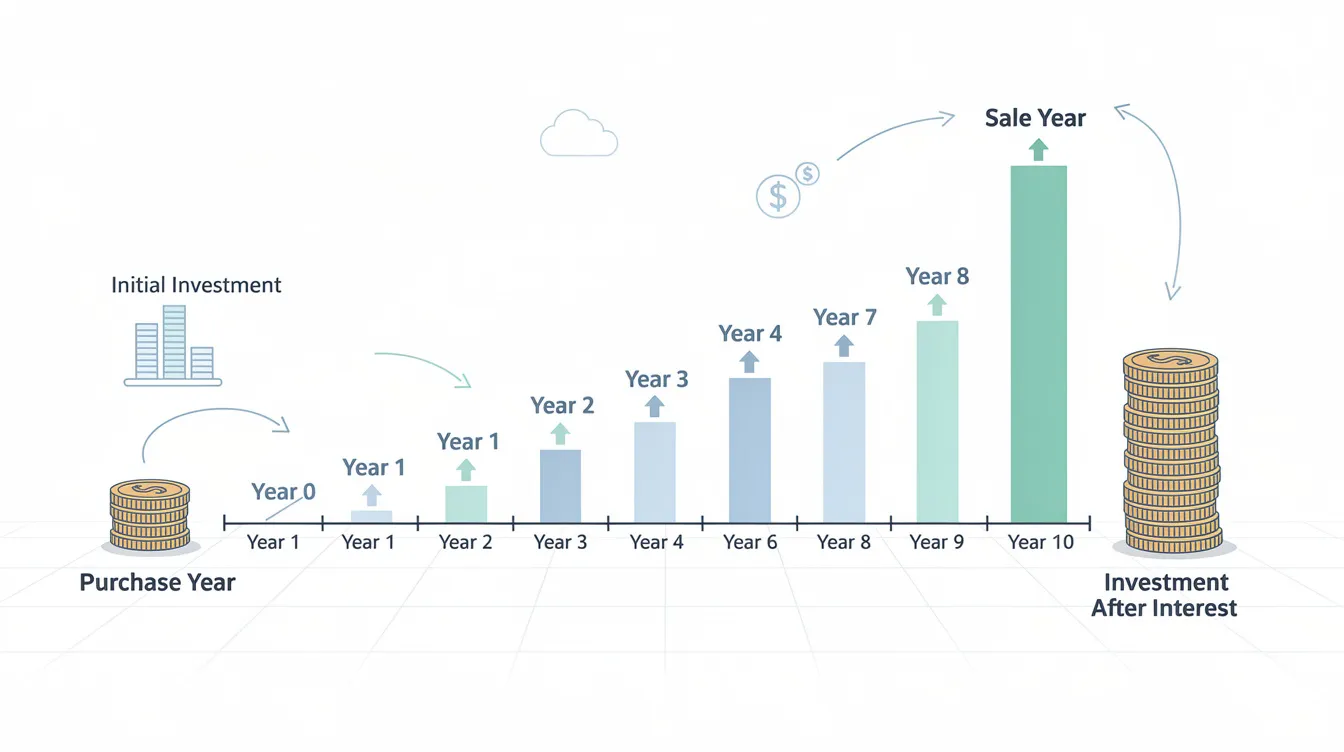
The accrued interest mechanism operates as follows. CPF assumes your Ordinary Account would have earned 2.5% annually on any funds you withdrew for housing. That “missed” interest is tracked from the month of each CPF withdrawal until the date of resale completion or voluntary refund. Accrued interest compounds monthly, not yearly, which means interest itself earns interest each month.
This obligation sits on CPF’s books as a legal “charge” on your property. It follows the flat until sale, transfer, or until you make a voluntary refund. You can check your running total at any time via the CPF portal.
With the mechanics clear, the next step is to see the exact math so you can estimate how much accrued interest you owe.
How CPF Accrued Interest Is Calculated (Step-by-Step)
Now that you know what CPF accrued interest is, here is how it is computed. The base rate is 2.5% per annum (the legislated floor for CPF OA interest), compounded monthly at roughly 0.2083% per month. This rate is reviewed quarterly but has remained at the floor for years. The examples below use rounded figures; for your precise numbers, log into the CPF website under “Property” to see your exact accrued interest updated monthly.
Formula for Lump Sum CPF Used at Purchase
The formula for accrued interest is: Principal × [(1 + 0.025/12)^months − 1].
In plain terms: take the CPF principal withdrawn, apply the monthly interest rate, and compound it for every month between withdrawal and sale.
Concrete example: An HDB buyer uses S$80,000 from CPF OA for the down payment, BSD, and legal fees in January 2018. The flat is sold in January 2026, which is 96 months later.
Accrued interest = S$80,000 × [(1 + 0.2083%)^96 − 1] = S$80,000 × [1.2214 − 1] = S$80,000 × 0.2214 ≈ S$17,700
That S$80,000 lump sum alone generates roughly S$17,700 of accrued interest. For a larger withdrawal, scale proportionally: a S$100,000 lump sum held for 25 years (300 months) accrues approximately S$83,000 in interest, nearly doubling the original CPF withdrawal.
|
Year |
CPF Principal Used |
Accrued Interest to Date |
Total Refund If Sold |
|---|---|---|---|
|
2018 |
S$80,000 |
S$0 |
S$80,000 |
|
2020 |
S$80,000 |
S$4,100 |
S$84,100 |
|
2022 |
S$80,000 |
S$8,400 |
S$88,400 |
|
2024 |
S$80,000 |
S$12,900 |
S$92,900 |
|
2026 |
S$80,000 |
S$17,700 |
S$97,700 |
Lump-sum CPF usage at purchase is usually the single largest driver of accrued interest because it compounds for the entire ownership period.
Accrued Interest on Monthly CPF Instalments
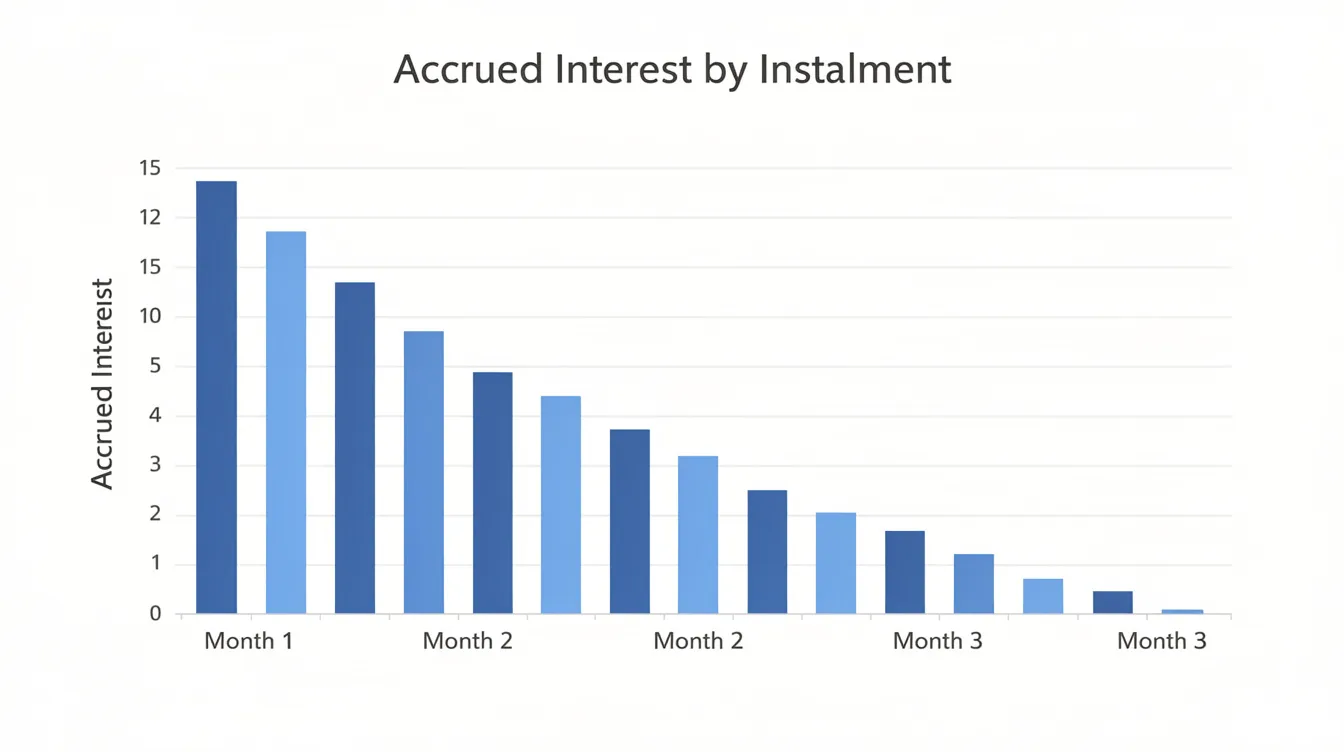
Each monthly instalment paid from CPF OA is a separate mini-withdrawal that starts accruing its own interest from that month. The first instalment in month 1 accrues for the full ownership period; the last instalment before sale accrues for just one or two months.
Example: A 4-room HDB owner pays S$1,200/month in mortgage payments entirely from CPF OA over 96 months (8 years). Total CPF principal from instalments: S$115,200. The early instalments, paid in years 1 and 2, each accrue interest for 6 to 8 years. The later ones accrue for only months. The aggregate accrued interest across all 96 instalments works out to roughly S$25,000 to S$35,000.
The exact calculation is iterative (96 separate compounding calculations, one per instalment), which is why the CPF portal’s “My Home” dashboard is the most reliable place to see your precise total rather than manual spreadsheets.
Total CPF Refund: Principal Plus Accrued Interest
When you sell, CPF refund includes both principal and accrued interest. Every dollar of CPF withdrawn for the property, plus all the compounded interest on those withdrawals, goes back into your CPF OA (and potentially your Retirement Account if you are 55 or older).
Summary example:
-
CPF principal used across down payment and monthly instalments: S$220,000
-
Total accrued interest after 9 years: S$46,000
-
Total CPF refund on sale: S$266,000
This entire S$266,000 returns to your CPF account, not your bank account. You cannot spend it on renovation costs, furniture, or a condo downpayment unless you make another CPF withdrawal under housing rules.
That CPF refund figure is what stands between your resale price and your actual net cash. The next section breaks down exactly how it eats into sale proceeds.
How CPF Accrued Interest Eats Into Your HDB Sale Proceeds
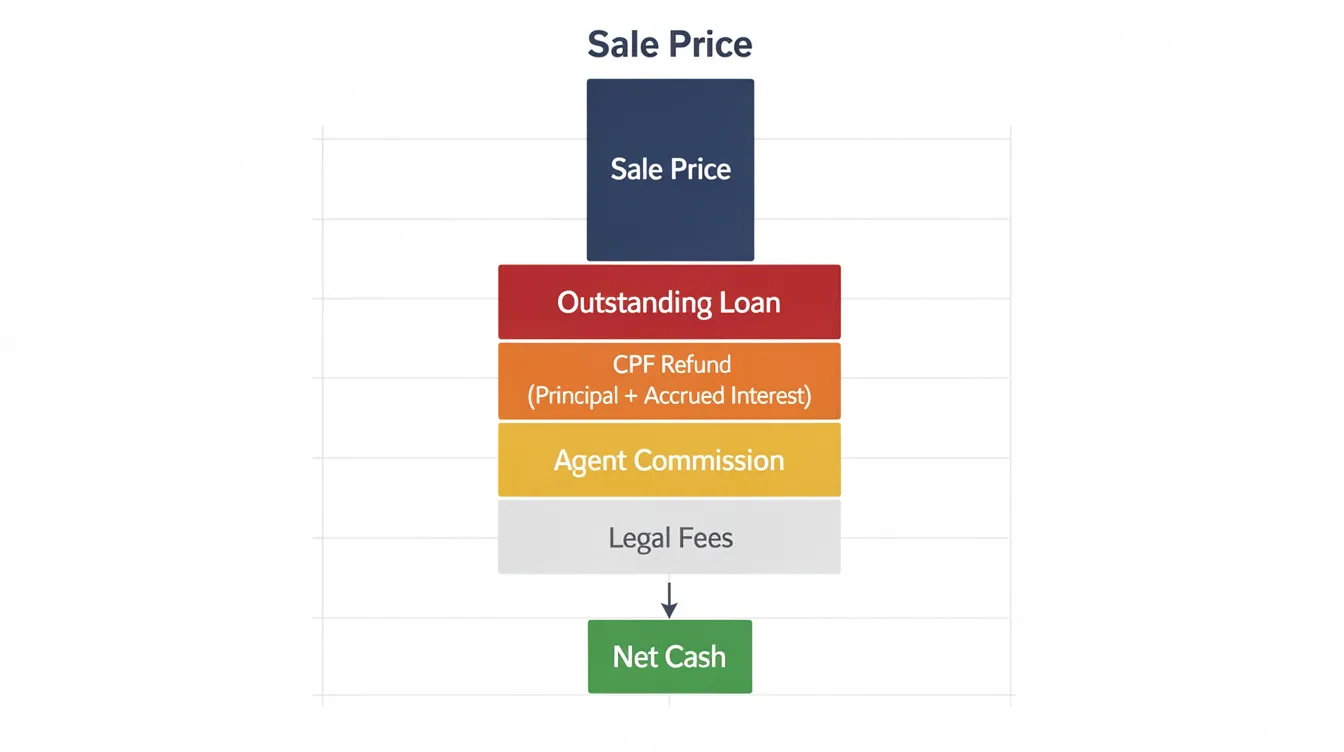
Many HDB owners look at recent transacted prices in their estate, subtract their outstanding loan in rough terms, and assume the remainder is spendable cash. The actual “waterfall” of deductions tells a different story.
The Order of Deductions When You Sell Your HDB
Sale proceeds first clear outstanding mortgage before CPF refund. Here is the sequence:
-
Repay the outstanding housing loan in full. Whether you hold an HDB loan at 2.6% or a bank loan, the entire remaining balance must be settled from sale proceeds.
-
CPF refund: principal plus accrued interest. Each owner’s CPF OA is refunded the exact amount of CPF withdrawn for this property, plus all accrued interest compounded monthly up to the resale completion date. Any housing grants received are also refunded with their own accrued interest.
-
Transaction costs. Agent commission (typically 1% to 2% plus 9% GST), legal fees, and conveyancing costs are deducted.
-
Net cash proceeds. Whatever remains after steps 1 through 3 goes to your bank account.
Net cash proceeds are sale price minus CPF refund and costs. The CPF refund lands back in your own CPF account; the cash you can actually deploy for the next property purchase is only the bank-account remainder plus whatever CPF you choose to withdraw again for your next home.
Sellers do not need to cover CPF shortfalls if sold at market value. If your sale proceeds cannot cover the full CPF refund after loan repayment, the CPF Board absorbs the shortfall, provided you sold at or above HDB’s valuation. But this means your cash proceeds drop to zero.
Worked Example: 4-Room HDB Sold in 2026 After MOP
Consider a couple who bought a S$420,000 BTO in Tampines in 2019:
CPF usage:
-
Lump sum at purchase (down payment, BSD, legal fees): S$60,000
-
Monthly instalments from CPF OA: S$1,000/month × 84 months = S$84,000
-
Total CPF principal: S$144,000
Accrued interest by mid-2026:
-
On the S$60,000 lump sum (approx. 84 months): ~S$11,300
-
On the monthly instalments (iterative, early ones compounding longer): ~S$9,700
-
Total accrued interest: ~S$21,000
Sale in 2026:
|
Line Item |
Amount |
|---|---|
|
HDB resale price |
S$580,000 |
|
Less: Outstanding HDB loan |
(S$220,000) |
|
Less: CPF refund (S$144,000 principal + S$21,000 accrued interest) |
(S$165,000) |
|
Less: Agent commission (2% + GST) |
(S$12,650) |
|
Less: Legal/conveyancing fees |
(S$3,000) |
|
Net cash to bank account |
S$179,350 |
The couple’s “paper profit” on the flat is S$160,000 (S$580,000 minus S$420,000 purchase price). But their actual cash in hand is S$179,350, while S$165,000 sits locked inside their CPF accounts. The estimated cash proceeds for their condo downpayment, renovation costs, and moving expenses is less than a third of the resale price.
Why This Matters for Your Upgrade Budget and Loan Eligibility
Lower-than-expected net cash affects every downstream decision:
-
Condo downpayment shortfall. A S$1.3M condo requires 5% cash downpayment (S$65,000) plus 20% that can come from CPF. If your cash from the HDB sale is S$179,350, you have coverage, but renovation costs, furniture, and a 3-to-6-month cash buffer can consume most of it.
-
Tighter monthly obligations. A larger bank loan on the condo means higher mortgage payments, which reduces cash liquidity for business capital or emergencies.
-
TDSR constraints. MAS Total Debt Servicing Ratio caps all debt obligations at 55% of gross monthly income. If you carry a car loan or business loan, the available borrowing capacity for housing drops, making sufficient cash reserves even more important.
With the single-property math covered, the next step is understanding how accrued interest compounds across an entire asset progression path.
CPF Accrued Interest Across Your Asset Progression Path (HDB to Condo to Landed)
Asset progression from HDB to condo to landed property is a multi-decade plan. Each sale triggers a full CPF refund; each new purchase restarts the accrued interest clock. Miscalculating at any stage can stall the progression or force compromises on location, size, or timing.
Stage 1: From First HDB to First Condo
A typical scenario: a couple buys a BTO at age 28 for S$400,000, sells at 33 after MOP, and plans to buy a S$1.3M mass-market condo in 2027.
If this couple used S$150,000 of CPF over 5 years, their accrued interest could be S$12,000 to S$18,000. That may seem manageable, but the gap between “projected cash if you ignore accrued interest” and “realistic cash after CPF refund” is often S$20,000 to S$60,000, depending on how heavily CPF was used. Many upgraders discover this gap only after they have committed to an Option to Purchase on their next property.
Using CPF heavily for the new condo purchase then restarts the cycle. A S$260,000 CPF withdrawal for a condo downpayment and monthly instalments begins generating its own future accrued interest from day one.
Stage 2: From Condo to Landed Property
An older upgrader in their mid-40s selling a S$1.4M condo to buy a S$3M landed property around 2030 faces a different scale of CPF refund obligation. If they used S$450,000 of CPF OA savings across 12 to 15 years of condo ownership, the total accrued interest could reach S$90,000 to S$120,000.
Those approaching age 55 between transactions encounter an additional constraint. CPF refunds first top up the Retirement Account to meet the Full Retirement Sum (FRS) before any excess flows to OA. For 2025/2026, the FRS is approximately S$205,800 (and adjusts annually). An upgrader whose CPF refund is large may find a substantial portion locked in their retirement account, unavailable for the next property purchase.
For business owners who also need capital for commercial or industrial property investments, this lock-up reduces cash liquidity at exactly the wrong moment.
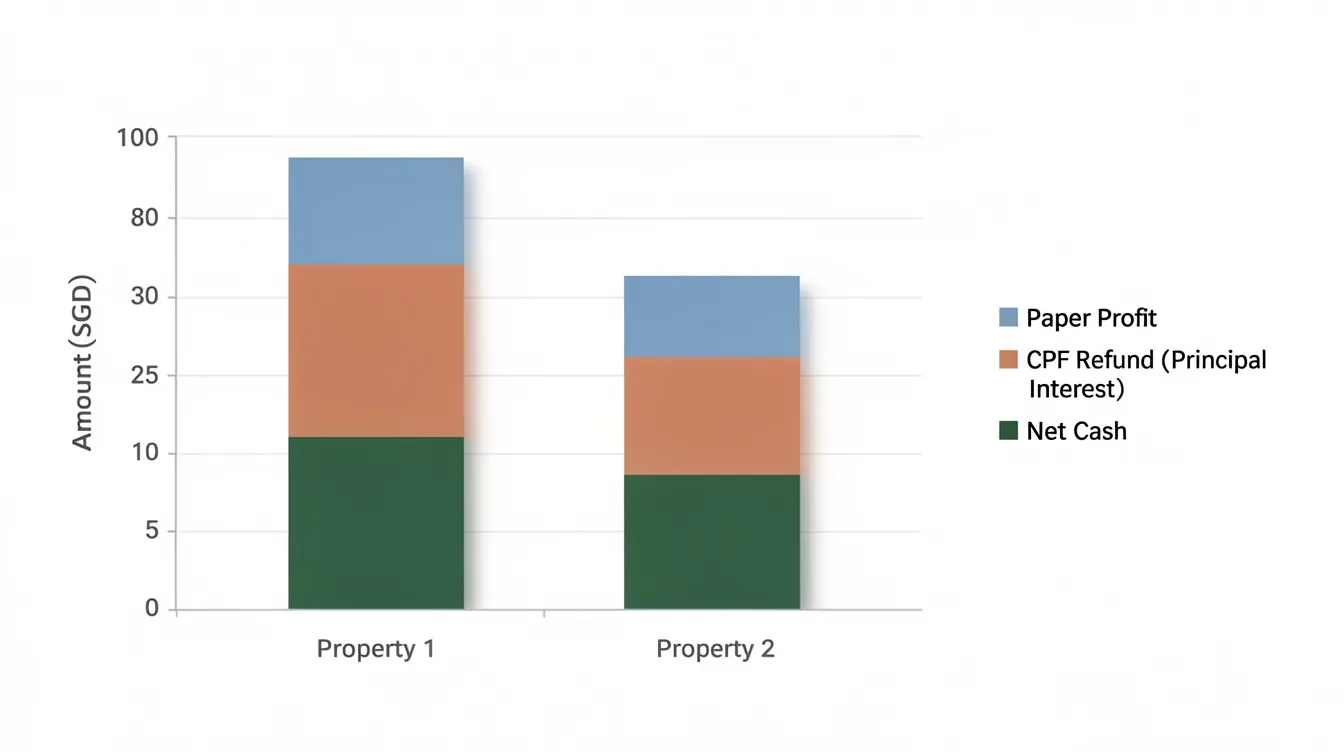
How Multiple Rounds of Accrued Interest Stack Up
Using CPF funds for both HDB and condo means paying accrued interest on two separate properties over two or more decades. Longer ownership of a property increases accrued interest considerably; the compounding is relentless.
Illustrative totals across two properties:
-
HDB phase (8 years): S$200,000 CPF usage generates ~S$40,000 accrued interest. Refunded CPF goes back into OA.
-
Condo phase (15 years): S$450,000 CPF usage generates ~S$120,000 accrued interest.
-
Combined accrued interest across both properties: over S$160,000 that never appeared in any headline sale price.
The numbers are not cause for panic; they are cause for planning. The next section covers specific strategies to reduce the impact.
Planning and Managing CPF Accrued Interest Like a Pro
CPF accrued interest is a controllable variable. You cannot eliminate it if you use CPF for housing, but you can structure your CPF usage, timing, and payment mix to keep it from derailing your upgrade goals.
Step-by-Step: Estimating Your CPF Accrued Interest Before You Sell
Do this 12 to 24 months before your planned sale date:
-
Log in to CPF with Singpass. Navigate to “My CPF” then “Home Ownership” or “Property.”
-
Download or note: total CPF principal used for current property (by owner), and total accrued interest to date (by owner).
-
Check your outstanding housing loan on the HDB portal or your bank’s mortgage statement. Get the exact figure, not an estimate.
-
Project forward. Use the formula (Principal × [(1 + 0.025/12)^months − 1]) or a spreadsheet to estimate accrued interest at your intended sale month, 12 or 24 months from now.
-
Compute your break-even sale price: outstanding loan + CPF refund (principal plus projected accrued interest) + estimated selling costs (agent, legal fees). Any sale price above this number is your net cash.
These figures from the CPF portal are updated monthly and are more reliable than generic online calculators.
Cash vs CPF: Structuring Your Monthly Instalments
The trade-off is straightforward. Using more CPF today means lower current cash outlay but higher accrued interest and less net cash later. Paying your mortgage with cash reduces CPF accrued interest. Partial cash payments reduce future CPF refund obligations.
Comparison over 10 years (120 months) on a S$2,000/month instalment:
|
Factor |
All CPF (S$2,000/month) |
Mixed (S$1,000 CPF + S$1,000 cash) |
|---|---|---|
|
Total CPF principal used |
S$240,000 |
S$120,000 |
|
Estimated accrued interest after 10 years |
~S$32,000 |
~S$16,000 |
|
CPF balance preserved |
Lower |
Higher by ~S$120,000 |
|
Monthly cash outflow |
S$0 |
S$1,000 |
|
Net cash at sale (all else equal) |
S$32,000 less |
S$32,000 more |
The mixed approach preserves S$16,000 of future cash by halving the accrued interest, at the cost of S$1,000/month from your current income. Whether this trade-off makes sense depends on your income stability, cash reserves, and how soon you plan to upgrade.
Timing Your Upgrade: Property Market vs Accrued Interest Curve
Waiting longer to sell may yield a higher resale price, but it also accumulates more accrued interest and exposes you to potentially higher purchase prices on the next property. The question is whether marginal price appreciation exceeds marginal accrued interest growth.
After MOP (typically 5 years), each additional year adds roughly 2.5% compounding on your entire CPF usage to date. If your total CPF principal is S$200,000, that is approximately S$5,000 of additional accrued interest per year, growing as the base compounds. If HDB resale prices in your town appreciate by S$20,000 to S$30,000 per year (as seen in some Punggol and Tampines transactions between 2022 and 2025), waiting a year may still be net positive. But if price growth slows to S$5,000 per year while your accrued interest adds S$6,000, waiting costs you money.
Use past transacted prices in your town (available on HDB’s resale price index) and your CPF portal’s accrued interest figure to model this before deciding.
Voluntary CPF Refunds: When Does It Make Sense?
A voluntary refund means paying cash back into your CPF OA before selling, reducing the principal on which interest accrues. Voluntary refunds stop CPF accrued interest from accumulating on the refunded portion.
Pros:
-
Less accrued interest at sale, increasing net cash.
-
CPF OA balance grows again at 2.5%, rebuilding retirement savings.
-
Smaller CPF refund obligation when you eventually sell.
Cons:
-
Cash becomes locked in CPF (subject to housing and retirement withdrawal rules).
-
Reduced cash liquidity for investments, business needs, or emergencies.
Example: You have S$180,000 of CPF principal outstanding. You make a voluntary refund of S$50,000 three years before your planned sale. Over those 3 years, you save approximately S$50,000 × [(1.002083)^36 − 1] ≈ S$3,870 in accrued interest. Whether S$3,870 of saved interest justifies locking S$50,000 in CPF depends on what that cash would earn or do elsewhere.
Common Mistakes HDB Upgraders Make with CPF Accrued Interest
Most pitfalls are not about choosing the wrong property. They are about misjudging CPF mechanics and overestimating how much cash you will actually hold after the sale.
Confusing Paper Profit with Spendable Cash
A seller sees a S$250,000 “profit” (resale price minus purchase price) and assumes that amount is available. After subtracting the outstanding loan, CPF refund (principal plus accrued interest), and selling costs, the actual cash may be under S$80,000. The refunded CPF sits in your CPF OA, not in your bank account. If you are close to age 55, a portion may flow to your Retirement Account under minimum sum rules, reducing even your CPF balance available for the next home.
Run a full proceeds waterfall, including your CPF refund, before signing an OTP on your next property.
Ignoring Co-Owner CPF Usage and Accrued Interest
Spouses often have different CPF usage profiles. One partner may have used S$150,000 from CPF OA while the other used S$50,000. Their accrued interest obligations differ accordingly. Assuming equal cash distribution leads to a rude surprise when most of the net sale proceeds flow back into one spouse’s CPF account.
Download CPF property statements for each owner separately. Plan your upgrade budget based on combined verified cash, not assumptions.
Committing to the Next Property Before Knowing Exact CPF Numbers
A common sequence: the couple falls in love with a condo unit, exercises the OTP, then discovers their CPF refund obligation is S$30,000 higher than expected. The 8-week completion timeline forces a bridging loan at 5% to 6% interest, eating further into their budget. Renovation costs get slashed. Monthly obligations climb.
Checking your CPF accrued interest and outstanding mortgage balance should be a prerequisite step before you start viewing properties, not an afterthought.
Overusing CPF for Transaction Fees
Many owners pay BSD, legal fees, and valuation fees from CPF OA without thinking twice. A S$15,000 BSD paid via CPF in 2017, compounding for 9 years, generates roughly S$3,600 in accrued interest by 2026. Across multiple small items, the total can reach S$10,000 to S$20,000 of accrued interest that would not exist if those fees had been paid in cash.
Whenever possible, pay cash for one-off transaction fees and reserve CPF for essential housing costs (down payment and loan repayment) where cash alternatives are less practical.
Conclusion and Next Steps
CPF accrued interest is predictable, calculable, and unavoidable if you use CPF OA for housing. It is not a penalty; it is the opportunity cost of redirecting retirement funds into property. For upgraders moving from HDB to condo to landed, it is also the single most common reason that estimated cash proceeds fall short of reality.
The core principles: know your CPF principal used and total accrued interest early; model net proceeds, not headline profit; and structure your cash versus CPF usage based on your upgrade timeline and long-term financial goals. Selling after property appreciation offsets accrued interest costs, but only if you have run the numbers in advance.
Your next steps:
-
Log in to the CPF portal today and check your current accrued interest and CPF principal used, for each co-owner.
-
Write down your target upgrade timeline (e.g., sell HDB in 2027, buy condo in 2028) and rough price ranges for both transactions.
-
Build a simple spreadsheet using the formula: Principal × [(1 + 0.025/12)^months − 1] to project your CPF refund at your intended sale date.
-
Decide whether to shift your monthly instalment structure toward more cash repayment starting next month.
-
If you are approaching age 55 or managing business capital alongside residential upgrades, consult a property advisor who can model CPF refund obligations, TDSR limits, and multi-property scenarios together.
Related topics worth exploring next: TDSR and MSR limits on loan size when upgrading; ABSD implications when holding multiple properties; and frameworks for comparing residential versus industrial property investments in Singapore.
Frequently Asked Questions on CPF Accrued Interest for HDB Upgraders
Do I Have to Top Up CPF Accrued Interest in Cash If My HDB Sale Price Is Low?
No. Sellers do not need to cover CPF shortfalls if sold at market value or above HDB’s assessed valuation. If your net sale proceeds after loan repayment are insufficient to cover the full CPF refund, the CPF refund shortfall is absorbed by the CPF Board. However, this means your cash proceeds drop to zero. You walk away with nothing in your bank account, and your CPF OA balance may still be lower than expected. In 2021, about 10% of HDB sellers could not fully refund their CPF principal plus accrued interest, though less than 1% of those cases involved flats sold below market value.
Can I Use the Refunded CPF Immediately for My Condo or Landed Upgrade?
Refunded CPF savings are generally available for future property purchases per CPF rules. The CPF refund lands in your OA at completion of the sale, and you can apply those funds toward your next property purchase, subject to CPF housing usage limits and withdrawal caps. However, refunded CPF is not cash. You still need to meet the minimum cash downpayment requirement (5% of purchase price for a bank loan on private property) from your bank account, not from CPF. If you are 55 or older, the refund first tops up your Retirement Account to meet the required retirement sum before any excess returns to your OA.
How Can I See My Exact Accrued Interest by 2026 or 2027?
Log in to the CPF website or app with Singpass. Navigate to the “Property” section under “Home Ownership.” For each property linked to your CPF account, you will see: total CPF principal withdrawn and total accrued interest to date. These figures update monthly and reflect compounding up to the previous month. They are more accurate than any third-party calculator. To project forward to your intended sale date, take the current figures and apply the compounding formula for the remaining months.
Is CPF Accrued Interest a “Bad” Thing Financially?
Accrued interest is not a fine or a loss. It represents the opportunity cost of using retirement funds for housing instead of letting them compound inside your CPF OA. Using CPF for housing can still make sense when you are cash-constrained and expect strong capital gains on the property, since selling after property appreciation offsets accrued interest costs. It makes less sense when property value growth is flat and you have sufficient income to pay cash for mortgage payments. The right balance depends on your income, cash reserves, upgrade timeline, and whether you need CPF savings for retirement or have other retirement funds.
How Does All This Change If I Cross Age 55 Before or After My Upgrade?
When you turn 55, CPF creates your Retirement Account and requires it to be funded up to the Full Retirement Sum (FRS), which is approximately S$205,800 for the 2025/2026 cohort and adjusts upward annually. When you sell a property after age 55, your CPF refund first goes toward topping up your Retirement Account to the required level. Only the excess, if any, flows back to your OA for use on a future home loan or property purchase. This means older upgraders may find less CPF available than expected for the next property. If your upgrade timeline places you within 2 to 3 years of turning 55, factor in the retirement sum top-up when projecting how much CPF you will have for your next home.
Refinancing to a lower interest loan reduces CPF usage going forward, and combining that with partial cash repayment in the years before turning 55 can preserve more OA balance for your next purchase.


