

Introduction
Managing holding costs and maintenance fees is the single most important discipline separating profitable property investors from those who merely collect rent. In Singapore’s 2024–2026 market, where property tax rates have been restructured upward and MCST budgets keep climbing, computing an accurate net rental yield – not the headline gross figure – is essential for informed financial decisions about any investment property.
This comprehensive guide shows you exactly how to calculate net rental yield after deducting property tax, MCST/maintenance fees, vacancy allowances, and other recurring expenses incurred during property ownership. It covers residential properties (condominiums, executive condominiums) as well as industrial and commercial strata units in Singapore. It does not address detailed income tax filing procedures or complex corporate holding structures – the focus is squarely on the cash costs of holding and maintaining investment property, and what those costs do to your real returns.
Here is the early answer: Net rental yield = (Annual rent collected – property tax – MCST/maintenance fees – insurance – repairs allowance – vacancy loss – other operating costs) ÷ purchase price or current market value × 100%. For most Singapore condos in 2025, this formula turns a seemingly attractive 3.3–3.5% gross yield into roughly 2.5–2.8% net. For well-located B1 industrial units, a 6–7% gross yield may settle around 4.5–5% net after all deductions.
By the end of this article, you will be able to:
-
List every major holding cost category for Singapore residential, commercial, and industrial property
-
Read and benchmark MCST budgets against comparable developments
-
Factor vacancy risk and bad debt into your yield model for different asset types
-
Compute net rental yield step-by-step with realistic 2024–2026 numbers
-
Stress-test your calculations against rising costs and changing market conditions
Understanding Holding Costs in Singapore Property
Holding costs are the recurring and periodic expenses you continue paying simply for owning an investment property – entirely separate from one-time acquisition costs like buyer’s stamp duty or legal fees. They are the reason a property advertised at “5% gross yield” may actually deliver closer to 3.5% in your bank account. For industrial, commercial, and residential investment units alike, these costs significantly impact the gap between gross and net returns, and ignoring them leads to missed opportunities for optimisation and, worse, nasty surprises in cash flow.
For any leased property in Singapore, major holding costs include annual property tax (determined based on the annual value assessed by the Inland Revenue Authority of Singapore), MCST or estate maintenance fees, building insurance, repairs and upkeep, landlord-paid utilities for common areas, accounting and compliance expenses, and the implicit cost of vacancy periods. Together, these factors play a crucial role in determining whether a property investment genuinely enhances productivity of your capital or quietly erodes it.
Core Components of Holding Costs
The core holding costs for a leased property in Singapore fall into several factors. Property tax – payable annually by January 31 – is typically the single largest line item for non owner occupied properties. MCST or condo maintenance fees come next, covering security, cleaning, lift servicing, landscaping, and common-area utilities. Insurance, repairs, and a reasonable maintenance allowance round out the recurring cash expenses. Holding costs also include storage fees and insurance expenses for commercial and industrial assets with shared facilities, and opportunity costs – the return you forgo by tying up capital in bricks and mortar rather than deploying it elsewhere.
It is important to distinguish between cash flow costs (paid monthly or yearly and directly visible in your bank statements) and non-cash items like depreciation. Most private property investors rightly focus on cash items when computing yield, since depreciation does not affect the money available for mortgage repayments or reinvestment. High holding costs can erode profit margins significantly: even if gross rent looks attractive, the net cash left after all deductions is the only number that matters for decision making.
Maintenance Fees vs Other Operating Costs
MCST fees apply to all strata-titled developments – condominiums, strata office buildings, strata factories, and business parks. The Management Corporation sets these charges to fund the management fund (day-to-day operations) and the sinking fund (long-term capital works and major replacements), as required under the Building Maintenance and Strata Management Act. For non-strata industrial developments, estate charges serve a similar function but are typically administered by the landlord or JTC.
Maintenance fees are fixed expenses that impact net yield or appreciation of assets, and they contrast sharply with ad-hoc capital expenditure. A new façade waterproofing project or lift replacement programme can trigger special levies that dwarf the regular monthly contribution. Compounding maintenance fees can significantly impact total invested capital over a five- to ten-year hold. Sophisticated buyers, lenders, and valuers all examine the MCST level per square foot as a performance metric when assessing investment viability – and so should you. Understanding how these various service fees are calculated is the first step toward managing them effectively.
How Property Tax, MCST Fees, and Vacancies Affect Net Rental Yield
With the foundational concepts established, the question becomes: how much do property tax, maintenance expenses, and vacancy periods actually cost you in dollar terms from 2024 to 2026? The answer is often more than investors expect. Many online yield calculators use simplistic formulas and ignore at least one of these three cost categories, producing misleadingly optimistic figures that do not reflect the true economics of property ownership in Singapore.
Annual Property Tax: What You Really Pay Each Year
Singapore’s property tax system is based on the annual value (AV) of a property – IRAS’s estimate of the expected gross annual rent if the property were let on the open market. The AV determines property tax rates under a progressive band structure for residential properties, while commercial and industrial properties pay a flat 10% of AV regardless of occupancy.
From 1 January 2024, non-owner-occupied residential property tax rates range from 12% on the first S$30,000 of AV up to 36% on AV exceeding S$60,000. In 2022, non-owner-occupied property tax rates were raised to 12–36%, a substantial increase from prior levels, reflecting the government’s intent to moderate investment demand. Singapore’s property tax rates for owner-occupied homes range from 0% to 32% under the revised 2025 bands, with the first S$12,000 of AV tax-free.
Numeric example: Consider a private property – a condo with AV of S$48,000, rented to a tenant. The annual property tax calculates as: first S$30,000 at 12% = S$3,600, next S$15,000 at 20% = S$3,000, and remaining S$3,000 at 28% = S$840. Total: S$7,440 per year. If this unit is rented at S$3,800/month (S$45,600/year) on a S$1 million purchase price, property tax alone consumes 16.3% of gross rent – shaving the gross yield from 4.56% to roughly 3.82% before any other deductions.
For industrial and commercial strata units, the flat 10% rate is simpler but still material. A unit with AV of S$60,000 pays S$6,000 annually – a predictable but non-trivial line item.

MCST / Maintenance Fees: The Silent Yield Killer
MCST fees are set through a budget approved at the Annual General Meeting, with costs allocated between the management fund and sinking fund based on share value or strata lot area. High ongoing maintenance fees can erode net rental yields year after year, and the effect compounds as estates age.
Realistic 2024–2026 ranges for Singapore strata properties are as follows:
-
Mass-market condominiums: approximately S$300–S$400 per month for smaller units (~S$0.25–0.50 psf); luxury or high-amenity developments with pools, gyms, concierge, and elaborate facades can push well above S$600–S$1,500 per month
-
Strata commercial offices: approximately S$0.40–S$1.20 psf/month for Grade A specifications
-
B1/B2 industrial strata: typically S$0.10–S$0.30 psf/month; more modern or premium business parks may reach S$0.50 psf
Impact example: A 1,000 sq ft condo unit paying S$350/month in MCST costs S$4,200/year. If the unit grosses S$50,400/year in rent (a 4.5% gross yield on a S$1.12 million purchase), the MCST alone strips 8.3% from gross income. Combined with annual property tax, the net yield can fall below 3% before repairs and vacancy are even considered. Unmanaged maintenance fees can transform affordable holdings into financial liabilities – particularly as intensive facilities age and require increasing capital expenditure.
Vacancy and Bad Debt: Pricing In Empty Months
Vacancy risk differs sharply across asset types. For well-located residential properties, investors typically assume one month of vacancy every two years, translating to roughly a 4–5% annual deduction from gross rent. Industrial property carries higher binary risk: as of Q2 2026, island-wide industrial occupancy sat at approximately 89.1%, implying vacancy of around 10.9%. Business parks are even more challenging, with occupancy around 77.9% in Q4 2024.
To translate vacancy into your yield model, apply an annualised vacancy cost: multiply your monthly rent by the expected number of empty months per year. For a condo renting at S$4,200/month with an assumed 0.5 months of vacancy per year, the cost is S$2,100. For industrial units where vacancy may extend to 1–2 months per year, the cost is proportionally larger and more volatile.
Bad debt and tenant default risk – while typically small – should also be budgeted. Conservative property investors treat 1–2% of gross rent as a buffer for rental arrears and recovery costs, especially for commercial or industrial tenants. Demand forecasting techniques applied to tenant markets, alongside monitoring inventory levels in tenant-facing industrial or commercial segments to support leasing assumptions, can help mitigate risks, but some level of provisioning for arrears and defaults remains essential.
Step-by-Step: Calculating Net Rental Yield After All Holding Costs
This section provides a clear formula, a worked residential example, and a strata industrial example side-by-side, so you can calculate net rental yield for any Singapore investment property in your portfolio. Calculations can be based on purchase price or current market value – using market value generally produces a more honest assessment of whether your capital is optimally allocated, since it reflects the opportunity cost of continuing to hold.
The Net Rental Yield Formula
Net Rental Yield = (Annual Gross Rent – Vacancy Cost – Property Tax – MCST / Maintenance Fees – Insurance – Repairs Allowance – Other Operating Costs) ÷ Property Value × 100%
Each variable should be estimated as follows:
-
Annual Gross Rent: 12 × monthly contracted rent. Use actual lease rent, not asking rent.
-
Vacancy Cost: Expected empty months per year × monthly rent. Use 0.5 months/year for strong-demand residential, 1–2 months for industrial.
-
Property Tax: Calculate from AV using the applicable tax rate bands (progressive for residential, flat 10% for non-residential).
-
MCST / Maintenance Fees: 12 × monthly MCST charge. Include both management fund and sinking fund contributions.
-
Insurance: Landlord’s fire and liability insurance – typically S$200–S$500/year for residential, more for commercial.
-
Repairs Allowance: Budget S$1,000–S$2,000/year for residential; 3–5% of gross rent for commercial/industrial.
-
Other Operating Costs: Agent commissions (amortised), accounting, compliance fees.
Use annual figures for consistency. Financing costs – mortgage payments and interest – can be included for a cash-on-cash return calculation, but are best analysed separately from asset-level net yield so you can compare assets regardless of loan amount or interest rates.
Worked Example: Private Condo Investment in 2025
Scenario: A 2-bedroom condo in the Outside Central Region, purchased at S$1,500,000 in mid-2025, rented at S$4,200/month.
Annual gross rent: S$4,200 × 12 = S$50,400 Gross rental yield: S$50,400 ÷ S$1,500,000 × 100% = 3.36%
Now deduct holding costs:
-
Vacancy: Assume 0.5 months/year (one month every two years) = S$2,100
-
Property tax: Assume AV ≈ S$48,000 (non-owner-occupied rates). First S$30,000 @ 12% = S$3,600; next S$15,000 @ 20% = S$3,000; remaining S$3,000 @ 28% = S$840. Total = S$7,440
-
MCST: S$350/month × 12 = S$4,200
-
Insurance: approximately S$300
-
Repairs allowance: S$1,200
Total holding costs: S$2,100 + S$7,440 + S$4,200 + S$300 + S$1,200 = S$15,240 Net rental income: S$50,400 – S$15,240 = S$35,160 Net rental yield: S$35,160 ÷ S$1,500,000 × 100% = 2.34%
The headline 3.36% gross yield drops to 2.34% net – a reduction of roughly 30%. And this does not yet include any home loan interest. Future MCST increases driven by aging facilities, or upward AV revisions by IRAS, could compress this yield further. Recurring expenses can erode Net Operating Income in real estate investments faster than most buyers anticipate.
Worked Example: Strata Industrial Unit for SME Owner-Operator
Scenario: A B1 strata industrial unit of 2,000 sq ft, purchased at S$900,000 in 2024, leased to a third party at S$2.50 psf/month.
Annual gross rent: 2,000 × S$2.50 × 12 = S$60,000 Gross rental yield: S$60,000 ÷ S$900,000 × 100% = 6.67%
Deductions:
-
Vacancy: Assume 1 month/year given industrial market conditions = S$5,000
-
Property tax: Flat 10% of AV. Assuming AV ≈ S$60,000, tax = S$6,000
-
MCST/maintenance: S$0.30 psf/month × 2,000 × 12 = S$7,200
-
Insurance: S$400
-
Repairs/upkeep: 3% of gross rent = S$1,800
Total holding costs: S$5,000 + S$6,000 + S$7,200 + S$400 + S$1,800 = S$20,400 Net rental income: S$60,000 – S$20,400 = S$39,600 Net rental yield: S$39,600 ÷ S$900,000 × 100% = 4.40%
The gross-to-net erosion is still significant, though industrial units typically deliver stronger net yields than residential properties because their property tax rates are a flat 10% rather than the aggressive progressive bands for non-owner-occupied residential. Owner-operators should also compare this yield with their business’s operating margin – if the implicit cost of tying capital in premises exceeds the return, it may be worth exploring alternative resource allocation strategies.
Practical Framework for Managing Holding Costs & Maintenance Fees
Once you can compute net yield accurately, the next step is to actively manage and reduce holding costs through continuous improvement initiatives – without compromising asset value or tenant satisfaction. Properties with strong management practices typically have better financial performance, and small, disciplined adjustments compound meaningfully over a multi-year hold.
4-Step Process to Control Holding Costs
Step 1: Audit. List every annual cost line item using the last 12 months of actual statements – IRAS property tax bills, MCST invoices, repair receipts, insurance premiums, legal and accounting fees, and agent commissions. Regular audits can identify misallocated money in budget management that would otherwise go unnoticed. Tracking maintenance costs as a percentage of asset value is a useful metric to establish your baseline and monitor progress over time.
Step 2: Benchmark. Compare your MCST burden and tax costs against similar developments in the same district, of comparable age and facility level. Use publicly available AGM budgets and listing data. If your MCST is materially above the benchmark, identify areas where the management corporation may be overspending – or where you can participate in building management decisions to control maintenance fees. Negotiate vendor agreements to avoid auto-renewing contracts and increase cost efficiency.
Step 3: Optimise. Renegotiate insurance policies for volume discounts if you hold multiple properties. Adjust your leasing strategy to reduce vacancy – for example, by offering competitive lease terms during low-demand periods. Explore minor asset upgrades (fresh paint, better lighting, updated fixtures) that allow rent increases without disproportionate cost growth, delivering cost savings over the hold period. Effective labor cost management can reduce maintenance expenses significantly; implementing lean principles can streamline maintenance processes and reduce costs. Preventive maintenance can minimize unplanned downtime and repair costs, and Just-In-Time inventory methods reduce carrying costs for spare parts in commercial or industrial buildings.
Step 4: Monitor. Review net yield at least annually – and whenever major changes occur such as interest rate shifts, MCST hikes, a new AV assessment from IRAS, or shifts in market conditions. Track performance metrics over time to identify whether your effective strategies are working. Establishing a reserve fund helps manage unexpected maintenance costs without disrupting your cash flow or forcing you to sell under pressure.
Comparing Different Assets on a Net Yield Basis
The following table compares three common Singapore investment property types on a net yield basis, helping investors optimize resource allocation by looking past headline numbers:
|
Metric |
New Condo (< 5 years) |
Older Condo (15+ years) |
B1 Industrial Strata |
|---|---|---|---|
|
Typical gross yield |
2.8–3.5% |
3.5–4.5% |
5.5–7.0% |
|
Property tax (% of gross rent) |
14–18% |
14–18% |
~10% (flat) |
|
MCST/maintenance (% of gross rent) |
7–10% |
10–15% |
8–12% |
|
Typical vacancy assumption |
4–5% |
5–8% |
8–12% |
|
Estimated net yield |
2.0–2.8% |
2.5–3.5% |
3.5–5.0% |
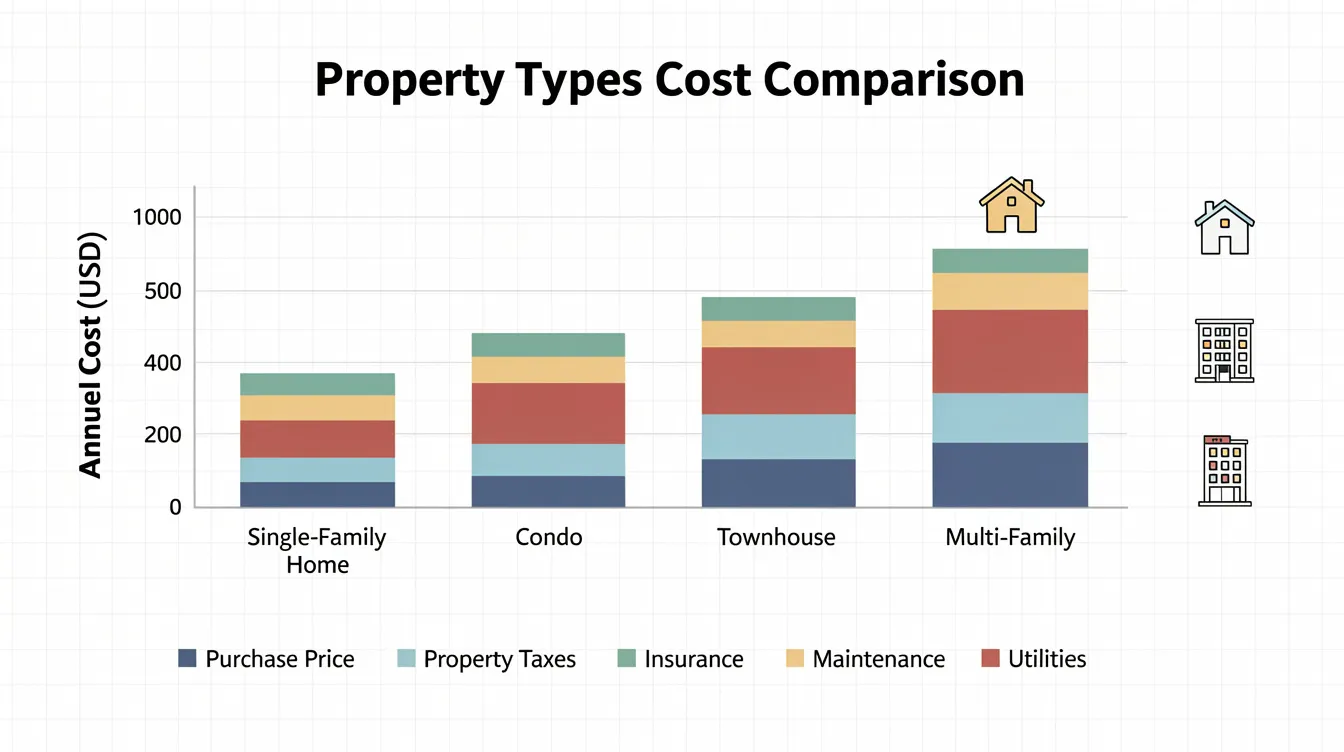
Older condominiums often deliver higher gross yields than new launches due to lower purchase prices, but their higher MCST/maintenance burden (aging lifts, façade works, rising sinking fund levies) partially offsets that advantage. Industrial strata units benefit from the flat 10% property tax rate but carry greater vacancy risk. This kind of Total Cost of Ownership analysis includes all lifecycle costs of assets and helps investors make informed decisions rather than chasing “glossy” new launches that may underperform on a risk-adjusted net basis.
Common Pitfalls and How to Avoid Them
Many Singapore buyers misjudge affordability and returns by underestimating holding costs, especially during the 2024–2028 period when property tax rates and maintenance budgets are simultaneously rising. Here are the three most common traps – and how to sidestep them.
Underestimating Future Increases in MCST Fees
Ageing estates and inflation drive higher management and sinking fund contributions over 5–10 years. What seems like a manageable S$350/month fee today could reach S$450–S$500 within a few years as façade repairs, lift modernisation, and rising contractor costs take effect. High maintenance fees can depress the resale value of a property, creating a double hit to total returns.
How to avoid it:
-
Review the past 5 years of MCST budgets and annual financial statements to identify areas of cost escalation
-
Check AGM minutes for upcoming major works or planned special levies
-
Stress-test your yield calculation with MCST fees 20–30% above current levels; if net yield turns negative or negligible under that scenario, reconsider the investment or budget accordingly
Ignoring Vacancy and Leasing Friction
The tendency to assume 100% occupancy is one of the most dangerous habits in property investment. Just one empty quarter in a three-year cycle can slash effective yield by a full percentage point – and that is before factoring in agent commissions, fit-out incentives, or marketing costs to secure a replacement tenant. Demand forecasting applied to local tenant markets helps, but some vacancy is inevitable.
How to avoid it:
-
Choose locations with proven tenant demand supported by transport links, amenities, and business clusters – areas where customer demand for rental space remains robust across cycles
-
Stagger lease expiries across your portfolio if you hold multiple properties, reducing the risk of simultaneous vacancies
-
Budget explicitly for agent commissions (typically 0.5–1 month’s rent) and any fit-out incentives in your annual cost model; efficient inventory management of your property pipeline ensures excess inventory of vacant units does not drain cash
Using Purchase Price Only and Forgetting Opportunity Cost
An investor who purchased a condo for S$800,000 in 2015 and sees it valued at S$1,400,000 in 2025 may calculate yield on the original purchase price and feel satisfied. But this ignores the opportunity cost of holding S$1,400,000 in that asset. Opportunity costs are a key component of holding costs. Holding costs can impact cash flow by tying up capital that could earn higher risk-adjusted returns elsewhere – whether in other properties, business expansion, or financial assets.
How to avoid it:
-
Recalculate net yield on current market value at least once a year
-
Compare net yield against alternative investments with similar risk profiles
-
Professional advisory helps owners make disciplined hold/sell/repurpose decisions, ensuring strategic initiatives around capital deployment are grounded in accurate, up-to-date numbers rather than anchoring to historic purchase price
Conclusion and Next Steps
True investment performance comes from managing holding costs and maintenance fees and computing net rental yield – not from chasing headline rents or glossy brochure projections. In Singapore’s 2024–2026 environment, where non-owner-occupied property tax rates reach up to 36%, MCST budgets are climbing with inflation and aging stock levels, and industrial vacancy runs near 11%, the gap between gross and net yield is wider and more consequential than ever.
Your immediate next steps:
-
Build or download a simple spreadsheet with rows for every holding cost category outlined in this guide – and populate it with your actual numbers
-
Gather last year’s IRAS tax bill, MCST invoices, insurance premiums, and repair receipts for each property you own
-
Run net rental yield calculations on each property using current market value, not just purchase price
-
Stress-test each property’s yield assuming 20–30% higher MCST, one additional month of vacancy, and a potential AV revision by the Inland Revenue Authority
Owners of industrial and business-use properties benefit from tailored assessment of operational fit, zoning, lease structure, and net yield implications – the kind of finance-informed analysis that turns raw data into valuable insights for portfolio decisions.
Looking ahead, gradual tightening of property tax for investment properties and continued MCST escalation driven by aging infrastructure and labour costs are near-certainties. Regular review – not a one-time calculation – is the only way to maintain operational efficiency and enhance efficiency across your property portfolio over time.
Frequently Asked Questions on Holding Costs, Maintenance Fees, and Net Rental Yield
These FAQs address the most common concrete questions Singapore property investors ask when working out real returns on their assets.
How do I quickly estimate net rental yield for a property I’m viewing this weekend?
Use this quick back-of-envelope method: (1) Take the monthly asking rent and multiply by 12 for annual gross rent. (2) Deduct 10–15% for property tax plus MCST/maintenance fees combined. (3) Deduct another 5–10% for vacancy, repairs, and insurance. Divide the result by the asking price. This gives you a rough net yield for screening purposes – if the number does not meet your minimum threshold, you can move on without detailed analysis. ABC analysis – categorising properties into A (high potential), B (moderate), and C (skip) – helps prioritise management efforts when viewing several factors across multiple listings. Detailed calculations should follow once actual MCST statements, AV data, and lease terms are available.
What’s a “good” net rental yield for Singapore residential and industrial property in 2024–2026?
Realistic ranges in current market conditions: 2.0–3.0% net for mass-market condominiums in suburban locations; 2.5–3.5% net for city-fringe older projects with lower purchase prices; 3.5–5.5% net for well-located B1/B2 industrial strata, depending on risk profile and lease tenure. What counts as “good” depends on your risk appetite, leverage (loan amount and interest rates on your home loan or investment loan), and alternative opportunities. Investors should compare net yield against risk-free rates and their own required return on capital to make informed decisions.
Should I include my mortgage interest in net rental yield calculations?
There is an important distinction between asset-level net yield (before financing) and equity cash-on-cash return (after mortgage payments including interest and principal repayment). Net yield measures the property’s stand-alone performance and allows you to compare assets regardless of how they are financed. Cash-on-cash return tells you what you actually earn on your equity after debt service. Calculate both: use net yield when comparing assets and making acquisition decisions; use cash-on-cash return for personal affordability and portfolio planning, especially when mortgage repayments consume a large share of rental income.
How can I tell if MCST fees are too high for a development?
Compare the monthly fee per square foot against at least 3–5 comparable projects in the same district and age band. For condos, anything materially above S$0.50 psf/month for a mass-market development warrants scrutiny. More important than the headline amount is what the fees pay for: robust security, well-maintained facilities, a healthy sinking fund reserve, and proactive management. Participation in building management decisions can control maintenance fees – attending AGMs and reviewing financial statements gives you direct influence. Automated inventory tracking systems and demand forecasting techniques applied to maintenance planning enhance visibility and control over where budget is spent. Properties where stock levels of spare parts and consumables are managed through Just-In-Time inventory methods tend to demonstrate better cost discipline.
Can AESTHETIC HAVENS help me analyse holding costs for industrial property?
AESTHETIC HAVENS provides advisory and content-driven analysis for industrial and business-use real estate in Singapore. Support can include reviewing lease structures, land tenure considerations, MCST budgets, and realistic net yield projections before acquisition or renewal. Whether you are evaluating a first industrial purchase or reviewing an existing portfolio, the goal is to ensure every investment decision is backed by accurate, stress-tested numbers – including full visibility on tax implications, maintenance expenses, and vacancy risk – so that property investors can mitigate risks and enhance productivity of their capital.

