

Introduction
Fractional real estate, property REITs, and direct physical property ownership represent three fundamentally different ways to gain exposure to Singapore’s real estate market – each with distinct trade-offs in liquidity, yields, and capital requirements. Whether you are an individual investor with S$5,000 to deploy or a business owner evaluating whether to purchase your own industrial unit, the right vehicle depends on how much capital you can commit, how quickly you may need your money back, and how much control you want over the underlying properties.
This guide focuses exclusively on Singapore-based investments across residential property, commercial, and industrial asset classes. It is written for investors and SME owners weighing real estate investment options in the current market environment (2023–2026). We deliberately exclude overseas REITs and unregulated crypto-tokenised property schemes.
In short: if you need liquidity and low capital entry, Singapore REITs are your strongest option. If you want property-level exposure without committing millions, fractional investment through regulated SPV platforms fills the gap. And if you need full control, operational use of the space, or want to maximise leverage, direct property ownership remains the most powerful – but also the most capital-intensive – path.
Here are the four key outcomes you will gain from this article:
-
Understand the structural differences between fractional ownership, real estate investment trusts, and outright property ownership in Singapore
-
Compare typical dividend yields and rental income ranges (with 2023–2026 Singapore market data) for each route
-
See how liquidity and exit options differ – from same-day SGX trading to multi-year SPV lock-ins and months-long property sales
-
Get a simple decision framework tailored to your capital size, risk tolerance, and desired involvement level
Understanding the Three Ways to Invest in Property in Singapore
All three investment options – fractional real estate, Singapore REITs, and direct physical property – provide exposure to income generating real estate. However, they differ significantly in legal structure, tax treatment, liquidity, minimum investment thresholds, and the degree of control investors exercise over property-level decisions.
What Is Fractional Real Estate in Singapore?
Fractional real estate in Singapore involves pooling investment capital with other investors to purchase shares or units in a special purpose vehicle (SPV) or co-investment fund that directly holds a specific property – for example, an industrial building in Tuas or a shophouse in Geylang. The SPV holds legal title to the real property; investors receive a proportionate share of net rental income and any capital gain upon sale, minus platform and management fees.
In Singapore, fractional ownership typically operates via MAS-regulated platforms or exempt offers restricted to accredited investors. The regulatory status of the platform matters enormously: unregulated arrangements carry significant counterparty and transparency risks, while licensed operators must adhere to applicable laws governing collective investment.
Fractional real estate allows shared ownership of properties and provides access to property ownership with lower capital requirements than buying a full unit. Investors can own verified fractions of properties through platforms, and fractional real estate offers income transparency without full ownership burdens.
Key characteristics at a glance:
-
Structure: SPV or fund holds the asset; investors hold shares in the SPV
-
Minimum investment: Ranges widely – from S$50,000 on platforms like RealVantage for commercial mall assets, up to S$200,000–S$500,000 for luxury residential fractional deals offered by Straits Trading
-
Holding period: Typically 3–7 years with fixed-term SPV structures; secondary transfers may be possible but market depth is thin
-
Best suited for: Accredited investors seeking specific asset exposure with moderate capital, willing to accept medium-term illiquidity
What Are Singapore Property REITs?
Singapore REITs (S-REITs) are estate investment trusts REITs listed on the Singapore Exchange (SGX) that own and manage diversified portfolios of income producing real estate. These portfolios span multiple asset classes – retail malls, office buildings, industrial and logistics parks, data centers, hospitality REITs properties like serviced apartments and hotels, and healthcare facilities.
Under MAS rules, REITs must distribute at least 90% of taxable income as dividends to enjoy tax transparency treatment. For individual investors, REIT dividends are tax-exempt in Singapore on locally sourced property income – a meaningful tax benefit compared to directly held rental income. Income distributions flow to unit holders as regular passive income, typically on a quarterly or semi-annual basis.
Liquidity is a defining advantage: REIT units are traded on the SGX like stocks, in board lots of typically 100 units, with intraday pricing and transparent bid-ask spreads. REITs can be bought with as little as a few hundred dollars – in fact, REITs require a minimum investment of around $100 for some lower-priced counters. This makes investing in REITs the most accessible way to gain exposure to professionally managed real estate properties across Singapore and, in some cases, the region.
Well-known S-REIT sectors include industrial REITs (e.g. CapitaLand Ascendas REIT, ESR-REIT), commercial REITs with prime office and retail assets, and hospitality trusts. For business owners and investors in the industrial space, Singapore REITs focused on logistics, business parks, and light industrial assets are particularly relevant.
What Is Direct Physical Property Ownership?
Direct property ownership means acquiring and holding legal title to a residential, commercial, or industrial property – whether that is a private property condo unit in Queenstown, a strata office in Raffles Place, or a B2 industrial unit in Tuas. Physical property ownership provides tangible asset security and full control over the asset and its management.
Financing typically involves a 25- to 30-year home loan or commercial mortgage, with loan-to-value ratios up to 75% (subject to MAS Total Debt Servicing Ratio rules). For residential property, buyers must also factor in Buyer’s Stamp Duty (BSD) and Additional Buyer’s Stamp Duty (ABSD), which can add substantially to upfront costs – Singapore citizens buying a second residential property pay 20% ABSD, while foreigners face 60%.
As a landlord, you collect rental income, handle property management, pay property tax, insurance, and maintenance fees, and bear full responsibility for leasing strategy. Zoning and lease structure significantly influence industrial and commercial property management, adding complexity beyond what residential landlords face.
While all three vehicles provide exposure to Singapore’s property market, what investors ultimately care about most is: how much capital do I need, what yield can I expect, and how easily can I exit? The next section addresses these questions directly.

Comparing Capital Requirements, Liquidity and Yields in Singapore
Building on the structural definitions above, this section dives into the practical investor questions: “How much cash do I need to start?”, “How fast can I get my money back?”, and “What income can I realistically expect?”
Initial Capital Outlay and Ongoing Costs
The gap in minimum investment between the three vehicles is enormous:
REITs: The lowest barrier to entry. A single board lot of a lower-priced S-REIT like ESR-REIT (trading at approximately S$0.255 per unit in late 2024) costs roughly S$25 for 100 units. More typically, investors deploy S$500–S$2,000 to build a meaningful starter position. Physical property ownership requires significant upfront capital by comparison.
Fractional: Minimum ticket sizes vary by platform and asset class. RealVantage has offered deals with minimums of S$50,000 for a commercial mall asset. Straits Trading’s fractional GCB and luxury condo offerings required S$200,000–S$500,000. Fractional real estate can allow smaller investors to participate in high-value properties that would otherwise be entirely out of reach.
Physical property: Direct property investment requires a down payment of 25% under current LTV rules, plus stamp duty, legal fees, valuation fees, option fees, and renovation costs. For a S$1 million condo, expect upfront cash requirements of S$300,000 or more. High initial costs and prolonged sales processes characterize physical property transactions.
Ongoing cost structures also differ materially:
-
REITs: No direct maintenance fee or property management responsibilities, but management fees are embedded in the trust structure, slightly reducing distributions. REIT management costs include asset management, property management fees, and trustee expenses – all disclosed in audited financial statements
-
Fractional: Platform fees, SPV administration costs, and management fees are deducted at the SPV level before payouts reach investors. Cost transparency varies significantly by platform
-
Physical: Mortgage interest expense, property tax (based on Annual Value – 10% of AV for commercial and industrial buildings), MCST or strata fees, insurance, maintenance, vacancy costs, and potentially significant tenant fit-out or refurbishment costs
Capital-based suitability guide:
-
Under S$50,000 deployable capital: S-REITs offer the best fit – diversified, liquid, low-cost entry
-
S$50,000–S$500,000: Fractional investment opens doors to specific income generating properties with moderate lock-in periods
-
Above S$500,000: Direct physical real estate becomes feasible, offering maximum control and leverage potential, especially for business owners who plan to occupy their own premises
Liquidity and Exit Options
How quickly can each investment be converted to cash?
REITs: Same-day or next-day liquidity on the SGX during trading hours. Settlement is typically T+2. REITs provide liquidity as they are traded on stock exchanges, with transparent pricing updated continuously. However, REIT prices are subject to market risk from stock price fluctuations and market sentiment, meaning exit prices may differ significantly from net asset value. REITs face liquidity risk during adverse economic conditions, when bid-ask spreads may widen and trading volumes thin.
Fractional SPVs: Often structured with fixed holding periods of 3–7 years. Exit typically occurs only when the underlying property is sold or the SPV is liquidated. Some platforms may permit secondary transfers between investors, but market depth is low, pricing is opaque, and an illiquidity discount is common. Liquidity for fractional real estate can vary depending on the platform. Fractional ownership combines some features of REITs’ liquidity with property-level control, but cannot match REITs for exit speed.
Physical property: The most illiquid option. Marketing, negotiating, and completing a sale typically takes 3–6 months, sometimes longer for commercial or strata industrial units where the buyer pool is narrower. High transaction costs are associated with buying and selling physical properties, including agent commissions, legal fees, and stamp duty. For residential properties sold within three years, Seller’s Stamp Duty (SSD) applies, penalising forced early exits.
Bottom line on liquidity: If you need emergency access to capital or flexibility to rebalance, REITs are clearly superior. Fractional deals suit investors comfortable with medium-term lock-ins. Physical property demands the longest time horizon and tolerance for illiquidity.
Dividend Yields vs Rental Yields (2023–2026 Ranges)
Yield comparisons require careful attention to the difference between gross and net figures, and between cash yield and total return (which includes capital appreciation).
S-REITs: The average dividend yield for S-REITs was approximately 8.1% as of June 2024, reflecting a period of elevated yields driven by lower unit prices amid higher interest rates. By mid-2026, yields had moderated to around 6.3% on average. Industrial REITs have maintained yields above 6% – CapitaLand Ascendas REIT (CLAR) currently yields approximately 6.2%, while ESR-REIT’s distribution yield reached roughly 8.3% in FY2024 (based on a unit price of S$0.255), though this partly reflects higher perceived risk. Income distributions from REITs are not guaranteed and can fluctuate with market conditions.
Fractional SPV deals: Some deals advertise target annualised returns of 7%–10% gross, including projected capital gains. In Singapore, Straits Trading’s fractional luxury residential offerings have projected annualised returns of approximately 7.6%–9.5% over five years. However, these are target returns – realised outcomes depend on rental performance, asset sale timing, and platform fees.
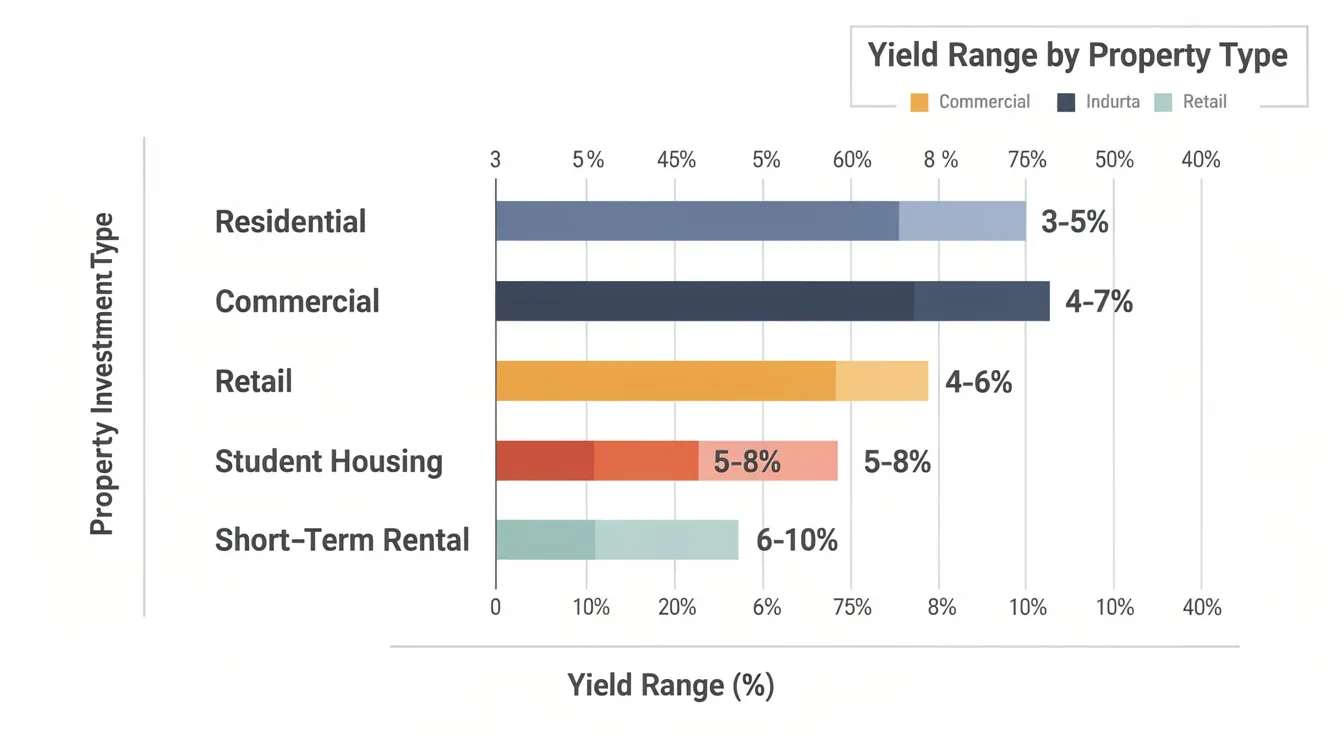
Physical residential: Gross rental yields for private condos in Singapore range by region: OCR (Outside Central Region) approximately 2.5%–3.0%, RCR (Rest of Central Region) approximately 2.5%–2.8%, and CCR (Core Central Region) just 1.8%–2.0%. Net yields after property tax, maintenance, insurance, and vacancy can fall to 1.0%–2.0% in prime areas.
Physical industrial and commercial: Gross yields for industrial real estate (factories, warehouses, business parks) typically range from 5.25%–6.25%, based on Colliers 4Q 2023 cap rate data. Commercial office yields sit around 3.0%–3.5%, with retail strata units at approximately 4.25%–4.75%. Industrial rents in Singapore have risen for 22 consecutive quarters as of 1Q 2026, underscoring resilient demand in this segment.
Investing in physical property entails ongoing management responsibilities that directly impact net yield, while REIT investors and fractional participants benefit from professional management – though at a cost.
Side‑by‑Side Comparison: Fractional, REITs, Physical Units
The following table consolidates the key metrics across all three investment options using current Singapore data:
|
Criterion |
Fractional SPV |
Singapore REITs |
Direct Physical Ownership |
|---|---|---|---|
|
Minimum capital |
S$50,000–S$500,000 |
S$100–S$2,000 (one board lot) |
S$300,000+ (down payment, BSD, ABSD, legal fees) |
|
Typical net yield range |
6%–10% target (incl. projected capital gain) |
5.6%–8.3% dividend yield (2024–2026) |
Residential: 1%–3% net; Industrial: 4%–6% net |
|
Liquidity / exit timeframe |
3–7 year lock-in; limited secondary market |
Same-day / T+2 on SGX |
3–6+ months to complete a sale |
|
Control over property decisions |
Limited; major decisions by manager or investor vote |
Minimal; via AGM voting only |
Full control (tenant selection, lease terms, renovations) |
|
Diversification |
Single asset per deal (can invest in multiple SPVs) |
Portfolio of multiple properties across sectors |
Concentrated in a single property |
|
Tax on income |
Depends on SPV structure; confirm with adviser |
Tax-exempt for individual investors (locally sourced) |
Taxable at personal or corporate income tax rate |
|
Typical investor profile |
Accredited investors; moderate capital, medium-term horizon |
Mass-market retail; any capital level; passive income seekers |
Business owners needing premises; high-capital investors; long-term holders |
Fractional investments usually have limited control for individual investors but offer access to specific, curated assets. REITs win decisively on portfolio diversification and liquidity. Direct ownership provides the greatest control and tangible asset security, but demands the most capital, effort, and tolerance for concentration risk.
Practical Implementation for Singapore Investors and Business Owners
With the comparison framework established, how should a Singapore investor or SME owner actually choose and execute a strategy in the current 2024–2026 environment? The answer depends on a structured assessment of objectives, resources, and constraints.
Step‑by‑Step: Choosing Between the Three Options
This framework is a starting point for analysis – not personalised investment advice. Always consult qualified advisers for your specific situation.
-
Clarify your investment objective: Are you seeking pure passive income, long-term capital appreciation, or strategic use of space for your business? Business owners who need industrial or commercial premises may benefit most from direct ownership, while pure yield seekers may prefer REITs
-
Assess available capital and financing capacity: Can you commit S$500,000+ and service a mortgage under TDSR rules? If not, REITs or fractional deals match your capital reality. If you have less than S$50,000, REITs are essentially your only regulated option
-
Decide desired involvement level: Passive investors should gravitate toward REITs (professionally managed, no landlord duties) or fractional platforms. Active investors comfortable with property management, tenant negotiations, and value-add renovation strategies can extract more from physical real estate
-
Determine liquidity needs and investment horizon: If your horizon is under 3 years or you may need emergency cash, trade REITs on the SGX. For 3–7 year commitments, fractional ownership becomes viable. Direct property suits investors with 10+ year horizons
-
Map to your primary vehicle – and consider blending approaches: Many sophisticated investors combine a liquid REIT core for portfolio diversification with a satellite allocation to fractional or direct property where they have an informational edge or operational use case
Control, Transparency and Risk Management
The degree of control varies dramatically:
Physical property owners control leasing, renovations, tenant mix (subject to zoning and MCST rules), and pricing strategy. This hands-on approach can enhance yields significantly – for example, converting a standard industrial unit into a higher-value fitted workspace. However, it demands active engagement and carries concentrated risk.
Fractional investors have limited say over day-to-day operations. Fractional investments usually have limited control for individual investors, with major decisions typically made by the property managers or fund manager, sometimes subject to investor voting thresholds. The quality of reporting – deal-level updates, property-specific dashboards – varies considerably by platform.
REIT investors exercise influence mainly via AGMs, voting on major transactions, and selecting which REIT managers to trust with their capital. However, REITs provide the highest transparency: quarterly or half-yearly SGX disclosures with audited financial statements, detailed breakdowns of the REIT’s portfolio, lease expiry profiles, and debt metrics. REIT managers operate under the MAS Code on Collective Investment Schemes.
Key risks by vehicle:
-
REITs: Interest rate risk (rising rates compress yields), leverage risk when REITs use debt to finance property acquisitions, and concentration risk if a REIT relies on few properties or tenants
-
Fractional: Platform/sponsor risk, asset quality uncertainty, fee structures that may obscure net returns, and illiquidity
-
Physical: Concentration in a single property, tenant default, vacancy periods, high transaction costs on exit, and financing risk if interest rates rise

Tax and Regulatory Considerations in Singapore
Tax treatment is a critical differentiator and often misunderstood:
REITs: Distributions from Singapore-sourced property income are generally tax-exempt for individual investors under current IRAS rules. This makes REITs one of the most tax-efficient vehicles for generating passive income from real estate. However, income distributions are not guaranteed and can fluctuate – and tax rules are subject to change.
Physical property: Rental income from directly owned investment property is subject to personal or corporate income tax at prevailing rates. Direct property ownership offers tax benefits like depreciation of certain building fixtures and deductibility of allowable expenses (property tax, mortgage interest, maintenance, insurance). In Singapore, property tax applies based on Annual Value – progressive rates for residential, and a flat 10% of AV for commercial and industrial buildings.
Fractional SPVs: Tax treatment depends heavily on the SPV structure – whether distributions are characterised as dividends, rental income, or capital returns. Investors should confirm the tax implications with both the platform and their tax adviser before committing.
On the regulatory side, property investment structures in Singapore are regulated by the Monetary Authority of Singapore. REITs listed on the SGX operate under comprehensive regulatory disclosure requirements. For fractional offerings, the importance of dealing with licensed or exempt financial institutions cannot be overstated – due diligence on the platform’s regulatory status is as important as due diligence on the underlying asset.
Common Challenges and How to Address Them
Even experienced investors make predictable mistakes when comparing these three property investing routes. Here are the most common pitfalls and how to mitigate them.
Overestimating Net Yield After All Costs
Investors frequently anchor to gross rental yields or headline REIT distribution figures without accounting for vacancies, maintenance capex, rising interest rates, or property management fees. A CCR condo with a 2.0% gross yield may deliver barely 1.0% net after all costs. Similarly, a fractional deal marketing “9% target returns” may net significantly less after platform fees, SPV administration, and any leverage costs.
Solution: Always model a conservative scenario – assume 1–2 months vacancy per year, higher interest rates than today, and realistic maintenance budgets – before committing capital. Compare net yields, not gross.
Ignoring Liquidity When Planning for Business or Personal Cash Needs
A common scenario: a business owner buys a physical real estate industrial unit, then needs to relocate or free up cash within two years. The sale takes six months, incurs SSD if within the holding period, and yields less than expected due to market conditions. Meanwhile, a mortgage redemption penalty adds further cost.
Solution: Align at least a portion of your real estate portfolio to highly liquid S-REITs for contingency funding. Before locking capital into long holding periods – whether fractional or physical – stress-test your cash flow needs across multiple scenarios.
Under‑Diversifying into a Single Property or Single Deal
Placing all available capital into one condo or one fractional SPV deal exposes you to acute concentration risk – a single bad tenant, a localised market downturn, or a problematic SPV sponsor can wipe out years of expected returns. Investing in REITs allows for diversification across multiple properties and such diversification is difficult to replicate with physical ownership unless you have substantial capital.
Solution: Consider a core-satellite investment strategy. Use S-REITs as a diversified, liquid core allocation. Add satellite positions in fractional deals or direct industrial/commercial assets only where you have a genuine informational edge, operational use case, or conviction on a specific property market segment.
Conclusion and Next Steps
In Singapore’s real estate investing landscape, each vehicle serves a distinct purpose. REITs win on liquidity, low capital entry, portfolio diversification, and tax efficiency for individual investors. Fractional real estate balances accessible entry points with property-level exposure and targeted returns, though at the cost of medium-term lock-ins and platform risk. Physical property ownership maximises control, leverage potential, and tangible asset security – but demands the most capital, effort, and longest time horizon.
Your next steps:
-
Clarify your budget, investment horizon, and liquidity needs using the step-by-step framework above
-
Shortlist suitable S-REITs by sector (industrial, commercial, hospitality) or identify fractional platforms and property types aligned with your objectives
-
Conduct thorough due diligence – on REIT financial health, fractional platform regulatory status, or specific property fundamentals – before committing
-
Engage a specialist adviser for industrial or commercial property shortlisting, valuation guidance, and operational fit analysis if you are considering business-use property
Related topics worth exploring next include a detailed guide to industrial property investment in Singapore, how to read REIT financial statements and assess distribution sustainability, and evaluating lease structures for business premises.
FAQs: Fractional Real Estate vs REITs vs Physical Property in Singapore
-
What is the minimum amount needed to start investing in Singapore REITs compared to buying a condo or industrial unit? REITs require a minimum investment of around S$100 for a single board lot of a lower-priced counter. By contrast, purchasing a private condo typically requires S$300,000+ in upfront capital (down payment plus stamp duty and legal fees), while fractional deals start from around S$50,000.
-
Are dividends from Singapore REITs really tax-free, and how does that compare to rental income from a physical property? Yes – REIT dividends from locally sourced Singapore property income are currently tax-exempt for individual investors. Rental income from directly owned physical property, however, is subject to personal income tax, though allowable expenses (mortgage interest, property tax, maintenance) can be deducted.
-
How risky is fractional property ownership in Singapore compared to listed REITs? Fractional deals carry platform/sponsor risk, asset concentration risk, and significant liquidity risk due to multi-year lock-ins. REITs are subject to market risk from stock price fluctuations but offer superior transparency through SGX disclosures, professionally managed portfolios, and risk diversification across multiple properties and tenants.
-
Can SMEs in Singapore use fractional or REIT investments to complement owning their own premises? Absolutely. An SME might own its operational premises (physical ownership for control and cost certainty) while investing surplus cash in S-REITs for liquidity and passive income, or in fractional deals for targeted exposure to different asset classes or locations.
-
Is it better to start with REITs first, then move into fractional or physical property later? For most investors – especially those with limited capital or experience – starting with REITs provides liquid, diversified exposure while learning how real estate investment works. As capital grows and risk tolerance matures, adding fractional or direct physical real estate to the portfolio makes strategic sense.
Additional Resources
-
MAS and IRAS guidance: Review current rules on REIT taxation, stamp duty rates, and collective investment scheme regulations before making investment decisions
-
SGX S-REIT data: Historical dividend yield data by sector is available through SGX and REITAS for benchmarking
-
Industrial and commercial property selection guides: Evaluate zoning, lease structure, and tenant demand before committing to physical property or fractional deals in this segment
-
Due diligence checklists: For fractional platforms, verify MAS licensing status, SPV governance documents, fee structures, and historical deal performance before investing
-
Tax planning: Consult a qualified tax adviser to understand current income tax and stamp duty implications – rules have shifted (e.g. the April 2023 ABSD revisions) and may change again post-2026

